

Telemedicine in Maryland: Laws, Rules and Regulations, and Policies
The provider's ultimate guide to telemedicine in Maryland. Learn how to streamline your telehealth business and keep ahead of the competition.

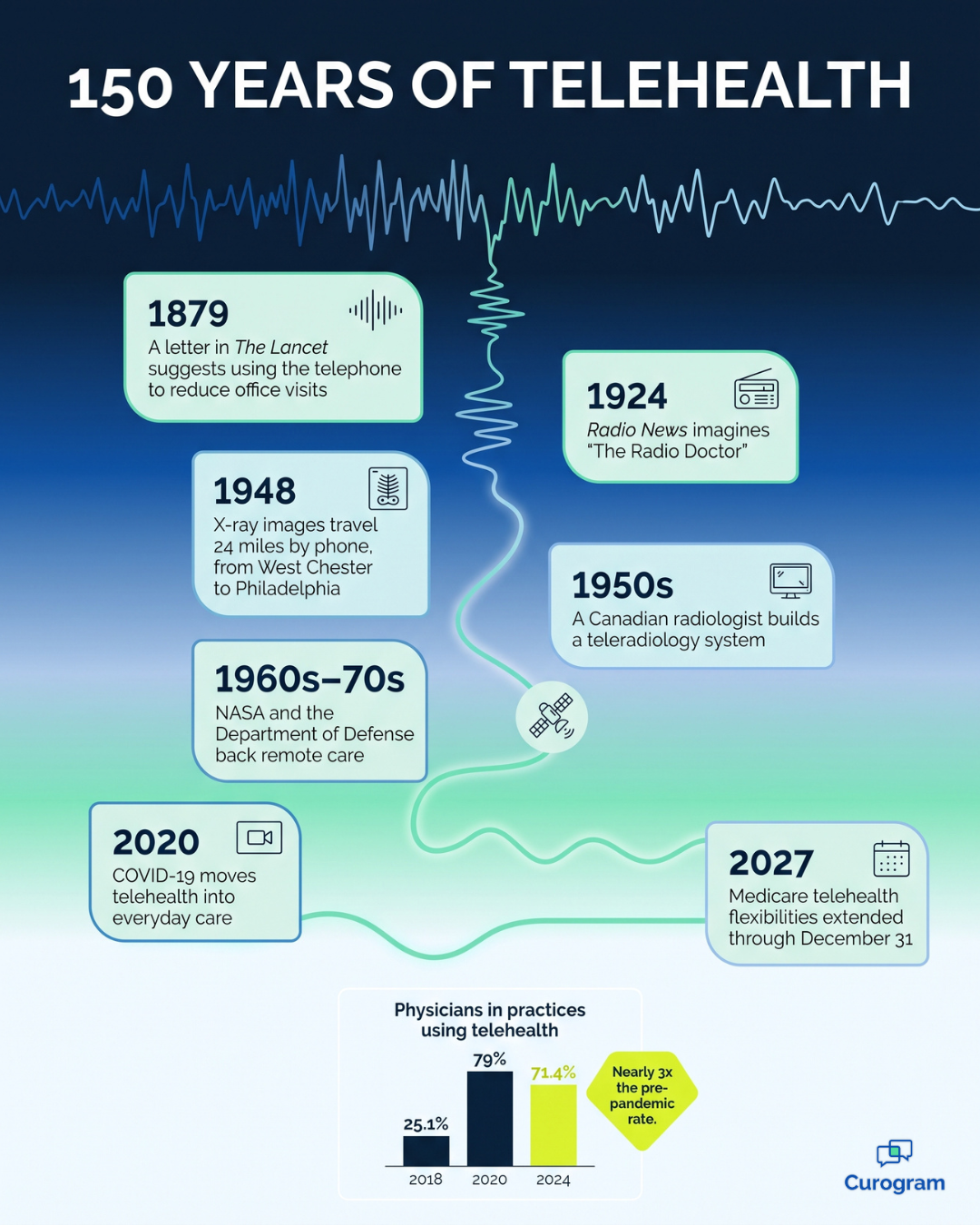
In 1879, a letter in The Lancet raised an odd idea. Physicians could use a brand-new device, the telephone, to reduce unnecessary office visits. Most readers probably dismissed it.
Nearly 150 years later, that idea supports a large share of modern American health care.
Telehealth often feels like a product of the pandemic. It isn't. It grew out of radio, phone lines, space programs, and military research long before COVID-19 made it part of everyday life. Knowing that history helps explain why telehealth works the way it does today, and why the rules around it can feel so complicated.
If your practice offers virtual visits, you have probably felt that complexity firsthand. One state defines telehealth one way, while its neighbor uses different terms. Medicaid pays for some services but not others, and licensing rules can stop you from treating a patient who moved across a state line.
Meanwhile, patient demand keeps growing. People managing chronic conditions want fewer trips to the clinic, and rural patients may live an hour or more from the nearest physician. Working parents want visits that fit around their jobs instead of disrupting them.
That gap between patient demand and regulatory red tape is where many practices get stuck.
This guide walks you through the history of telehealth, from early radio dreams to the video visits your patients use today. You will see how individual states define it, how coverage and licensing currently work, and what the real benefits and drawbacks look like for patients, providers, and hospitals.
You will also learn what the pandemic changed for good and how the right platform can make virtual care easier to manage. By the end, you will understand where telehealth came from, where it stands now, and how your practice can get the most value from it.
Telehealth has been around for more than a century. Each time a new invention showed up, people found ways to use it for medicine. When radios became common, many people talked about doctors hosting radio shows and advising patients from afar.
In 1924, an illustration on the cover of Radio News magazine carried the headline "The Radio Doctor—Maybe!" It showed a doctor seeing a patient over a video screen. Back then, it was pure imagination. Less than a century later, that image became a normal part of care.
Here is how the idea turned into real practice:
| Year | Milestone | Why It Mattered |
|---|---|---|
| 1879 | The Lancet suggests using the telephone to reduce office visits | The first known idea of remote care |
| 1924 | Radio News shows "The Radio Doctor" on its cover | The public starts picturing video visits |
| 1948 | Radiology images are sent by phone 24 miles, from West Chester to Philadelphia | The first real transfer of medical images |
| 1950s | A Canadian radiologist builds a teleradiology system | Remote image reading becomes a working tool |
| 1960s–1970s | NASA, the Department of Defense, and the U.S. Department of Health back new projects | Federal funding speeds up research |
| 2020 | COVID-19 shuts down in-person visits | Telehealth moves from niche to mainstream |
The 1960s and 1970s were a turning point. The Department of Defense and the U.S. Department of Health sponsored several teleradiology projects through the 1970s and 1980s. That early support laid the groundwork for the tools you use today.
Each state has its own definitions of telehealth and telemedicine. The differences may look small, but they can affect what you are allowed to offer and what gets paid.
For example,
South Carolina defines telemedicine as sharing a patient's medical information from one site to another through electronic tools. The goal is to provide care when a face-to-face visit isn't needed.
This usually means live, two-way audio and video between the patient and the provider. It covers diagnosis, consults, and treatment.
Louisiana keeps it much shorter. The state defines telemedicine as "rendering healthcare services when a physician or other licensed practitioner and a beneficiary are not in the same location."
Many states do not separate telemedicine and telehealth at all. In this article, we use the two terms interchangeably.
Still, it helps to know the general difference:
In practice, this means you should always check your own state's wording before you launch or expand a virtual service.
Telehealth's rapid growth has influenced the healthcare industry's large-scale adoption of telehealth services over the past months, ever since the COVID-19 outbreak. It has allowed medical practices to deliver a wide range of much-needed services to patients nationwide in an innovative, cost-effective manner.
elehealth gives all citizens a unique opportunity to receive what we would consider a basic human need:
Healthcare. Knowing how many rural areas the U.S. alone has, it isn't surprising to see the rapid expansion of telehealth services.

The numbers show how fast telehealth went mainstream. According to the AMA's Physician Practice Benchmark Survey, only 25.1% of physicians worked in practices that used telehealth in 2018. By 2020, that number had jumped to 79%.
Usage dipped a little after the pandemic peak, but it held strong. In 2024, 71.4% of physicians still worked in practices using telehealth. That is nearly three times the 2018 rate.
Coverage has grown too. Here is how state Medicaid programs and private payers handle telehealth, based on the Center for Connected Health Policy's Fall 2025 report:
| Coverage Area | What States Do |
|---|---|
| Live video (Medicaid) | All 50 states, DC, and Puerto Rico pay for some form |
| Audio-only phone (Medicaid) | 46 states and DC pay in some capacity |
| Remote patient monitoring (Medicaid) | 41 states pay |
| Store-and-forward (Medicaid) | 40 states pay |
| All four types (Medicaid) | 32 states pay |
| Private payer laws | 44 states, DC, Puerto Rico, and the Virgin Islands have one |
| Explicit payment parity | 24 states and Puerto Rico require it |
What does this mean for you? Live video is covered almost everywhere, but other services vary a lot. Before you add remote monitoring or store-and-forward services, confirm that your state's Medicaid program will pay for them.
On the federal side, Medicare's pandemic-era telehealth flexibilities have been extended several times. In early 2026, Congress extended them through December 31, 2027. That includes letting patients receive care at home and allowing audio-only visits.
Cross-state licensing remains one of the biggest hurdles. In general, you must be licensed in the state where your patient is located at the time of the visit.
Some states make this easier:
Even with these options, the rules shift often. It pays to review them at least once a year.
| Quick fact: Even after the pandemic, 71.4% of physicians worked in practices that used telehealth in 2024, nearly three times the 25.1% rate from 2018. |
| What it means for your practice: Patients now expect a virtual option. If you don't offer one, some of them will find a practice that does. Treat telehealth as a core service, with clear workflows, reminders, and follow-up, not as an emergency add-on. |
Telehealth benefits anyone that decides to participate in it — from hospitals and physicians to patients. If you're curious to learn more about this, let's see how different groups benefit from telemedicine.
The primary purpose of telemedicine and telehealth was to facilitate patients' access to healthcare.
The benefits telehealth offers to patients include:
Telemedicine makes healthcare more convenient, eliminating many of the reasons some patients may avoid, cancel, or miss appointments.
Telehealth also comes with significant benefits for healthcare workers, so let's see what these benefits entail:
It is important to note that telehealth also functions as an outstanding business model for healthcare workers. They can choose how many patients they want to see a day and provide convenient access to medical care.
Critical Access Hospitals could use telehealth in a way that results in:
Ultimately, telehealth allows hospitals to serve a higher volume of patients while minimizing risks to staff and the costs associated with in-person care.
Telehealth has few downsides. The main disadvantages of telehealth are legal, regulatory, law, and policy issues stemming from the various telehealth policies in individual states.
For example, some of the most common challenges with telemedicine in the legal and regulatory fields are:
Apart from these legal issues, there aren't many other drawbacks. The other disadvantage of telehealth is staying up-to-date with technology and equipment.
The COVID-19 pandemic changed the way we think about and use telehealth. Telehealth was not a widely available option until the COVID-19 virus forced us all to stay at home and social distance when we had to go out. Now, providers offer telehealth services to keep themselves, their staff, and their patients safe from the spread of coronavirus and other illnesses.
Now that everyone sees the importance and the necessity of remote medical care first-hand, they realize the other benefits of telehealth. As a result, many patients and providers may opt for telehealth even after the pandemic ends.
Curogram is a HIPAA-compliant telemedicine and patient engagement platform designed specifically for healthcare professionals. In addition to secure telehealth software,
Curogram includes:
Contact us today to learn more about how Curogram can help you implement a best-in-class telemedicine and patient engagement platform.
Telehealth did not appear overnight. It began as a suggestion in an 1879 medical journal, took shape through radio, phone lines, and federally funded research, and then went mainstream when COVID-19 closed waiting rooms across the country.
Today, it is a permanent part of how care gets delivered. Nearly three in four physicians work in practices that use telehealth. Medicaid programs in every state reimburse some form of live video. Medicare's flexibilities now continue through 2027, giving practices more room to plan.
Still, the road is not smooth. Definitions vary from state to state, and coverage for remote monitoring and store-and-forward services remains uneven. Licensing rules can also block you from seeing a patient who lives just across a state line. These are significant hurdles for busy teams, and they are not disappearing anytime soon.
That is exactly why the technology you choose for virtual care really matters now.
A strong telehealth platform does more than host a video call. It helps patients schedule visits, complete forms in advance, receive reminders, and reach your team by text with questions. When all of that runs in one secure, HIPAA-compliant system, your staff spends less time chasing patients and more time caring for them.
The history of telehealth shows a clear pattern. Each new technology, from the telephone to the video screen, brought care a little closer to the patient. The practices that thrive next will be the ones that make virtual care feel as convenient and reliable as an in-person appointment.
If you are ready to take that step, Curogram can help. It combines telehealth, two-way texting, online scheduling, and automated reminders in one platform designed for medical practices.
See how Curogram simplifies virtual care for your practice in a quick demo and discover how much time your team could save.
The idea goes back to 1879, when a letter in The Lancet suggested doctors could use the telephone to reduce unnecessary office visits. The first real medical use came in 1948, when radiology images were sent by phone 24 miles from West Chester to Philadelphia. NASA, the Department of Defense, and federal health agencies expanded the field in the 1960s and 1970s.
Telemedicine always involves diagnosing and treating a patient from a distance. Telehealth is the broader term. It includes telemedicine, plus remote patient monitoring, provider-to-provider consults, and staff education. Many states use the two terms interchangeably, so check how your state defines them.
Yes, but coverage varies by service. According to the Center for Connected Health Policy's Fall 2025 report, all 50 states, DC, and Puerto Rico pay for some form of live video. Coverage for other services is less consistent, with 41 states paying for remote patient monitoring and 40 paying for store-and-forward.
In most cases, the provider must be licensed in the state where the patient is located during the visit. Some states offer exceptions or special telehealth registrations. The Interstate Medical Licensure Compact, which now includes 44 states, DC, and Guam, also makes it faster for eligible physicians to get licensed in more than one state.
Yes. According to the AMA, 71.4% of physicians worked in practices that used telehealth in 2024. That is lower than the 2020 peak of 79%, but nearly three times the 25.1% rate from 2018. Medicare's telehealth flexibilities have also been extended through December 31, 2027.
The provider's ultimate guide to telemedicine in Maryland. Learn how to streamline your telehealth business and keep ahead of the competition.

Review telemedicine reimbursement by state for all 50 states, and learn which parity laws, Medicaid rules, and licensing limits apply before you bill.
Telemedicine is gaining acceptance in the U.S., helping providers safely deliver healthcare services to patients remotely using technology.