
Skip to the main content.

10 min read

How Does Text-to-Pay Reduce Time to Collect Payments in Healthcare?

How Does Text-to-Pay Reduce Time to Collect Payments in Healthcare?
💡 Medical practices can reduce time to collect in healthcare by up to 76% with text-to-pay tools. Paper billing cycles often drag on for 60 to 90 days, which hurts cash flow and drives up costs. SMS payment links tap into a 98% open rate and prompt over 30% of patients to pay within five minutes.

This approach can lower labor costs per claim by 35% and minimize accounts receivable days across the board. Practices that switch to this model see faster revenue cycles, fewer write-offs, and less time spent chasing down payments.

For any practice looking to improve healthcare billing efficiency, text-to-pay offers a clear, proven path to medical practice revenue growth and stronger ROI.

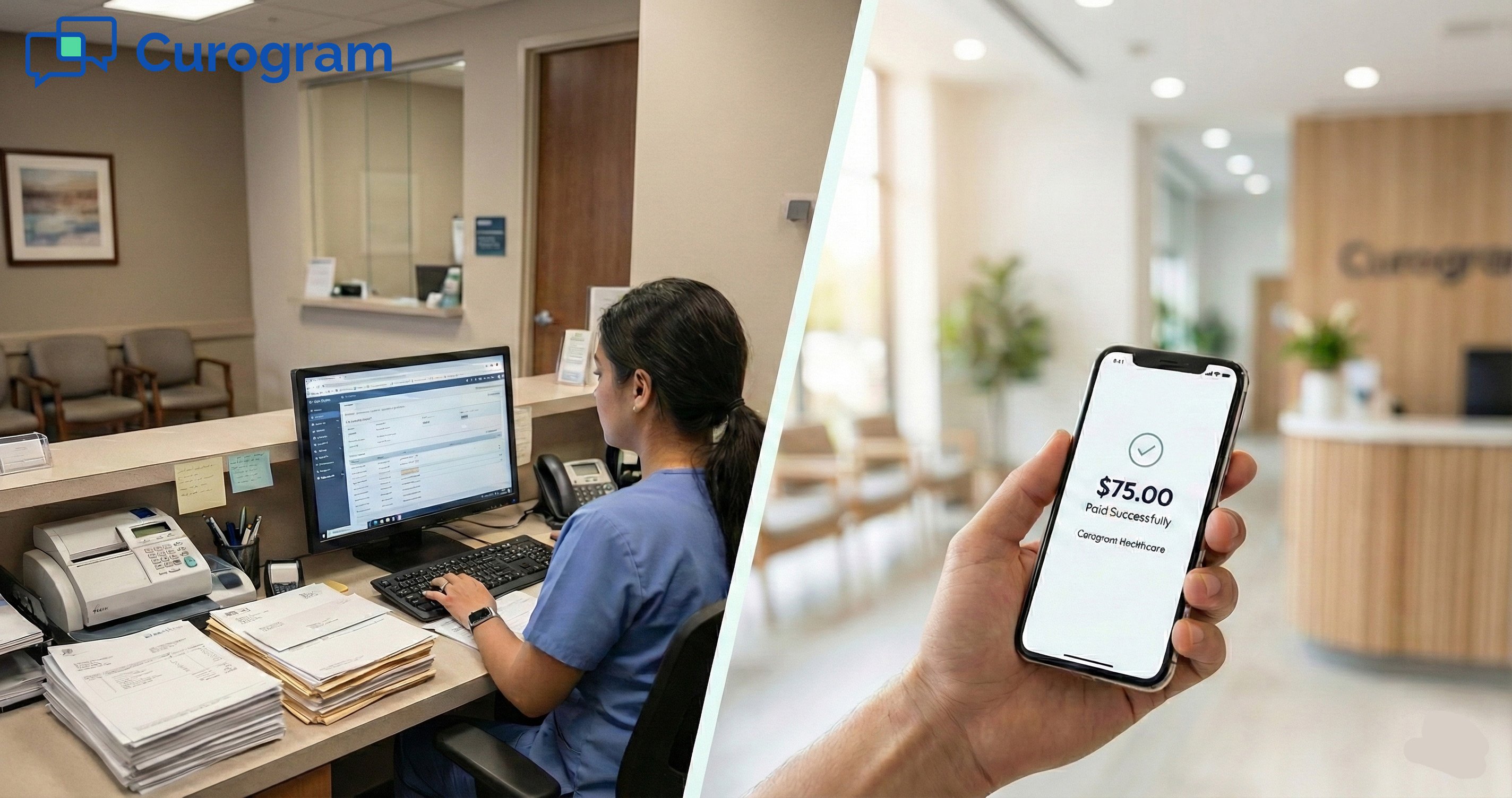
Your billing team sends a statement. Then they wait. Weeks pass. The paper sits in a pile on the patient's counter, or worse, it gets lost in the mail. This cycle plays out at thousands of practices every single day.

Slow payments are more than a hassle. They drain revenue, bloat costs, and keep your practice stuck in survival mode. When it takes 60 to 90 days to collect on a balance, that money sits idle while your bills keep coming in.

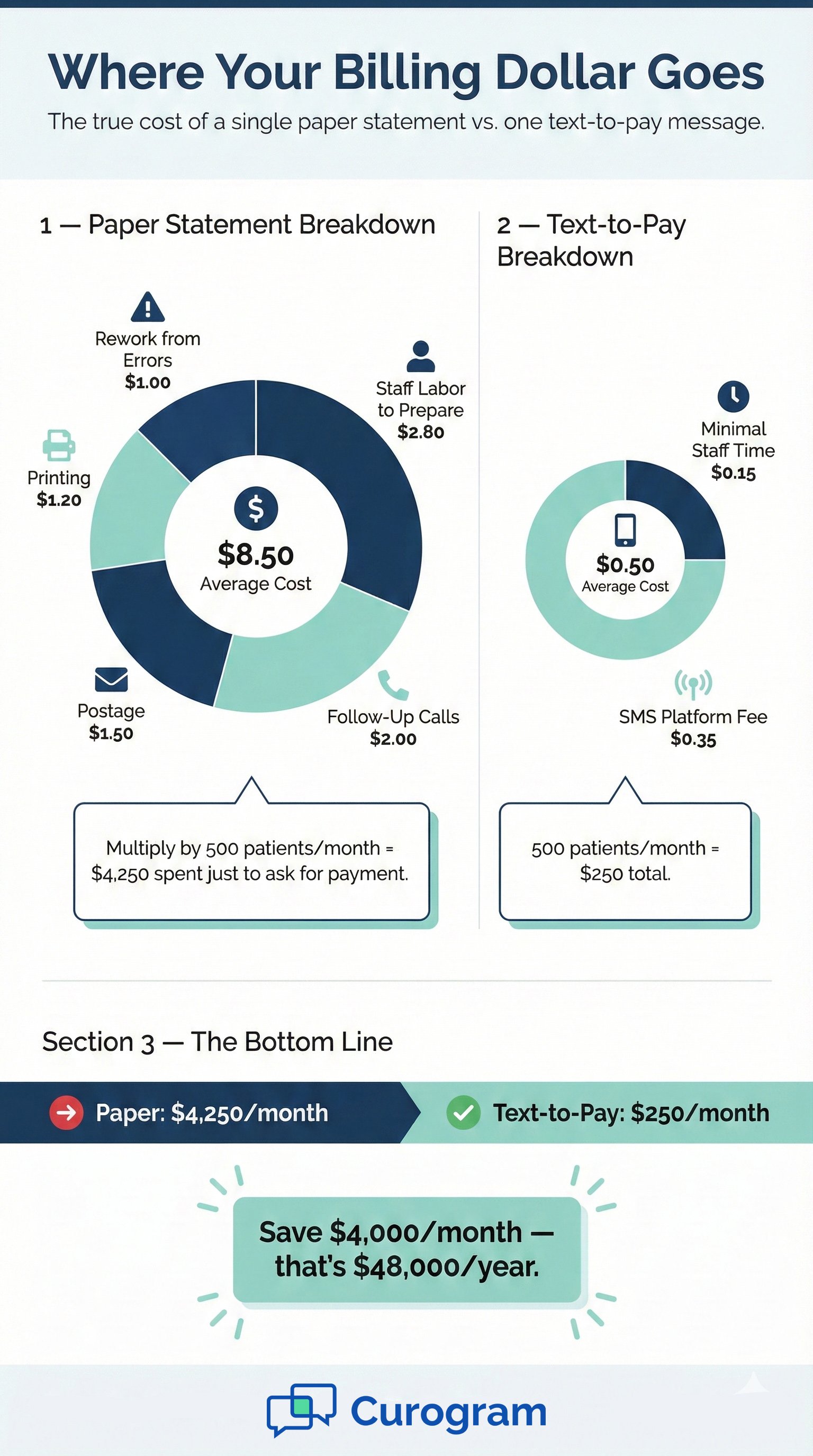
The math is simple but painful. Each mailed statement costs your office $5 to $12 when you factor in paper, postage, and labor. Multiply that by hundreds of patients each month, and you are bleeding cash just to ask people to pay.

Rising labor costs make it even harder. Staff spend hours on the phone leaving voicemails and fielding calls about balances. That time could go toward tasks that grow the practice instead of chasing down overdue bills.

Meanwhile, patients want a better option. Most people pay bills on their phone for almost everything else. They expect the same ease from their doctor's office. When you force them into a paper-based process, many just put it off.

This is exactly why more practices now use text-to-pay to reduce time to collect in healthcare. An SMS with a secure payment link meets patients where they already are, on their phones. The result is faster payments, lower overhead, and a healthier bottom line.

In this post, we break down the ROI of text-to-pay. You will see how it slashes accounts receivable days, cuts labor costs, and fuels medical practice revenue growth. Whether you run a small clinic or a large group, the data points to one clear truth: speed pays.


The Financial Villain: Why Slow Collections Kill Growth

Slow payments are one of the biggest threats to a practice's financial health. When cash takes too long to come in, it creates a ripple effect that touches every part of your business. Let's look at why delayed collections are so harmful and what they really cost.

The A/R Stagnation Problem

Accounts receivable that sit unpaid beyond 45 days become a serious risk. The longer a balance stays open, the less likely you are to collect it. Industry data shows that bills older than 90 days have a collection rate that drops below 20%. That means most of that money is gone for good.

This is what makes it so vital to minimize accounts receivable days. Every extra day a balance sits unpaid raises the chance of a write-off. Write-offs chip away at net income over time and make it harder to plan for growth.

Many practices carry large amounts of aging A/R without knowing the true cost. When you add up the staff time, follow-up calls, and re-sent statements, the real expense is far higher than the face value of the bill.

Bad debt does not stay flat. It builds on itself. When a practice writes off too many unpaid balances, it has less cash to invest in staff, tools, or space. That lack of investment then leads to slower service, which pushes more patients away and creates even more bad debt.

Rising Costs Make Manual Billing a Strategic Risk

Healthcare labor costs are set to rise even further in 2025 and beyond. Hiring and keeping skilled billing staff gets more expensive each year. When your team spends most of its time on manual tasks like printing, mailing, and calling, you are paying top dollar for low-value work.

Manual billing also slows down the entire revenue cycle. Each step, from printing to posting, adds days to the process. Those added days reduce healthcare billing efficiency and push payments further into the future.

The risk here is not just financial. It is strategic. Practices that cling to old billing methods fall behind those that adopt faster, smarter systems. The gap only widens as costs climb.

A paper-based billing model works only when volumes are low. As a practice grows, the number of statements, calls, and follow-ups grows with it. You either hire more staff or let balances slip through the cracks. Neither option supports real growth.

The Hidden Paper Tax on Your Practices

Mailing paper statements is one of the most overlooked drains on practice revenue. Each statement costs between $5 and $12 when you include printing, postage, and the staff time to prepare it. That adds up fast across hundreds of patients each billing cycle.

This is what some call the "paper tax." It is a cost that shows up quietly in your budget but can total thousands of dollars each month. Practices that shift to digital payments cut this expense almost overnight.

A single mailed statement might seem cheap on its own. But when you count the labor to print it, stuff the envelope, run it through postage, and then track whether the patient responded, the real cost is clear. Most practices could redirect those dollars toward efforts that drive medical practice revenue growth instead.


Maximizing Revenue with Predictive Cash Velocity

Speed is the core driver of a healthy revenue cycle. The faster you collect, the less you spend chasing payments. Text-to-pay tools create what some call "predictive" cash velocity, where you can forecast revenue with more confidence because money comes in quickly and steadily.

Instant Conversion from SMS Payment Links

Text messages have a 98% open rate, far higher than email or paper mail. That means almost every patient who gets an SMS payment link will see it. Even better, 32% of patients pay within five minutes of getting the text. This kind of speed is something paper statements can never match.

The ROI of text to pay shows up almost right away. When a third of your patients pay within minutes, your daily cash intake jumps. This makes it much easier to cover payroll, rent, and other fixed costs without dipping into credit lines.

SMS links also reduce the number of follow-up steps your staff needs to take. Fewer reminders, fewer calls, and fewer re-sent statements all translate to lower overhead and faster cash flow.

A bill that never gets seen can never get paid. Paper mail has an open rate well below 50%, and email hovers around 20%. With SMS near 98%, text-to-pay puts the bill directly in front of the patient at the right moment, which is why it is so effective at helping practices reduce time to collect in healthcare.

Increasing Point-of-Service Collections

Ty is not just for follow-up billing. Practices can also send payment links at the point of service to capture co-pays and balances before the patient leaves. This approach has been shown to raise overall collection rates by as much as 40%.

When patients can tap a link and pay on the spot, there is less friction and less chance they forget later. It shifts the culture from "bill and chase" to "bill and collect." That shift has a direct impact on the bottom line.

The front desk is already a busy place. Adding a quick text link to the checkout flow takes seconds and removes the awkward face-to-face payment ask. Patients prefer it, and the practice gets paid faster. That is healthcare billing efficiency in action.

Consumer-Centric Billing Builds Loyalty

Around 85% of patients now prefer to pay their bills through digital methods. They use mobile wallets, tap-to-pay, and online portals for nearly everything. When a medical practice offers the same kind of ease, it stands out.

Meeting patients where they are is not just a nice touch. It reduces friction, lowers disputes, and keeps patients from putting off payments. A smooth billing experience also builds trust and makes patients more likely to stay with your practice.

When you give patients a payment method they already use and trust, they act on it fast. Resistance drops. Excuses shrink. The result is a shorter time to collect and stronger cash flow for the practice.

Healthcare billing cost comparison of paper statements vs. text-to-pay


Slashing Labor Costs through Billing Automation

Labor is one of the largest expenses for any medical practice. When billing staff spend their days on manual work like printing, calling, and posting payments, those costs climb fast. Billing automation changes this by handling the routine steps and freeing your team to focus on higher-value tasks.

A 35% Drop in Labor Costs with Automation

Practices that automate their billing workflows see labor costs fall by around 35%. This happens because the system sends payment links, posts receipts, and tracks follow-ups on its own. Staff who once spent hours on phone calls now handle only the cases that truly need a human touch.

This kind of savings adds up fast. A mid-size practice with three full-time billing staff could operate with fewer team members or redirect those roles to tasks that support growth. Either way, the ROI is clear and quick to appear.

Automation also removes the fatigue factor. When staff do the same tedious tasks all day, mistakes happen. Those errors create rework, which costs even more time and money.

Many practices have found they can run billing with 30% to 40% fewer full-time staff after adopting automation. The remaining team members are more focused, more productive, and less likely to burn out. This is not about cutting jobs. It is about using people where they matter most.

Unified Financial Visibility in Real Time

Billing dashboards that come with modern payment platforms give managers a live view of revenue, A/R aging, and payment trends. Instead of pulling reports at the end of the month, leaders can spot issues and act on them in real time.

This kind of visibility makes it far easier to minimize accounts receivable days. When you can see which balances are aging, you can trigger a reminder before they slip into the danger zone. Proactive action beats reactive scrambling every time.

With real-time dashboards, billing managers no longer guess where the gaps are. They see them. This level of clarity drives better choices around staffing, outreach timing, and follow-up cadence, all of which support stronger healthcare billing efficiency.

Eliminating Double Entry Rework

Manual payment posting is prone to errors. Studies suggest that nearly 80% of medical bills in the U.S. contain mistakes. Many of these come from double entry, where staff type the same data into two or more systems.

Automated payment tools that tie into your practice management system or EMR remove this problem. When a patient pays through a text link, the system logs the payment and updates the record in one step. No rework. No mismatch.

When your billing platform connects with your EMR, data flows in one direction without manual touch points. This removes the gap where errors creep in. Fewer errors mean fewer denied claims, fewer patient complaints, and a cleaner revenue stream.


The ROI of Secure and Compliant Cash Flow

Security is not just a checkbox. It is a key driver of whether patients will actually use a digital payment tool. If patients do not trust the system, they will not pay through it, no matter how easy it is. Here is how secure, compliant billing fuels better ROI.

Building Patient Trust with Secure Payments

About 59% of patients worry about how their data is used when they pay online. That fear is real, and it holds people back from paying on time. A PCI-compliant, encrypted text-to-pay platform gives patients the sense of safety they need to act.

When patients feel their data is safe, they pay faster. Trust removes the mental barrier that makes people delay. It also reduces the number of patients who call the office to verify a link is real before they click it.

This matters because faster trust means faster cash. Practices that invest in secure payment tools see a direct lift in both collection rates and patient satisfaction.

Patients do not need to know the details of PCI compliance or encryption. They just need to see a clean, branded link from a name they trust. A well-built text-to-pay system provides that experience and puts patients at ease from the first tap.

Reducing Bad Debt with Gentle, Automated Reminders
Most patients do not skip payments on purpose. They forget, lose the bill, or just put it off. Automated text reminders solve this by sending a gentle nudge before the bill hits the 90-day mark. This keeps fewer accounts from falling into "emergency mode."

Practices that use automated reminders see a clear drop in bad debt. When patients get a friendly text at 30 and 60 days, many pay right then. This means fewer accounts age past the point of no return, which supports the goal to reduce time to collect in healthcare.

The best reminder schedule hits patients at key intervals: shortly after the visit, at 30 days, and again at 60 days. Each message should be brief, clear, and include a direct payment link. Practices that follow this pattern report stronger results and fewer accounts sent to collections.

Capital for Reinvestment and Growth

When cash comes in faster, practices gain options. That money can go toward hiring, new equipment, expanded hours, or a second location. Without fast cash flow, many practices turn to loans or lines of credit just to keep the lights on.

Text-to-pay creates a steady stream of revenue that makes planning easier. Leaders can budget with confidence when they know most payments will arrive within days, not months. This is the kind of financial stability that supports long-term medical practice revenue growth.

Faster payments mean less need for outside funding. Practices that collect quickly can reinvest from their own cash flow. That keeps interest costs low and puts the practice in a much stronger position for the future.


Patient in a clinic smiling at a mobile payment confirmation on their phone

Get Started: See the ROI for Your Practice

The data is clear. Practices that adopt text-to-pay cut their collection times, lower their costs, and build a stronger financial base. Whether your goal is to minimize accounts receivable days, reduce labor overhead, or simply get paid faster, the path forward starts with the right tools.

Curogram's platform makes it easy to send secure payment links by text, track payments in real time, and automate follow-up reminders. It connects with your existing EMR so there is no double entry and no learning curve for your staff. Most teams are up and running in under 10 minutes.

If you are ready to see how text-to-pay can reduce time to collect in healthcare for your specific practice, schedule a demo today. Our team will walk you through the platform and show you the ROI of text to pay based on your current volume and workflow.

Faster payments. Lower costs. Stronger growth. That is what smart billing automation looks like, and it starts with a single text.

Schedule a demo today to see how Curogram’s "Smart Automation" can reduce your time to collect and deliver a high-speed ROI for your practice’s bottom line.


Frequently Asked Questions

How does text-to-pay help reduce time to collect in healthcare?

Text-to-pay sends a secure payment link straight to the patient's phone. Since SMS has a 98% open rate, patients see the bill almost right away.

Over 30% pay within five minutes, which shrinks collection cycles from months to days. This speed directly helps practices minimize accounts receivable days.

Why is manual billing a risk for medical practices in 2025?

Labor costs keep rising, and manual billing requires a lot of staff time for tasks like printing, mailing, and calling. Each paper statement costs $5 to $12 to produce and send. As costs climb, practices that rely on old methods lose money on every bill they mail out.

How does billing automation lower labor costs for a practice?

Automation handles the routine work of sending payment links, posting receipts, and tracking follow-ups. Practices that switch to automated billing see labor costs fall by about 35%.

Staff can then focus on tasks that support medical practice revenue growth instead of chasing down payments.

Why do patients prefer text-to-pay over paper statements?

Around 85% of patients prefer digital payment methods. Text-to-pay fits the way people already manage their lives on their phones. It removes friction, cuts out delays, and gives patients a fast, easy way to pay without mailing a check or calling the office.

How does secure billing improve collection rates?

About 59% of patients worry about data safety when they pay online. A PCI-compliant text-to-pay platform builds trust and removes that barrier. When patients feel safe, they pay faster, which improves healthcare billing efficiency and reduces bad debt across the board.


Healthcare Text-to-Pay ROI: Smart, Affordable Way to Get Paid Faster

Healthcare Text-to-Pay ROI: Smart, Affordable Way to Get Paid Faster

💡 Text-to-pay ROI healthcare systems help clinics get paid faster while cutting costs. The results are clear and quick. Clinics see payments arrive...
Read More
Why Patient Payments Are Delayed — and How Text-to-Pay Solves It

Why Patient Payments Are Delayed — and How Text-to-Pay Solves It

💡 Patient payment delays cost clinics time and money. Most practices wait 30 to 90 days to collect payments after service. This creates cash flow...

Read More
How to Automate Your Patient Billing Workflow with Secure SMS

How to Automate Your Patient Billing Workflow with Secure SMS

💡 An automated patient billing SMS workflow makes the medical collection process faster and easier. It works by sending secure, HIPAA compliant...

Read More