
.jpg) Mira Gwehn Revilla
Mira Gwehn Revilla
1 min read
Integration 101: Let Your EMR Connect to a HIPAA-Compliant Platform
💡Connecting your EMR system to a HIPAA-compliant platform is no longer optional. With a solution tailored to medical practices of all sizes,...

Every medical practice faces a choice. You can keep doing things the old way or find smarter tools that save time and money.
For many clinics, the old way means staff spend hours on the phone each day. They call patients one by one to confirm visits or share updates. This drains resources fast.
The benefits of mass SMS for healthcare providers go beyond simple alerts. Broadcast texting gives your practice a way to reach hundreds of patients in seconds.
Think about what that means for your team. No more long call lists. No more chasing patients who never pick up the phone.
Consider this common scenario: A patient cancels their 2 PM slot at 10 AM. With phone calls, your staff might reach five people before the slot goes unfilled.
With mass texting, you send one message to 50 waitlisted patients. Within minutes, the slot is filled. That is the real ROI of mass texting in action.
Healthcare outreach profitability depends on how well you use your team's time. Every hour a staff member spends on the phone is an hour they cannot help patients in the lobby.
It is an hour they cannot process forms or handle billing. The math is simple. Reduce medical practice cost by cutting low-value phone work.
Mass SMS also helps you increase medical practice revenue. You can promote flu shots, wellness checks, or new services to your entire patient list at once. One text can fill an entire clinic day.
This guide walks you through the real business case for mass texting. You will see exactly where the money goes, where it comes from, and how modern practices are using smart outreach to stay ahead.
Manual phone outreach is one of the most costly habits in a medical office. Many practices do not realize how much money they lose by sticking to outdated methods. The problem is not just time. It is the chain of costs that come with slow, one-by-one calls.
Start with labor. A front desk staffer making phone calls might reach 10 to 15 patients per hour on a good day. If you need to contact 200 patients about a schedule change, that takes a full work day.
During that time, the staffer cannot greet walk-ins, answer new patient calls, or process forms. You lose output across the board.
Next, think about missed chances. When a patient cancels, you have a short window to fill that slot. Manual calls take too long.
By the time staff work through the list, the slot stays empty. Each unfilled slot is lost revenue. A typical clinic visit might bring in $100 to $300. Multiply that by five empty slots a week, and you see the drain on your yearly income.
Paper and mail also add up. Some offices still send mailed reminders. Postage, printing, and supplies cost money. Worse, mailed notices arrive days later. Patients often ignore them. Compare that to a text message that lands in seconds and gets read right away.
The drain is not always obvious. It hides in small tasks that pile up over months. Staff overtime. Missed calls. Unfilled slots. Each one chips away at your bottom line.
Moving away from manual outreach does not mean you fire your staff. It means you free them to do work that needs a human touch.
Greeting patients, solving problems, and keeping the office running smooth. Cutting phone time helps you reduce medical practice cost in ways that show up on your balance sheet fast.
Smart broadcasts let you reach your entire patient base with a single tap. Instead of hoping patients see a flyer or remember to call, you put your message right in their hands. Text alerts work because almost everyone reads them.
This section covers three ways mass texting drives new revenue, fills your schedule, and brings back patients who have drifted away.
Mass texting opens doors to services patients might not know you offer. Say your clinic adds a new dermatology provider. You could wait for word to spread, or you could send a single text to 2,000 patients. Within hours, your booking line is busy.
The same logic works for seasonal pushes. Flu shot season is a perfect example. A quick broadcast can fill an entire week of vaccine slots. Compare that to posting a sign in your lobby that only current visitors see.
Wellness checks and annual physicals often slip through the cracks. Patients mean to book them but forget. A simple text reminder brings them back. Each visit adds to your daily count and your revenue.
You can also use mass texting to promote high-margin services. Cosmetic treatments, weight loss programs, or new lab panels all benefit from direct outreach. Patients who might never ask about these services will respond to a well-timed text.
The key is relevance. You do not blast every patient with every offer. Use your EMR data to target the right groups. Diabetic patients get reminders for A1C checks.
Women over 40 get mammogram prompts. This kind of healthcare outreach profitability comes from matching the message to the patient.
One clinic reported filling 60 new slots in a single day after a flu shot broadcast. That is the power of smart mass texting. You skip the slow drip of phone calls and go straight to results.
Empty slots cost money every day. When a patient cancels, you lose that revenue unless someone else fills the spot. Manual outreach is too slow to capture these last-minute chances. Mass texting solves this problem.
Here is how it works:
You keep a list of patients who want earlier appointments. When a slot opens, you send a broadcast to that list. The first patient to reply gets the spot. This process takes minutes, not hours.
Practices using this method can reduce no-show rates by up to 75%. That is not a small gain. For a clinic that sees 30 patients a day, cutting no-shows means adding hundreds of visits per month.
The effect grows over time. Patients learn they can get quick access if they respond fast. This builds loyalty and keeps your schedule full. Staff spend less time calling and more time helping patients in the office.
Think about peak seasons too. Back-to-school physicals, holiday flu shots, and end-of-year wellness visits all create high demand. Mass texting lets you manage that surge without burning out your staff.
Same-day fills also boost patient trust. When someone needs care fast and you can offer it, they remember. They tell friends. They leave good reviews. This ripple effect helps increase medical practice revenue long after the single visit.
The old way is to hope patients call when they need you. The smart way is to reach out when you have space and let them jump in.
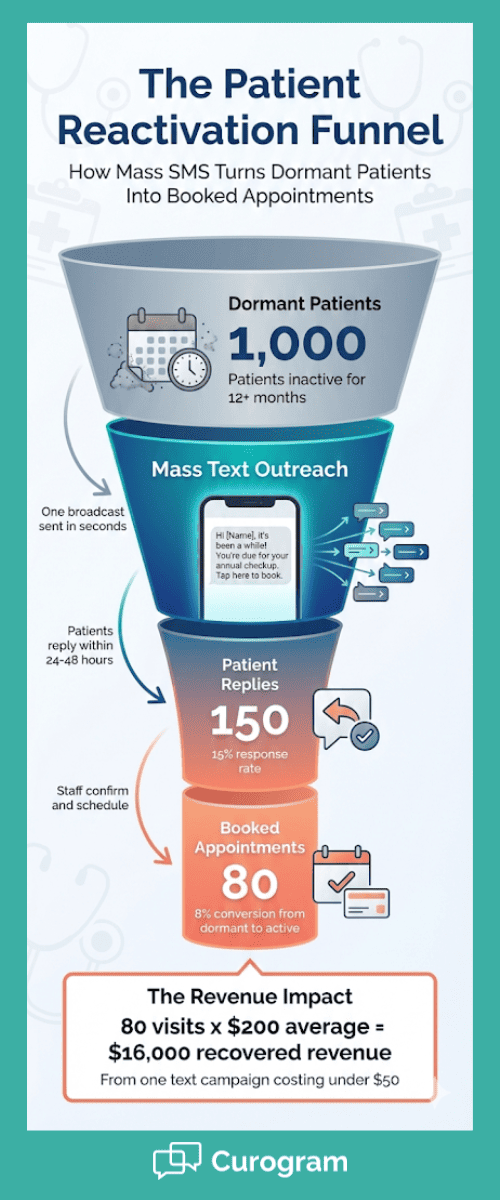
Many patients fall off the radar. They move, get busy, or simply forget to book their next visit. These dormant patients represent untapped value. Mass texting gives you a low-cost way to bring them back.
A simple "We miss you" message can prompt a patient to schedule. Add a gentle reminder about overdue screenings, and you give them a reason to act. This type of outreach turns one-time visitors into regular patients.
Consider the lifetime value of a patient:
If an average patient visits twice a year and spends $400 per visit, that is $800 per year. Over five years, that adds up to $4,000. Losing that patient to inactivity is a real cost. Winning them back with a single text is a smart play.
Dormant patient campaigns work best when you segment your list. Focus on patients who have not visited in 12 to 18 months. Send a targeted message about what they are due for. Annual physicals, dental cleanings, or specialist follow-ups all make good hooks.
Some practices offer a small incentive, like free parking or a waived form fee. This small gesture shows you value the patient and want them back. The return on this tiny investment is often huge.
Reactivation is one of the clearest ways to see the ROI of mass texting. You already spent money to acquire these patients. Bringing them back costs almost nothing. The revenue they bring adds straight to your bottom line.
Do not let dormant patients stay lost. A well-crafted broadcast can fill your schedule with familiar faces who are ready for care.
Staffing is one of the biggest line items in any medical practice budget. When outreach tasks pile up, offices often hire more help or pay overtime. Automation changes that equation. Mass texting paired with smart systems lets your current team handle much more work without burning out.
Here is how scalable automation helps you cut costs and run leaner:
Seasonal spikes put pressure on every practice. Flu season, back-to-school rushes, and holiday surges all drive call volumes up. The traditional answer was to hire temp staff or pay overtime. Both options drain your budget fast.
Mass texting lets you handle these spikes without extra hands. One person can send a broadcast to 1,000 patients in seconds. That same task would take a team of callers a full day. The savings are clear.
Think about what happens when you do not have to scramble. Staff stay calm. Mistakes drop. Patients get faster answers. The whole office runs better.
Temp workers also come with hidden costs: Training time, payroll fees, and management effort. By the time they are up to speed, the rush might be over. With automation, you skip all of that. Your core team handles the load with tools built for scale.
The math works in your favor. If a temp staffer costs $20 per hour and works 40 hours during a surge, that is $800 per week. A mass texting tool might cost a fraction of that for the entire month. You reduce medical practice cost without losing quality.
Automation does not replace people. It removes the grunt work so your team can focus on tasks that need a human touch. Greeting patients, solving complex issues, and building relationships. Those are the jobs that matter.
Data entry eats hours every week. Staff pull patient lists from the EMR, copy them into spreadsheets, and format them for outreach. Then they enter responses back into the system. Every step adds time and invites error.
EMR integration changes everything. A good mass texting platform pulls patient data straight from your records. No manual lists. No copying and pasting. The system builds your broadcast group in seconds.
When patients reply, the data flows back into your EMR. Confirmed appointments update in real time. Staff do not have to re-enter anything. This zero double entry approach saves hours each week.
Errors also drop. Manual data entry leads to typos, missed records, and outdated info. Automated syncs keep everything accurate. When you call a patient, you see the latest details. When you send a text, it goes to the right number.
Integration also speeds up compliance. HIPAA rules require careful handling of patient info. The fewer times data moves by hand, the lower your risk. Automated systems log every action and keep your records clean.
Staff morale improves as well. Nobody enjoys typing the same info into two systems. When you remove that task, your team feels less burdened. They can spend time on work that feels meaningful.
Reducing double entry is one of the easiest ways to cut costs. You do not need new hires or fancy tools. You just need a system that talks to your EMR and keeps data flowing smooth.
Every practice has tasks that only humans can do. Calming a nervous patient. Explaining a complex bill. Solving a scheduling puzzle. These are the moments that build trust and keep patients coming back. Automation frees your staff to focus on these high-value tasks.
When your team spends hours on the phone reading reminders, they lose time for deeper work. Mass texting handles the routine so staff can handle the rest. The result is a practice that feels more personal, not less.
Resource optimization also means using skills wisely. Your best front desk person should not be stuck leaving voicemails all day. Let them greet patients, train new hires, or improve workflows. The return on their talent goes up when you remove low-value tasks.
Patients also notice the difference. Shorter hold times. Faster check-ins. More attention during visits. These improvements show up in satisfaction scores and online reviews.
Think of automation as a force multiplier. Your team does not shrink. Their impact grows. One staffer with the right tools can do the work of three using old methods.
The benefits add up across the year: Less overtime, fewer errors, better patient care. All of these flow from one simple shift. You stop wasting human effort on tasks machines do better.
Reducing medical practice cost does not mean cutting corners. It means putting every dollar and every hour to its best use. Smart automation is the fastest path to that goal.

Your online reputation is a marketing engine that runs around the clock. Good reviews draw new patients. Bad reviews push them away.
Managing this reputation by hand takes time most practices do not have. Mass texting gives you a way to collect reviews at scale without extra work. The payoff shows up in more patients, lower marketing costs, and steady growth.
Satisfied patients often forget to leave reviews. They mean to do it, but life gets in the way. A simple text reminder changes that. After a visit, your system sends a quick message asking for feedback. Patients tap a link, write a few words, and post a review in under a minute.
This small step has big effects. More reviews mean higher search rankings. When someone looks for a doctor nearby, Google shows practices with strong ratings first. Each new review boosts your spot in the results.
The timing also matters. A text sent right after a good visit catches the patient while the feeling is fresh. They are more likely to write something positive and specific. A review that says "Dr. Lee took time to answer all my questions" carries more weight than a generic five-star click.
Automated surveys also let you catch problems early. If a patient rates their visit poorly, you can reach out before they post a public complaint. This gives you a chance to make things right and protect your reputation.
The numbers add up fast. A practice that collects 20 new reviews per month will outpace one that waits for reviews to trickle in. Over a year, that is 240 more data points telling the world you deliver great care.
Healthcare outreach profitability includes the patients you gain from a strong online presence. Automated review collection is one of the smartest investments you can make.
Social proof is a simple idea. People trust businesses that other people trust. A high review count signals that your practice is safe, reliable, and worth the visit. This trust drives real business results.
Think about how patients choose a new doctor. They search online. They read reviews. They compare ratings. A practice with 300 reviews and a 4.8 average beats one with 20 reviews and a 4.9 average. Volume matters because it shows consistency.
Each review adds to a library of proof. New patients read these stories and picture their own experience. When they see dozens of people praising your care, they feel confident booking an appointment.
The best part is the compounding effect. More reviews lead to higher rankings. Higher rankings lead to more clicks. More clicks lead to more patients who leave more reviews. This cycle builds on itself with little extra effort from your team.
Social proof also protects you from the occasional bad review. Every practice gets one now and then. When you have hundreds of positive reviews, one complaint fades into the background. Patients see it as an outlier, not a pattern.
Building this proof takes time if you rely on chance. With mass texting, you speed up the process. You turn happy patients into vocal advocates without chasing them down. The ROI of mass texting shows up every time a new patient books based on what they read online.
Bringing in new patients costs money. Ads, mailers, and promotions all take a chunk of your budget. The more you spend to land each patient, the harder it is to turn a profit on their care.
Online reviews offer a cheaper path. When happy patients share their experience, they do your marketing for free. Each review is a small ad that reaches everyone searching for care in your area.
Compare the costs: A Google ad click might run $5 to $20 or more. A Facebook campaign needs a monthly budget. A review costs you nothing but the text message that asked for it. The patient does the rest.
This shift is what makes healthcare outreach profitability possible at scale. You stop paying for every eyeball and start earning attention through trust. Over time, organic growth replaces paid pushes.
Satisfied patients also refer friends and family. Word of mouth is the oldest form of marketing, and it still works. A great review or a quick text to a friend can bring in new patients who already trust you before they walk in the door.
The goal is to lower your cost per new patient while raising the quality of those patients. People who find you through reviews or referrals tend to stay longer and spend more. They are not bargain hunters. They are looking for care they can count on.
Mass texting is the tool that starts this flywheel. You ask for reviews. You collect social proof. You attract patients who value what you offer. The result is growth that pays for itself.
Unpaid patient balances hurt cash flow and take staff time to chase. Many offices wait too long to follow up, or they rely on costly collection agencies.
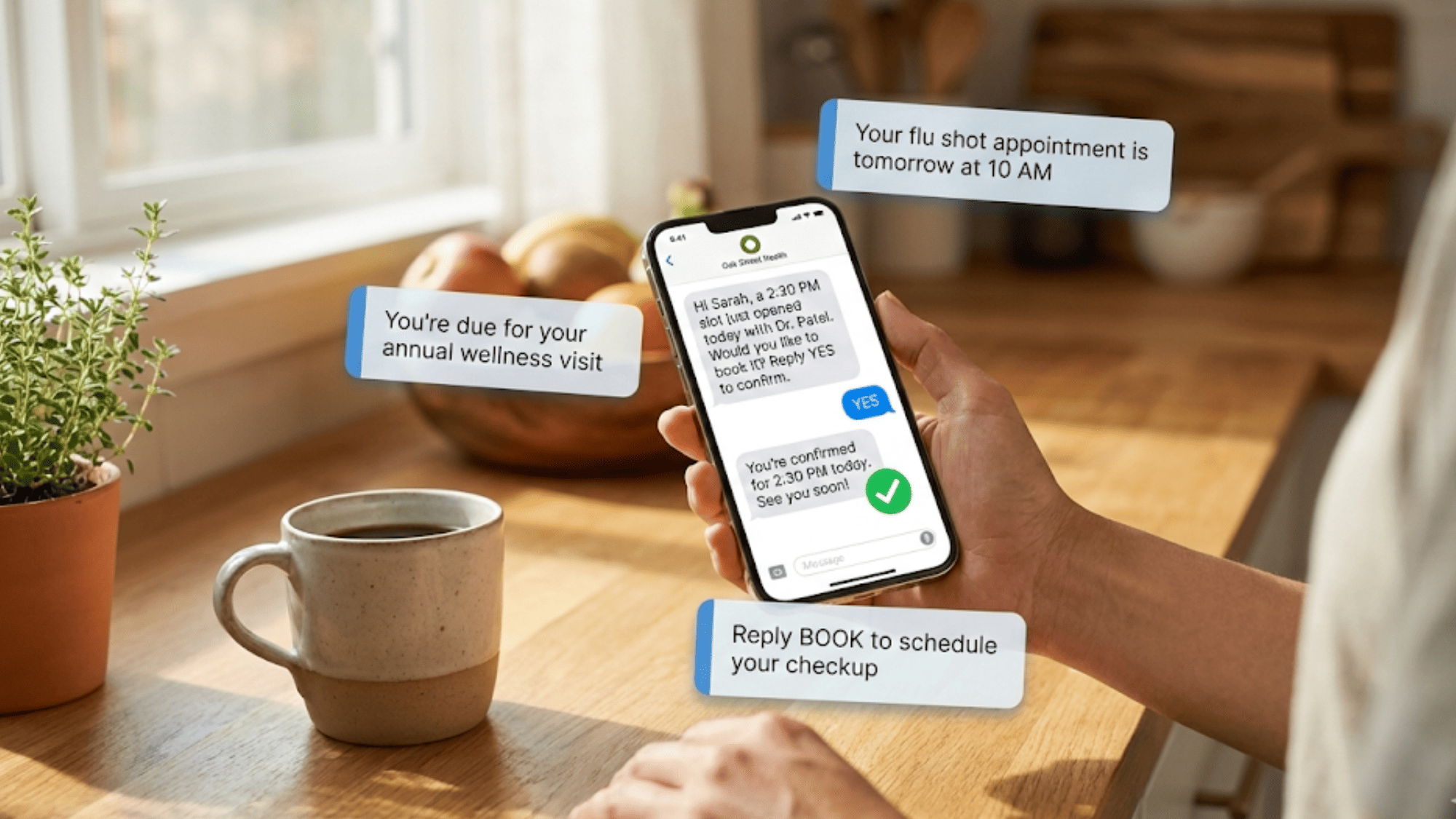
Mass payment reminders offer a faster, cheaper option. A friendly text can prompt patients to pay before the bill goes stale. Here is how text-based reminders improve your finances.
Cash flow is the heartbeat of any practice. You need money coming in to pay staff, buy supplies, and keep the doors open. Delayed payments slow everything down.
Mass payment reminders speed up the cycle. After a visit, your system sends a text with the balance and a payment link. Patients tap, enter their card info, and pay in seconds.
The effect is faster turnaround. Instead of waiting 30 or 60 days for payment, you collect within days. This steady flow makes planning easier. You know what is coming in and can budget with confidence.
Patients also prefer texting. Most people carry their phone everywhere. A text reminder reaches them where they are. They can pay while waiting in line, sitting on the couch, or riding the bus. Convenience drives action.
Think about the compound effect. If you collect $10,000 in patient balances 30 days sooner, that money can cover payroll, buy equipment, or earn interest. Over a year, faster collection adds up to real value.
Text-to-pay also cuts down on billing disputes. When patients see a clear message with the exact amount and an easy link, they pay without friction. Confusion drops, and so do angry calls to your billing team.
Immediate cash flow helps you increase medical practice revenue by keeping money moving. The quicker you collect, the healthier your balance sheet looks.
Collection agencies take a big cut. Some charge 25% to 40% of what they recover. If a patient owes $500, you might only see $300 after fees. That loss hurts, especially when a simple reminder could have solved the problem.
Mass texting lets you handle the first tiers of collection yourself. A friendly text at 7 days. A follow-up at 14 days. A firmer note at 30 days. Each message costs pennies compared to agency fees.
Most patients do not ignore bills on purpose. They forget. They lose the statement. They mean to pay but get distracted. A quick text puts the balance back on their radar. Many will pay right away once reminded.
By catching these accounts early, you reduce the number that ever reach collections. The fewer accounts you send out, the less you pay in fees. The savings go straight to your bottom line.
Automation makes this even easier. Your system tracks balances and sends reminders on a schedule. Staff do not have to build lists or dial phones. The work happens in the background while your team handles other tasks.
This approach also protects patient relationships. A text reminder feels less harsh than a letter from a collection agency. Patients stay happy, and you stay paid.
Lowering collection costs is a direct way to reduce medical practice cost. You keep more of what you earn and spend less chasing it down. Mass payment reminders are the tool that makes it happen.
Mass SMS is not just another tool. It is a shift in how your practice reaches patients, fills schedules, and manages money. The benefits of mass SMS for healthcare providers show up in every part of your operation.
Start with costs. Manual phone calls drain staff time and lead to missed slots. Mass texting handles routine outreach in seconds. Your team gets hours back each week. Those hours turn into better service and lower overtime bills.
Move to revenue. Empty slots and dormant patients are lost money. Smart broadcasts fill gaps fast and bring back patients who drifted away. Each text can drive visits, promote new services, and grow your daily count.
Also consider reputation. Reviews build trust and draw new patients. Automated requests make it easy for happy patients to share their experience. The more reviews you collect, the higher you rank and the more patients find you.
The ROI of mass texting is clear across every metric. Lower labor costs, higher patient volume, stronger reputation, and faster payments all add up. Healthcare outreach profitability comes from putting the right message in front of the right patient at the right time.
Modern practices that embrace mass SMS stay ahead. They reduce medical practice cost and increase medical practice revenue at the same time. That is the formula for long-term success.
The path to better outreach starts with one step. You do not need to overhaul your whole practice. You just need the right tool and a clear plan.
Begin by looking at your current costs. How many hours does your staff spend on the phone each week? How many slots go unfilled? How long does it take to collect patient balances? These numbers show where mass texting can help most.
Next, think about your goals. Do you want to cut costs, grow revenue, or both? Most practices find that the benefits of mass SMS for healthcare providers touch every part of the business.
Fewer phone calls mean lower labor costs. More filled slots mean higher revenue. Faster payments mean stronger cash flow.
A good platform should connect to your EMR. This link saves time and cuts errors. Patient lists update on their own. Responses flow back without manual entry. Integration is the key to true automation.
Training should be quick. The best tools feel like texting from your phone. Staff should be up and running in minutes, not days. If training takes weeks, the tool is too complex.
Look for features that match your needs. Mass broadcasts, payment links, review requests, and two-way messaging all add value. Choose a platform that offers what you need now and can grow with you later.
The benefits of mass texting shows up fast. Practices often see results in the first month. Check out our no-show rates ROI calculator and get insights on how much revenue your practice could recover by reducing missed appointments with automated SMS reminders.
Strengthen your bottom line with tools built for modern healthcare. Book your demo today to see how Curogram's Smart Outreach delivers the results your practice needs.
.png)
1 min read
💡Connecting your EMR system to a HIPAA-compliant platform is no longer optional. With a solution tailored to medical practices of all sizes,...

1 min read
.jpg?width=30&name=square-formal-photo%20(1).jpg) Mira Gwehn Revilla : 3/15/26, 11:00 AM
Mira Gwehn Revilla : 3/15/26, 11:00 AM
💡 Choosing the right appointment reminder software in 2026 depends on your practice size, budget, and EMR. Top options include Curogram,...
.png)
1 min read
 Aubreigh Lee Daculug : 2/1/26, 2:00 PM
💡 Automated medical reminders deliver a measurable revenue impact by cutting no-show rates by up to 75% and reducing manual reminder call costs by...