
 Carylee Gali
5 Reasons Healthcare Providers Should UseText Messaging
 Carylee Gali : 3/16/22, 7:00 AM
There's no doubt about it — patients prefer text messages. Check out these five reasons you should find the right way to text your patients.

At 4 p.m., the front desk starts the call list. Eighty names, two minutes each, and half go to voicemail.
Nobody finishes that list. It gets abandoned around name sixty, and the last twenty become tomorrow's no-shows. Texting looks like the obvious fix, and mostly it is. The part nobody mentions is that both channels run under one federal rule, with the same cap.
That rule sets how many reminders you may send and how long they may be. It also sets how a patient gets out of them. Most practices have never counted against it. Reminders get built one at a time, by whoever set up that feature, and nobody adds the total.
Below: what each channel is good at, what the evidence says, and the limits that apply to both.
A March 2026 review and meta-analysis pooled 10 studies and 8,236 patients. Reminders of any kind lifted attendance, at a risk ratio of 1.11.
The text-only result was less firm. Four studies, 4,636 patients, a risk ratio of 1.14, and a confidence interval running from 0.99 to 1.31.
That range crosses 1.0, so the text effect did not reach significance on its own. The studies also disagreed sharply with each other.
Worth saying plainly, since we sell texting. Reminders work. The case for text over phone rests on cost and workflow more than on the trial data.
Calling costs staff time at a fixed rate. Two minutes a name, eighty names, and five o'clock arrives first.
Texts all go out at once. Handling the replies is a smaller job than the dialing was, and it can be shared.
Calls that nobody answers tell you nothing about your no-show rate. Confirmations tell you which slots are safe to leave alone.
Voicemail ends the exchange. A text can be answered, and a patient who cannot make Tuesday says so on Tuesday morning. That reply is the whole value. It turns a reminder into a confirmation, and a cancellation into a slot you can still fill.
Our write-up of automated reminders in Elation Health walks through how the confirmations land back on the schedule.
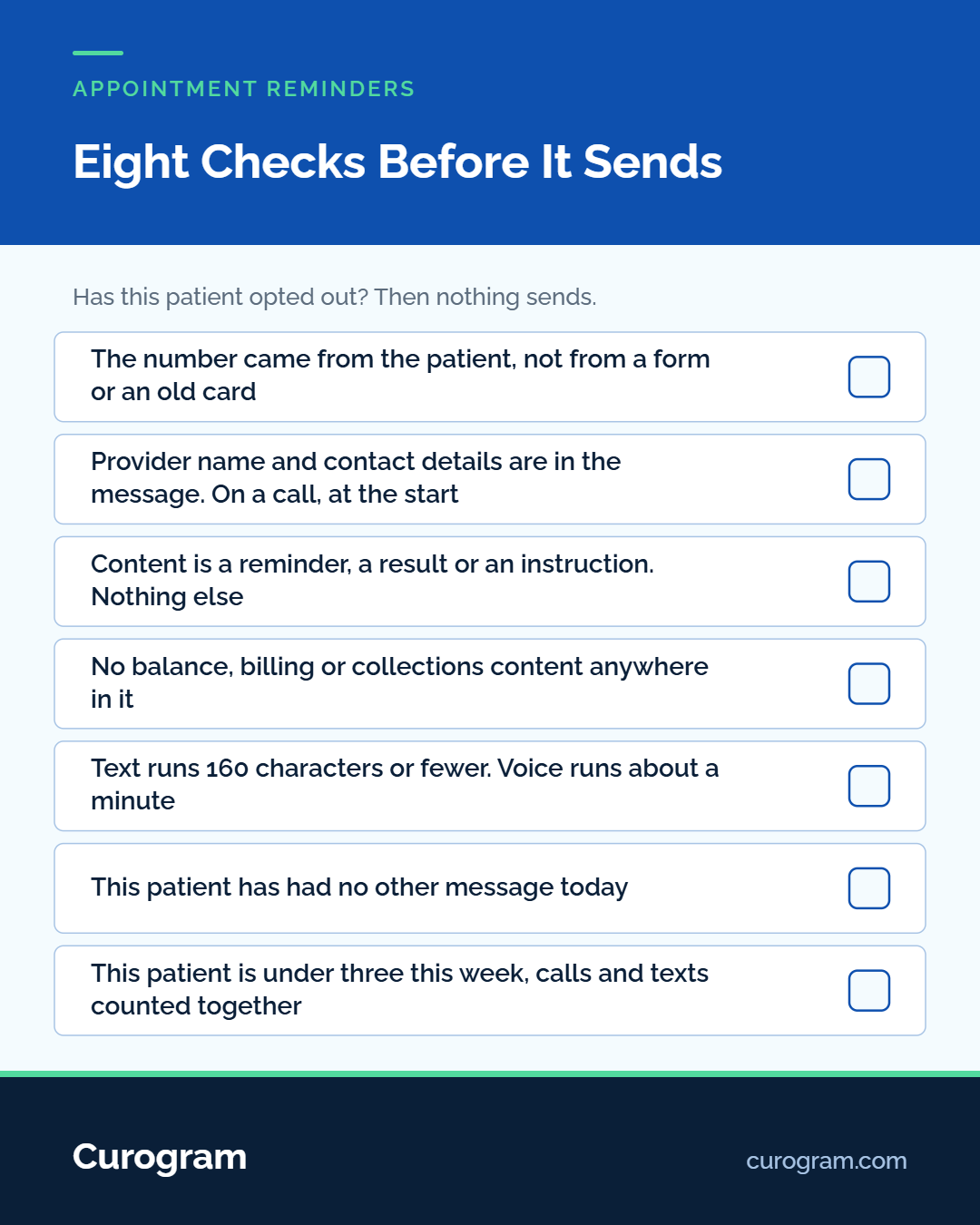
Short is the only way a reminder text works. That happens to match what the rule asks for.
Health care texts are capped at 160 characters under the exemption. Voice messages get about a minute. Most people treat that length as a carrier quirk. It is a condition of the exemption.
Texts are covered only when they go to the mobile number the patient supplied. A number copied off an old insurance card does not qualify.
Which makes the intake field the weak point. Numbers go stale, and nobody notices until a message bounces.
Reminders that carry prep steps raise the stakes again. We covered appointment prep reminders in Allscripts, where the message has to reach the right person to be any use.
Some patients have a landline and no mobile. Some share a number. A voice call reaches both.
That is a real gap in any text-only program. It tends to sit in the oldest part of the panel.
In that same March 2026 analysis, telephone reminders came out at a risk ratio of 1.11. Five studies, 3,369 patients, and an interval running from 1.04 to 1.19.
That one did reach significance, at a p-value of 0.002. Its studies also agreed with each other far more closely than the text studies did.
No study in the review compared the two head-to-head. So nobody can say from this data that one beats the other.
This is the condition most practices miss. A reminder call that could land in voicemail needs a toll-free number on it. Patients ring that number to opt out.
A call answered by a person needs something else again. It needs a key-press or voice opt-out the patient can use before hanging up.
Most reminder voicemails give a clinic name, a date and a callback number for the clinic. A callback number does not do the job of an opt-out number.
A shared mailbox, a speakerphone in a kitchen, a car display showing a transcript. The message is out of your hands once it lands.
Which is why reminder scripts stay thin. Clinic name, date, time, callback number, and nothing about why the patient is coming in.
Messages under this exemption also have to meet the HIPAA privacy rules. That makes the thin script a condition of the exemption.
|
Text |
Voicemail |
|
|---|---|---|
|
Patient can reply |
Yes |
No |
|
Reaches a landline |
No |
Yes |
|
Length allowed |
160 characters |
About one minute |
|
Opt-out required |
Reply STOP |
Toll-free number |
|
Daily cap per patient |
1 message |
1 message |
|
Weekly cap per patient |
3 combined |
3 combined |
The last two rows are one cap, not two. Calls and texts are counted together.
Permitted content is a named list, not a judgement call. Reminders and confirmations are on it, with wellness checks and pre-op instructions.
Lab results, post-discharge follow-up, prescription notices and home health instructions sit there too.
Money is not on the list. Balances, billing and collections fall outside it, even when they concern a real appointment.
Under the federal delivery rules, a provider may send one message per patient per day. The weekly ceiling is three, across both channels.
Count a text at booking, a call three days out, and a text the night before. That reaches three. Add a lab result notice and the week is over the line.
Opt-outs under this exemption have to be honored right away. Replying STOP is the only route a text has to offer.
Scale makes the counting harder, not easier. Our piece on enterprise reminder workflows in GE Centricity covers what changes across many sites.
Curogram HighlightCurogram's Text Patient Reminders send from the schedule, so the message goes to the number on the chart. Patients reply in the same thread they use for everything else. Confirmations and cancellations are written back, and STOP is handled on the spot. Staff see it beside the rest of that patient's messages, not in a separate tool. |
Count what you already send. Booking, prep, reminder, result, recall. Put the calls and the texts in one column, per patient, per week.
If that number is above three, something has to go before anything new is added.
Then check two scripts. Does the reminder text say reply STOP? Does the reminder call leave a toll-free opt-out number? Most practices pass the first and fail the second. The voicemail script is usually years old and nobody owns it.
Keep voice for the landline part of the panel, and run text for everyone else. Evidence supports both, and the cap applies either way. Then pick one thing to stop sending. Something already goes out that nobody reads, and it is using a slot the night-before reminder needs.
Last, give the voicemail script an owner. It was written once, by someone who has probably left, and nobody has read it since.
Book a Curogram demo to see a reminder go out and come back.
 Carylee Gali : 3/16/22, 7:00 AM
There's no doubt about it — patients prefer text messages. Check out these five reasons you should find the right way to text your patients.

 Joshua Inciso : 5/17/22, 8:05 AM
See how TCPA and TRACED rules apply to healthcare texting, what appointment reminders require, and where most practices lose track of patient...

 Mira Gwehn Revilla : 3/14/26, 1:00 PM
Explore the patient communication evolution from phone-only to multi-channel. Learn text, email, portal, and app strategies with implementation...