
Why No-Show Rates Are Higher in Mental Health — and How to Fix Them
 Jo Galvez : 4/25/26, 11:00 AM
Mental health no-show rates often exceed 30%. Learn the root causes of missed therapy appointments and proven ways to bring attendance back up.

Front desk staff at behavioral health clinics do more than answer phones. They are often the first person a patient in crisis speaks to, and the last voice they hear when they call to reschedule. Turnover rates for administrative staff in medical practices can run above 30% annually — and in behavioral health, the toll is even higher.
Reducing front desk burnout in behavioral health is not just a staffing issue. It is a patient care issue. When staff are stretched too thin, callbacks get missed, hold times climb, and patients fall through the cracks. The good news: there are practical, proven steps that can relieve the pressure — without adding headcount.
Not all front desks are the same. In behavioral health, the administrative role comes with a layer of emotional weight that most other settings simply don't carry. Staff deal with high call volume, fragile patient populations, and scheduling systems that were not built for the complexity of mental health and substance use care.
When a patient calls in distress — or calls repeatedly because they are scared — front desk staff absorb that energy. This is sometimes called secondary stress, and it builds quietly over time. Unlike clinicians, support staff rarely receive training on how to handle emotionally intense interactions. That gap adds up.
Compassion fatigue is real in behavioral health settings, and it does not discriminate between clinicians and the people at the front desk. Staff who feel unprepared or unsupported are more likely to disengage — or leave.
Behavioral health practices often run with fewer front desk staff than the call volume demands. A single admin may handle dozens of inbound calls in a morning — confirmations, reschedules, medication questions, crisis referrals. Call center fatigue sets in fast when there is no relief valve.
In settings with lean staffing, every missed lunch break and every unanswered voicemail adds to the pile. There is rarely time to catch up, let alone breathe. The behavioral health administrative burden is real, and it is compounded daily.
A behavioral health appointment is not a 15-minute slot. Sessions run 45 to 90 minutes, and patients often reschedule — sometimes more than once. Each reschedule requires a phone call, a hold, a confirmation, and an update in the system. Multiply that across dozens of patients and the math gets painful fast.
The ripple effect is real: one rescheduled slot can throw off an entire day's calendar. Staff spend significant time on coordination tasks that could be handled in other ways, and that time adds up across the week.
Prior authorizations for mental health and substance use services are notoriously slow and inconsistent. Front desk staff in behavioral health are often caught in the middle — fielding calls from patients asking about coverage, following up with payers, and managing a process that rarely moves at the pace patients need.
This is one of the leading sources of behavioral health workforce burnout that does not get talked about enough. The emotional and cognitive load of managing insurance barriers, on top of everything else, pushes staff toward the edge.
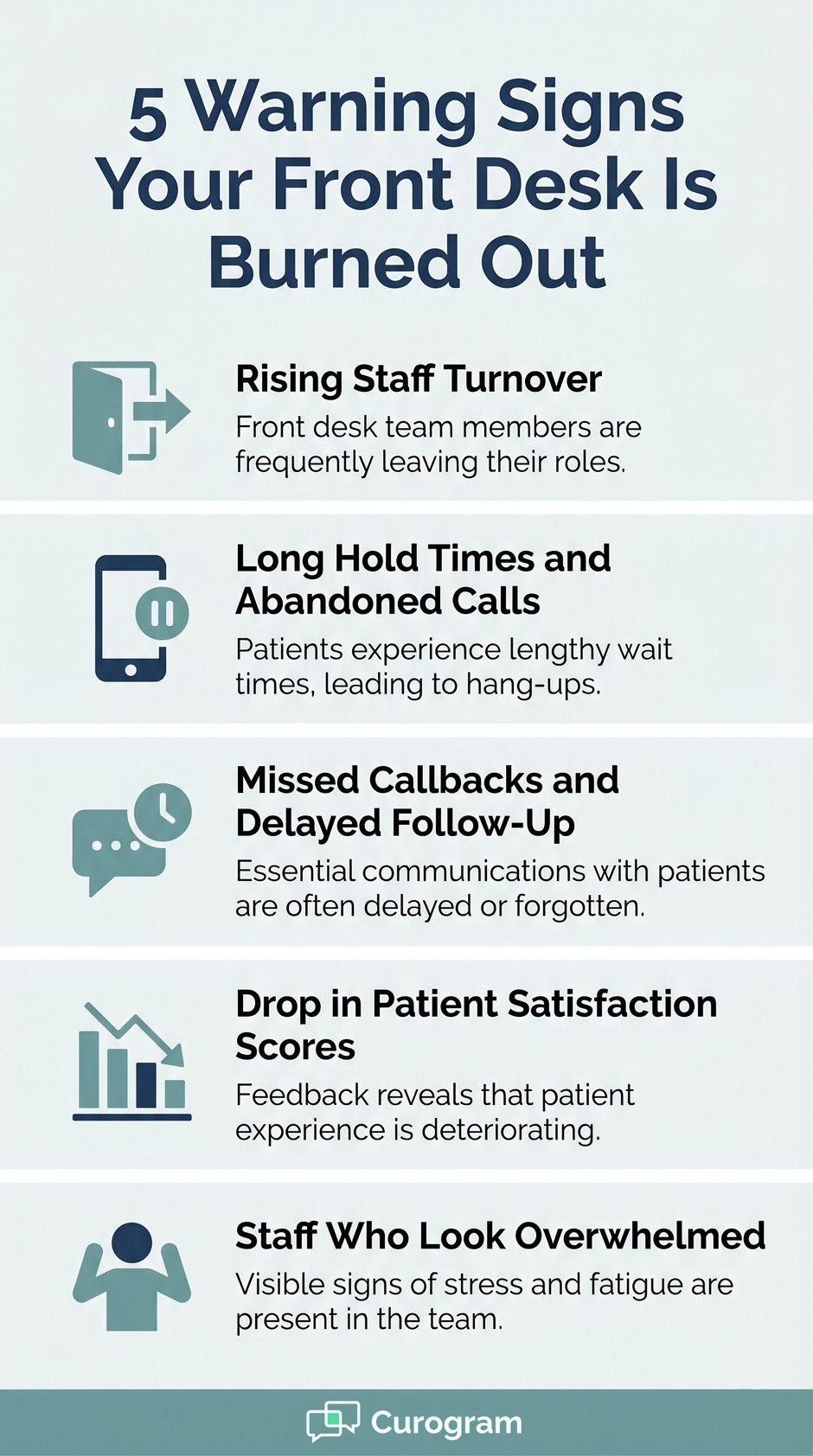
Burnout rarely announces itself. It shows up in patterns — small shifts in behavior and performance that, taken together, signal something is wrong. If you manage a behavioral health practice, these are the signs worth watching.
Front desk turnover behavioral health practices experience is often higher than what clinic directors expect. When one person leaves, the workload shifts to whoever remains, accelerating the burnout cycle for everyone else. High turnover also means constant retraining, which pulls attention away from patient care.
If your front desk has seen more than one departure in a year, it is worth asking what the job feels like from the inside — not just what the exit interview says.
When hold times stretch past two or three minutes, patients hang up. In behavioral health, that abandoned call might be someone who finally worked up the courage to book an appointment. Lost calls are not just a service problem — they are a clinical risk.
Rising hold times are usually a sign that staff are handling more calls than they can manage well. That is a system problem, not a people problem.
A voicemail list that grows faster than it shrinks is a red flag. Missed callbacks and delayed follow-up are among the most visible signs of a front desk under strain. For patients in behavioral health care, delays in response can have real consequences.
Mental health clinic staff retention suffers when workers feel like they are failing patients — even when the real problem is a workflow that was never designed to handle the volume they're facing.
When patients feel like they cannot reach their clinic, their satisfaction scores reflect it. Long holds, missed calls, and slow follow-ups all show up in feedback — and they often get attributed to the front desk rather than the underlying workflow issues.
This creates a painful cycle: staff are blamed for problems that are structural, morale drops, and performance suffers further. Breaking that cycle requires looking at the systems, not just the people.
There is no single fix for reducing admin burden in mental health settings. But there are changes that make a measurable difference — and that staff notices quickly. These are not theoretical. These are things clinics are doing right now.
The phone is the single biggest source of pressure for most front desk teams. Every call that comes in must be answered, routed, and resolved — often with hold time on both ends. Moving routine conversations to two-way text shifts that dynamic entirely.
Staff can handle a text message when they are ready, rather than drop everything when a phone rings. Workflow automation through HIPAA-compliant texting platforms allows patients to confirm appointments, ask basic questions, and get answers — without a single phone call. Curogram client data from clinical settings shows practices can reduce phone call volume by up to 50% with two-way SMS.
That is not a small shift. Fewer inbound calls means more breathing room for staff — and more time for interactions that actually require a live conversation.
Manually calling patients to confirm appointments is one of the most time-consuming tasks a front desk team handles. It is also one of the easiest to automate. Automated reminders — sent by text or email — confirm appointments, collect responses, and update the schedule without staff involvement.
Covina Arthritic Clinic confirmed more than 1,100 appointments per month automatically using Curogram — at peak, that reached 1,310 in a single month, with zero additional headcount (Curogram client data from clinical settings). That is over 1,100 phone calls their staff did not have to make. For a behavioral health clinic, that kind of relief can meaningfully change what a workday feels like.
Paper intake forms are a hidden time sink. Staff print them, hand them out, chase them down, scan them, and file them — all before a patient's first appointment even starts. Digital intake cuts that loop entirely.
When patients complete forms before they arrive, staff walk into each appointment with the information they need already in the system. It is one of the clearest examples of how reducing admin burden in mental health settings frees up time for higher-value work — and it reduces the frustration that comes from chasing paper all day.
One of the least talked-about drivers of front desk burnout is the blurry line between work hours and after-hours. If staff feel responsible for checking voicemails or returning calls outside their shift, that boundary needs to be rebuilt.
Automated after-hours messaging — letting patients know when they will hear back and what to do in a crisis — protects staff time while keeping patients informed. Clear handoffs and defined workflows reduce the anxiety that comes from feeling like something is always falling through the cracks.
Burnout is not only about volume — it is also about feeling invisible. Staff who never see the impact of their work have a harder time staying motivated. Simple dashboards that show confirmed appointments, response rates, and resolved messages give staff a sense of progress and control.
Support staff retention improves when people feel like they are contributing to something that is working. When the numbers show that the new system is reducing call volume or clearing the callback list faster, that matters. It turns a draining job into one with visible results.

Abstract benefits are easy to describe. But what does a better workday actually look like for someone at the front desk of a behavioral health clinic? A side-by-side comparison makes the difference concrete.
|
Task |
Without Better Tools |
With Better Tools |
|
Appointment confirmations |
Staff call each patient manually — 45+ minutes per morning |
Automated texts sent overnight; staff review responses in minutes |
|
Inbound call volume |
20–40 calls before noon; frequent holds |
Up to 50% fewer calls; routine questions handled via text |
|
Patient intake |
Paper forms printed, handed out, scanned, filed |
Forms completed digitally before arrival; data in system on day one |
|
After-hours messages |
Staff check voicemails before leaving or after hours |
Automated response tells patients when to expect a callback |
|
Reschedule requests |
Inbound call, hold, manual reschedule, re-confirm |
Patient texts to reschedule; staff confirms with one tap |
|
Staff awareness of progress |
No visibility into what's resolved or pending |
Dashboard shows confirmed appointments, cleared callbacks |
For large behavioral health agencies managing high call volume across multiple sites, the gains can be even more significant. River Valley FQHC achieved that 24% reduction through Curogram's Welligent integration, which connects two-way texting directly into their existing workflow — no separate system, no added complexity. That kind of change does not just save time. It changes what the job feels like.
Behavioral health workforce burnout is often treated as a morale problem. But the data points to something more structural: when the tools match the workload, staff perform better and stay longer. Practices that invest in the right workflow tools are investing in their people.
Once you start making changes to front desk workflows, you need a way to know if they are helping. The right metrics tell you whether your team is gaining ground — or still running in place.
Here are the numbers worth tracking:
|
Metric |
What It Tells You |
Healthy Benchmark |
|
Inbound call volume |
Whether automation is reducing routine calls |
Downward trend over 3–6 months |
|
Abandoned call rate |
Whether patients can reach you |
Below 5% |
|
Appointment confirmation rate |
Whether reminders are working |
85%+ confirmed before appointment day |
|
Callback response time |
Whether staff are keeping up |
Under 24 hours |
|
Staff turnover rate |
Whether conditions are improving |
Below 15% annually |
|
Patient satisfaction scores |
Whether patients feel cared for |
Trending upward quarter over quarter |
Curogram client data from clinical settings shows a 30%+ increase in staff productivity when two-way SMS is introduced. Productivity gains like that do not happen in a vacuum. They reflect staff who are less stressed and better supported by their tools.
If your numbers are not moving in the right direction after 60–90 days, that is a signal to look deeper. Are the automated tools actually being used? Is staff aware of the new workflows? Are patients engaging with text-based communication? Measurement is how you tell the difference between a tool that is working and one that is collecting dust.
Small wins add up. A 10% drop in call volume, a few extra minutes per staff member per hour — these are not dramatic numbers, but they compound. Over a quarter, they translate into real relief. Over a year, they translate into lower turnover and better care.

Front desk burnout in behavioral health is a real problem — and it is not going to fix itself. But it is also not inevitable.
When clinics reduce the volume of repetitive phone calls, automate what does not need to be manual, and give staff clearer workflows, the results show up fast. Staff have more energy. Patients get faster responses. And the team stays together longer.
The connection between staff wellbeing and patient outcomes is not theoretical. When your front desk is supported, your patients are better served. That is the real case for investing in better tools and workflows.
If you are ready to see what a lighter workload looks like for your team, explore how Curogram's patient engagement in behavioral health tools can help. You can also learn more about our call center solutions and patient workflows — or reach out to see how other behavioral health clinics are making this work.
Schedule a demo to see how Curogram help reduce front desk burnout in you mental and behavioral health clinic.
Frequently Asked Questions
 Jo Galvez : 4/25/26, 11:00 AM
Mental health no-show rates often exceed 30%. Learn the root causes of missed therapy appointments and proven ways to bring attendance back up.
 Jo Galvez : 4/25/26, 9:00 AM
Learn how behavioral health practices improve patient engagement, reduce no-shows, and support better outcomes with communication tools and...
 Jo Galvez : 4/26/26, 11:00 AM
Nearly 1 in 3 Americans lives in a mental health shortage area. Learn how rural behavioral health practices close access gaps with texting and...