
 Michael Hsu
Telemedicine Arkansas: State Laws and Policies | Blog
 Michael Hsu : 6/13/20, 9:03 AM
Learn how Arkansas top telehealth providers launched profitable, streamlined, and compliant telemedicine services in Arkansas.

A patient in Tensas Parish calls at 8:40 on a Tuesday. She has a rash, a truck with 180,000 miles on it, and no clinic inside 40 minutes. Your 10:00 slot is open. A video visit would settle this in nine minutes.
Then the questions start. Is the physician covering that morning fully licensed here, or working under a board permit? Does this need video, or will a phone call hold up?
Will Medicaid pay if she takes the call at her kitchen table? Front desk staff should not have to guess at any of that, and most days they do.
Louisiana has rewritten its telehealth policy several times since the Telehealth Access Act passed in 2014. Parts of the rules loosened. Audio-only visits are allowed under state law when a physician can meet the in-person standard of care. Louisiana Medicaid pays the distant site provider at the same rate as an office visit, and a patient's kitchen counts as a valid location.
Other parts stayed tight. Those are the ones that catch practices assuming federal policy is the whole story. The DEA waiver on remote controlled substance prescribing runs through December 31, 2026. Louisiana stacks its own in-person rule on top of that, and the stricter rule governs.
We wrote this for the people who make the rules work on a Tuesday morning. That means the scheduler, the biller, and the manager checking a modifier before a claim ships.
Below you will find what the state medical board expects before a telemedicine visit starts. You will also find who needs a permit and what it costs, how Medicaid pays, and where prescribing stops.
One more thing up front. Most virtual care programs lose more visits to missed appointments than to any statute, so we close on that problem too.
Louisiana telemedicine laws sit in two rule sets, and they do different jobs. The Telehealth Access Act, R.S. 40:1223.1 through 1223.5, defines telehealth statewide and directs every licensing board to write matching rules for the professions it regulates. LSBME rules in LAC 46:XLV, Chapter 75, govern what a physician does during the visit itself.
R.S. 40:1223.3 defines telehealth broadly. Live visits, store-and-forward transfers, remote monitoring, and the transfer of medical data all fall inside it. Behavioral health sits in that definition by name, which matters for counseling practices billing Medicaid.
Two things are carved out. Fax transmissions are not telehealth. Email and text messages are not telehealth unless they meet HIPAA rules, which puts ordinary SMS outside the definition.
The medical board uses a tighter term. Under LAC 46:XLV.7503, telemedicine means care delivered through two-way video and audio at the same time. An email between a doctor and a patient does not qualify. Neither does a consult between two physicians.
Fax and unsecured email fall outside telehealth entirely. A text telling a patient to join a visit is fine, since that is scheduling logistics rather than clinical care, and nothing in the chart changes because of it.
A text carrying a lab result is a different thing. Louisiana Medicaid's behavioral health manual says it plainly: telehealth does not include text, email, or fax for delivering care.
LSBME permits interactive audio without video under one condition. The physician must review the patient's medical records first, then judge that the same standard of care can be met.
Medicaid adds a step for EPSDT: the need and reason for audio-only must appear in the chart. Some services still require video because of what they are clinically, and the Medicaid provider manuals flag those cases wherever the requirement applies.
Six disclosures have to reach the patient and land in the chart before the first visit. LAC 46:XLV.7507 and 7511 list them. They need to be written down once, unless the details change.
Six items belong in the record before the first virtual visit:
Two more items sit beyond standard informed consent. Patients must be told how the physician relates to them, and what role any other provider plays in their care. They must also be told they can decline telemedicine and withdraw at any time.
Behavioral health groups billing Medicaid carry a longer consent list, covering the reason for using telehealth instead of an in-person session and the risks of no treatment at all.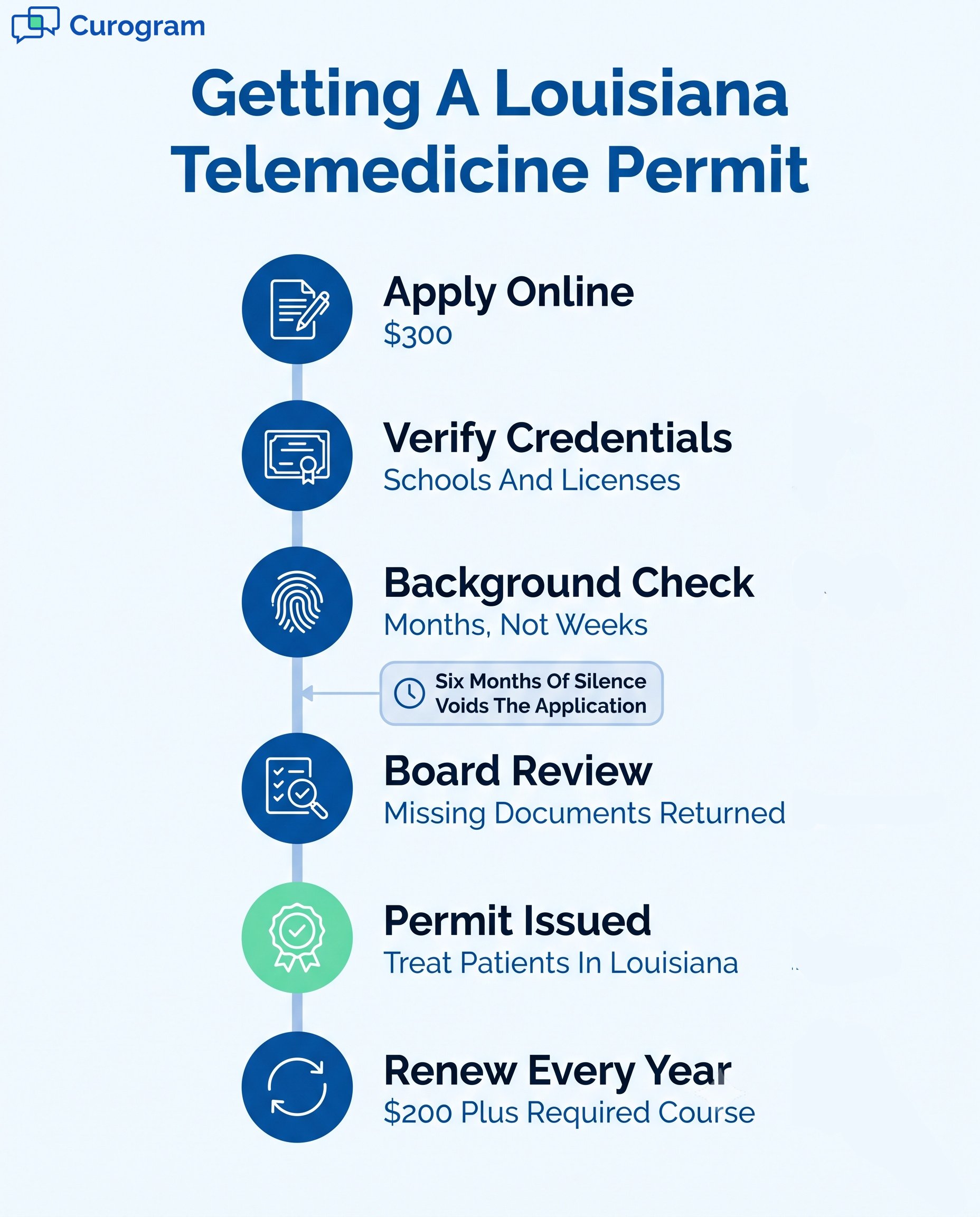
One line in LAC 46:XLV.7507 settles most licensing questions. The practice of medicine is deemed to occur at the location of the patient. A physician in Houston treating someone in Shreveport is practicing medicine in Louisiana.
Two paths exist. Hold a full, unrestricted state medical license, or hold a telemedicine permit issued by the board. Anyone searching for a Louisiana telemedicine license lands on one of those two. The permit is the limited version, built for physicians who hold no license here.
Eligibility is specific. Applicants need an unrestricted license from another state's medical board. They also need two years of ACGME-approved residency in the United States or Canada, in the same specialty.
A Doctor of Medicine degree from a board-approved school rounds out the list, along with passing scores on FLEX or USMLE Steps 1 through 3. Residents and fellows cannot apply while enrolled in training.
Louisiana telemedicine permit at a glance:
|
Item |
Requirement |
|---|---|
|
Initial permit fee |
$300, non-refundable |
|
Annual renewal |
$200 before expiration, otherwise $300 |
|
Residency |
2 years ACGME-approved, same specialty |
|
Before first renewal |
Laws and Rules course via CE Broker |
|
Inactivity limit |
6 months, then the application is void |
$300 to apply, and none of it comes back. Renewal runs $200 if it arrives before the expiration date. Miss that date and the full $300 applies again. Before the first renewal, the physician takes the Laws and Rules course through a free CE Broker account, and skipping it stops the renewal outright.
Background checks take months, not weeks. LSBME advises asking for criminal background materials early, because the board cannot start the check until an application is filed.
Malpractice history, prior board sanctions, or a single yes answer on the oath page each add a sworn narrative to the file and push the timeline out further. Treat permit timing as the long pole, not the software.
LAC 46:XLV.7513 draws hard lines around permit holders. A permit is a narrower authority than a license, not a license with a different name.
Permit holders cannot open an office in Louisiana, meet patients in the state, or take patient phone calls here. They cannot supervise, work with, or consult for an allied health provider based in Louisiana.
Reading diagnostic studies also sits outside the permit. Pathology, echocardiograms, ultrasounds, intraoperative monitoring, radiology, and nuclear medicine all require full licensure.
Physicians are not alone in this. Out-of-state counselors register with the Licensed Professional Counselors Board for $100, renewing at $50. Louisiana licensees practicing teletherapy need board approval plus three clock hours of teletherapy training. Speech-language pathologists, audiologists, and optometrists each have their own route in.
Federal policy and state policy do not line up on controlled substances, and that gap is where Louisiana practices get exposed, because it widened rather than closed this year.
DEA and HHS issued a fourth temporary extension effective January 1, 2026. Through December 31, 2026, a DEA-registered clinician may prescribe Schedule II through V drugs by telemedicine without a prior in-person exam, provided the listed conditions are met.
Louisiana did not follow. Under LAC 46:XLV.7513(C)(3), no physician may order a controlled substance by telemedicine without at least one in-person visit with that patient in the past year. The order must also serve a real medical purpose and match the standard of care for an in-person visit.
When two rules conflict, the stricter one governs the visit. A Louisiana practice relying on the DEA extension alone is running an exposed workflow.
One in-person visit inside twelve months. That is the whole test, and it belongs in a chart field rather than someone's memory. Behavioral health programs feel this hardest, since their remote volume is highest. Check the date before the visit, not after the script goes out.
One carve-out exists. A physician with a full state license who treats a patient at a Louisiana-licensed facility holding a current DEA number does not need the prior in-person visit. Permit holders cannot use it, since the exception turns on full licensure. Facility-based telepsychiatry lives comfortably inside this exception, while direct-to-home consumer telehealth sits outside it and carries the full in-person rule.
Board rules put two clinical areas off the table completely, whatever license the prescriber holds.
Section 7513(C)(1) bars telemedicine for treating non-cancer-related chronic or intractable pain. It points to the board's rules at sections 6915 through 6923. Pain practices can still use video for scheduling, teaching, and follow-up questions outside treatment. The treatment itself needs an in-person visit.
Section 7513(C)(2) bars telemedicine for obesity treatment, pointing to sections 6901 through 6913. Given how many weight programs now run entirely online, this rule deserves a careful read before any Louisiana-facing program opens enrollment.
Louisiana Medicaid telehealth reimbursement is more generous than the licensing rules. Two claim fields cause most of the denials, and both live on the same line.
Louisiana Medicaid pays the distant site provider at the same level as an in-person service. Originating sites get nothing. No limit applies to where the patient sits, so a home, a school, or a clinic all work as the originating site.
That distant site provider has to be enrolled with Louisiana Medicaid first. Covered services include those in the telemedicine appendix of the CPT manual, plus anything a provider manual names outright.
Store-and-forward is out. LDH ties payment to a definition requiring two-way, real-time audio and video, which rules out delayed transfers. Rural health clinics and FQHCs bill at the all-inclusive rate, and they code audio-only the same way as audio and video.
Louisiana Medicaid telehealth claim requirements:
|
Claim element |
Requirement |
|---|---|
|
Place of service |
02 (other than home) or 10 (home) |
|
Modifier |
95 |
|
Both present |
Required, or the claim does not pay |
|
Clinical record |
Must show delivery by telehealth |
|
Distant site |
Enrolled Louisiana Medicaid provider |
POS and modifier both have to appear. LDH states it without hedging: both the correct POS and the 95 modifier must be on the claim to get paid. Pick POS based on where the patient was, not the provider. A patient at home is 10, and a patient at a school or clinic is 02.
Every telehealth claim also needs the chart to show the service was delivered by telehealth. That sits apart from the claim fields, and it is the one auditors read. A single macro in the note template closes it for good.
State insurance law sets floors that Louisiana plans cannot write around. Federal coverage now has a firm end date to plan against.
R.S. 22:1821(F) protects the originating-site physician. Pay cannot fall below 75% of the usual amount for an intermediate office visit, and policy language that discriminates against telehealth is void. Physical and occupational therapy get true payment parity under R.S. 22:1845.1 and 22:1845.2. Plans there cannot demand a prior in-person relationship or extra prior authorization.
Congress passed the Consolidated Appropriations Act, 2026 (H.R. 7148) on February 3, 2026. It extends the Medicare telehealth waivers through December 31, 2027. Geographic and site limits stay waived, the home remains a valid site, audio-only stays covered for non-behavioral services, and FQHCs and RHCs continue as distant site providers. Acute Hospital Care at Home runs through September 30, 2030.

Remote patient monitoring sits in two places here. A statute sets the clinical criteria, and a Medicaid waiver pays for specific equipment.
R.S. 40:1227.5, amended by SB 70 in the 2025 session, requires a recommendation from the patient's provider for disease management by remote monitoring. Beyond that, the patient has to meet one of four criteria.
A CMS-defined chronic condition qualifies, and the statute names sickle cell disease, mental illness, asthma, diabetes, cancer, and heart disease. Two or more hospital stays, including emergency room visits, in the last twelve months also qualifies. Pregnancy and the weeks after birth qualify. So does an infant discharged after neonatal intensive care.
R.S. 40:1227.7 sets four conditions on any equipment and network used. Devices must meet the FDA standards that apply. They must stay in good repair and free of safety hazards, and they must arrive in the home either new or sanitized. Technical and clinical support has to be available to the patient using them.
Louisiana Medicaid pays for three telecare services through this waiver: activity and sensor monitoring, health status monitoring, and medication dispensing and monitoring.
Sensor monitoring is calibrated to the person's normal movement at home. At minimum it watches points of egress, detects falls, detects movement or the lack of it, tracks whether doors are open or closed, and offers a push-button alert. Health status monitoring collects weight, pulse oximetry, and vital signs, which fits heart failure, diabetes, and lung disease.
Billing runs on a one-time install fee plus a monthly maintenance fee. Only one claim per month is allowed, and partial months cannot be billed. A patient cannot get telecare sensor monitoring alongside traditional PERS. Medication systems must alert the provider or the family caregiver whenever a dose is missed, and the device has to send that alert by text or email.
Compliance protects the visits you hold. It does nothing for the ones that never start. Virtual slots go empty for reasons no statute covers. A telemedicine platform only pays for itself when patients show up.
A patient gets a visit link by email at 2 in the afternoon on Thursday, for a Monday appointment. Monday morning, that email is four screens down. She calls the clinic at 9:50, waits on hold behind two people rescheduling knee injections, and hangs up. The 10:15 slot sits empty for 20 minutes.
Drive time does not exist, so the old reminder cadence is wrong. A confirmation the day before, plus the link 15 to 30 minutes ahead, matches how a video visit starts. Practices using automated text reminders moved no-show rates from 14.20% to 4.91% and hold confirmation rates above 75%, based on our internal data. One clinic reactivated 1,240 lapsed patients by SMS recall and reconverted 35% of them.
A virtual visit that opens with form-filling burns clinical minutes. Sending secure online patient forms by text ahead of time puts history, consent, and insurance in the chart before the provider joins. This is also where the LSBME disclosure list can be captured and stored once, exactly as the rule allows.
State law draws this line for you. R.S. 40:1223.3 leaves email and text that fail HIPAA rules outside the definition of telehealth. Louisiana Medicaid separately requires a secure system that protects patient privacy, so HIPAA-compliant telehealth is a payment question as well as a legal one.
Appointment times, links, and payment requests travel fine over standard SMS. Conditions, results, and treatment details do not. HIPAA-compliant 2-way texting handles both, keeping clinical content in an encrypted channel while logistics stay in the thread patients already read. Curogram maintains SOC 2 Type II and HIPAA compliance across that stack.
Curogram connects with your EHR rather than replacing it. The telehealth note, the disclosure record, and the visit itself stay where auditors look for them. That matters in Louisiana, where the chart has to show telehealth delivery for the claim to hold. EMR integration keeps the schedule and the chart in one place instead of two.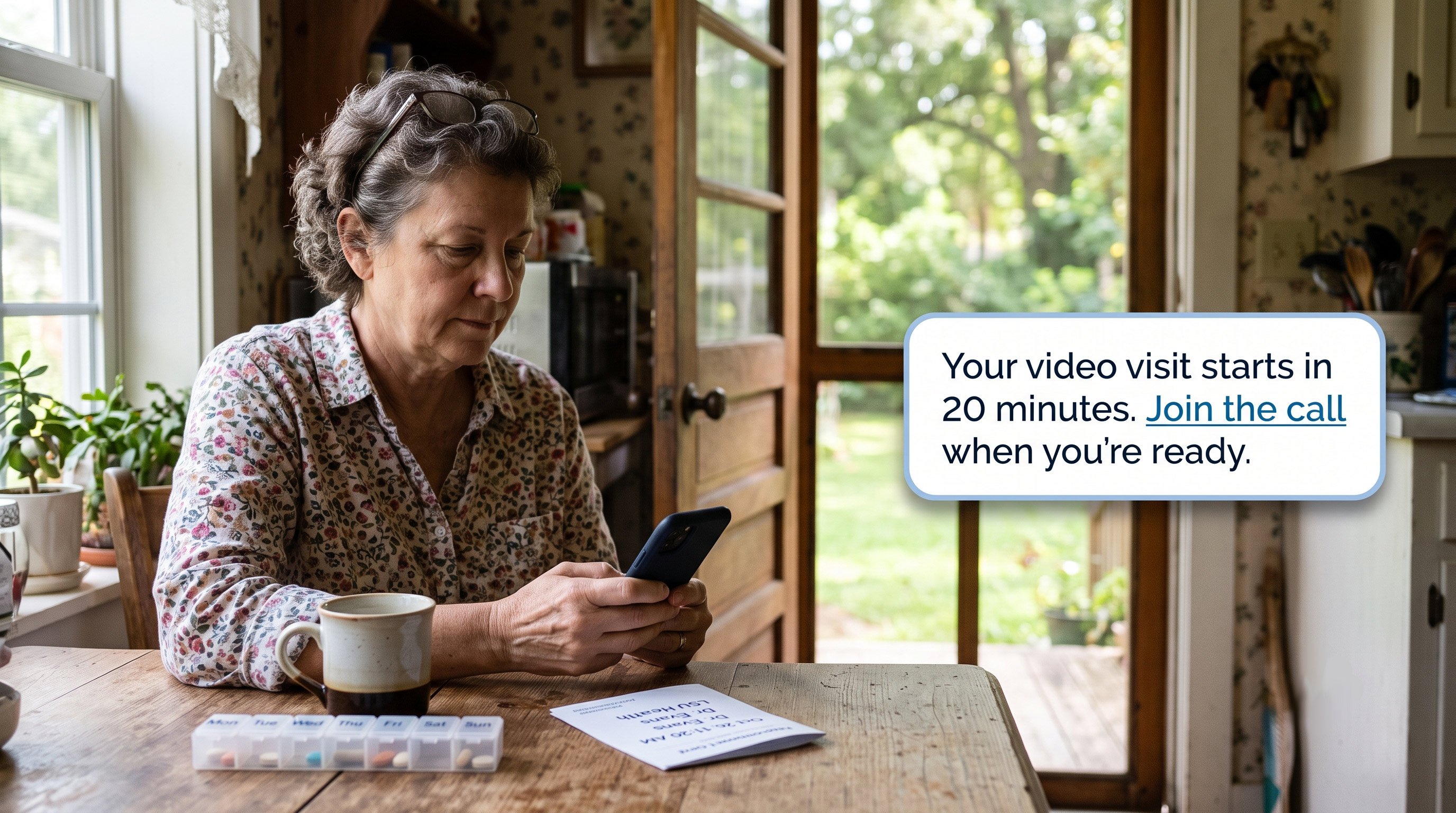
Louisiana is not a hard state for telemedicine. It is a specific one.
Payment is settled in ways many states still argue about. Medicaid pays the distant site at parity, sets no limit on where the patient sits, and covers audio-only in the cases its manuals name. State insurance law floors originating-site pay at 75% of an intermediate office visit. The Medicare waivers now run through December 31, 2027.
Licensing and prescribing carry the friction. A Louisiana patient means Louisiana authority: a full license, or a $300 permit with a $200 renewal and a Laws and Rules course attached. Controlled substances need an in-person visit inside the past year, federal extension or not. Non-cancer chronic pain and obesity treatment stay closed.
None of this is hard to manage. Most of it reduces to four habits.
Verify the permit or license before the schedule fills. Write down the six disclosures once per patient. Put modifier 95 and the right POS on every claim. Track the last in-person visit date for anyone getting controlled substances.
Then there is the part no statute covers. A fully compliant program still loses money when the 10:15 slot goes empty because a patient could not find a link. Rural patients are the ones telehealth in Louisiana was built to reach. They are also the ones most likely to miss a visit over a dead battery or a buried email.
That is a communication problem, and it answers to the tools built for it. Reminders sent close to the visit. Forms finished before the call. A text thread a patient can answer without waiting on hold.
Building a Louisiana telehealth program this year?
Book a short demo, and we can walk through your reminder timing, your intake flow, and where PHI moves today. No obligation to change anything afterward.
This article summarizes public rules and is not legal advice. Confirm specifics with LSBME, the Louisiana Department of Health, or your counsel before changing policy. The Center for Connected Health Policy tracks Louisiana updates as they land.
Rules move. Louisiana revised its telehealth policy repeatedly across a decade, and the DEA extension expires December 31, 2026. Whatever you build this year should survive that date without a rebuild.
 Michael Hsu : 6/13/20, 9:03 AM
Learn how Arkansas top telehealth providers launched profitable, streamlined, and compliant telemedicine services in Arkansas.
 Michael Hsu : 6/21/20, 10:57 AM
Looking to capture the telehealth market? Here are the best methods that will help you practice telemedicine in South Carolina profitably and...
 Michael Hsu : 6/22/20, 11:03 AM
The provider's ultimate guide to telemedicine in Wisconsin. Learn how to streamline your telehealth business and keep ahead of the competition.