

1 min read
6 Marketing Ideas to Launch Telemedicine in Your Practice
💡Six marketing ideas fill a telemedicine launch: boosted social posts, Google search ads, display retargeting, a dedicated telemedicine page,...

In the spring of 2020, thousands of medical practices launched video visits in a matter of days, with almost no time to plan. Staff learned new software on the fly, patients received visit links over the phone, and everyone hoped the connection would hold.
That rush was understandable at the time. Unfortunately, many practices never went back to build a real plan once the emergency passed.
Today, virtual care is a standard expectation rather than a temporary emergency solution. Many patients choose where to receive care based on how easily they can reach their provider online, and they notice quickly when telehealth options feel clunky or confusing.
Offering video visits is not the same as having a telehealth strategy. Without a plan, telehealth tends to sit off to the side, used by some providers and avoided by others. Patients may not even realize it's currently available, while your front desk spends hours on phone tasks that a quick text could handle.
It sounds like a technology problem. It isn't. It's a planning problem.
A solid telehealth strategy gives your practice direction. It defines what you want telehealth to accomplish for your organization, which tools your team should use, and how you'll promote your services. It also shows you how to keep care personal through a screen and where to invest your time and budget for the greatest return.
Fortunately, you don't need a huge budget or a dedicated IT department to get started. You need clearly defined goals, reliable communication tools, and a well-prepared, confident staff.
In this guide, you'll learn what telehealth includes, how it benefits both your practice and your patients, and why a written plan matters. You'll also find five practical steps to build a telehealth strategy that patients use and your team can manage with confidence.
Telehealth is the use of digital tools to deliver and manage care from a distance. Those tools include computers, laptops, tablets, and smartphones. Instead of every interaction happening in an exam room, you can connect with patients wherever they are.
Telehealth covers far more than video calls. Common examples include:
Each of these can save time for your staff and make care easier for patients to reach. You can learn more about the history, growth, and future of telehealth in our guide to Medicare telehealth.
Telehealth works best when everyone benefits. Your practice gains efficiency and a broader reach, while patients enjoy faster, more convenient access to care.
Here's how the advantages compare:
| For Your Practice | For Your Patients |
|---|---|
| Clearer, faster communication with patients | Visits that may cost less than an in-person appointment |
| A wider area to attract new patients | Care from home, which helps patients with mobility or transportation issues |
| Better care quality through regular follow-ups | Easier ways to reach your team |
| Higher patient satisfaction | Quick access to care when they need it |
| Fewer no-show appointments | Less time spent traveling and waiting |
These benefits often increase once people experience telehealth firsthand. A 2016 Medscape report found that attitudes toward telehealth improved for both patients and providers as they used it. In other words, the hesitation many people feel before their first virtual visit usually fades quickly.
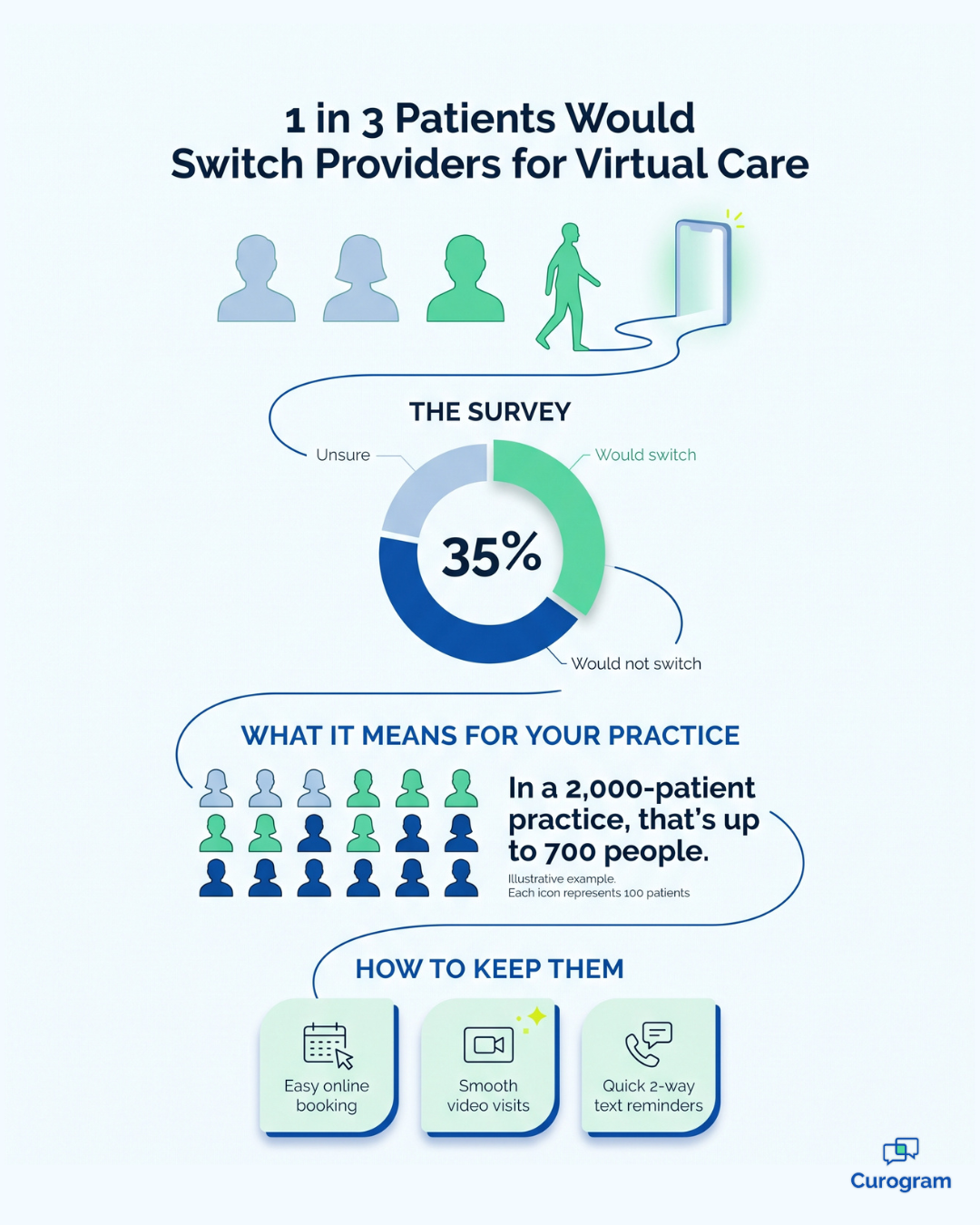
Telehealth can also protect your patient base. In a Sage Growth Partners survey, 35% of patients said they would switch providers to get access to virtual care. For example, in a practice with 2,000 active patients, that could mean up to 700 people who care enough about telehealth to leave for it.
Satisfying those patients is easier than it sounds, because a smooth, comfortable video visit goes a long way. As word spreads that you offer telehealth and deliver it well, you build a reputation that separates you from competing practices.
A telehealth strategy gives your practice a clear sense of direction. Instead of guessing, your team knows what to focus on and why.
A strong plan may include:
Each of these pieces supports the others. Your goals guide your marketing. Your training shapes the patient experience, and that experience drives your results.

| Don't try to launch every telehealth tool at once. Choose one specific problem to solve first, such as high phone volume or frequent no-shows. Record your current baseline, then track that number consistently for 90 days. A clear, measurable early win makes it much easier to gain your team's support for the next phase. |
Ready to put your plan on paper?
The following five steps will help you build a telehealth strategy that supports your team, your patients, and your long-term business goals.
Every effective plan begins with a clearly defined goal. When you know exactly what you want to accomplish, choosing the right approach becomes much easier. Start by identifying where telehealth could create the greatest improvement for your practice right now.
For example,
2-way text messaging can reduce incoming phone calls by up to 50%. That allows your front desk to concentrate on patients in the office instead of juggling calls throughout the day.
Here's what that could look like in practice.
As an illustrative example, imagine your team handles 100 calls every day, and each conversation takes about 3 minutes.
That adds up to 5 hours of staff time daily, so reducing call volume by half would recover roughly 2.5 hours a day, or approximately 50 hours every month.
Automated smart reminders are another valuable option. They let you send multiple reminders for each appointment, choose the time of day they go out, and personalize the content for each patient. Fewer missed appointments mean steadier revenue, lower costs, and better health outcomes.
Once your goal is clear, select telemedicine software that supports it and aligns with your mission. Then you're ready to promote your services.
Even excellent virtual care won't help if patients don't know it exists. Your aim is to reach current and potential patients with the right message through the right communication channels.
Your telehealth marketing plan can include one or more of the following:
Don't be afraid to invest in marketing. Begin with the channels your patients already use, then track which ones generate the most appointments. Keep in mind that effective marketing also raises expectations, so your team needs to be prepared to deliver.
Successful virtual care depends on careful planning and consistent training. Your staff needs to deliver a smooth experience from the very first click, because that experience is what earns patient trust.
Every team member should understand how your telehealth platform works, regardless of their role. That includes front desk staff who schedule visits, nurses who manage intake, and providers who lead each appointment.
Short online training modules are an easy place to start, since staff can learn at their own pace and revisit lessons whenever they need a refresher. Training can also reveal which platform fits your workflow best, which makes the final decision easier.
Patient-centered care makes your patients the highest priority. It encourages them to take a more active role in their health and helps them maintain wellness over time.
Well-trained staff make this possible. They share clear information, listen carefully, collaborate as a team, and show empathy, even through a screen. How your team presents itself during a virtual visit shapes how patients feel about your practice, so this step belongs at the center of your plan.
Many practices still treat telehealth as a side service. To get its full value, build it into the way your whole team works, from front desk staff to providers (and you!).
Everyday tasks can run through telehealth systems, such as:
When telehealth is part of daily workflows, patient engagement becomes stronger and more frequent. Patients get used to reaching you digitally, and your team spends less time on manual tasks.
When COVID-19 hit, the financial health of many practices suffered badly. To keep caring for patients and keep their doors open, many providers turned to telehealth as a lifeline.
Demand for virtual care grew rapidly during the pandemic, and it hasn't disappeared. Patients continue to look for safe, convenient ways to communicate with their providers.
A well-executed telehealth strategy helps your practice stand out from competitors. As you work through each part of your plan, you'll see what's succeeding and what isn't, which makes it easier to adjust, improve, and stay ahead.
Telehealth is no longer a temporary solution. It's now part of how patients expect to receive care, and it influences which practices they decide to stay with over time.
But simply offering video visits isn't enough. Without a clear plan, telehealth stays scattered: a few providers use it, patients forget it's available, and your staff keeps completing tasks by hand that the right tools could handle in seconds.
A strong telehealth strategy changes that. It begins with one measurable goal, such as fewer phone calls or fewer no-shows. From there, you promote your services through the channels your patients already use, and you train your team so every virtual visit runs smoothly.
Throughout the process, you keep the focus on the patient rather than the technology. The final step is the one that makes everything stick. When telehealth becomes part of everyday tasks like reminders, scheduling, and follow-ups, it stops feeling like an extra service and simply becomes how your practice operates daily.
Building a telehealth strategy also requires leadership. Your team will look to you to set the direction, explain why the change matters, and celebrate early progress. Start small, measure your results consistently, and adjust as you learn.
The right platform makes each step easier. Curogram brings video visits, HIPAA-compliant 2-way texting, smart appointment reminders, and online booking together in one place, so your staff isn't constantly switching between tools.
Practices using Curogram's 2-way texting have reduced call volume by up to 50%. For a busy front desk, that can mean hours returned every week to spend with the patients right in front of them.
If you're ready to turn your plan into measurable results, discover how Curogram can support your telehealth strategy. Book a demo to explore the platform and find the right fit for your practice.
1 min read
💡Six marketing ideas fill a telemedicine launch: boosted social posts, Google search ads, display retargeting, a dedicated telemedicine page,...

1 min read
💡 Telehealth patient texting uses secure, two-way SMS to connect practices with patients before, during, and after virtual visits. Practices send...
1 min read
💡 Telemedicine changes the patient-doctor relationship by keeping both sides in touch between visits. Patients can text a question, join a video...