
Digital Client Intake Forms for Welligent | Done by Text
Welligent intake packets stall behind portal logins. Curogram texts intake and screening forms so clients finish them on their phones before they...
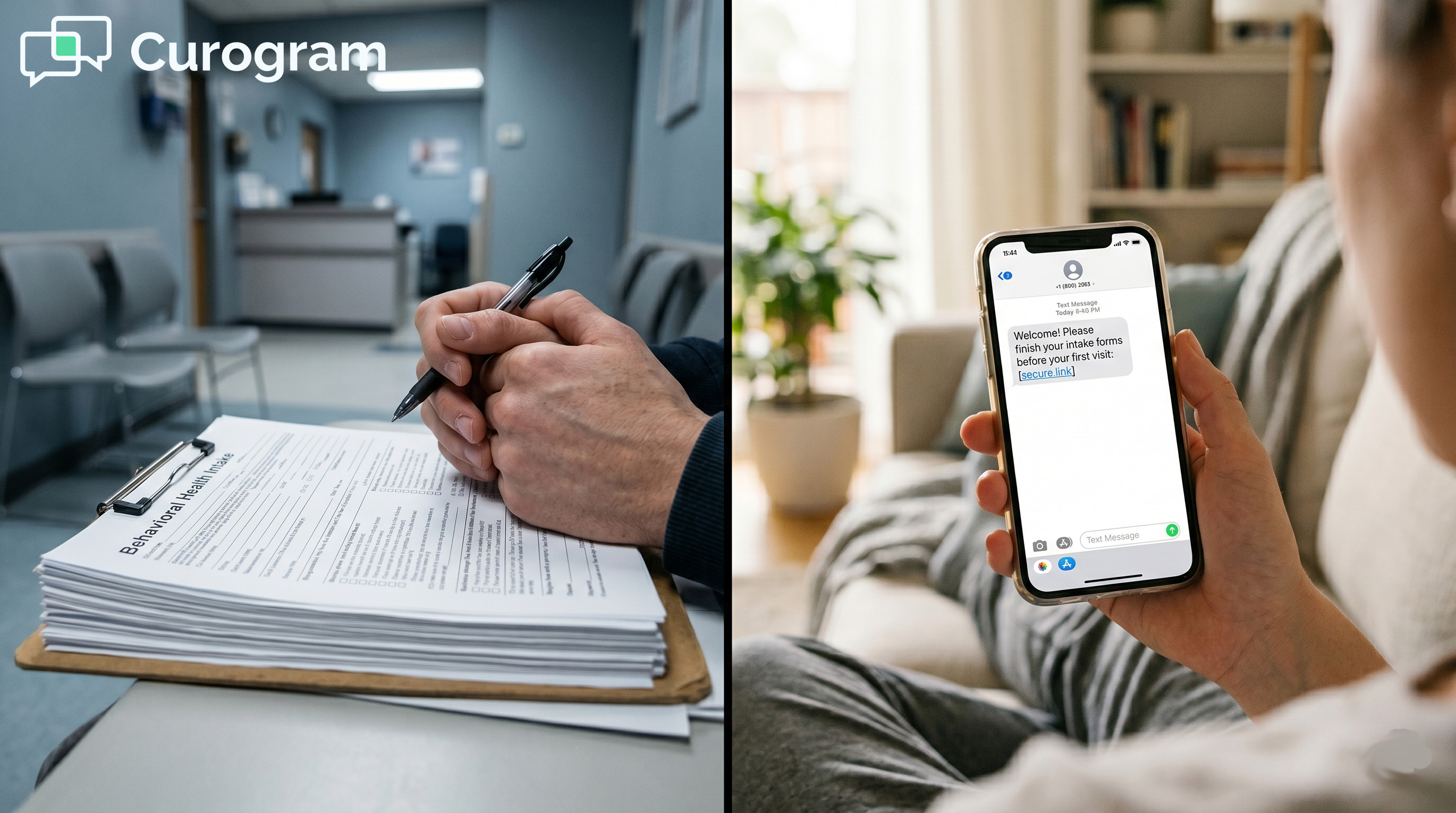
Two intake coordinators at the same agency can end the day very differently. One spends the afternoon with a stack of scanned packets, matching handwriting to Welligent fields box by box. Her colleague opens a list of packets that clients finished at home over the weekend, checks each one, and enters it.
Same Welligent setup, same programs, same caseload. Where the client filled out the forms is what changed.
Welligent's intake documentation is thorough for good reason. Multi-program agencies answer to Medicaid, block grants, and program-specific consent rules, and Welligent tracks all of it.
Its client-facing route runs through Welligent Connect, so a client who never activates the account brings nothing on admission day. At the front desk, that packet turns into paper.
We think the quickest efficiency gain open to a Welligent access center is moving packet completion to the client's phone, before arrival. It takes no new hires and no change to how Welligent documents or bills.
Paper carries costs that never appear on a budget line. Every page gets handled twice. Blank sections turn into callbacks. A misread insurance ID surfaces weeks later as a denied claim, and a skipped screener leaves a gap in the chart.
And the people absorbing all of it are the same ones answering phones and greeting clients in the lobby. Moving intake to text changes the shape of their job. Staff send packets, watch them come back, and confirm clean data, and the scanner sits idle most of the day.
A SUD IOP admission paperwork process shows the problem clearly, since the packet is long and the consents are strict.
Agencies that set out to eliminate double data entry in behavioral health intake usually start by counting hours. Errors cost more. A misread birth date means a rejected claim, and a missed screener answer means a clinician starts without it.
National survey data shows how much of the workday this paperwork eats. The National Council for Mental Wellbeing asked this in its 2023 workforce survey.
About a third of behavioral health workers said most of their time goes to administrative tasks. Among those who see clients, 68% said admin work takes time away from clients.
High-volume intake processing at a CMHC means several packet types moving at once. A single morning might bring an IOP admission, an outpatient intake, and a school-based referral.
Foster care case opening documentation adds household forms, placement details, and consents from a guardian or caseworker. Each program has its own packet and screener, so on paper each one is a separate stack to chase.
Staff spend hours tracking which client still owes which page. For the full cross-program view, see digital client intake forms for Welligent behavioral health organizations.

Booked admissions in Welligent sync to Curogram as appointments. From there, staff send the packet that matches the program. An IOP client gets the set with Part 2 consents and screeners, and a foster family gets the household documents.
Clients receive a text with a secure link and fill out the forms on their phone. No app, email, or password stands in the way. For SUD admissions, the message stays neutral, so no treatment details show on the lock screen.
Finished packets show up in Curogram's dashboard, so staff can see who still owes forms. Automated reminders nudge clients who haven't finished before the visit. A lost link gets texted again in seconds.
For access center admissions efficiency, this piece saves the most phone time. A text nudge replaces the callback that used to land in voicemail.
That same thread carries automated SMS appointment reminders, so clients hear from one familiar number for both. Our guide to behavioral health intake forms clients complete by text covers what clients see on their end.
Welligent connects to Curogram through a private API that brings appointments in. Form answers don't write back to the Welligent chart on their own. Staff open the typed packet, check it, and enter it into Welligent through their usual documentation step.
Nothing is left to decipher. Curogram's Welligent integration already runs mass texting for Welligent users and appointment reminder texts for Welligent users on that connection.
Secure Online Forms give each Welligent program its own packet, built once and sent by text. Packets can include e-signature consents, insurance card photos, and questions that appear only when they apply.
Staff choose the packet, send the link, and review what comes back in a HIPAA-compliant, SOC 2 Type II certified dashboard. Forms can follow a client's preferred language. Clients never make an account, so there's no client-side setup for staff to support.
See our page on online intake forms for Welligent users for setup details.
One coordinator's tasks shift like this across a week of admissions. This is an illustrative example, not a client case.
|
Task |
Paper Route |
Text Route |
|---|---|---|
|
Before arrival |
Wait for a portal login |
Send the link, watch returns |
|
At check-in |
Hand out a clipboard |
Greet a client whose packet is done |
|
After the visit |
Scan and re-key pages |
Review typed answers, enter them |
|
Blank sections |
Call the client back |
Text the link again |
To measure intake completion rate improvement, track one number by program for the first month. Count the share of packets finished before arrival, and you'll see which programs need a tweak to timing or reminders.
A finished packet still gets a human check. Most coordinators settle into a routine like this:
No step involves guessing at handwriting. Clinicians walk into the first session already briefed.
Atlas Medical Center, a Curogram client, used automated reminders to cut no-shows from 14.20% to 4.91% in three months. Atlas isn't a behavioral health agency, and forms weren't part of that result. Its lesson for intake is that clients respond to well-timed texts.
That no-portal route can also carry text-to-pay for copays and sliding-scale balances, which access centers often chase by phone.
Welligent is where your documentation, billing, and program rules live, and it should stay that way. Curogram handles the packet, which should never touch a clipboard or a scanner again.
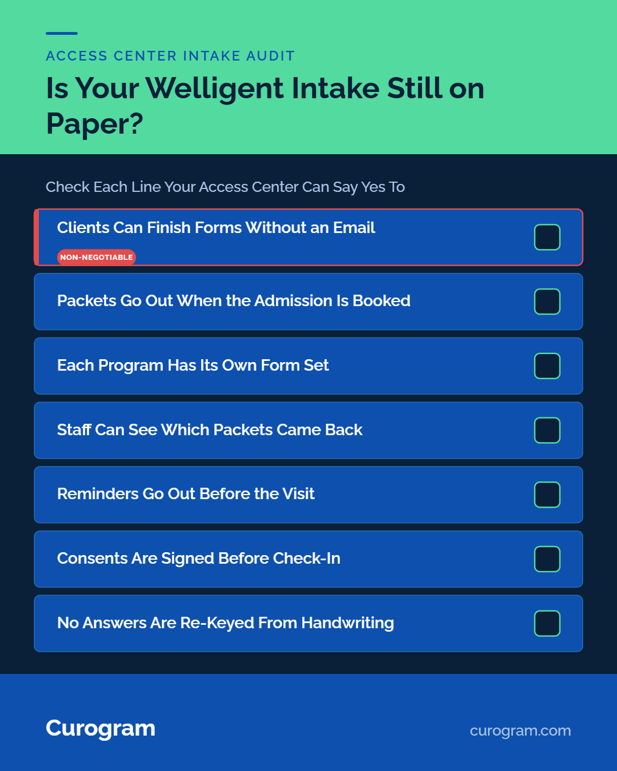
Try a quick count before you talk to anyone. Take this week's admissions and multiply by the minutes your team spends typing up each paper packet. That total is the time a Welligent intake paperwork workflow for access center staff can hand back.
Start with your longest packet. For most agencies, that's the SUD IOP admission.
Schedule a demo, and we'll map the pre-arrival workflow for your programs live. Bring that number and a copy of your intake packet.
Completed forms sit in Curogram's HIPAA-compliant, SOC 2 Type II certified dashboard under a Business Associate Agreement. That's a tighter chain of custody than packets waiting in a scanning tray. For SUD admissions, the text shows no treatment details.
Staff send a text and review a form, which are both familiar tasks. Clients need no app or account, so there's no client setup to support. Welligent documentation and billing workflows stay the same as before.
Text the link again at the desk, or hand the client a device to finish the open sections there. A full paper intake stays available for the rare client who needs it, so nobody gets turned away.
Each program gets its own form set. The SUD IOP packet carries its consents and screeners, while the foster care packet carries household documents. Staff pick the right one when the admission is booked in Welligent.
Clients type each answer once, so staff never guess at a handwritten birth date or insurance ID. Review replaces retyping, which removes the step where transcription errors usually start in a paper workflow.
Welligent intake packets stall behind portal logins. Curogram texts intake and screening forms so clients finish them on their phones before they...
Behavioral health clients complete intake forms on their phone before their first session. No app, no portal, no early arrival required.
Stop manually typing behavioral assessments into your EMR. Learn how Welligent form write-back automation in Curogram syncs data directly into your...