10 min read

Secure Behavioral Health Grant Funding with Welligent SMS

Secure Behavioral Health Grant Funding with Welligent SMS
💡 The best way to secure behavioral health grant funding with SMS and Welligent is to use Curogram to send post-visit surveys by text.
  • Clients reply with a simple number score — no app or portal needed
  • Surveys trigger after each visit, tied to your Welligent schedule
  • Feedback data exports into clean reports for grant boards
  • All surveys stay fully compliant with HIPAA and 42 CFR Part 2
  • Staff workload drops because the entire process is hands-free
Curogram helps non-profits and county agencies bypass the Welligent Connect portal to capture client satisfaction scores from hard-to-reach groups. The result is real proof of impact for every grant cycle.

Your next grant renewal is coming up. You know the work your team does matters. But can you prove it with numbers?

This is the reality for most non-profit and county agencies in human services. Staff members are saving lives, running crisis groups, and keeping families safe. Yet when it's time to report outcomes to the grant board, the data just isn't there.

Paper surveys pile up half-finished. The Welligent Connect portal sits unused because clients never log in. And agency directors walk into funding meetings with thin data that doesn't reflect the true impact of their programs.

That missing data is not just a small gap. It's a threat to your budget, your staff, and the people you serve.

The good news? There is a way to fix this. Agencies that use automated SMS surveys now capture client satisfaction scores in human services at rates far above the old methods. A simple text message — sent right after a visit — gets answers from the people who would never fill out a form or open a web portal.

In this guide, we'll show you how to secure behavioral health grant funding with SMS and Welligent by using Curogram. We'll walk through the data gap that puts grants at risk.

We'll explain how text-based surveys bypass the Welligent Connect portal. And we'll break down how the whole process runs on its own — saving your staff time and giving your grant reports the hard numbers they need.

If your agency runs on grants and uses Welligent, this is for you.

The Grant Funding Dilemma: Proving Your Impact

Grant money is the lifeline of most non-profit and county-run programs. Grants from sources like SAMHSA, state health offices, and county boards fund the staff, the space, and the care your clients receive. But that money is never a sure thing.

Every grant cycle, your agency must prove that its programs work. Funders want hard evidence: how many clients were served, what they thought of the care, and how outcomes changed over time. Without that proof, even the best programs risk losing their funding.

Think of it this way:

A county agency runs a substance use program that serves 400 clients per year. The state grant that funds this program is worth $350,000. To renew it, the agency must show that at least 70% of clients report a positive care experience. If only 50 clients fill out the paper survey, the board sees a response rate of just 12.5% — far too low to draw any real conclusion.


That's not a data problem. That's a funding problem.

The Data Gap

Here's where the gap starts: Your team delivers strong care every day. But the tools used to collect feedback don't match the reality of your clients' lives.

Handing a paper survey to someone leaving a crisis session is bad timing. Asking a client in a group home to log into the Welligent Connect portal assumes they have Wi-Fi, a device, and the patience to create a login. For foster youth, homeless clients, or at-risk families, these barriers are too high.

The result? You lose the voices of the very people your programs serve. And without their input, your data doesn't reflect the real story.

Consider this example:

A family services agency has 200 active clients. They hand out paper forms at checkout. They get back 30 forms per quarter — a 15% response rate. Those 30 forms might lean positive, or they might not. Either way, the board sees a tiny sample and questions the program's reach.


The Cost of Low Response Rates

When your response rate is low, it creates two problems:

  1. The data may be skewed. Only the most vocal clients — either very happy or very upset — tend to respond. This means your numbers don't tell the full story.

  2. Grant reviewers know what low response rates mean. They see it as a red flag. A SAMHSA grant reviewer, for instance, looks for data that represents the full client base. If your numbers come from a small slice, the reviewer may question whether the program truly meets community needs.

This is the dilemma that agency directors and program managers face. The work is real. The impact is real. But the proof is stuck in paper forms, unused portals, and missed chances to collect feedback. Non-profit grant reporting software should fix this — but only if it reaches your clients where they actually are.

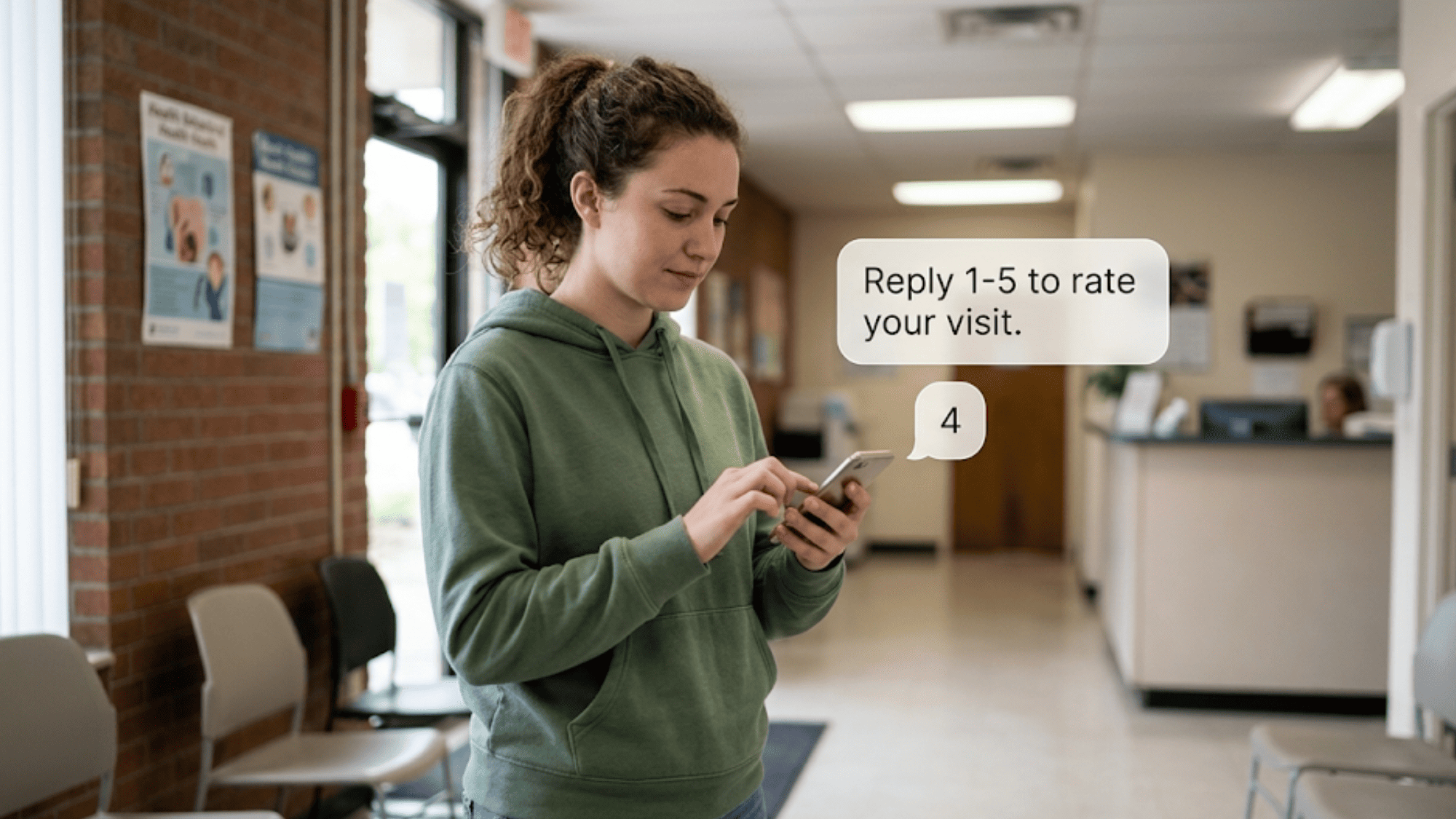
Young woman replying to SMS survey on her phone while leaving a community behavioral health clinic

Bypassing the Portal for Accurate Representation

To get a true picture of your program's impact, you need feedback from everyone — not just the clients who are easiest to reach. This is a matter of equity.

Many of the people your agency serves face real-world barriers. Foster youth may change homes and phone numbers often. Homeless clients may not have steady internet. Families in crisis are not going to sit down and log into a portal after a hard session.

When you only collect data from clients who can access a web portal, you miss the voices that matter most. And those missing voices create a gap that weakens your grant reports.

Funders are looking for proof that your services reach the most at-risk groups. If your data comes only from the easiest-to-reach clients, it tells an incomplete story.

The Mobile-First Door

The fix is simple: meet clients where they are. Nearly every adult in the U.S. has a cell phone, even in low-income groups. SMS is the one channel that reaches almost everyone.

Curogram sends a short, native text message after each visit. It might read:

"Reply 1–5 to rate your recent visit."

No app. No password. No data plan. The client taps a number, and the response goes straight into your system.

This is what it means to bypass the Welligent Connect portal. Instead of asking a client to log in, set up a profile, and fill out a long form, you send one text. It takes five seconds to answer. And because it goes right to their phone, it reaches the same person who would never open a portal.

The Result: Real Representation

Higher response rates aren't just about bigger numbers. They mean your data is more accurate. When you hear from 200 out of 400 clients instead of 30, the results carry far more weight in a grant report.

Grant boards want data that reflects the full community you serve. A 50%+ response rate from a diverse client base — including hard-to-reach groups — shows funders that your program truly connects with the people it was built for. That's the kind of proof that protects your budget.

Based on our internal research, Curogram clients using automated post-visit surveys see response rates that outpace traditional methods by a wide margin. This aligns with broader trends showing that SMS open rates exceed 90%, compared to roughly 20% for email.

When your feedback tool works for all of your clients — not just a few — your data tells the true story. And that story is what wins the next grant.

Automating the Collection (The Budget Unlocker)

Non-profit budgets are tight. Every dollar and every hour of staff time matters. So when your team spends hours each week calling clients, printing forms, and tallying results by hand, that's a direct cost to your programs.

Let's put it in numbers:

Say, you have two admin staff members who each spend five hours per week on survey tasks: printing forms, mailing them out, calling clients who didn't respond, and entering results into a spreadsheet.

That's 10 hours per week, or about 520 hours per year. At $20 per hour, that's $10,400 per year spent on a process that still produces low response rates.


Now, multiply that by the stress. Staff members are already stretched thin. Asking them to chase down survey replies on top of scheduling, intake, and client support is a recipe for burnout. And burned-out staff make more mistakes, which means your data quality drops, too.

The Welligent Integration

This is where Curogram changes the game. It connects to your Welligent schedule and runs the whole process on its own.

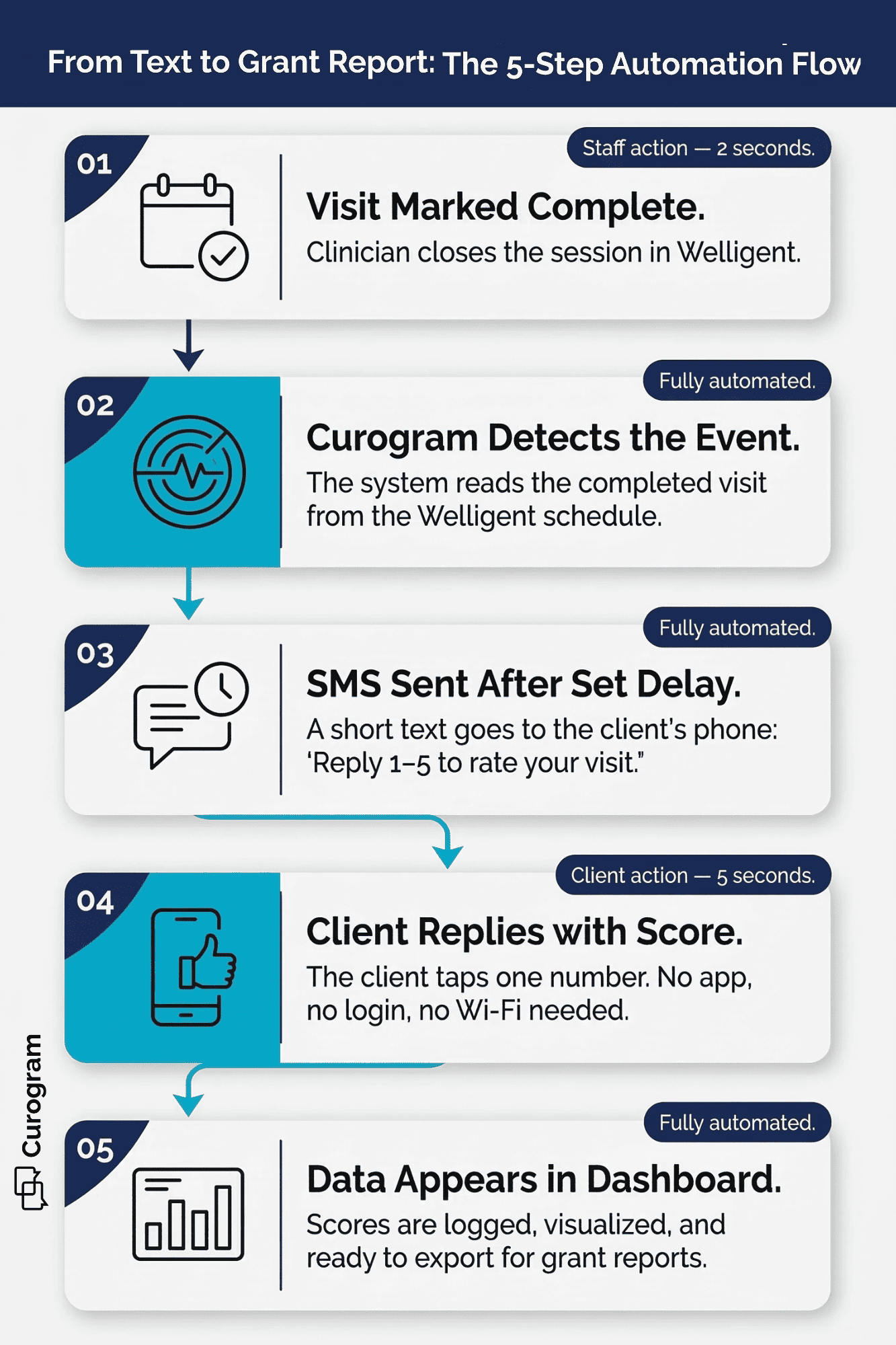
Here's how it works, step by step:

  1. A client finishes a session and the clinician marks the visit as complete in Welligent.
  2. Curogram detects the completed visit and waits for a set time — say, one hour.
  3. The system sends a text: "How was your visit today? Reply 1–5."
  4. The client replies with a number.
  5. That score is logged and added to Curogram's dashboard.

No staff member has to press a button, make a call, or enter a number. The system does it all. This is the heart of what makes it work as non-profit grant reporting software — it removes the human effort from data collection while keeping the data accurate and timely.

What This Looks Like in Practice

Imagine you run a mental health program with 300 active clients per month. Using manual methods, your team might reach 45 clients (15%) for feedback each month. With Curogram's SMS surveys running after every visit, you're now collecting scores from 150 or more clients per month.

At the end of the quarter, instead of showing a grant board 135 data points from paper forms, you show them 450+ scores from a system that runs on its own. That's over three times the data, with zero added staff work.

Method

Monthly Clients Surveyed

Quarterly Data Points

Staff Hours/Week

Paper forms + calls

~45 (15%)

~135

10

Welligent portal

~30 (10%)

~90

3

Curogram SMS

~150+ (50%+)

~450+

0


The numbers speak for themselves. The manual path eats time and still falls short. The portal path saves staff time but barely reaches clients. The SMS path delivers the most data with the least effort.

Exportable Proof for Grant Reports

When grant reporting time arrives, you don't need to scramble. Curogram stores all survey responses in a clean, visual dashboard. You can filter by program, date range, location, or clinician.

Need to show satisfaction trends over the past year for your SAMHSA renewal? Pull the report. Need to compare scores across two sites for a county board meeting? Filter and export. The data is always there, always up to date, and always ready.

Based on our internal data, Curogram's automated systems confirm over 1,100 actions per month for clients who use the scheduling tools. That same level of reliability applies to post-visit surveys, giving you a steady stream of data without manual work.

This is what we call the "budget unlocker." By removing the cost of manual data collection and replacing it with a system that runs itself, you free up both money and staff time. Those freed hours go back to direct client care — the very thing your grants are supposed to fund.

Vertical flowchart of how automated SMS surveys collect client feedback through Welligent integration

A Quick ROI Check

Let's illustrate this through numbers: $10,400 per year in staff time for manual surveys. Curogram's SMS tools cost a fraction of that. Even before you count the value of the data itself — and its power to keep grants flowing — the return on investment is clear.

For an agency running on a $350,000 grant, losing that funding because of poor data is not an option. The cost of a tool that keeps the data flowing is small compared to the cost of losing the grant entirely.

And the value goes beyond grant reports — the same platform that captures client feedback also helps boost your agency's public reputation through automated review requests. If you're curious what that kind of return looks like for your team, Curogram's ROI Calculator can show you the numbers based on your own appointment volume.

Uncompromising Privacy: 42 CFR Part 2

Working in behavioral health means following strict privacy rules. It's not just about HIPAA. Programs that handle substance use data must also comply with 42 CFR Part 2, which adds even tighter controls around client identity and treatment records.

This matters for your surveys, too. If a text message reveals that someone is in a substance use program, that's a privacy breach. And a privacy breach doesn't just hurt the client — it can end your grant, trigger fines, and damage trust in your agency.

The Standard

Curogram was built with this in mind. Automated SMS surveys are short, generic, and discreet. A typical message reads: "How was your visit today? Reply 1–5." There's no mention of the program name, the type of treatment, or the client's condition.

This means the survey is fully 42 CFR Part 2 compliant feedback. Even if someone else sees the text on the client's phone, there's no way to tell what kind of care the person received. The message could be from a dentist, a check-up, or any other visit.

On top of this, all data is stored and handled in line with HIPAA rules. Curogram's platform uses secure systems to protect client responses from end to end. For agencies in human services, this means you can capture client satisfaction scores without ever putting a client's privacy at risk.


How Curogram Helps Non-Profits Protect Their Funding


Curogram is more than a texting tool. For non-profits and county agencies using Welligent, it's the bridge between the work you do and the proof you need to keep doing it.

Curogram meets clients where they are. By sending plain-text SMS surveys that need nothing more than basic cell service, it reaches the groups that portals and paper miss: foster youth, homeless clients, at-risk families, and others who face real-world barriers.

It also runs on its own. Once set up with your Welligent schedule, there's no daily upkeep. Surveys go out after each completed visit, and scores land in a dashboard you can access any time. Based on our internal data, Curogram clients have achieved a 75% or higher rate of confirmed actions through automated systems — showing the kind of reliability that grant boards want to see.

The reporting side is built for this exact use case. Whether you're writing a SAMHSA renewal or building a slide deck for your county board, you can pull clean charts and tables in seconds. No more scrambling at the end of the quarter.

And through it all, your clients' data stays safe. Curogram's 42 CFR Part 2 compliant feedback tools and HIPAA-grade security mean you never have to choose between good data and good privacy.

For agencies that rely on grants, the risk of missing data is too high. Curogram fills that gap — quietly, securely, and without adding a single task to your staff's plate.

Conclusion

Your agency's mission is clear: serve your community and change lives. But without strong data to back up that work, the grants that fund it are at risk. And when funding slips, programs shrink, staff are cut, and clients lose access to care they count on.

The old methods don't work for the people you serve. Paper forms sit in stacks. Portal logins go unused. Manual phone calls eat up staff time and still miss most of your clients. The result is thin data, weak reports, and tense board meetings where numbers don't match the impact your team makes every day.

Curogram changes that picture. Automated community impact surveys sent by text reach the people other tools miss — foster youth, homeless clients, at-risk families, and others who face real-world barriers.

These surveys run on their own, tied to your Welligent schedule, so no staff member has to lift a finger. Every reply feeds a clean dashboard that's ready to export the moment grant reporting time comes around.

And none of it puts your clients at risk. Every message is short, generic, and built to meet the strict standards of both HIPAA and 42 CFR Part 2. Your data stays safe, your clients stay protected, and your reports carry the weight that funders expect to see.

If your agency uses Welligent and depends on grant funding, the path forward is simple. Stop relying on methods that leave you short on data. Replace the guesswork with a system that delivers real numbers from real clients — every single time.

Ready to protect your funding and prove your impact? Book a quick demo to see how SMS surveys can power your next grant report.


Frequently Asked Questions

How can we export survey data for grant board meetings?
Curogram's dashboard lets you filter by program, date, or site and export clean reports in seconds — formatted and ready for grant boards or SAMHSA reviews.
Why don't clients need internet access to leave a score?
Curogram uses native SMS, not a web link or app. Clients only need basic cell service to reply with a number, which makes it ideal for low-income or transient groups.
How does Curogram keep survey messages private under 42 CFR Part 2?

Each text is short and generic — for example, "Reply 1–5 to rate your visit." There's no mention of treatment type, program name, or diagnosis, so privacy is built in.

How does the Welligent integration reduce admin work for our staff?

Once connected, Curogram watches your Welligent schedule and sends surveys after each completed visit. No staff member needs to trigger, track, or tally anything.

Why should we trust SMS over portal-based surveys for hard-to-reach clients?

SMS open rates top 90%, while portal login rates for at-risk groups often fall below 15%. Texting removes every barrier — no app, no login, no Wi-Fi — so you hear from the people who matter most.