How to Prepare for a Telehealth Visit in Athenahealth
💡 Knowing how to prepare for a telehealth visit in Athenahealth is key to good virtual care. Both patients and clinics play a role in preventing...
Table of Contents
Radiology centers face growing patient volume every year. Many exams need careful prep work before the visit. Some require follow-up consults to review results. When patients miss these steps, schedules fall apart and revenue drops.
Most imaging centers rely on in-person visits for pre-exam checks and result reviews. Patients often skip these appointments due to time limits or travel issues. This creates gaps in workflow and lowers daily capacity.
Telehealth in Veradigm solves these problems by making care more accessible. Virtual visits let patients connect from home or work. This reduces the friction that leads to missed appointments. Imaging centers can screen patients earlier, answer questions faster, and keep schedules on track.
For multi-site radiology networks, virtual care creates more consistent processes across all locations. Veradigm virtual consultations work within existing scheduling systems. Staff don't need to learn new platforms or change their daily routines.
HIPAA-compliant telemedicine also protects sensitive patient data during every interaction. Radiology workflows handle protected health information constantly. Secure virtual visits reduce the risk of data exposure through unsecured channels.
This blog explores how telehealth strengthens imaging center operations. We'll cover pre-procedure screening, follow-up care, compliance, and financial impact. You'll learn how virtual visits fit into Veradigm workflows and support enterprise-scale radiology networks.
Whether you manage a single center or oversee multiple locations, telehealth offers real solutions. It helps you increase throughput, reduce no-shows, and improve patient satisfaction. Let's look at how virtual care works for modern radiology practices.
Hundreds of patients go through radiology centers weekly. Each exam type has its own timing needs and prep rules. MRI scans need strict safety screening. CT studies often require contrast clearance. Interventional radiology procedures demand detailed risk assessments.
These requirements create multiple patient touchpoints before exam day. Many centers schedule in-person pre-visits for screening and education. Patients must take time off work, arrange transport, and navigate parking. Some skip these visits entirely, thinking they can handle prep on their own.
When patients arrive unprepared, exams get delayed or cancelled. Staff waste time rescheduling. Modalities sit idle when they should be generating revenue. The entire imaging workflow breaks down from a single missed prep step.
Telehealth in Veradigm creates a better path forward. Virtual visits remove the barriers that prevent patients from completing prep requirements. They can join from anywhere with internet access. No travel time, no parking hassles, no waiting rooms.
This shift makes a real difference for patient compliance. A working parent can take a 15-minute virtual consult during lunch. An elderly patient avoids multiple trips to the imaging center. Rural patients don't need to drive an hour for a simple prep review.
Virtual care also helps imaging centers manage their schedules more efficiently. Staff can conduct more pre-visit screenings per day without adding physical space. They can squeeze in last-minute consults when questions arise. Follow-up visits for result reviews happen faster.
For Veradigm users, virtual consultations integrate smoothly with existing systems. Appointments appear in the same calendar. Patient data flows through familiar channels. Staff access the same documentation tools they use for in-person visits.
This seamless integration matters for operational stability. Imaging centers can't afford disruptions during busy periods. New tools need to enhance workflows, not complicate them. Telehealth becomes part of the daily routine rather than a separate process.
Multi-location networks gain even more value from virtual care. A single radiologist can support prep screenings across three sites without traveling. Specialist consultations reach every location equally. This creates better resource use and more consistent patient experiences.
The impact shows up in measurable ways. Fewer day-of cancellations mean higher modality utilization. Better prep compliance leads to more successful first-time scans. Faster follow-ups improve patient satisfaction scores.
Imaging centers that adopt telehealth can handle growing patient volume without expanding facilities. They serve more people with the same physical resources. This scalability becomes critical as demand for imaging services continues to rise.
Virtual visits also reduce the burden on front desk staff. Fewer in-person check-ins mean shorter wait times. Phone lines stay clearer for urgent needs. Administrative teams can focus on more complex tasks.
The shift to virtual care isn't about replacing in-person visits entirely. It's about using the right format for each interaction. Quick screenings and result reviews work well remotely. Complex consultations might still need face-to-face time. Telehealth gives imaging centers the flexibility to choose.
Effective scheduling and coordination separate high-performing imaging centers from struggling ones. Telehealth in Veradigm enhance both functions by streamlining pre-procedure workflows and accelerating post-exam communication. These improvements create measurable gains in efficiency and patient satisfaction.
Interventional radiology procedures carry a higher risk than standard diagnostic imaging. These exams often involve sedation, contrast agents, or invasive techniques. Patients need thorough medical clearance before the appointment.
Traditional pre-procedure workflows require separate in-person visits. Patients meet with nurses or physicians to review their medical history. They discuss medications, allergies, and prior reactions. This process can take several days to schedule and complete.
Veradigm virtual consultations compress this timeline significantly. A patient can have their screening call the same day they schedule the procedure. Staff can identify risk factors immediately and address them before exam day. This prevents last-minute surprises that force cancellations.
Virtual screening also improves accuracy. Patients feel more comfortable discussing sensitive health issues from home. They have more time to gather medication lists and medical records. The quality of information improves when patients aren't rushed or stressed.
For imaging centers, this means better first-time success rates. More patients arrive properly prepared. Fewer exams get postponed due to overlooked contraindications. Modality schedules stay full and productive.
High-prep studies like colonography or enhanced MRI benefit equally. These exams require specific dietary restrictions and bowel prep protocols. Patients often have questions about the instructions. A quick virtual visit can clarify everything and prevent prep failures.
Improving Follow-Up and Result Review Workflows
Many diagnostic studies require follow-up conversations with patients. Radiologists may need to explain findings or recommend next steps. Primary care physicians might want to review results before making treatment decisions.
These follow-up visits often get delayed when patients struggle to schedule in-person time. They balance work commitments, childcare, and other responsibilities. Some postpone important conversations for weeks or months.
HIPAA-compliant telemedicine removes these scheduling barriers. Patients can hop on a secure video call during their lunch break. Evening and weekend slots become easier to fill. The delay between imaging and follow-up shrinks dramatically.
Faster follow-ups improve continuity of care. Patients get answers while their questions are still fresh. Physicians can start treatment plans sooner. The entire care cycle moves more efficiently.
For Veradigm users, virtual follow-ups integrate with existing documentation workflows. Results appear in the same system. Notes from the virtual visit link to the imaging order. Everything stays connected and accessible.
This integration matters for compliance and quality tracking. Imaging centers can prove they completed follow-up communications. They can demonstrate care coordination across the patient journey. These records become valuable during audits or accreditation reviews.

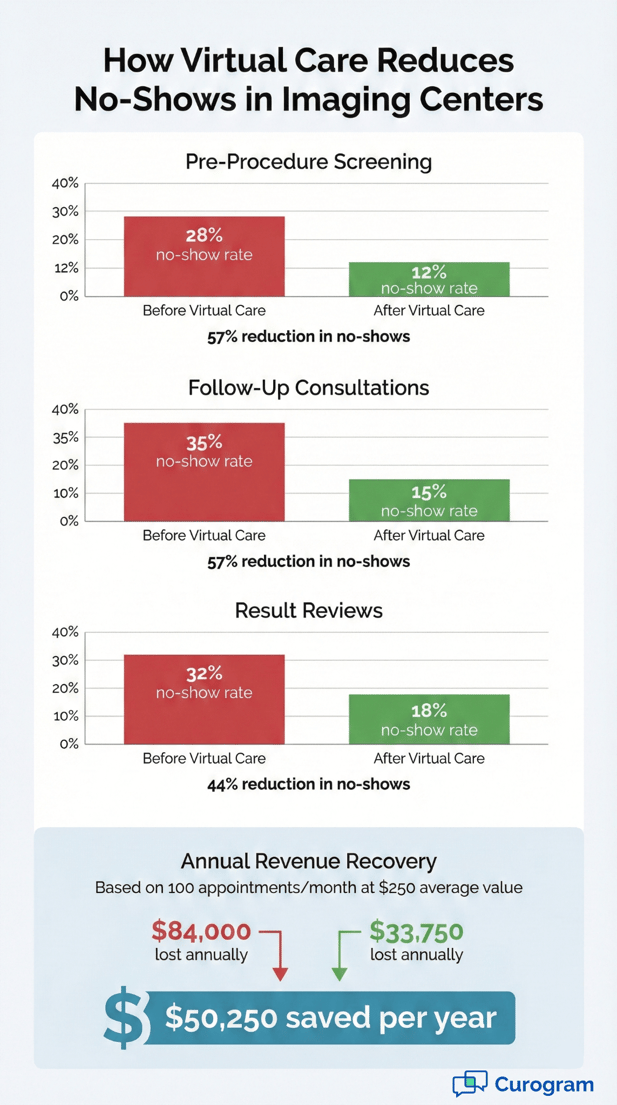
No-shows and prep failures create cascading problems throughout imaging operations. Virtual care tackles these issues by removing access barriers and improving patient education. The result is more reliable scheduling and better exam completion rates.
No-shows cost imaging centers thousands of dollars each month. Empty appointment slots represent lost revenue that can never be recovered. The problem gets worse when patients miss follow-up visits that could have prevented complications.
Transportation issues cause many missed appointments. Patients without reliable cars struggle to reach imaging centers. Public transit doesn't always serve medical facilities well. Ride-sharing costs add up quickly for people on tight budgets.
Telehealth in Veradigm solves this problem by eliminating the need for travel. Patients can attend from home, work, or anywhere with internet access. A smartphone or computer becomes their gateway to care.
This accessibility boost shows immediate results. Imaging centers that offer virtual follow-ups may see attendance rates climb 30-40%. Patients who previously cancelled repeatedly start showing up consistently. The scheduling gaps disappear.
Working adults particularly benefit from virtual options. They can join a follow-up call between meetings. They don't need to request time off or explain absences to employers. The flexibility reduces stress and improves compliance.
Parents with young children face similar challenges. Finding childcare for medical appointments creates significant barriers. Virtual visits let them participate while kids nap or play nearby. This simple change makes follow-up care much more achievable.
Rural patients gain the most dramatic improvement. They might live 50 miles from the nearest imaging center. With telehealth, a two-hour round trip becomes completely unnecessary for routine follow-ups. Virtual care brings services directly to underserved communities.
For imaging centers, fewer no-shows mean more predictable revenue. Schedules fill more reliably. Staff can plan their days with greater confidence. The ripple effects touch every part of operations.
Patient confusion about exam prep causes frequent day-of issues. Someone shows up having eaten breakfast before a fasting scan. Another forgets to remove metal jewelry before an MRI. These mistakes force rescheduling and create workflow chaos.
Written instructions help, but many patients still have questions. They might not understand medical terminology. They worry about specific medications or health conditions. Uncertainty makes them less likely to follow directions correctly.
Visual demonstrations work particularly well over video. Staff can show patients how to drink the contrast solution properly. They can demonstrate breathing techniques for chest imaging. These visual aids improve retention and compliance.
Language barriers also become easier to address. Virtual visits allow interpretation services to join seamlessly. Family members can participate from different locations to help translate. This inclusive approach ensures everyone understands the requirements.
Virtual prep visits give patients a chance to ask questions in real time. A technologist can explain why certain foods interfere with contrast. A nurse can review which medications to continue or pause. This interactive format prevents misunderstandings.
Veradigm virtual consultations make these educational sessions easy to schedule. They slot into existing appointment calendars. Staff can conduct them efficiently without pulling people from other tasks. The time investment pays off in reduced prep failures.
The impact on exam success rates becomes clear quickly. More patients arrive ready to complete their studies. Modality utilization improves across the board.
Staff morale benefits too. Technologists spend less time dealing with unprepared patients. They can focus on delivering quality imaging rather than managing preventable problems. The work becomes more satisfying when workflows run smoothly.
Patients often think of important questions after scheduling their exam. They remember a previous allergic reaction. They wonder if a new medication might interfere. They worry about claustrophobia in the MRI scanner.
Without an easy way to get answers, some patients simply don't show up. They convince themselves the exam isn't safe or necessary. Fear and uncertainty drive them to cancel at the last minute or not show at all.
HIPAA-compliant telemedicine creates a safe channel for these conversations. Patients can schedule a quick virtual check-in when concerns arise. A clinical staff member can address their worries and provide reassurance.
These proactive conversations prevent anxiety-driven cancellations. Patients arrive feeling confident and prepared. They know exactly what to expect. The exam proceeds without emotional or logistical complications.
For complex cases, virtual consultations allow specialists to weigh in remotely. A radiologist can review a patient's history and confirm that the imaging plan makes sense. An anesthesiologist can assess sedation requirements. This expert input happens efficiently without coordinating multiple in-person meetings.
Imaging centers gain operational stability from better patient readiness. They can trust their schedules more completely. Same-day surprises become rare exceptions. Daily workflow becomes more predictable and less stressful.
Some imaging procedures carry serious risks for certain patients. Contrast agents can cause reactions in people with kidney disease. Gadolinium raises concerns for specific neurological conditions. Interventional procedures demand careful cardiac and bleeding risk assessment.
These screenings must happen before exam day to protect patient safety. Waiting until arrival means potential emergencies or forced cancellations. Neither outcome serves patients nor imaging centers well.
Virtual screening visits allow thorough risk evaluation well in advance. Clinicians can review lab results, medication lists, and medical history. They can consult with referring physicians if needed. All of this happens days before the scheduled exam.
When issues emerge, there's time to address them properly. A patient might need different contrast protocols. Another might require cardiac clearance. These adjustments happen smoothly when discovered early.
Telehealth in Veradigm supports this proactive approach perfectly. Risk screenings integrate with order management. Red flags trigger appropriate protocols automatically. Clinical teams stay informed without manual tracking.
Enterprise imaging networks particularly value this systematic approach. They can standardize risk screening across all locations. Every patient receives the same level of safety evaluation. Liability exposure drops while quality metrics improve.
Large radiology networks often struggle with inconsistent workflows between locations. One site might excel at pre-visit communication while another has gaps. These variations create uneven patient experiences and operational inefficiencies.
Veradigm virtual consultations solve this problem through centralization. A single team can handle pre-screening for all locations. They follow identical protocols and use the same documentation standards. Every patient gets the same quality of preparation support.
This standardization improves metrics across the entire network. No-show rates become more uniform. Prep success rates rise at previously struggling sites. Leadership gains clear visibility into performance patterns.
Staff also benefit from shared knowledge and resources. Best practices spread quickly through the centralized team. New protocols roll out simultaneously everywhere. Training becomes more efficient and consistent.
Physical space limits how many patients an imaging center can serve. Adding more modalities requires expensive construction. Hiring more staff for in-person consultations creates ongoing overhead costs.
Virtual care removes these physical constraints. One clinician can conduct twice as many consultations remotely compared to in-person visits. No exam rooms sit idle between appointments. The efficiency gains compound across multiple sites.
As patient volume grows, virtual capacity scales much more easily than physical infrastructure. Networks can serve 20% more patients without expanding facilities. This scalability makes growth more profitable and sustainable.
Radiology data includes some of the most sensitive health information. Images often reveal serious diagnoses. Prep instructions reference private medical conditions. Every communication channel must protect this information completely.
Consumer video apps don't meet healthcare security requirements. They lack proper encryption, audit logging, and access controls. Using them creates serious compliance risks and potential HIPAA violations.
HIPAA-compliant telemedicine through Curogram ensures every virtual visit stays secure. All video streams use end-to-end encryption. Session logs capture every interaction for audit purposes. Enterprise IT teams maintain full visibility and control.
Critical prep instructions must reach patients through protected channels. Details about fasting, medications, and medical history can't travel over unsecured email or text. The risk of data exposure is too high.
Virtual visits provide a secure environment for these conversations. Patients receive instructions directly through encrypted channels. Documentation flows into compliant systems automatically. No information leaks through consumer apps or unprotected platforms.
This security extends across all imaging locations. Multi-site networks maintain consistent compliance standards. Audit teams can verify proper protocols everywhere. Risk management becomes simpler and more reliable.
Day-of cancellations represent one of the costliest problems imaging centers face. A cancelled CT scan worth $600 creates immediate revenue loss. The empty time slot often can't be filled on short notice. These losses multiply across dozens of weekly appointments.
Better pre-procedure screening through telehealth catches issues before patients travel to the facility. Virtual consultations identify medical contraindications days in advance. Staff verify lab results and medication status during video calls. Problems get resolved when there's still time to proceed on schedule.
This increases daily imaging capacity without adding equipment or extending hours. Centers can schedule appointments closer together when they trust patients will arrive ready. A facility might boost CT capacity from 32 to 38 daily patients through improved reliability alone.
Those six additional exams per day can represent $3,000-4,000 in extra revenue. Annually, that's $750,000-1,000,000 from the same equipment and space. Modality utilization climbs from 75% to 90% as prep failures decrease.
Revenue becomes more predictable across high-value modalities like interventional radiology. IR procedures worth $2,000-5,000 each demand rigorous preparation. Virtual pre-procedure consultations ensure every requirement gets met before the scheduled date.
Patients understand post-procedure care expectations clearly. They've confirmed proper medication adjustments. They've completed the necessary lab work. This thoroughness protects the center's most valuable procedures from preventable cancellations.
Telehealth removes friction that undermines throughput throughout the patient journey. Questions get answered immediately during video sessions rather than through phone tag. Prep clarifications happen in real time with visual demonstrations. Follow-up scheduling occurs before patients leave their virtual consultation.
Each removed friction point accelerates patient flow. The time from scheduling to completion may shrink from 12-14 days to 6-8 days. Faster cycles mean higher total volume without capacity expansion.
Telehealth reduces call volume and minimizes manual coordination across all patient touchpoints. Front desk teams at busy centers spend 40-50% of their time on phone coordination. Much of this involves repetitive prep instructions and scheduling confirmations.
Virtual consultations replace these inefficient interactions with structured appointments. Staff deliver information once during scheduled video sessions. Patients receive written summaries they can reference anytime. Phone volume can typically drop 30-40% after implementation.
Fewer in-person check-ins reduce space and staffing requirements throughout the facility. Pre-procedure consultations that previously required exam rooms now happen virtually. Waiting areas handle lower volumes during peak periods. Physical infrastructure supports more imaging capacity.
This efficiency allows centers to serve more patients without expanding facilities. A three-person front desk team might handle 35% more daily volume through better workflows. The labor cost per completed exam decreases significantly.
Virtual follow-ups minimize rescheduling burdens that drain staff productivity. Traditional workflows require extensive coordination when patients miss appointments. Staff must contact patients, notify referring physicians, and update multiple systems. Each cancellation consumes 20-30 minutes of labor.
Telehealth dramatically reduces these disruptions by improving attendance rates. Patients keep virtual follow-up appointments at 90%+ rates versus 60-65% for in-person visits. Lower no-show rates mean less rescheduling work. Staff focus on coordination that adds value rather than fixing avoidable problems.
Enterprise imaging centers gain measurable ROI from streamlined workflows across all locations. Multi-site networks centralize virtual care under standardized processes. One team handles pre-screening for multiple facilities efficiently. This shared resource model amplifies returns as volume grows.
Combined with HIPAA-compliant texting for secure patient communication, virtual care creates a complete digital coordination platform. Centers track ROI through reduced cancellations, higher utilization, and lower administrative costs.
Curogram works within your current Veradigm environment. Virtual appointments appear in the same scheduling system the staff use daily. Patient data flows through familiar documentation pathways. Nothing disrupts established workflows.
Staff adoption happens quickly because the interface feels natural. They don't need extensive training on complicated new software. Virtual visits become just another appointment type rather than a separate system to manage.
This smooth integration minimizes implementation risk. Imaging centers can launch virtual care without operational disruption. Patient experiences improve immediately while staff confidence remains high.
Curogram handles enterprise-scale telehealth demands. The platform supports thousands of virtual visits across multiple imaging sites. Performance stays consistent even during peak scheduling periods.
Multi-location networks benefit from unified processes and reporting. Executives can track virtual visit metrics across the entire organization. They see which sites excel and where improvements are needed.
This enterprise focus means Curogram grows with your network. Adding new locations doesn't require separate implementations. The same platform scales to support expanding operations.
Every Curogram session uses bank-level encryption. Patient data never travels through unsecured channels. All interactions get logged for complete audit trails.
Enterprise IT teams maintain full governance and oversight. They can review access patterns, verify security controls, and generate compliance reports. This transparency reduces regulatory risk significantly.
SOC 2 compliance demonstrates Curogram's commitment to security best practices. Your imaging network can trust the platform to protect sensitive patient information across every virtual interaction.
Telehealth transforms how imaging centers handle patient preparation and follow-up care. Virtual visits remove the barriers that cause no-shows and prep failures. Patients get the support they need without travel or scheduling hassles.
For radiology networks using Veradigm, virtual consultations strengthen workflows across all locations. Pre-procedure screening happens earlier and more thoroughly. Follow-up appointments occur faster with better attendance. High-risk patients receive proper evaluation before exam day.
The operational benefits show up quickly. Fewer cancellations mean better modality utilization. Higher first-time success rates increase daily throughput. Administrative burden drops as processes become more efficient.
Security remains paramount throughout every virtual interaction. HIPAA-compliant telemedicine protects sensitive patient data. Enterprise IT teams maintain full control and audit visibility. Compliance risks decrease while care quality improves.
Curogram delivers all of this within your existing Veradigm environment. The platform integrates smoothly without disrupting current operations. Staff adopt virtual workflows easily. Patients receive secure, accessible care across your entire network.
Multi-location imaging centers gain the most value. Centralized virtual care creates consistent patient experiences everywhere. Resources scale efficiently as volume grows. Leadership gains clear performance visibility across all sites.
The future of radiology includes virtual care as a standard component. Imaging centers that adopt telehealth now position themselves for sustainable growth. They serve more patients, reduce costs, and improve satisfaction scores.
Your network deserves technology that enhances rather than complicates workflows. Telehealth in Veradigm through Curogram delivers exactly that outcome. Better prep, fewer no-shows, stronger compliance, and higher revenue all become achievable.
Book a Demo to See Curogram + Veradigm in Action.
Telehealth removes common barriers that cause patients to miss appointments. They don't need transportation, time off work, or childcare. Virtual visits let patients join from anywhere with internet access. Imaging centers can typically see 30-40% fewer no-shows when they offer virtual options.
Radiology data contains extremely sensitive patient information that needs protection. Consumer video apps lack proper encryption and security controls. Using them creates HIPAA violation risks and potential data breaches. HIPAA-compliant telemedicine ensures every virtual visit stays secure with end-to-end encryption.
Virtual consultations let staff screen high-risk patients days before their exam. Clinicians can review medical history, medications, and lab results remotely. They identify potential issues early when there's time to address them properly. This prevents day-of cancellations from unexpected contraindications.
Virtual care removes physical space constraints that limit patient volume. One clinician can handle twice as many consultations remotely compared to in-person visits. Networks can centralize pre-screening across all locations with standardized protocols. As volume grows, virtual capacity scales much easier than building new facilities.
Virtual prep visits give patients a chance to ask questions in real time. Staff can clarify fasting requirements, medication instructions, and safety protocols. Visual demonstrations over video help patients understand exactly what to expect. Centers typically see fewer prep-related cancellations after implementing virtual consultations.
💡 Knowing how to prepare for a telehealth visit in Athenahealth is key to good virtual care. Both patients and clinics play a role in preventing...
💡 Curogram integrates directly with GE Centricity EMR systems to provide HIPAA-compliant telehealth for specialty and radiology practices without...
💡 Virtual visits in Exa allow secure communication with patients at your convenience. When follow-ups happen only in person, many people skip...