

8 min read

Veradigm Digital Intake | Forms Via Text, No Portal

Veradigm Digital Intake | Forms Via Text, No Portal
💡 Veradigm EHR secure online forms digital intake text link without portal login FollowMyHealth changes how practices collect patient data.       

Curogram sends forms straight to a patient's phone 48 hours before the visit — no app, no account, no portal enrollment.  

Patients tap the link, fill out medical history, insurance, and consent forms in 5–8 minutes, and submit. Data flows into Veradigm before they walk in. 

Check-in drops from 15–20 minutes to 2–3. Manual data entry disappears. The clipboard drawer finally closes.


It's 8:00 AM at your practice. Six patients walk through the door at once.

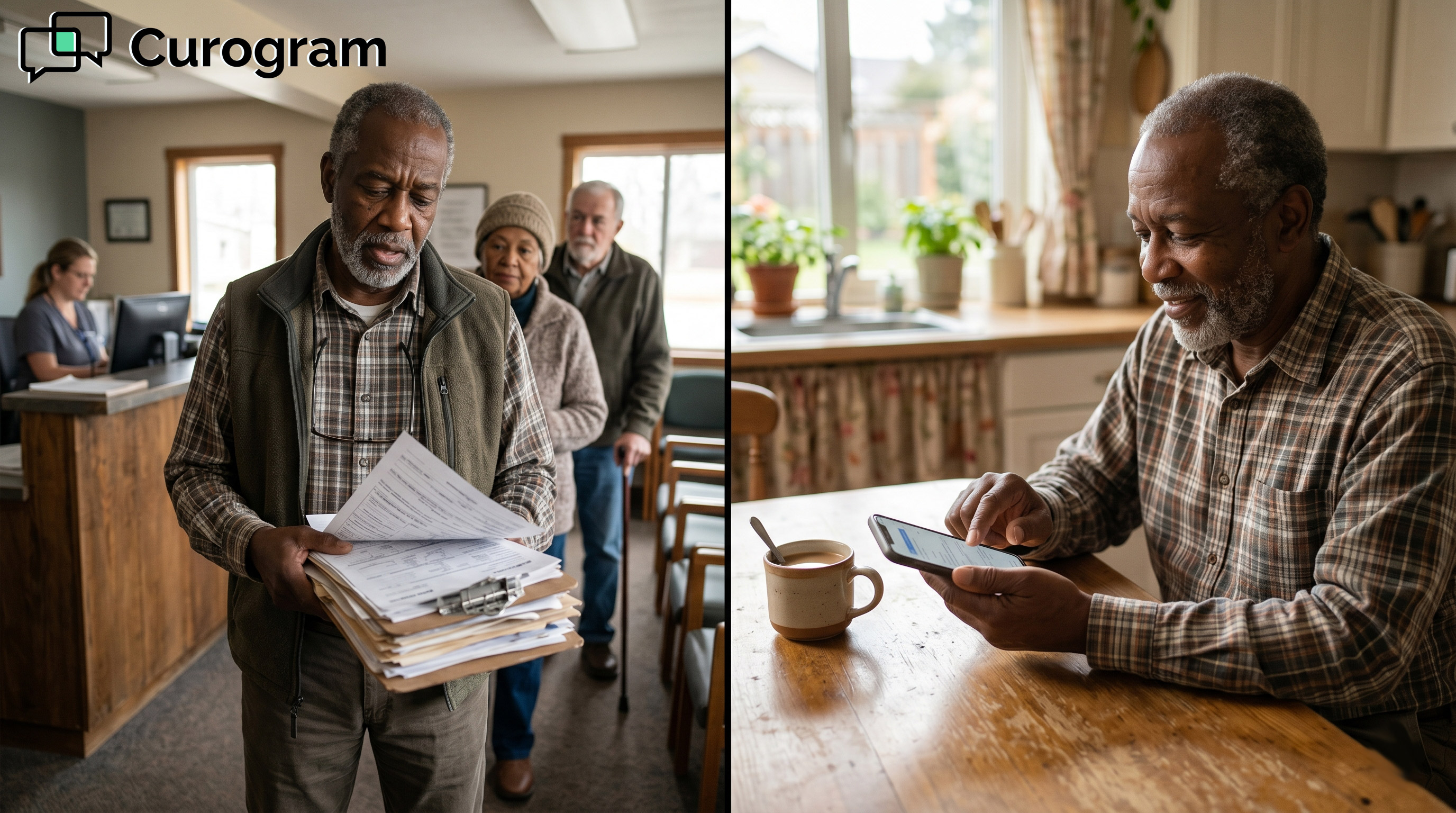
Three are FollowMyHealth users. They're done — forms completed, check-in easy. The other three? They get a clipboard, a pen, and a long wait ahead.

Your front desk manages both groups while the phone rings and the fax hums. The portal users are stuck waiting for the paper users. Your schedule slips before the first provider even opens an exam room.

Here's the quiet truth most practice managers already know.

FollowMyHealth has digital forms. But patients have to log in to complete them. For every patient who never set up a portal account — or a new patient who hasn't even been invited yet — those digital forms might as well not exist.

So the clipboard comes out. Again.

Imagine this:

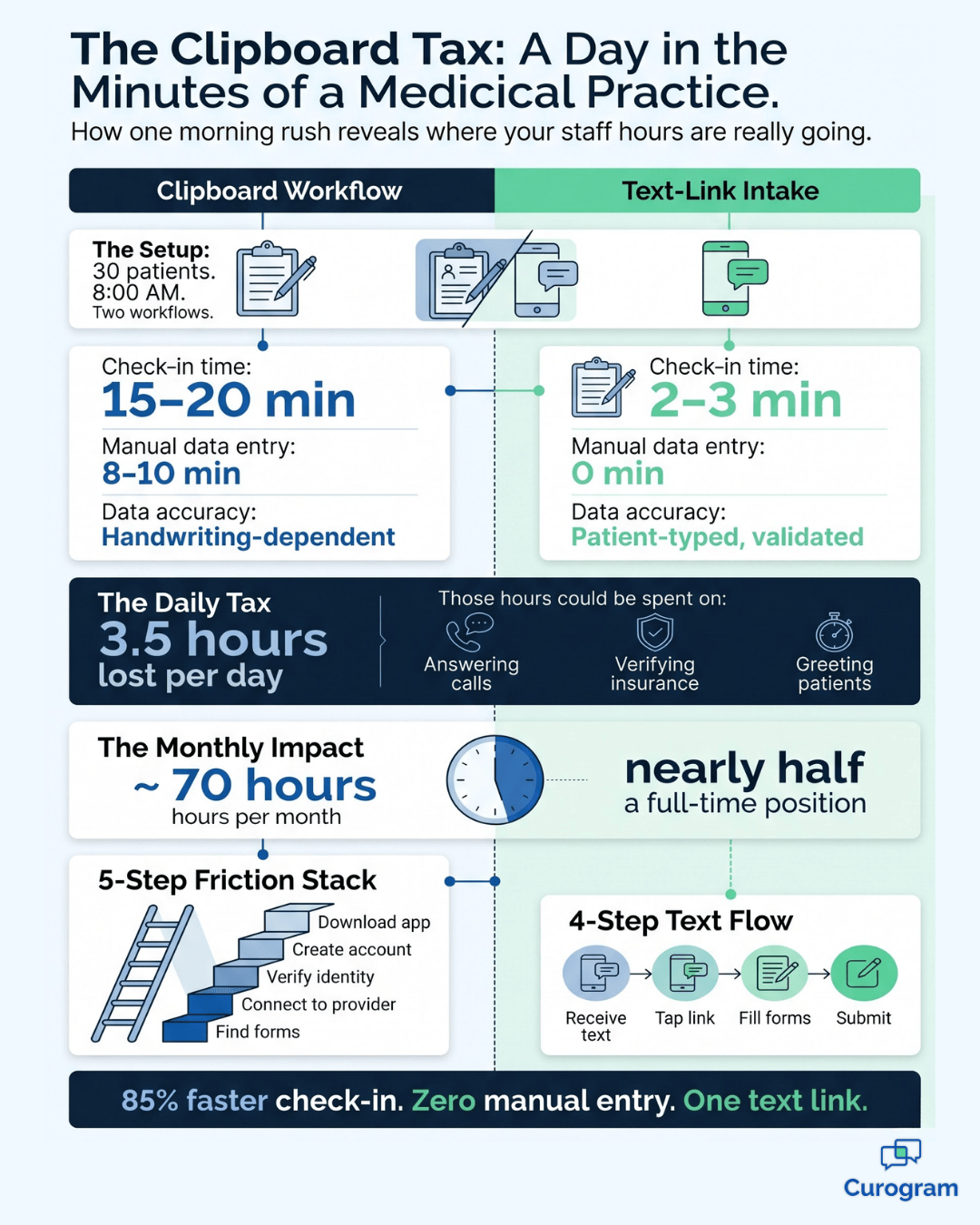
A new patient books a first-time visit with your cardiologist. Your team sends the enrollment email. Download the app. Create a login. Verify your identity. Connect to the provider. Then find the forms. That's six steps before a single question gets answered.

Most patients shrug and say they'll "just fill it out when I get there."

Think about what that costs you. Hours of manual data entry. Transcription errors that follow patients into billing and prescribing. Waiting rooms that jam up the schedule. Staff who should be welcoming patients, not deciphering handwriting.

This isn't a technology problem. It's a delivery problem.

The forms are fine. The path to reach them is broken.

In this guide, you'll see how Veradigm practices are closing that gap with a simple fix: sending intake forms by text link. No portal. No app. Just a tap.

How "The Login Before the Form" Quietly Runs Your Waiting Room

FollowMyHealth is a capable patient portal. It has digital intake. It syncs with Veradigm EHR. On paper, it should have killed the clipboard years ago.

In practice, it hasn't. And the reason is one small word: login.

Every digital form sits behind portal enrollment. For enrolled patients, that's fine. For everyone else — which is most of your schedule — it's a wall.

The New Patient Paradox

A new patient calls to book their first visit. Your front desk sends a FollowMyHealth enrollment invite. The patient opens the email on the way to lunch, sees what's asked of them, and closes the tab.

Here's what they're being asked to do before they've even met your provider:

  • Download the app
  • Create an account and password
  • Verify their identity
  • Connect to the right provider
  • Navigate to the intake forms

On appointment day, they show up 15 minutes early and get handed six pages of forms.

They write for 20 minutes. The digital version existed the whole time. They just couldn't get to it.

This is the paradox. The patients who need forms most — brand-new patients with a full medical history to share — are the ones least likely to have a portal account.

The Manual Entry Tax You're Paying Every Day

Every paper form costs your staff 8–10 minutes of manual data entry. Medical history. Medication lists. Insurance cards. Consent signatures. All typed into Veradigm by hand.

Run the math for a 30-patient day. That's 4–5 hours of staff time vanishing into keystrokes.

Daily Patients Paper Intake % Manual Entry Time Staff Hours Lost
30 60% (18 patients) 9 min per patient ~2.7 hours/day
30 80% (24 patients) 9 min per patient ~3.6 hours/day
50 70% (35 patients) 9 min per patient ~5.25 hours/day

For your team, that's one person doing data entry nearly half the day instead of answering calls, verifying insurance, or greeting patients.

And every transcribed field is an error waiting to happen.

A misread medication. A flipped insurance ID. A wrong dosage that travels into prescribing decisions. The paper clipboard isn't just slow. It's risky.

0 handwriting errors to decode

When patients type their own medical history, medication list, and insurance info, the clipboard-era guesswork disappears. Smart form validation catches mistakes before submission — so your staff sees clean, legible data instead of squinting at cursive at 8:45 AM.

The Check-In Bottleneck

Go back to that 8:00 AM waiting room. Three portal patients are ready. Three paper patients need 15–20 minutes each.

Your front desk runs both workflows at once — while the phones ring and referrals stack up. The portal patients wait anyway, because the paper patients are holding the line.

This isn't a tech gap. It's a portal adoption gap. And it shows up in every location, every morning, at every Veradigm ambulatory practice running the same split workflow.

The Specialty Gap

Multi-specialty practices have it worse.

Cardiology needs pre-procedure risk questions.

Orthopedics needs surgical history and imaging records.

Pediatrics needs immunization and developmental screening. Internal medicine needs full medication reconciliation.

Each specialty needs its own intake set.

Even when a portal supports specialty customization, the patient still has to be enrolled. For a first-time cardiology visit, that's one more barrier on top of an already heavy pre-visit list.

Infographic comparing clipboard vs. text-link intake showing 85% faster check-in for Veradigm practices

The Clipboard Killer: One Text, Every Patient, Every Time

So what does the fix look like? Simple.

Send the form the way patients already communicate — by text.

This is where Allscripts Professional digital intake forms text delivery becomes more than a feature. It becomes a different model for check-in. Curogram sends a HIPAA-compliant link to the patient's phone 48 hours before the visit. They tap it. They fill it out. They submit.

No app. No account. No portal.

How It Works — Tap, Complete, Arrive Ready

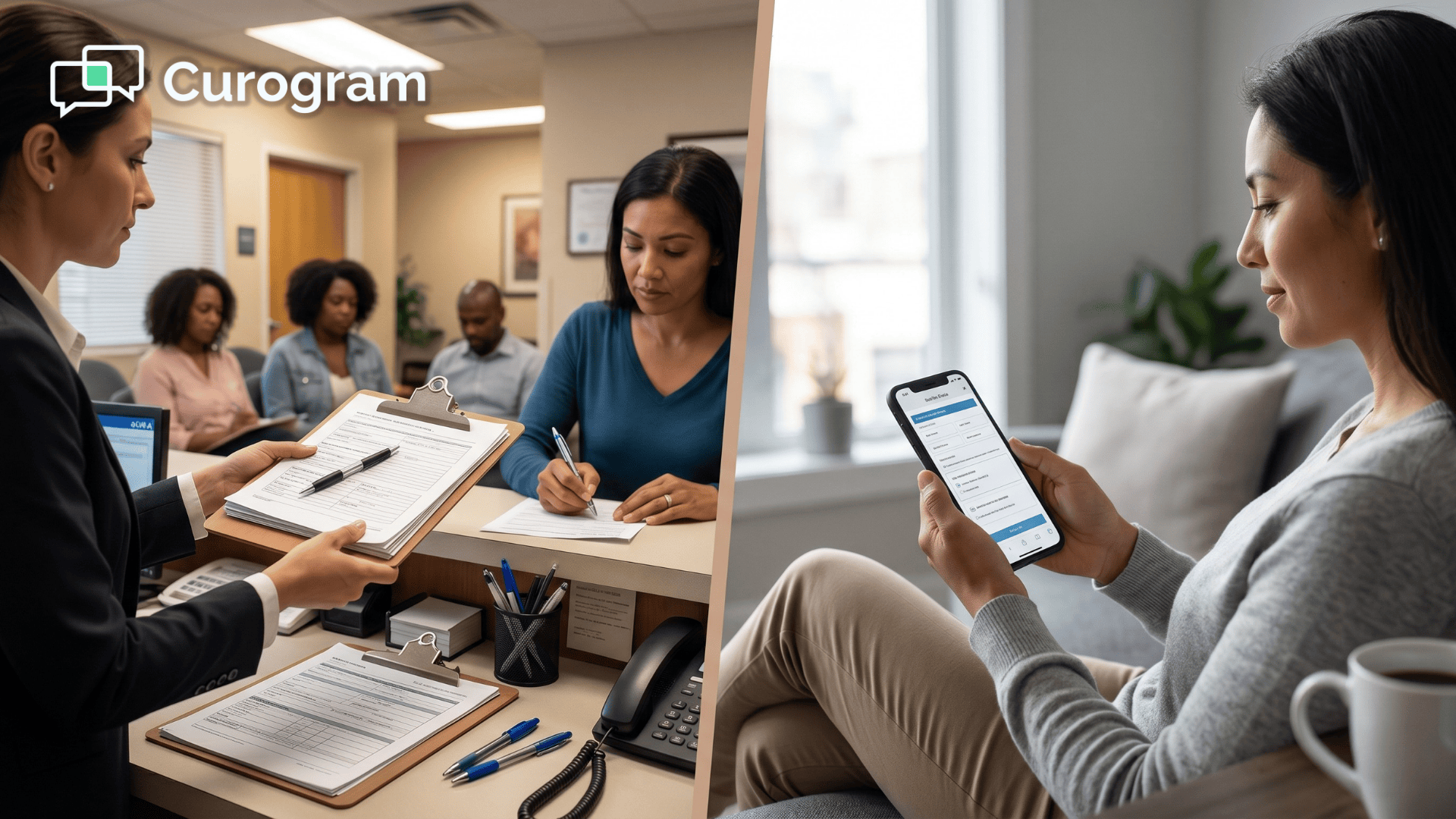
The patient gets a text. They tap the link. Their phone browser opens a mobile-friendly form set — medical history, medications, allergies, insurance, consent, and any specialty questions you need.

They fill it out from the couch, the car, or during lunch. Five to eight minutes. Done.

Smart logic skips questions that don't apply. A wellness visit doesn't ask about surgical history. Insurance cards are captured with the phone camera. Signatures are electronic.

The patient experience is four steps: receive text, tap link, fill forms, submit.

The staff experience is this:

Complete, legible, digital data in Veradigm before the patient walks in.

This is what a FollowMyHealth intake portal alternative text link actually looks like in practice — same clinical data, different delivery.

The Integration with Veradigm EHR

Curogram connects to Veradigm through the open API architecture. Appointment data and patient demographics flow in. Completed intake data flows out to the practice management workflow.

Your dashboard shows completion status for every patient on the schedule — done, pending, or incomplete.

Staff know who's ready and who needs a nudge.

The integration lives in the same App Expo ecosystem that supports Luma Health, Inbox Health, and other Veradigm partners.

No custom IT build. No months of setup. HIPAA compliant intake forms Veradigm ambulatory practice teams can turn on without a six-figure IT project.

Patient checking in at medical practice after completing Veradigm digital intake forms via text link

Built for Multi-Specialty, One Platform

Every specialty gets its own template — delivered through the same text workflow.

  • Cardiology: pre-procedure risk, cardiac history, medications with dosages
  • Orthopedics: surgical history, imaging records, physical therapy notes
  • Pediatrics: immunization records, developmental milestones, school and camp forms
  • Internal medicine: full medication reconciliation, chronic condition tracking, preventive care history

One platform. Every specialty. One text link per patient.

That's what Veradigm patient intake forms no app download actually enables — a single, consistent workflow across cardiology, ortho, peds, and primary care.

What "Arrived. Already Done." Looks Like in Real Numbers

The shift from clipboard to text doesn't just feel faster. It shows up in the numbers.

The Metrics That Move

Practices using text-delivered digital intake see check-in time drop from 15–20 minutes to 2–3 minutes.

85% faster check-in

That's the drop per patient when forms arrive by text instead of clipboard — from 15–20 minutes down to 2–3. It's the difference between a jammed waiting room at 8:00 AM and a schedule that actually starts on time.

That speed ripples through the rest of your morning.

When check-in collapses from 15–20 minutes to 2–3, a few things change at once:

  • Providers start on time instead of 20 minutes behind
  • Waiting rooms stop getting crowded at peak hours
  • Front desk staff stop firefighting and start verifying

For a 30-patient day with 70% paper intake, that's about 3.5 FTE hours returned to your team every single day. Over a month, that's roughly 70 hours — nearly half a full-time position freed from data entry.

In practice, this means your front desk stops being a transcription service and starts being a patient welcome hub.

The Shift from Clipboard to Command

Check-in becomes a verification, not a collection. "We have your information, here's your co-pay, the doctor will see you shortly." That's it.

Staff time moves from typing to patient experience, insurance verification, and care coordination. The work that actually moves the needle on satisfaction and revenue.

This is what digital patient registration Veradigm EHR text-first workflows deliver — not incremental improvement, but a different front desk role entirely.

A Tuesday Morning, Reimagined

Tuesday, 8:00 AM. Multi-location Veradigm practice. 42 patients on the schedule.

Fourteen are FollowMyHealth users. Forms done through the portal. The other 28 got a Curogram text link 48 hours ago. Twenty-four completed their forms before arriving. Four are still pending — those get a reminder text or finish on their phone in the waiting room.

Your front desk preps for 4 clipboard patients instead of 28. Check-in flows. Providers start on time. Every chart has complete, legible data.

The clipboard drawer stays closed. That's the whole goal.

This is the outcome of solving the FollowMyHealth form completion barrier text solution — not by replacing the portal, but by filling the gap it leaves behind.

Ready to Close Your Clipboard Drawer for Good?

Here's the truth about intake in 2026. FollowMyHealth works — for patients who log in. Curogram handles everyone else. Together, they cover 100% of your schedule.

The math is straightforward. If 60–80% of your patients are still filling out paper forms, your front desk is losing 3–5 hours a day to manual entry. That's 60–100 hours a month. That's a staffing problem you're solving with overtime and frustration instead of automation.

Veradigm EHR handles clinical documentation. FollowMyHealth digitizes intake for enrolled patients. Curogram reaches everyone else — through the one channel every patient already uses without thinking. Text.

No downloads. No logins. No training sessions for patients. Just a link they tap.

So ask yourself:

How many clipboards did your front desk hand out this morning? How many minutes did each one cost? How many errors slipped through?

If those numbers sting, you're not alone.

Most Veradigm ambulatory practices are running the same split workflow — and most of them are ready to close the gap.

Schedule a Demo with Curogram. Bring your current check-in time data and your portal enrollment rate. We'll show you exactly how many hours your team gets back when every patient — enrolled or not — arrives with forms already done.


Frequently Asked Questions

Can patients really complete complex specialty forms on a phone?

Yes. Curogram's form builder is built for mobile from the start. Layouts are responsive, fields auto-adjust, and smart logic skips sections that don't apply. Even a full cardiology pre-procedure set or a pediatric intake with immunization history is completable in 5–8 minutes on a smartphone. Insurance cards are captured with the phone camera. Signatures are electronic. No pinching, zooming, or squinting required.

Does the form data flow into Veradigm EHR, or do we still enter it manually?

It flows in automatically. Curogram connects to Veradigm through the open API, so completed form data moves into your practice management workflow without staff retyping anything. Your team sees the same data the patient entered — no scanning, no handwriting to decode, no double entry. The goal is zero manual transcription, and that's what the integration delivers.

What happens if a patient doesn't complete forms before arrival?

Your dashboard shows real-time completion status for every patient on the schedule. Patients who haven't finished get an automated reminder text. If they still arrive without completing the forms, they can finish on their phone in the waiting room using the same link. It's still faster and more accurate than a clipboard. Staff see at a glance who needs attention and who's ready to be roomed.

Is text-link intake HIPAA compliant?

Yes. Curogram is built as a HIPAA-compliant platform, and the text-link intake workflow is designed to protect patient data from send to submission. The link opens a secure, encrypted mobile form — not an SMS that contains health information. Signed BAAs, audit trails, and role-based access controls are standard. Your practice gets the convenience of text delivery without the compliance risk of open messaging.

Do patients need to create an account or download anything to use the text link?

No. That's the whole point. The patient gets a text, taps the link, and the form opens in their phone's browser. No app download, no account creation, no password, no portal enrollment. This is what makes text-link intake work for the 60–80% of patients who never set up FollowMyHealth — they get a digital experience without the login barrier that kept them on paper.