
Staff Burnout & Reputation | The Review Request
 Aubreigh Lee Daculug : Apr 24, 2026, 2:00:00 PM
How Veradigm & Curogram empower front desk staff to generate Google reviews without asking. 1,064 new 5-star reviews in 3 months.

Picture this. A patient just left your office. She felt heard by your clinician, got her questions answered, and walked out with a treatment plan that made sense. She liked you. She'd recommend you to her sister.
Will she leave a Google review?
Almost certainly not.
She has errands. A meeting at 3. Kids to pick up. By the time she remembers her appointment, she's already thinking about dinner. Your name fades.
The moment passes. Her five-star experience vanishes into the quiet space where most positive reviews go to die.
Now picture another patient.
He waited 40 minutes past his appointment time. The front desk was short with him. He's annoyed, and he's motivated. He pulls out his phone in the parking lot, searches your practice, and leaves a 2-star review before he even starts the car.
See the problem?
The loudest voices online are almost never a fair reflection of your actual care. Happy patients drift away. Frustrated ones take action. Over time, your Google Business Profile becomes a microphone for complaints, not a reflection of reality.
This is why so many high-performing practices have average ratings that look mediocre. It's not that the care is bad. It's that the feedback loop is broken.
If you're running a Veradigm EHR patient experience Google review post-visit text strategy (or thinking about starting one), you already sense what's missing.
Clinical excellence doesn't automatically translate to online visibility. You need a way to reach the silent majority, at the exact moment they're most likely to say yes.
That moment is short. And if you miss it, you lose it.
Your last 50 patients probably had a good experience. Maybe 45 of them would rate you highly if asked. But almost none of them will go home, open Google, search your practice name, and write about their visit.
That friction is enormous for someone with nothing to complain about.
Reviews take effort Effort requires motivation. And satisfied patients have very little of it.
98% |
| Of happy patients leave without reviewing. For every 50 visits, roughly 1 frustrated patient takes the time to write a review — while the 49 satisfied ones move on with their day. |
A bad experience creates urgency. Patients who feel wronged remember your practice name, search it on Google, scroll past every other result, and type a detailed review.
That 1 angry patient out of 50 visits becomes visible. The other 49? Invisible.
This is the asymmetry that quietly damages your practice.
New patients start their search on Google. Before they ever call your office or check your website, they're forming an opinion from a handful of strangers' words.
Here's what they're actually scanning:
If your profile shows a 3.8-star average and the recent reviews mention billing or wait times, they move on. They're not seeing your real patient experience — they're seeing a skewed sample that represents maybe 2% of your actual visits.
A practice with 1,200 visits per month can lose roughly 16 potential new patients each month just from an unfair review profile.
Over a year, that's nearly 200 patients who chose someone else based on what they saw online.
Here's the part that stings.
Most happy patients assume reviews are for extreme cases only.
They think you don't need one from them.
They'd gladly leave feedback if asked directly, at the right moment, in the right way.
Nobody's asking.
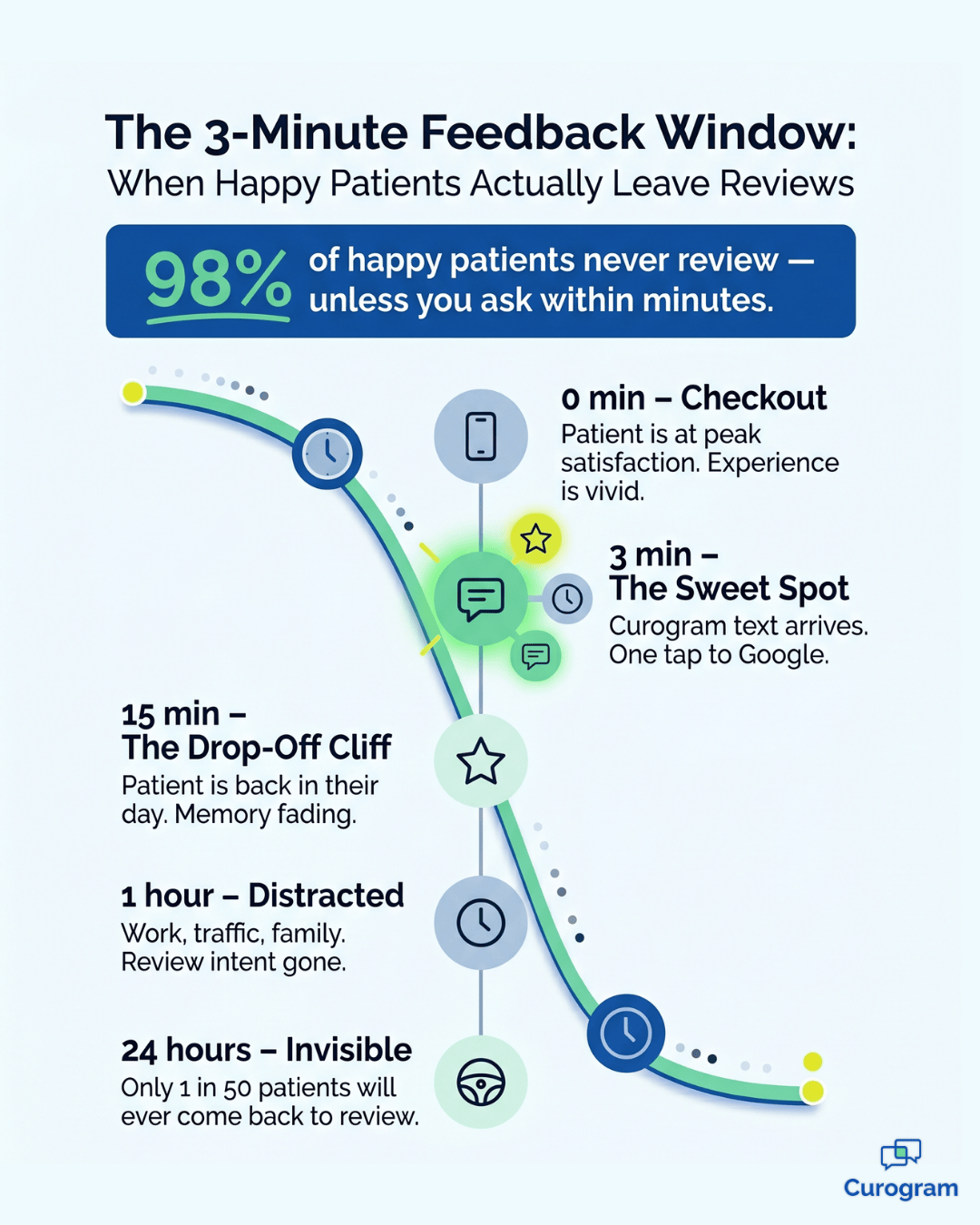
Curogram is built to capture feedback at the exact moment it's most honest and most positive:
Right after the visit. Instead of hoping patients remember, it meets them on their phone before they've even left the parking lot.
This is what the post-visit review text message medical practice workflow was designed for. Minimal friction, maximum timing.
30 seconds |
| Is all it takes for a patient to leave a review. One tap on a branded text opens their Google review page directly — no app, no login, no password reset. |
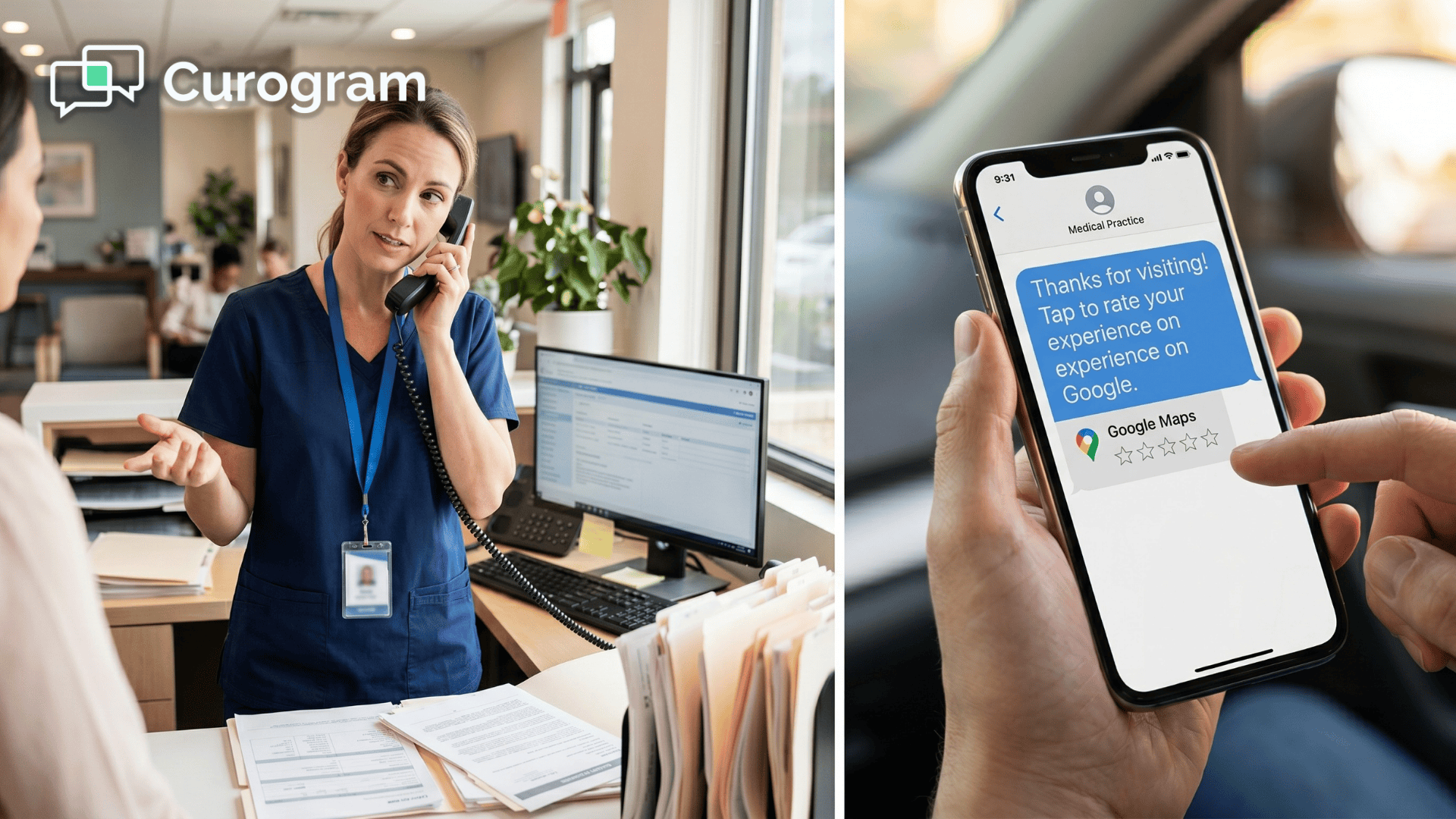
A patient checks out. Within minutes, they get a short, branded text.
Something like:
"Thanks for visiting [Practice Name]! Mind sharing a quick review on Google? It takes about 30 seconds."
One tap opens their Google review page.
Here's what's intentionally missing from the experience:
The message is simple, your practice name is visible, and the link goes straight to the one place that matters for your visibility: your Google Business Profile.

Curogram reads the discharge timestamp from your Veradigm system and triggers the text automatically. The Allscripts patient review experience automated workflow is the same — Curogram handles both seamlessly since they share the same underlying platform.
Your clinical team changes nothing. Your front desk changes nothing. The automation handles everything from discharge to text to review submission.
This matters because practices already using FollowMyHealth often wonder if adding Curogram creates overlap. It doesn't.

Think of it as a FollowMyHealth patient feedback alternative for public reviews — while FollowMyHealth handles secure, private messaging, Curogram focuses on public reputation building.
They complement each other cleanly.
Primary care, pediatrics, surgical centers, urgent care, specialists — all benefit.
50–100 reviews/month |
| Is what high-volume practices regularly capture after turning on post-visit prompts. Compare that to the 1–2 spontaneous reviews most practices see in the same timeframe. |
The reason is simple:
Timing beats channel. Patients are most willing to estimo
Before traffic, work emails, or the dinner rush pulls their attention elsewhere.
One multi-location practice using Curogram for Veradigm patient satisfaction Google Business Profile management went from about 993 total reviews (accumulated slowly over years) to 8,159 total reviews.
The jump came from just 3 months of post-visit text prompts.
That's roughly 354 new reviews per month. Around 12 per day across their locations. All from patients who were always happy — they just finally had a way to say so.
The practice's average rating climbed visibly, and Google's algorithm noticed almost immediately.
Once the profile started checking more boxes the algorithm cares about, visibility compounded on its own:
More visibility led to more clicks. More clicks led to more bookings.
Prospects searching for a provider saw dozens of fresh, positive experiences instead of a few old complaints. The profile finally told the true story.
This is the key insight. The practice didn't hire better doctors or rebuild their intake process. They just gave happy patients a way to be heard.
The patient review automation text message healthcare approach made existing excellence visible.
For your team, this is the lowest-effort, highest-yield reputation strategy available. You're not asking clinicians to do more. You're just closing a feedback loop that was always leaking.
Your Veradigm EHR already runs your clinical care at a high level. But clinical excellence doesn't defend your online reputation on its own. That requires asking — at the right time, in the right way, with almost zero patient effort.
Curogram is that ask, automated.
Here's what changes when you turn it on. Your happy patients finally get a moment to speak up.
Your Google Business Profile starts reflecting the quality of your day-to-day care. Your new patient pipeline stops leaking to competitors with better review averages. And your front desk does nothing extra — the automation runs quietly in the background.
The math is hard to ignore. Capturing even 30 additional reviews per month means roughly 360 per year.
If your current average sits at 4.0 stars and climbs to 4.7, you become the obvious choice in local search. Every new patient you gain from better visibility is revenue your team already earned but never captured.
Think of it this way. You're not building a new reputation. You're finally letting your real one show up.
Schedule a Demo with Curogram to see exactly how a Veradigm patient visit triggers a review text message in real time. You'll watch the one-click flow from the patient's side, see the integration work live, and understand how practices are adding 30 to 100 new 5-star reviews every month — without adding a single task to your staff.
 Aubreigh Lee Daculug : Apr 24, 2026, 2:00:00 PM
How Veradigm & Curogram empower front desk staff to generate Google reviews without asking. 1,064 new 5-star reviews in 3 months.
 Aubreigh Lee Daculug : Mar 18, 2026, 12:00:00 PM
Staff at rural Azalea Health clinics automate Google review requests via text after every visit. No awkward asks. Reviews flow in on autopilot.
 Aubreigh Lee Daculug : Apr 16, 2026, 3:00:01 PM
Satisfied imaging patients rarely leave reviews. Text-based feedback capture boosts positive reviews and strengthens your imaging center’s reputation.