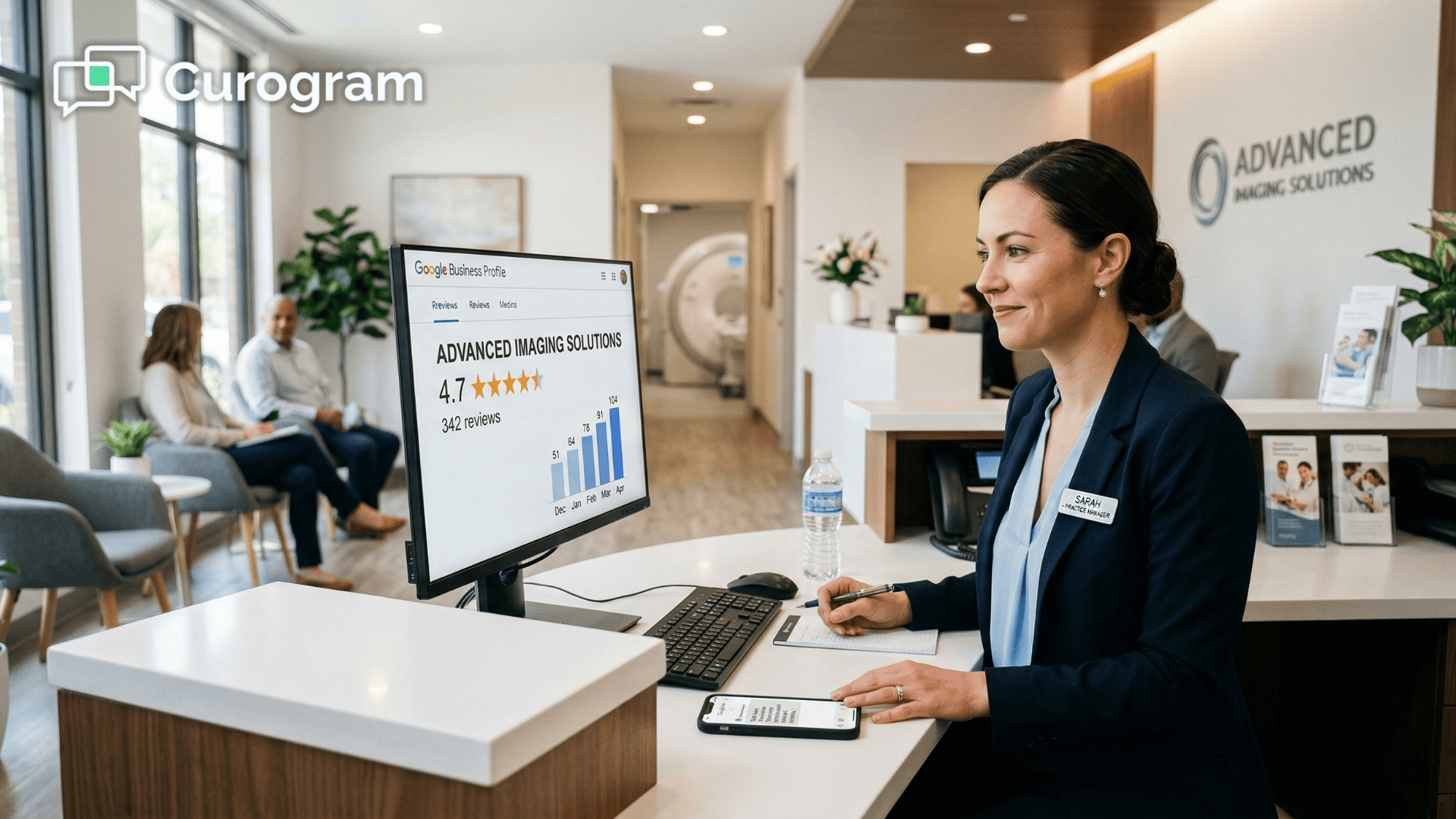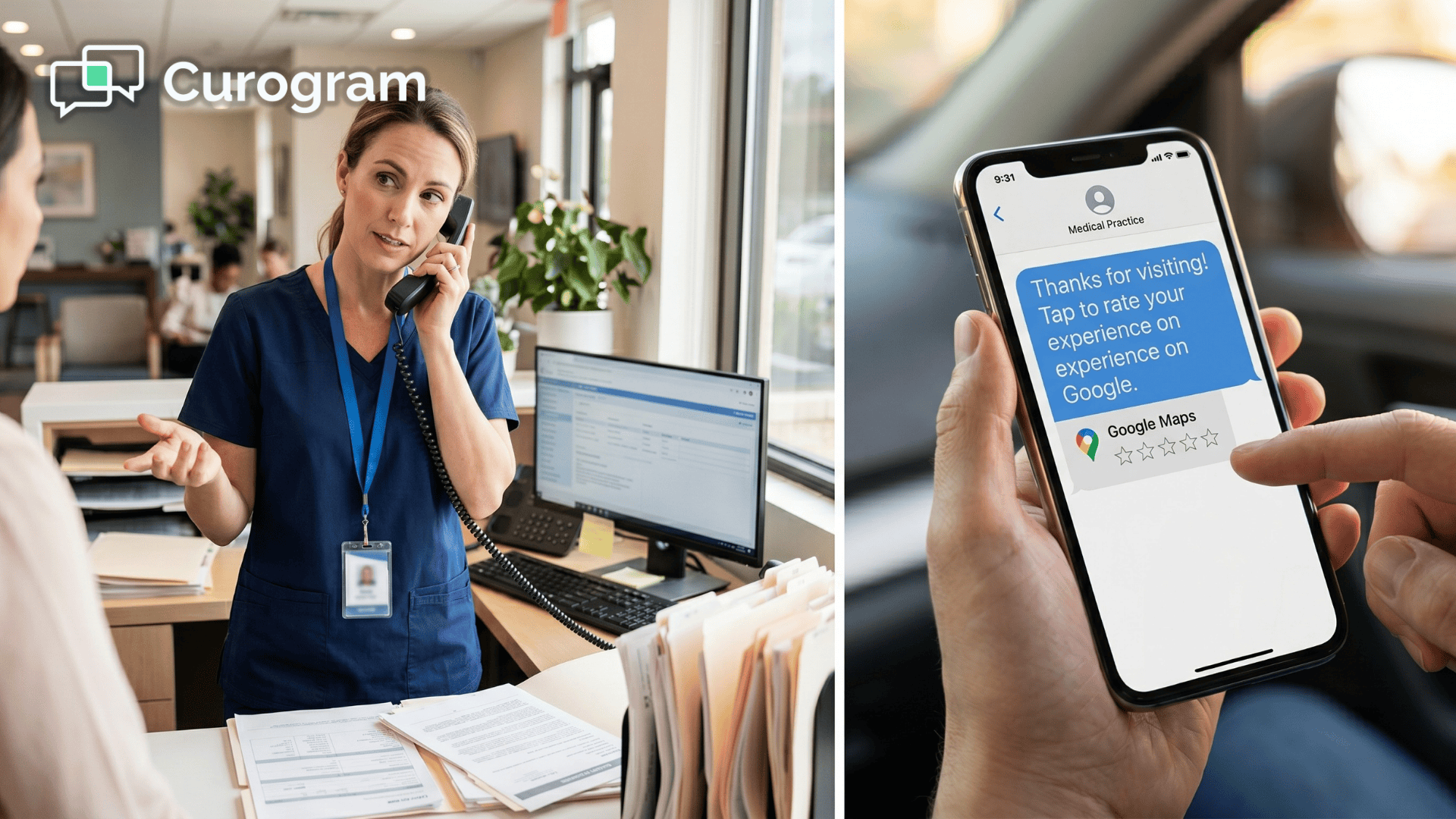

💡 A Veradigm EHR staff automated review request workflow removes the manual burden of asking every patient for a Google review.           

Front desk teams are already stretched thin with checkout, insurance, and scheduling tasks.    

Curogram integrates directly with Veradigm to send a post-visit text that prompts patients to leave feedback on Google Business Profile. No cards, no reminders, no extra work for staff.    

The result for one multi-location practice: 1,064 new 5-star reviews in 3 months, plus hours returned to the front desk each week.


Think about the last time your front desk staff had a calm moment. You probably can't.

Between checking patients in, verifying insurance, answering the phone, and scheduling follow-ups, the idea of pausing to ask, "Hey, would you mind leaving us a Google review?" feels almost comical.

So it doesn't happen. Not consistently, anyway.

Meanwhile, your happy patients walk out the door and go on with their day.

They don't think about reviews. They felt good about their visit, and that's the end of it. The only patients who do think about reviews are the ones who had a bad experience. They'll find your Google Business Profile on their own time.

That's the quiet problem sitting inside most multi-location practices.

Your online reputation is shaped by a vocal minority because the silent majority never gets asked.

Veradigm EHR handles your clinical workflows beautifully. It was built for charting, orders, and documentation, not for reputation management.

There's no built-in feature to automatically request Google reviews, and no one expects there to be. But that gap creates a real business problem. About 90% of new patients start their search on Google, and what they see on your profile often doesn't reflect the actual quality of care you deliver.

This is where the conversation about a Veradigm EHR staff automated review request workflow Google becomes urgent.

The goal isn't to add another task to your front desk. It's to remove one.

Curogram sits alongside Veradigm and turns review generation into a background process, so your team keeps doing what they do best while your reputation catches up to your care.

The Hidden Cost of Asking Staff to Do One More Thing

Here's the scene. A patient finishes their appointment and walks to the front desk. Your team member is already juggling a copay, a rescheduled follow-up, and a ringing phone.

Somewhere in that chaos, they're supposed to remember to ask for a review.

Maybe they hand out a card with a QR code.

Maybe they send a manual email later that day.

Maybe they simply forget, because they're human and they've done this checkout thirty times already before lunch.

None of these methods scale. Cards get tossed or lost in a coat pocket. Manual emails get buried, with around 70% never opened at all.

And across multiple locations, the pattern drifts. One manager pushes hard on reviews, another doesn't, and your Google Business Profiles end up looking wildly different from site to site.

Why the Ask Rarely Lands

The ask itself isn't the issue. The timing is.

By the time a patient gets home, the visit is no longer top of mind. Life takes over.

Even the most satisfied patient is unlikely to log into Google later that evening to write a thoughtful review of a routine appointment. That window of warmth closes fast, usually within the first hour after discharge.

Front desk review solicitation automation exists precisely because humans can't hit that window reliably.

A person can, on a good day, remember to ask maybe half the patients who check out.

A system, once configured, asks every single one of them, every single time, within minutes of the visit ending.

The Multi-Location Drift Problem

Let's put some numbers on this. Say you run three locations, each seeing 40 patients a day. That's 120 patients walking out your doors daily across the practice.

In a manual setup, your team might request reviews from roughly a third of those patients on a good day.

Of the ones asked, maybe 10% to 15% actually follow through and post. The math lands somewhere around 4 or 5 reviews captured per day across all three sites combined.

But the real issue isn't the total. It's the imbalance. One site pulls ahead because a manager pushes hard on the ask. Another site barely moves because the team is short-staffed that week.

Over a month, your Google Business Profiles start telling three different stories about the same practice.

Potential patients notice. They draw conclusions about each location's quality that have nothing to do with actual care. This means your reputation isn't reflecting reality.

It's reflecting which manager remembered to nag their staff hardest.

Why Your Current Reputation Strategy Keeps Falling Short

Most Allscripts Professional front desk review requests strategies run on willpower. Ask harder. Remind the team. Put up a sign. Print a new flyer.

None of it addresses the real issue, which is that manual review generation is fundamentally at odds with how a busy front desk actually works.

When you trace the failure points, they fall into a few predictable patterns:

  • Competing priorities at checkout: the phone, copays, and scheduling always win over a review ask.
  • Memory-based systems: if the ask depends on staff remembering, it gets dropped on busy days.
  • Inconsistent cross-location enforcement: policies drift the moment a manager looks away.

The staff aren't lazy. They're overloaded.

When you tell a receptionist that reviews are a priority, you're layering a new responsibility on top of twelve existing ones.

The first time a phone rings during checkout, the review ask disappears. It has to, because the phone is louder than the policy.

Then there's the guilt loop. Staff feel bad they aren't asking. Management feels frustrated that counts are low. Everyone knows reviews matter for medical practice staff review management Veradigm users, but no one has the bandwidth to fix it at the workflow level.

So the problem calcifies.

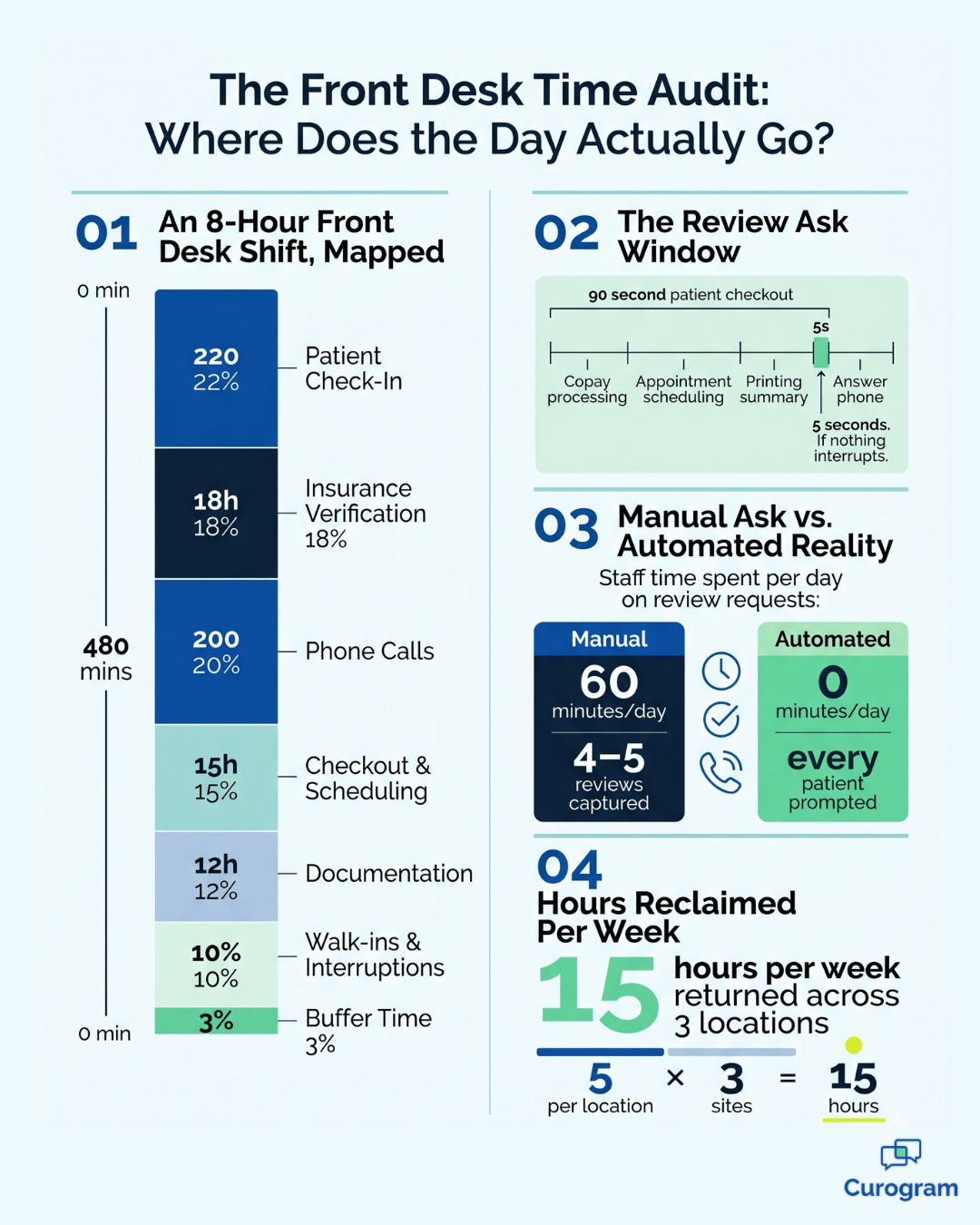
Infographic showing front desk time audit and hours reclaimed with Curogram automated review workflow

The Channel Problem

Email is often the default fallback, and it doesn't work well here.

Email open rates for healthcare messages hover around 20% to 30%.

Add the extra friction of clicking a link, navigating to Google, and signing in, and your conversion from email to posted review drops to near zero.

Text is different. SMS open rates sit around 98%, and most messages are read within 3 minutes.

When a Veradigm practice Google reviews staff burden finally gets addressed through text rather than email, the numbers shift dramatically.

You're meeting patients on the channel they actually use, at the moment they're most willing to engage.

The Timing Problem

Even good outreach fails if it arrives too late. A review request sent the next day competes with everything else in a patient's inbox. A review request sent three days later feels like homework.

The window that matters is the first 60 minutes after checkout, while the visit is still emotionally fresh. Hitting that window manually is nearly impossible. Hitting it automatically is trivial, if the system is wired correctly.

How an Automated Post-Visit Review Engine Changes the Math

This is where an automated patient review workflow EHR integration does real work. Instead of asking staff to remember, you let the EHR do the remembering.

Curogram connects to Veradigm and watches for the discharge event.

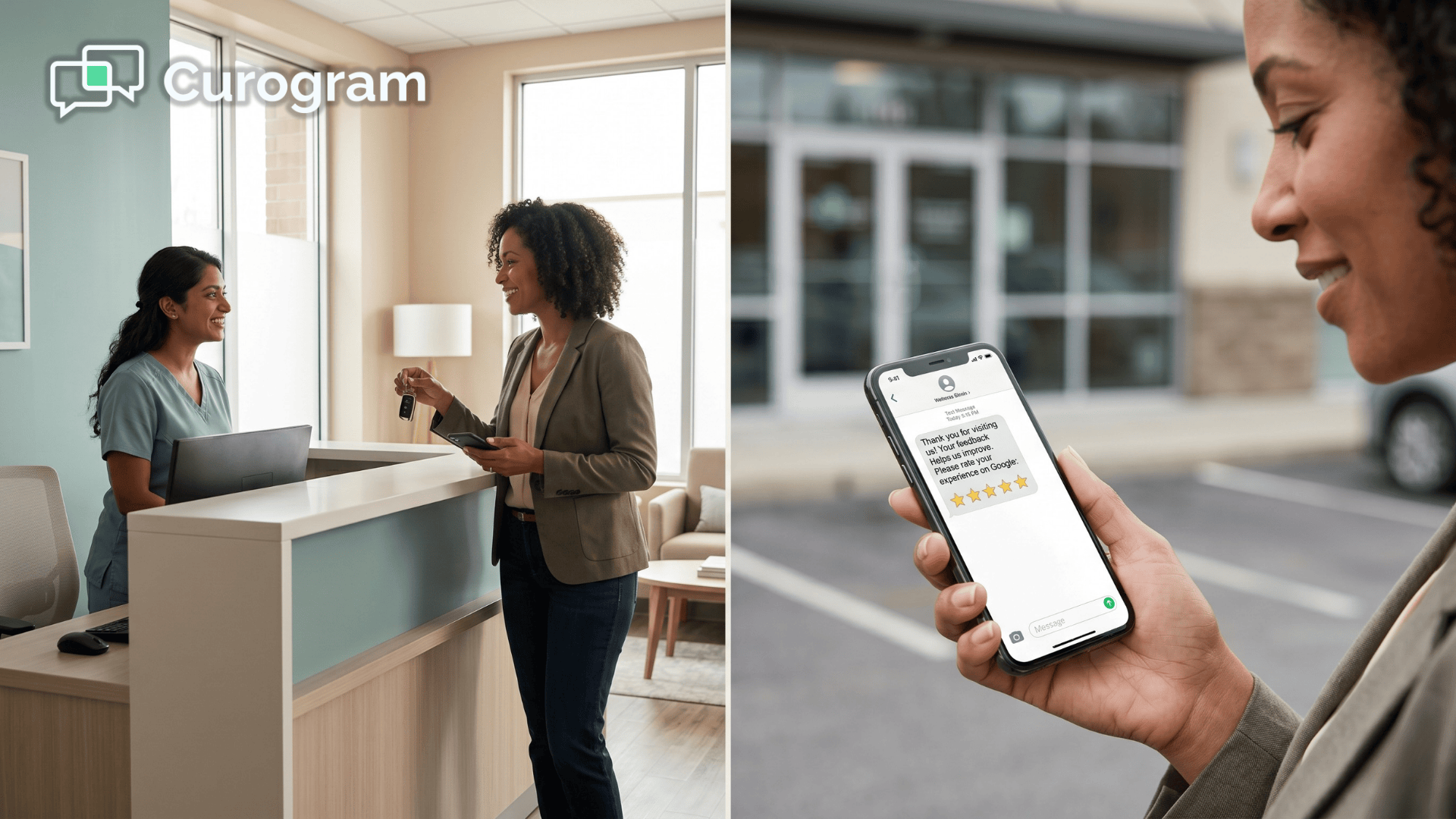
When a patient is checked out in Veradigm, Curogram receives that signal and triggers a branded text message to the patient within minutes.

The text is short, warm, and contains a one-tap link to your Google Business Profile review form.

The patient taps. They rate their visit. The review posts. Your staff does nothing different than they did yesterday.

Patient checking out at medical practice front desk while receiving automated review request text

What the Workflow Looks Like in Practice

Here's the simple version.

A patient completes their visit and gets marked as discharged in Veradigm. Curogram reads that discharge timestamp, identifies the correct location, and sends a personalized text to the patient within 5 to 10 minutes.

The patient taps the link and leaves a review on your Google Business Profile. If they don't respond, no follow-up spam is sent. If they opt out, they never receive another request.

That's the whole workflow. No cards, no apps to download, no staff training beyond a brief orientation.

The feedback loop runs quietly in the background, and Veradigm remains your clinical system of record.

Why Text Beats Every Other Channel

The gap between SMS and email performance isn't small. It's enormous.

Channel Open Rate Typical Response Window Review Conversion
Email 20%–30% 24+ hours Very low
Printed card Varies wildly Days to weeks Near zero
SMS (automated post-visit) ~98% Under 3 minutes Meaningfully higher

In practice, this means you're no longer fighting for attention. You're arriving at the exact moment your patient is most likely to act, through the channel they check most often.

Multiply that advantage across hundreds of visits a week, and the review count moves quickly.

Built for Multi-Location Realities

Multi-location practices get an extra benefit. Curogram can route each patient to the correct Google Business Profile based on the Veradigm location they visited.

Appear at the top of Google. Automate 5-star reviews and build a pervasive online reputation today with Curogram.  

A patient at Site A gets a link to Site A's profile.

A patient at Site C gets Site C's. Reviews land where they should, and no location gets starved of feedback because a manager forgot to push the policy.

That consistency is quietly powerful. Every location runs the same protocol without any of them having to remember it.

Happens When the System Does the Asking

Numbers tell this story better than adjectives. One multi-location practice that deployed Curogram alongside Veradigm went from roughly 993 total reviews across all sites, many old and some negative, to 8,159 total reviews within a few months.

The breakdown is what matters. In the first 3 months alone, they added 1,064 new 5-star reviews. That's not a slow drip.

That's an average of more than 350 new 5-star reviews per month, with zero additional effort from the front desk.

What the Numbers Mean for Your Team

Let's translate this into something tangible. If your front desk previously spent even 30 seconds per patient asking about reviews, across 120 patients a day that's an hour of staff time daily.

Automate that ask and you're reclaiming roughly 5 hours of front desk capacity per week, per location. Across 3 sites, that's 15 hours a week back in the practice's pocket.

For your team, that time goes back into patient care, phone coverage, and collections, the things staff actually should be doing.

For your reputation, the shift is just as meaningful. A consistent stream of recent 5-star reviews pushes your Google Business Profile higher in local search rankings. New patients searching for providers in your area see fresh, positive feedback at the top of the results.

That translates into more patient inquiries without a dollar spent on paid advertising.

From Manual Burden to Passive Revenue

The most underrated outcome is cultural. Staff stop feeling guilty about review counts. Managers stop nagging. Reviews stop being a topic in weekly meetings because they simply happen.

Reputation quietly becomes a background asset rather than a recurring fire drill. Your team gets credit for delivering great care, and the system gets credit for remembering to ask. That's the division of labor that actually works in a busy practice.

Ready to Let Your Reputation Catch Up to Your Care?

Your Veradigm EHR was built for clinical excellence. It handles charting, orders, and documentation with precision. What it wasn't designed for is reputation building, and that's not a flaw. It's just a gap, and gaps can be filled.

Curogram fills that gap without touching your clinical workflow. Patients still check in the way they always have.

Your providers still chart in Veradigm. Your front desk still runs checkout the same way they ran it yesterday.

The only difference is that your Google Business Profile quietly fills up with recent, positive reviews from the patients who already love your practice.

That shift is not cosmetic. It's operational. Every new 5-star review pushes your practice higher in local search, increases the trust of potential patients browsing your profile, and compounds over time.

One practice saw 1,064 new 5-star reviews in 3 months. Another could be yours in the next quarter if the workflow is wired correctly.

And the best part is what your staff won't notice.

No new task. No new login. No new reminder.

Just a review count that climbs week after week without anyone having to chase it.

Schedule a Demo with Curogram and walk through a live example of a patient visit flowing from Veradigm discharge to a posted Google review. You'll see exactly how your team's 


Frequently Asked Questions

Do patients feel spammed if they get a text asking for a review?

No. The text arrives right after their visit, while the experience is still fresh in their mind, and it's a single message rather than a follow-up sequence. Patients who had a good visit are usually happy to leave feedback when it only takes one tap. About 98% of text messages are opened and read within 3 minutes, so you're reaching patients at the moment they're most willing to engage. If a patient opts out, Curogram respects that choice and never sends again.

Does Curogram's review text comply with HIPAA and TCPA?

Yes. Curogram includes clear opt-in and opt-out mechanisms that align with TCPA regulations, and all text communication follows HIPAA standards for healthcare messaging. The review request itself doesn't contain any protected health information. It's simply a friendly message with a link to your public Google Business Profile. Your legal and compliance teams can review the integration with full confidence.

Will this work if our multi-location practices have different Google Business Profiles?

Yes. Curogram can be configured to route review requests to the correct Google Business Profile for each location, based on which Veradigm site the patient visited. Patients get a direct link to their specific location's profile, so reviews accumulate correctly across your entire practice footprint. Every site gets its fair share of fresh, location-specific feedback, which matters a lot for local search visibility.

How long does it take to set up Curogram with our existing Veradigm system?

Implementation is faster than most practices expect. Curogram's integration team handles the technical connection to your Veradigm EHR, and most practices are up and running within a few weeks. There's no need to rebuild workflows or retrain your front desk on new software. Your team keeps using Veradigm the way they always have, and Curogram runs quietly in the background once the review messaging is configured for each location.

Can we customize the text message patients receive after their visit?

Yes. The review request text is fully brandable, so patients see your practice name, tone, and voice rather than a generic template. You can adjust the wording to fit your specialty, add a brief thank-you, or tailor the message for different visit types. The link to your Google Business Profile stays central to the message, but everything around it is yours to shape. This matters because a message that sounds like your practice gets a higher response rate than one that feels like a system-generated ping.