


NextGen 5-Star First Impression | Win Patients on Google
💡 For NextGen Enterprise organizations, the Google Business Profile is the first impression 90% of prospective patients see — before your website,...

6 min read
Aubreigh Lee Daculug
:
June 29, 2026
Your happiest patients rarely say a word online. They thank your front desk, walk out the door, and move on with their day. Then the moment passes, and they forget all about it.
That quiet goodwill never reaches the one place that shapes how new patients judge you: your Google profile.
Meanwhile, the patients who felt let down always seem to find the time to post.
So your overall rating ends up reflecting a vocal few instead of the happy majority. It looks thinner than your practice deserves, and that thin profile quietly costs you new patients every week. For the full picture, explore our Complete Guide to Automated Google Reviews for CharmHealth Practices.
Here is the truly frustrating part.
Your patients are not unhappy at all. They simply never get asked at the right moment, in a place that feels easy. CharmHealth records the clinical side of every visit beautifully, but it was never built to point a patient toward Google while their gratitude is still strong.
So that gratitude just sits there, unspoken and totally invisible to the next person searching for care nearby.
Consider how you personally pick a restaurant or a specialist. You read the reviews before anything else. Your future patients follow that same instinct before they ever pick up the phone to call your office.
The good news is that most patients truly want to help.
They only need a friendly, well-timed nudge while the visit still feels recent. A brief text, sent at the perfect moment, turns silent satisfaction into proof that others can see.
This article explains why that approach works, how it feels from the patient's side, and the kind of real results it can deliver.
Let's begin with the reason your reviews look thinner than the care you actually provide.
Most patients leave feeling good and never think to post about it. That is normal human behavior, not a sign of weak care. The problem is timing and reach.
CharmHealth's portal-based feedback forms live behind a login. Many patients never open them, so the practice rarely hears from the people who left happy.
Without a prompt at the right moment, the only patients who reliably post are the exceptions:
Everyone in the satisfied middle stays quiet, and that silent middle is where your reputation actually lives.
When you don't text patients for Google reviews soon after the visit, the loudest voices online become the few frustrated ones, and your rating starts to lean in their direction.
Now picture the underlying math. A typical practice without systematic prompting captures reviews from only a small fraction of its patients. That thin collection is remarkably easy to skew. One difficult week and a couple of frustrated posts can pull your average down quickly.
For your team, this feels like watching real goodwill evaporate. Patients mean to help.
They just never get the chance. The page that new patients read ends up telling the wrong story about the care you give every day.

The fix is not more effort from your front desk. It's better timing, handled automatically. Curogram reaches each patient in their text thread at the exact moment they're most willing to help.
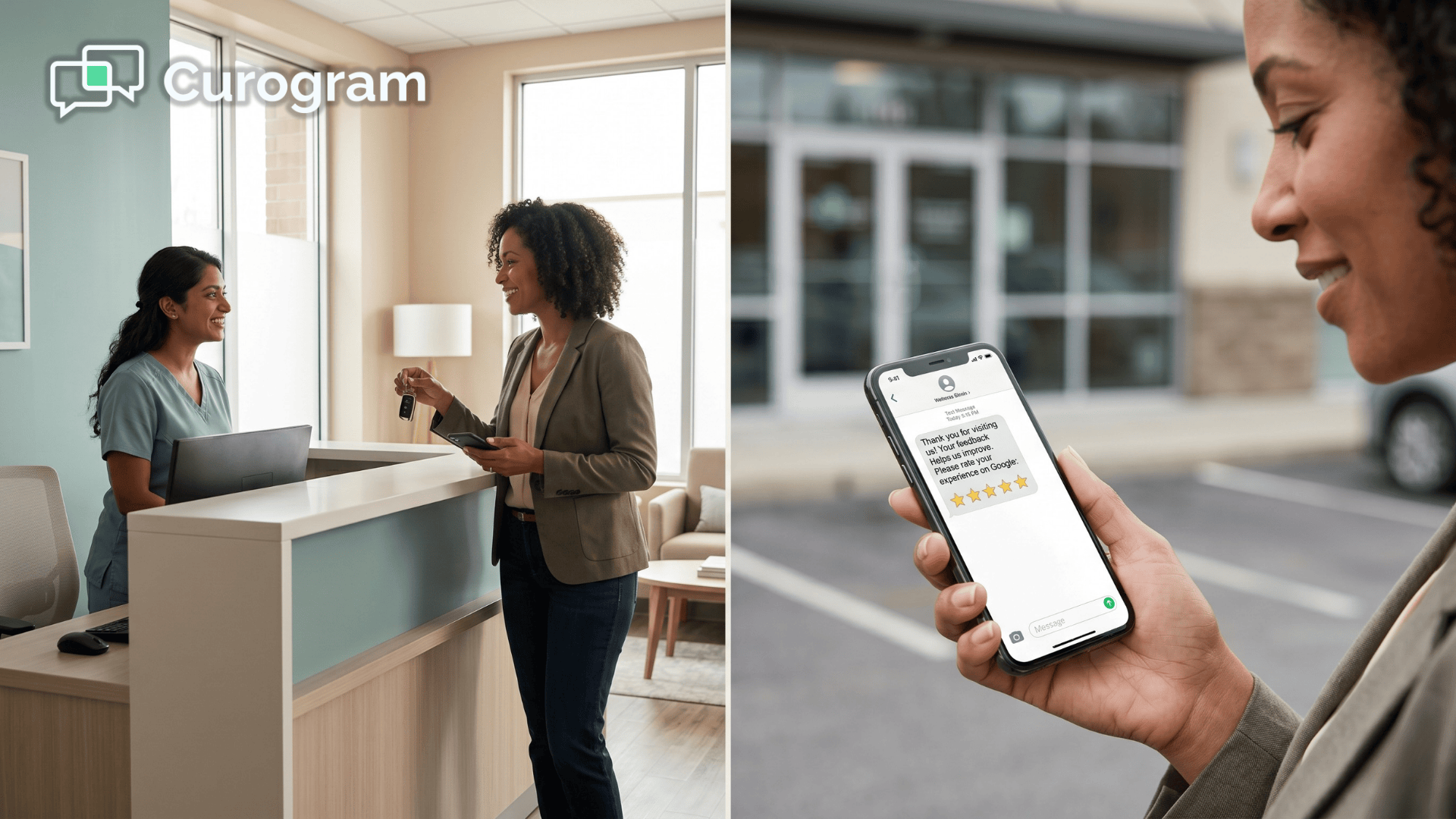
Curogram's automated Google reviews feature sends a short, post-visit review request SMS once the appointment wraps up. Inside is a one-tap Google review link that drops the patient straight onto your Google profile.
There's no login, no app to download, and no portal to remember.
That simplicity matters more than it sounds. Every extra step is a place where a willing patient quietly gives up.
Because the request is tied to the CharmHealth visit, it lands while the experience is still fresh. That is exactly when patients feel grateful and ready to act.
A request sent two weeks later gets ignored.
A request sent the same day gets a tap.
This is also why text beats email by a wide margin.
Review request open rates for SMS often sit well above 90%, while marketing emails frequently struggle to clear 25%.
Most people read a text within minutes. For your team, that gap is the difference between a review and silence.
For families and older patients, replying to a text and tapping a link is far simpler than hunting down a review site on their own. Leaving a patient review by text feels natural because texting is already how they talk to people.
The review requests travel on the same secure channel as your other patient messages — the HIPAA-compliant two-way texting your practice already trusts. So far more patients actually finish the task.

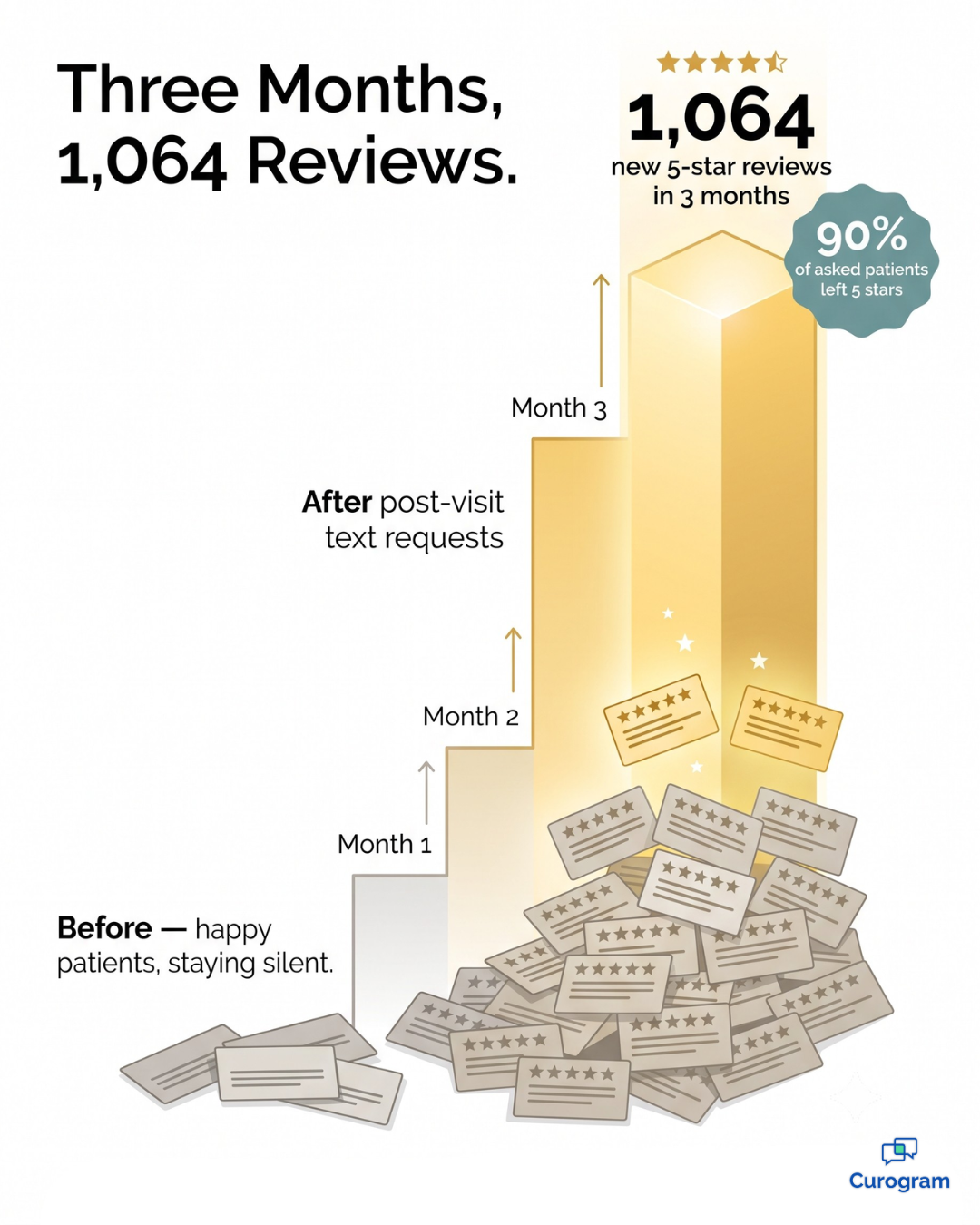
The results speak for themselves. At a comparable practice, 90% of asked patients left 5-star reviews. That same practice added 1,064 new 5-star reviews in three months.
Sit with that number for a second. Over a thousand reviews, in a single quarter, from patients who were happy all along and simply needed a nudge.
Here is a simple example to show how fast this adds up for a midsize practice.
| What you measure | Without prompting | With post-visit texts |
|---|---|---|
| Patients seen per month | 800 | 800 |
| Share who get asked | A handful | Nearly all |
| New reviews per month | ~8 | ~120 |
| New reviews per year | ~96 | ~1,440 |
These are illustrative numbers, not a promise. But the pattern is real. When you actually ask, satisfied patients leave reviews in volumes that a passive form will never match.
What changes is not just the count. It's the balance. The silent majority finally becomes visible, so your profile reflects how patients truly feel. One bad review no longer drags down a thin average, because dozens of honest 5-star reviews surround it.
For your practice, that shift means something concrete. CharmHealth captures the visit. Curogram captures the voice.
Together with the passive review signals your practice already earns, your online reputation finally matches the quality of care you deliver.
Turning this on doesn't require a major project or a complicated new system to learn. The review requests run right on top of the CharmHealth workflow your team already runs. Most practices are set up and sending within a single day.
Here is what the setup actually looks like:
That is genuinely the whole lift. From that point forward, the platform handles the asking for you automatically, every single day, without anyone on your team lifting a finger.
The most valuable part is how quietly the whole setup runs in the background. Your front desk stays focused on the patients in the room, instead of chasing feedback afterward.
Each request simply goes out at the one moment most likely to earn a response.
Your patients already feel good about the care they received. The only missing piece is a simple way for them to say so at the right moment. That single gap is the whole story.
A well-timed text quietly turns satisfied patients into public 5-star reviews, while CharmHealth keeps running smoothly underneath it all. You don't redesign your workflow, and you don't pile another task onto your front desk. You simply stop letting genuine goodwill slip away unnoticed.
Remember the contrast that started this whole conversation.
The unhappy few will always post on their own, with no encouragement at all. The happy many almost never do, unless somebody actually invites them. A one-tap text request is the bridge that finally links those two groups.
And the math here is hard to argue against. When asking becomes automatic, your review count climbs steadily, your rating holds firm, and future patients see an honest picture long before they call. That makes it one of the lowest-cost growth levers you have, and it sits right beside the EHR your team already uses every day.
Think about what a stronger profile is truly worth to your practice.
Every new patient who picks you because of your reviews is revenue you would have lost to a rival with a fuller page. Across a full year, that easily outweighs the small cost of sending a few friendly texts.
So here is the simple next step. Stop letting happy patients stay silent, and start inviting the review by text so your reputation can finally match your care.
Curious how the whole thing actually feels, from the first text request to the posted review? Schedule a Demo and we'll walk you through the complete CharmHealth patient journey, start to finish. It takes only a few minutes of your time.
No. The text contains a one-tap link straight to your Google Business Profile. There's no Charm Patient Portal login and no app to download. That removed friction is exactly why so many more patients follow through and post.
Yes. Requests are opt-in and include a STOP option, and they carry no protected health information. Every patient is invited rather than filtered, so the approach stays both courteous and policy-compliant. You're simply asking for honest feedback, not steering it.
Inviting all patients gives you honest, representative feedback and a chance to make things right. The steady stream of positive reviews keeps an occasional negative one in proportion. In practice, a fuller profile reads as more trustworthy to new patients, not less.
Right after the visit, while the experience is still fresh. That's when goodwill peaks and patients are most willing to act. Curogram ties the request to the CharmHealth appointment, so the timing happens automatically without anyone watching the clock.
Yes, and often better than you'd expect. Tapping a link in a text is far easier than searching out a review site or remembering a portal password. For many older patients, a text is the most comfortable way to interact, so they're more likely to finish the task.
💡 For NextGen Enterprise organizations, the Google Business Profile is the first impression 90% of prospective patients see — before your website,...
💡 Positive patient reviews at imaging centers on Google ratings are skewed by a structural problem: satisfied patients leave without saying a word...
💡 Most happy patients never leave a Google review. They walk out satisfied, get distracted, and forget. Meanwhile, frustrated patients actively...