


Text-to-Pay for GE Centricity: The Enterprise Guide to SMS Payment
💡 Text-to-pay billing for GE Centricity enterprise collections fixes a costly gap in large practices. While athenaIDX handles back-office revenue...
8 min read
Jo Galvez
:
June 15, 2026
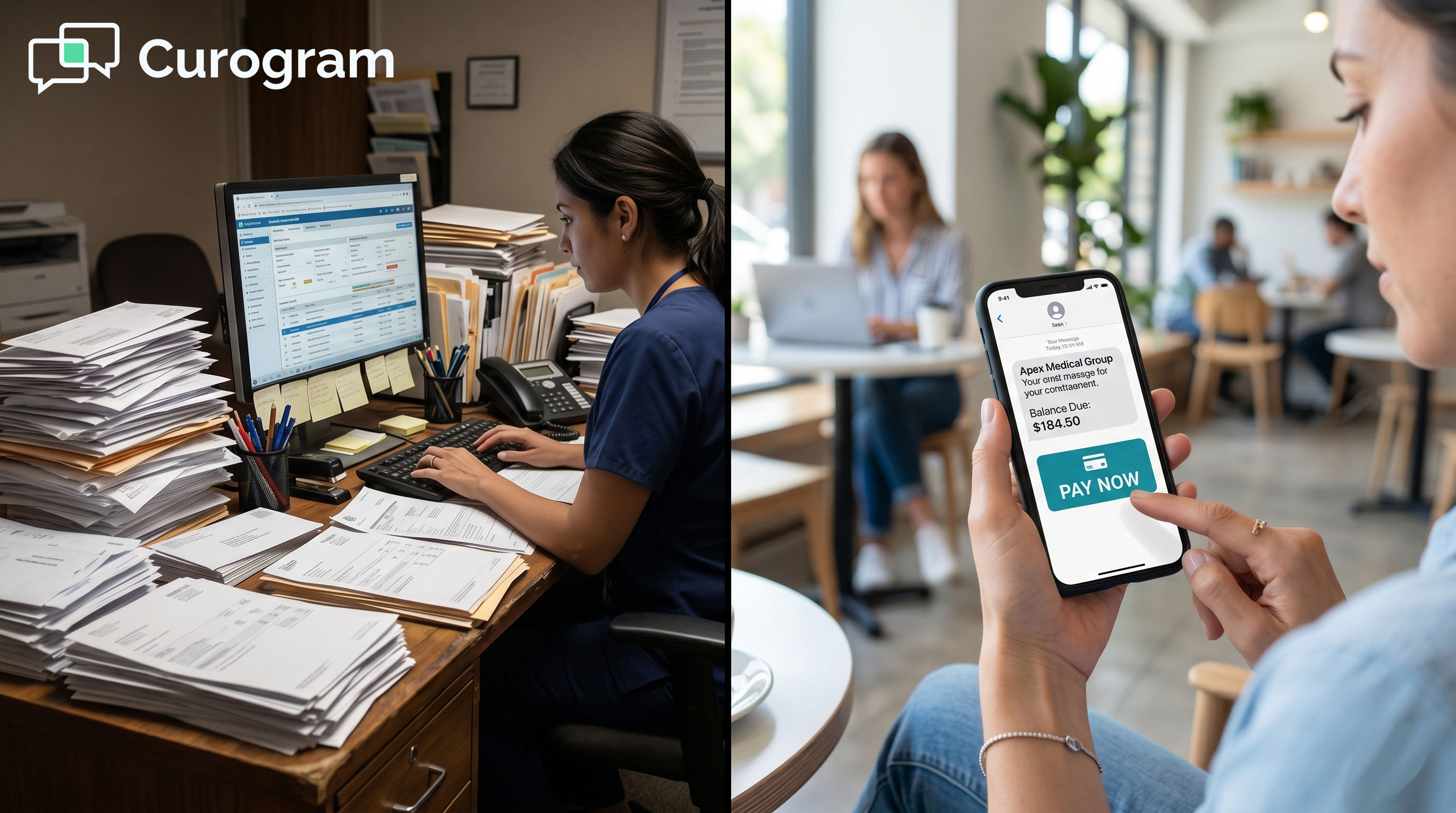
It is Monday morning at a busy behavioral health practice. The billing coordinator faces a stack of 120 paper statements.
Each one needs printing, folding, a stamp, and a trip to the mailbox. By Thursday, the follow-up phone calls begin.
This is the weekly grind in many practices that run TherapyNotes. The software is strong at claims, denials, and account tracking.
But once insurance pays its share, the leftover client balance falls to old methods. The paper goes out in the mail, and the phone calls soon follow.
Here is the painful part of this routine. TherapyNotes paper statement costs reach $800 to $1,000 every month.
Yet those mailers collect only about 20% of what clients owe. The billing coordinator then spends hours chasing small copays by phone.
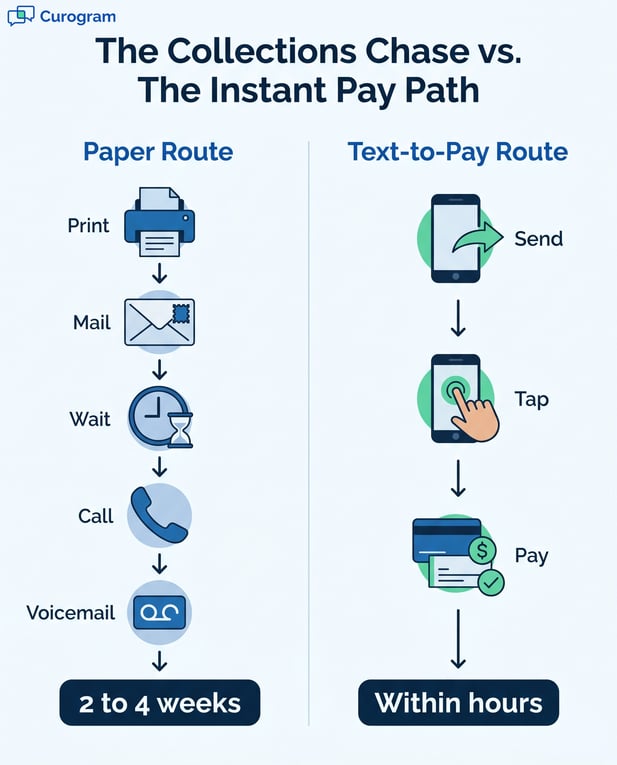
Each of those calls runs 5 to 7 minutes of staff time. Many simply end in a voicemail that no one returns. For a $25 copay, the labor often costs more than the balance. This slow loop is the trap we call the Collections Chase.
It really does not have to work this way anymore. A text reaches clients on the screen they check most often.
A secure link then lets them pay in just seconds. This is the heart of automated payment collection with TherapyNotes and Curogram.
The fix is not a rip-and-replace project, either. It is a light layer that sits on top of the billing you already trust. That makes it easy to start and easy to keep.
This guide breaks down the true cost of paper for your practice. It shows how Text-to-Pay frees your billing staff from the phone.
You will see how behavioral health accounts receivable reduction can be simple. You will also learn to win back hours each month for better work.
TherapyNotes does many things well for your front office and your back office. It tracks claims, posts payments, and manages accounts with ease.
But it was never built to collect the final client balance. That single gap turns into a costly daily chase.
The system follows every claim, payment, and adjustment with real care. The trouble starts only at the very last step. That step is getting the client to actually pay what they owe.
TherapyNotes handles insurance claims, ERA files, and account tracking without much fuss. But the moment a client owes a leftover balance, the default path is a mailed paper statement.
That approach already felt dated a decade ago, and it still does today. It leaves the single hardest step, last-mile collection, only half finished.
Behavioral health clients often carry quiet unease about their care and their bills. A statement with the practice name printed on the envelope can deepen that private stress.
Many clients respond by setting the bill aside or tossing it out unopened. So paper struggles here far more than it does across most other fields.
When paper billing fails to bring payment, the phone calls begin in earnest. That is the exact point where the real cost starts to pile up fast. Both time and money slip away by the hour.
Monday means printing and stuffing 120 statements at roughly $0.80 apiece. From Tuesday through Thursday, the coordinator dials 40 clients with balances over 60 days old.
Every single call means looking up the account, dialing, waiting, and leaving yet another voicemail. Eight times out of ten, the client never calls back at all.
Add the pieces together, and the numbers truly start to sting. Statements run $800 to $1,000 monthly, while call time adds $400 to $600 more.
With paper recovering only about 20%, most of that spend buys nothing back. This drains TherapyNotes billing staff time on collections that rarely land.
Here is the deeper loss in plain terms. Your billing coordinator is trained for revenue cycle work, not for envelope duty. Skilled talent ends up stuck stuffing mail and dialing voicemails. That is no way to run a modern practice.

There is a much faster way to finally close the open bill. Curogram acts as your Collections Liberator for that crucial last mile.
It moves payment off paper and phone and onto one simple text. The whole flow becomes quick, private, and easy.
The core idea behind it could not be any simpler to grasp. You send a secure link straight to the client by text. The client then pays right from the phone already in their hand.
Curogram sends a payment link to the client right after the session ends. The client taps the link, enters a card, and the balance clears at once.
There is no login to remember and no patient portal to dig through. There is no two-week wait for the mail, either.
A link sent right after the visit arrives at the perfect moment. The client still clearly feels the value of the session they just had.
That timing lifts the odds they pay on the spot, while it is fresh. Speed and good timing do most of the heavy lifting for you.
The real power shows up when overdue balances start to pile up. One feature can clear that whole backlog in a single move. No stamps, no envelopes, no phone tag.
This tool lets billing staff text every open balance in one action. Instead of 120 mailers and 40 follow-up calls, a single send reaches them all.
The backlog that once took a full week now takes only minutes. Small copays that never justified a call finally become worth collecting.
A live dashboard shows who paid, who opened, and who still needs a nudge. Staff then follow up only with the handful of clients who stall.
This drives real TherapyNotes copay collection efficiency week after week. It also helps reduce billing overhead for any busy counseling practice.
Curogram does not try to replace your trusted billing engine. It simply sits beside TherapyNotes and finishes the job that it starts.
Your team keeps managing claims and ERA files inside TherapyNotes, while payments run through Curogram by text. There is no double entry, and the two layers never clash.
The shift is about far more than swapping one tool for another. It changes how the whole billing day actually feels for your team.
Phone calls turn into quick, simple clicks. Daily stress turns into clear, useful data.
The gains here are easy to measure for almost any practice. They show up in both reclaimed staff time and collected money. The proof sits right there on the dashboard.
Practices drop $800 to $1,000 every month in paper statement costs alone. They also win back 10 to 15 hours of billing time once lost to calls.
One Curogram client confirmed more than 1,100 visits a month using these same automated texts. That figure reflects Curogram client data from clinical settings.
Text links reach clients in seconds rather than in long, slow weeks. SMS messages get opened about 98% of the time across most audiences.
That speed lifts collection rates well above the 20% that paper brings in. Faster cash also means balances age less and accounts receivable steadily shrink.
Here is how the two methods stack up:
|
Factor |
Paper Statements |
Text-to-Pay |
|---|---|---|
|
Monthly cost |
$800 to $1,000 |
Far lower per dollar |
|
Collection rate |
About 20% |
Much higher |
|
Time to pay |
2 to 4 weeks |
Often within hours |
|
Staff time per balance |
5 to 7 minute call |
A few seconds |
|
Client comfort |
Low, feels exposed |
High, fully private |
When the chase finally ends, the role itself starts to grow. The coordinator becomes a true revenue analyst, not just a caller. The job gets more interesting and far more valuable.
This Collections Reset frees your skilled staff from low-value busywork at last. They stop stuffing envelopes and dialing endless voicemails all week long.
Instead, they watch a clean dashboard and help only the few clients who get stuck. The role finally matches the real talent you hired in the first place.
Picture the very first Monday of a brand-new month. The coordinator texts 180 clients who owe a total of $7,200 in balances.
By Friday, well over half have already paid, with zero phone calls placed. The whole task took minutes, not the usual 12 hours of dialing.
That is the new normal for the whole billing team. Money arrives faster, and staff feel real relief each day.
The practice also keeps far more of what it rightly earns. The long Collections Chase is finally, fully over.

TherapyNotes runs the full billing cycle with real skill. It just does not close the loop on the client balance.
That final mile still leans on paper and phone calls. Curogram steps in to finish the job your software starts.
Think hard about what paper truly costs your practice. You spend close to $1,000 each month just to mail statements.
Yet they bring back only about 20% of what clients owe. Then the staff burns even more hours chasing the rest by phone.
Here is the simple truth at the center of it all. TherapyNotes is your billing system, plain and clear. Curogram is your collection system. One submits the claim, while the other captures the copay.
Together, the two close the gap that paper billing leaves wide open. You eliminate paper statements across your therapy practice for good.
You also free your billing coordinator for work that matters far more. That, in the end, is the real win.
The change is not hard to get started, either. Text-to-Pay works right beside your current TherapyNotes setup. There is no rebuild and no risk to your claims process. The payment layer simply sits on top of what you have.
You are never left to set it up alone. Curogram onboarding guides your team through each early step. The path from paper to text stays smooth and clear.
So take a quiet moment to add up your own numbers. Count your spend on paper, postage, and collection calls each month.
Then weigh how much faster a single text could get you paid. The math tends to speak loudly for itself.
The best way to see the difference is to watch it live. Book a short, personalized demo with our team.
Curogram runs beside TherapyNotes and needs no API link. Your team keeps managing claims, ERAs, and accounts in TherapyNotes. Client payments flow through Curogram by text instead. There is no double entry and no system clash.
A 7-minute call to collect $25 costs more in staff time than the copay itself. A text costs almost nothing to send. So small balances finally become worth collecting. Batch texting recovers money that paper and phone could never justify chasing.
Payment processing fees match standard credit card rates. Paper statements cost $0.80 to $1.20 each, plus postage and staff time. Per dollar collected, text payment costs far less. Book a demo for pricing matched to your practice volume.
Statements arrive weeks late and often get lost in junk mail. Clients who feel stigma may avoid a bill with the practice name on it. Many set it aside and never pay. This is why paper recovers only about 20% of balances.
Most people see a text within minutes of getting it. A link sent right after the session reaches clients while their willingness is high. Many pay the same day, often within hours. That speed shrinks the wait that paper drags out for weeks.
💡 Text-to-pay billing for GE Centricity enterprise collections fixes a costly gap in large practices. While athenaIDX handles back-office revenue...
💡 Billing staff at small practices spend hours each month printing statements, stuffing envelopes, and making collection calls. Most of that work...
💡 Small practices using Practice Fusion text-to-pay SMS payment links are moving away from paper billing for good. Traditional paper statements...