
 Jo Galvez

Cost per no-show equals visit value, plus acquisition cost when the patient is new. One governed two-way reminder sequence runs at every site, and patients confirm, cancel, or rebook by reply.
Replies reach the schedule, so freed slots surface days ahead of check-in. A weekly report ranks each location by no-show rate, confirmation rate, and recovered slots.
Based on our internal data, Curogram clients run no-show rates 53% lower than industry benchmarks, and recovered visits lift revenue 10% to 20%.
Most Tebra groups can tell you their cost per new patient within a few dollars. Ask what one no-show costs, and the room goes quiet.
That gap makes sense. Tebra grew out of Kareo and PatientPop, and groups that run on it tend to watch the growth side closely: ad spend, lead volume, booking rate. Those numbers live on a dashboard someone opens every Monday.
The missed visit lives in a different report, if it lives anywhere. It gets counted as an operations problem, filed under "patients are unreliable," and left to each site manager.
We think that's backward. A group that prices every step of acquisition should price the show-up the same way, and run one reminder standard across every site to protect it.
The math below uses illustrative figures. Swap in yours as you read.
The Villain: The Five-Figure Leak
Your marketing team knows cost per lead and cost per booking. Cost per no-show is higher than both, because it contains both.
What One Empty Slot Carries
A booked new patient arrives at the schedule with a price tag already attached. You paid for the ad, the call, and the staff time to book.
When that patient doesn't show, all of it goes, plus the slot itself. Birch's 10:30 with Dr. Patel can't be sold to anyone at 10:31.
That's the no-show cost per acquired patient: visit value plus acquisition cost. Established patients carry only the visit value, which is still real money.
How It Looks at the Front Desk
Monday at Birch, the day sheet shows 38 visits. By noon, 5 of those chairs are empty.
Two of the 5 got a robocall Friday and meant to cancel. The call had no way to take an answer, so the patients just stayed home. The front desk finds out at check-in, too late to call the waitlist.
Why a Five-Figure Leak Is Common
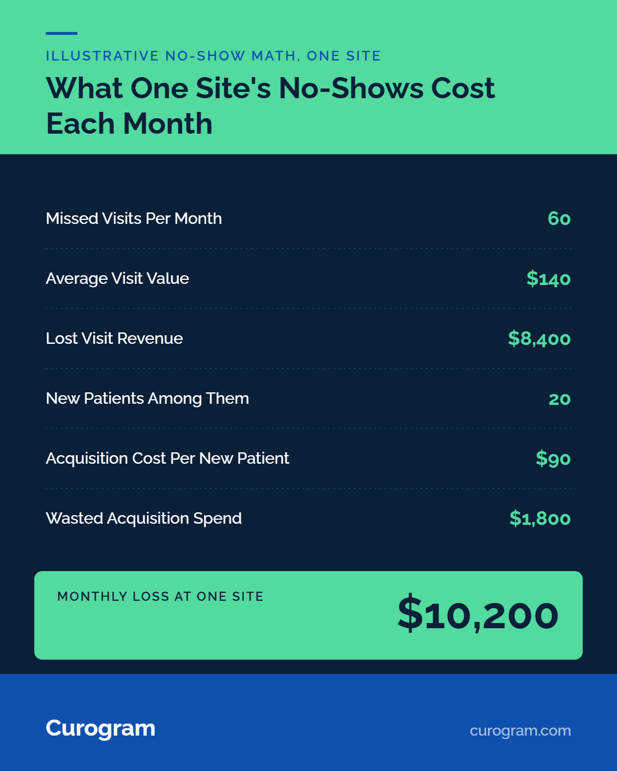
Illustrative figures: one site misses 60 visits a month, and 20 of those are new patients. At $140 a visit and $90 to acquire each new patient, that's $8,400 plus $1,800. The site loses $10,200 a month, or about $122,000 a year.
Multiply that by four locations. Marketing then spends next quarter's budget replacing patients the group already paid for once.
The Guide: The Reminder Policy Engine
Curogram treats the show-up as the last conversion in your funnel. It works through our Tebra integration, so Tebra stays your system of record.
A Group No-Show Reduction Playbook in Four Steps
This is the order we'd run it in, with owners attached.
|
Step |
What Happens |
Owner |
When |
|---|---|---|---|
|
1. Price it |
Compute cost per no-show for each site |
Owner or CFO |
Week 1 |
|
2. Set one sequence |
Lock cadence, wording, and the reply option |
Owner |
Week 1 |
|
3. Refill freed slots |
Offer canceled times to waitlist patients |
Site front desk |
Daily |
|
4. Benchmark |
Rank sites on the weekly report |
Regional manager |
Every Monday |
Steps 1 and 4 are the ones most groups skip. Without them, there's no way to tell which site is improving.
What the Patient Sees and Sends
A typical sequence sends a text 3 days out, another the day before, and a short note 2 hours before. Each one ends the same way: "Reply C to confirm or R to reschedule."
A patient who replies R reaches a staff thread with the visit attached. Our page on appointment reminder texts for Tebra users shows the confirm, cancel, and reschedule options.
Why Two-Way Matters for the Numbers
An August 2025 MGMA Stat poll of 265 practices found 27% saw no-show rates rise over the prior year. Leaders whose rates held steady or fell credited frequent digital reminders and easy rescheduling.
A reply option is easy rescheduling at its simplest. The patient who can't make Thursday says so on Tuesday.
Curogram Highlight: Two-Way Confirmation Logic
Two-Way Confirmation Logic lets patients confirm, cancel, or rebook by replying to the reminder. Each answer syncs to the schedule, so a freed slot shows up while the front desk can still fill it.
That changes the confirmation workflow front desk staff run today. The afternoon call list goes away, and staff open only the threads that need a person, such as a patient asking to move a visit to another site.
Owners get a weekly per-location report with no-show rate, confirmation rate, and recovered slots. It gives the bottom of the funnel the same weekly view your marketing reports give the top.

The Success: Closing the Leak at Every Location at Once
Based on our internal data, Curogram clients run no-show rates 53% lower than industry benchmarks. Recovered visits drive a 10% to 20% increase in revenue.
From Top-of-Funnel Focus to Full-Funnel Discipline
Most groups already run one discipline well. Leads get tracked, tested, and improved every week.
Once the show-up has its own number, it gets the same treatment. Confirmation rate predicts the schedule utilization multi-location owners see at month end, so it becomes the leading figure to watch.
Which Numbers to Track Weekly
Track three things per site: confirmation rate, no-show rate, and slots refilled from cancellations. Add one more for the group: the gap between your best and worst site.
That gap is your no-show variance metric. A group average can look fine while one site loses twice as many visits as another.
Where the Recovered Money Shows Up
A slot freed on Tuesday and refilled by Wednesday is a visit that would have been lost. The acquisition spend on the original patient still earns a visit, just on a new date.
Apply funnel economics, missed appointment by missed appointment, and the marketing dashboard finally lines up with the day sheet. Our guide to standardizing appointment reminders across Tebra locations covers how to lock one sequence group-wide. For site-by-site tracking, see enterprise analytics and location benchmarking.
Conclusion: Give the Bottom of the Funnel a Number
A group this careful about acquisition should be just as careful about arrival. Right now, most of that care stops at the booking.
Tebra fills the top of your funnel. Curogram works on the patient's commitment to show up at the bottom.
Compute one number this week: monthly no-shows, times visit value plus acquisition cost, times 12. Then decide whether the current setup gets another year.
Book a demo, and we'll work out your per-location leak from your own schedule data and model what recovery looks like.
Frequently Asked Questions