
 Aubreigh Lee Daculug

Curogram's "Rollout Playbook" wins both the same way: ownership plus respect. Each location manager sees their own call volume and no-show numbers, gets a trained super-user from their own team, and leads go-live with a checklist that fits clinic life.
Tebra workflows stay the same, so training takes hours, not days. Every location that reaches the 75%+ confirmation benchmark makes the next manager easier to win.
"We'll see how long this one lasts."
A front desk lead says it quietly, half to herself, after the morning huddle. Her clinic joined your group four months ago. Since then, she has learned a new logo, a new billing process, and a new set of rules from people she has never met.
Now there's an email about an "exciting new patient texting platform."
She isn't being difficult. She's tired.
That one sentence tells you more about your rollout than any launch plan. It also explains why so many multi-site go-lives stall without anyone noticing.
The software switches on, and the training sessions happen on schedule. Then staff gradually slip back to the phone, the voicemail box, and their personal cell phones.
Growing multi-location groups encounter this constantly. Legacy locations have seen enough headquarters memos to know they can wait them out. Acquired locations are still absorbing the last round of changes, so one more feels like a burden. Both groups resist, just for different reasons.
This is where change management for Tebra patient communication rollout plans usually breaks down. Leaders focus on the tool and forget the people who decide whether it gets used.
Those people aren't in the boardroom. They're at the front desk, juggling check-ins, ringing phones, and patients who want answers now.
Here's the good news. Adoption isn't a mystery. It follows a predictable pattern you can plan for.
In this guide, you'll learn why the top-down memo fails and how to turn each location manager into the owner of their own go-live.
You'll see how a super-user, a realistic checklist, and each site's own numbers can turn quiet resistance into real buy-in. You'll also learn what success looks like when staff start calling the change "ours."
Let's start with the thing that's working against you.
Why the Headquarters Memo Never Sticks
Every growing organization has sent one. It goes out from the main office, uses words like "exciting" and "seamless," and asks every site to go live by a set date. It feels like progress. It rarely is.
Every Manager Asks the Same Question
Location managers evaluate every new initiative by one simple test:
Does this help my Tuesday? If the answer isn't clear, the project drops to the bottom of the list.
Acquired-location managers add a second filter. They ask, "Is this another thing the new owners are doing to us?" That question has nothing to do with the software. It has everything to do with trust, and trust takes time after an acquisition.
How the Memo Lands at an Acquired Site
Think about a manager who is four months into new ownership and two rebrands deep. The memo arrives, promising a better way to reach patients. She reads it, sighs, and adds it to the pile.
Her team watches her reaction closely. When she shrugs, they shrug.
That's integration fatigue resistance, and it's quiet by design. Nobody objects in meetings or files a complaint. They simply continue doing things the familiar way.
The Cost You Can't See on a Dashboard
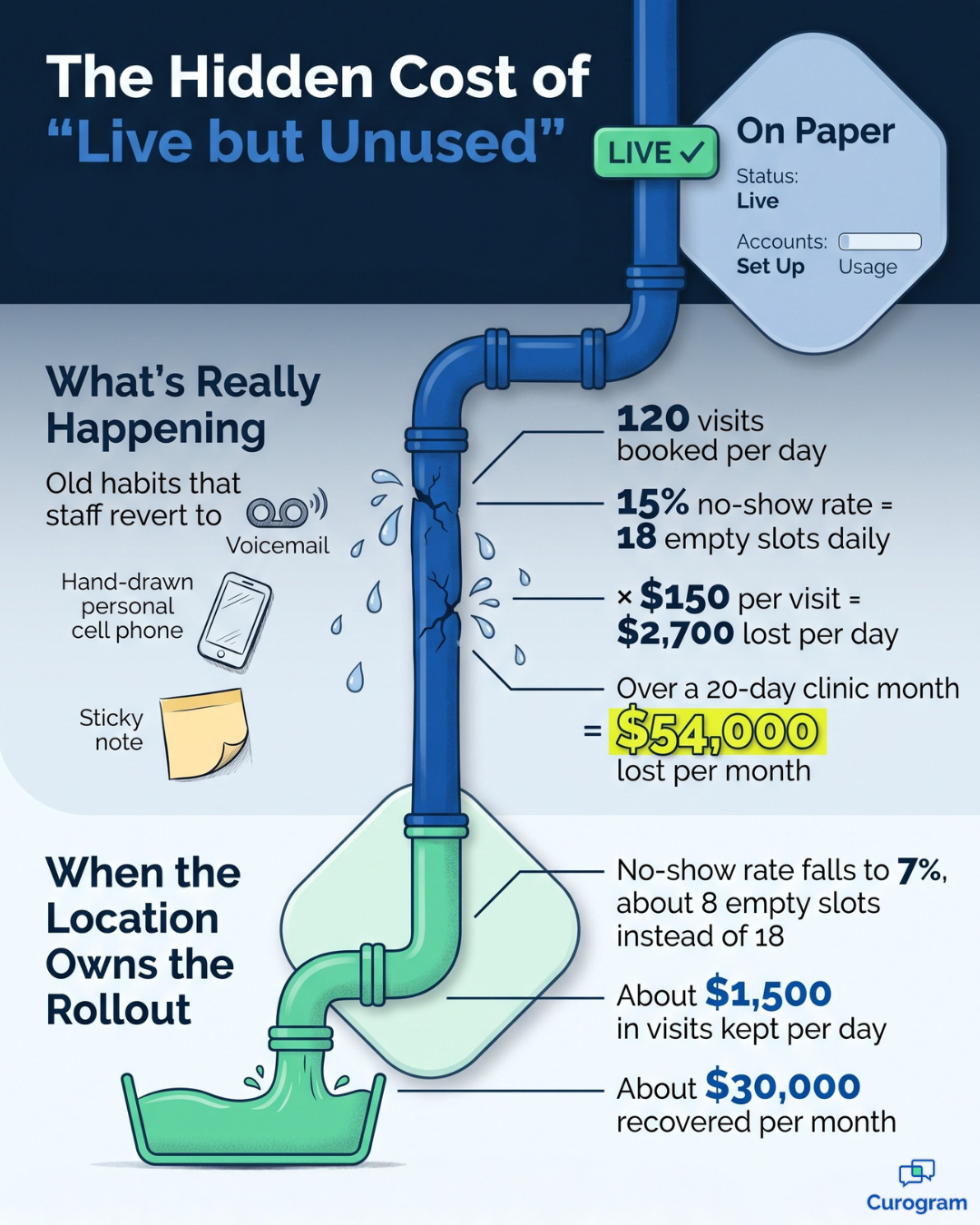
Passive resistance is difficult to identify because everything appears fine on paper. The location is "live." Accounts are set up. Usage is low, but it isn't zero.
Underneath, old habits keep running. Staff return calls from personal phones and leave voicemails patients never hear. Meanwhile, the group pays full price for a platform that isn't doing its job.
Here's an illustrative example.
Say one acquired location books 120 visits a day and has a 15% no-show rate. That's 18 empty slots daily. At $150 per visit, the leak is about $2,700 a day, or roughly $54,000 over a 20-day clinic month.
In practice, every month of "live but unused" keeps that leak wide open.
Where the Gap Finally Shows Up
The adoption gap usually surfaces at renewal. Someone says, "We never really used it." By then, an entire year has passed.
Worse, the gap is often widest at the locations the group most needed to integrate. The acquired sites needed the most support. They got the least benefit.
The Rollout Playbook: Putting Every Manager in Charge
The fix isn't a better memo. It's a different approach. Curogram's "Rollout Playbook" makes each location manager the lead in their own go-live.
Their data makes the case. Their super-user carries the floor. Their checklist sets the pace.
No piece of location manager buy-in software can replace that kind of ownership. But the right platform can make ownership easy to hand over. For the full multi-site picture, see our guide to rolling out patient texting across Tebra locations.
Start with each site's own numbers. Before go-live, show the manager how many calls their front desk handles, how many voicemails pile up, and how many no-shows slip through each week. Group-wide averages don't move anyone. A manager's own numbers do.
Next comes the super-user. Each location picks one respected staffer, someone coworkers already turn to, and trains them early. When someone asks "How do I do this?" during a busy check-in rush, the answer comes from a familiar face at the next desk.
That's where adoption is really decided. It's also a super-user model group leaders can repeat at every new site.
Because Curogram works alongside Tebra, staff keep the system they already know. Scheduling, charting, and billing stay the same. What's new is a simple shared inbox for patient texts. That keeps training to hours, not days, and it's a promise managers can check with their own staff.
Finally, give managers a go-live checklist staff can actually follow.

It should fit real clinic life, not a project plan:
- Baseline review: The manager sees their site's call volume, voicemail count, and no-show rate.
- Super-user prep: One trusted staffer trains a week or two before go-live.
- Training front desk: New platform basics in one short session, built around real daily tasks.
- Soft launch: Start with appointment reminders, then add two-way texting.
- Week-one check-in: The manager and super-user review usage together.
Short, clear steps like these keep the rollout moving without adding pressure. They also give managers a way to show progress early.
Tell Tired Teams the Truth
For change-fatigued teams, how you frame the rollout matters as much as what you roll out. Acquired practice staff adoption improves when you present the platform honestly, as the change that takes work away.
Here's how the framing shifts by location type:
| Legacy Locations | Acquired Locations | |
|---|---|---|
| Main pushback | "We've seen memos like this before." | "One more thing from the new owners." |
| What wins them | Their own data and a peer super-user | Proof the change lightens their load |
| Best framing | "Here's what your numbers could look like." | "Here's what comes off your plate." |
| First win to show | Fewer missed calls | Fewer voicemails to return |
Curogram clients have seen call volume drop by 50% and front desk productivity rise by 30% or more. For a tired team, that isn't another mandate. It's relief.
From "One More Thing" to "My Win": Signs Your Rollout Is Working
When managers own the rollout, results show up in two places: the data and the break room.
Here are three signs it's working.
- Confirmation rates climb faster. Locations led by enrolled managers reach the 75%+ confirmation benchmark sooner. With text messages earning a 98% open rate, patients actually see their reminders. Atlas Medical Center, a Curogram client, cut its no-show rate from 14.20% to 4.91%.
- The words at the front desk change. Listen for the shift from "the new owners' project" to "our upgrade." This is your leading indicator. When staff say "our," usage and results tend to follow.
- Managers share their own results. At the group meeting, managers present their before-and-after numbers. Acquired-location managers often become the most believable voices in the room, because everyone knows they started as skeptics.
Go back to the illustrative location from earlier. If its no-show rate fell from 15% to 7%, it would lose about 8 patients a day instead of 18. That's roughly $1,500 in daily visits kept, or about $30,000 a month.
For your team, that's the difference between a rollout that "went live" and one that paid for itself.
Each win also makes the next rollout easier. The next manager isn't hearing a pitch from headquarters. They're hearing from a peer who stood exactly where they stand now. Track those wins on a shared location benchmarking scoreboard so every site can see its progress.
Skip the Memo and Enroll Your Managers Instead
Adoption is decided at the front desk. It's decided by people the memo never persuaded and, at acquired locations, by people the memos wore out.
That's why the best rollouts don't start with an announcement. They begin with a genuine conversation.
Tebra remains the system your staff already know. Curogram arrives as their relief valve: fewer calls, fewer voicemails, and faster answers for patients. Frame it that way because it's true. Staff can recognize the difference between a sales pitch and a promise they can verify.
When each manager owns their go-live, the whole group benefits. Their data makes the case, and their super-user handles the daily questions. Their checklist sets a pace that fits their clinic. Every location that reaches the 75%+ confirmation benchmark makes the next manager easier to win.
Here's one simple step you can take before your next go-live.
Sit down with that location's manager for 30 minutes and show them their own baseline: call volume, voicemail backlog, and no-show leak.
Don't pitch. Just share the numbers and ask what they would prioritize first.
Then watch the posture change. Arms uncross, and questions become specific. The conversation shifts from "Do we have to?" to "When can we start?"
That shift is what transforms a rollout into real, lasting adoption. It also keeps your acquired locations from feeling like the last to know and the first to be blamed.
You don't have to build the playbook alone. Our team can help you identify where friction usually hides and plan around it before it slows your rollout down.
Schedule a Consultation, and we'll build a manager-enrollment kit for your first location. It includes baseline data, a go-live checklist, and a super-user training plan. Your managers lead the way. We'll make sure they have everything they need to win.