Reduce Admin Workload in StreamlineMD: The ROI of Digital Forms
💡 Online patient forms help StreamlineMD radiology, vascular, and IR practices save money and boost revenue. Faster check-in cuts wait times and...
15 min read
Mira Gwehn Revilla
:
Updated on January 9, 2026
Table of Contents
A patient forgets to stop blood thinners before an IR procedure. Your team doesn't find out until they're already on the table. The case gets canceled. The room sits empty. Revenue walks out the door.
This happens more than it should. And it's almost always preventable. For radiology, vascular, and IR practices, small gaps in communication create big financial problems. A missed prep call leads to a failed MRI. An unanswered patient question causes a no-show. Staff spend hours on the phone instead of moving patients through.
These issues add up fast. One canceled IR case can cost thousands. Multiply that across a week, and you're looking at serious losses.
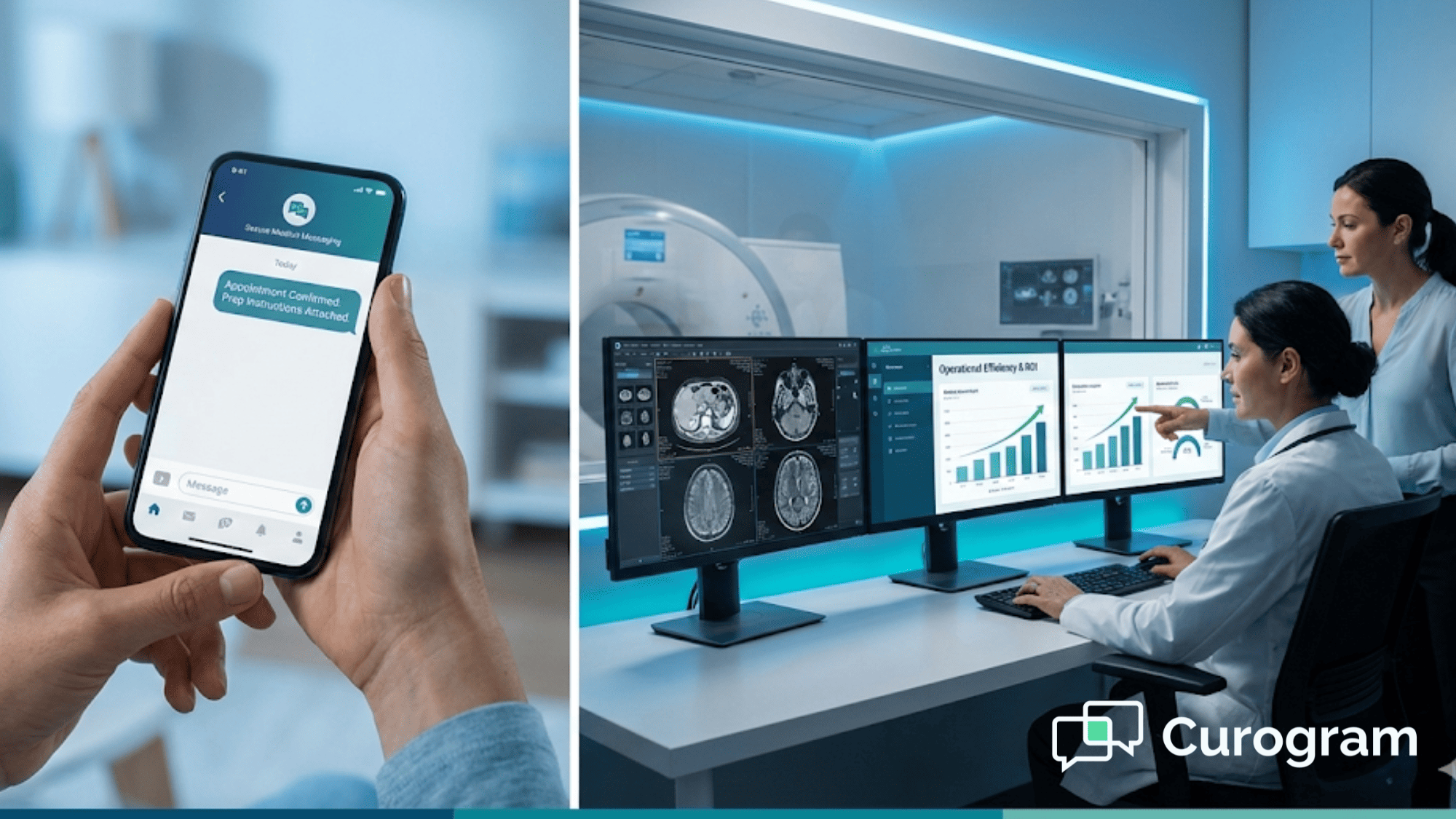
But here's the good news: telehealth fixes most of these problems. When you expand access with StreamlineMD telehealth, patients get the prep help they need before they arrive. Your staff can message instead of call. Questions get answered in minutes, not hours. Procedures stay on schedule.
The result? A hybrid care workflow that protects your revenue and cuts your costs at the same time. This isn't about adding more tech for the sake of it. It's about making your current operation work better. Telehealth plugs the gaps that drain time and money from your practice every single day.
In this post, we'll break down exactly how virtual care delivers telemedicine ROI for imaging practices. You'll see where the savings come from. You'll learn which workflows improve the most. Let's look at what this shift means for your bottom line.
Your practice runs on precision. Every scan needs the right prep. Every procedure needs the right timing. But when communication breaks down, everything else breaks with it. Without telehealth integration, that breakdown is expensive.
Picture this: A patient arrives for an abdominal CT. They were supposed to fast for six hours. But they ate breakfast because the instructions were unclear. Now, the scan can't push through, all because there was no clear communication.
Your tech loses 20 minutes explaining the issue. The patient leaves frustrated. The slot goes unfilled. You've lost billable time and created a bad experience.
This scenario plays out daily in practices that rely on phone-only communication. Instructions get lost. Patients forget. Staff don't have time to follow up.
IR procedures are high-stakes. A single vascular case might bring in $3,000 or more. But if a patient didn't stop their blood thinner in time, the case gets scrubbed.
That's not just lost revenue. It's wasted OR time. It's a surgeon standing idle. It's a ripple effect that throws off the rest of your day.
One study of surgical cancellations found that patient-related issues caused up to 40% of same-day cancellations. Most of those issues could have been caught earlier with better outreach.
Your front desk spends hours on the phone. They're answering prep questions, confirming appointments, and chasing down patients who didn't call back.
That's expensive labor tied up in repetitive tasks. And when call volume spikes, patients wait on hold. Some hang up. Some miss their prep window entirely.
Every extra minute on the phone is a minute your staff can't spend on higher-value work. Over time, this drives up staffing costs without improving outcomes.
When patients feel confused, they get upset. When they show up unprepared and get turned away, they get angry.
That anger often lands on Google. A single one-star review can turn away dozens of potential patients. And once your online rating dips, it takes months to recover. Clear communication isn't just about efficiency. It's about protecting your reputation.
Here's where virtual care changes the game. Telehealth gives you a direct line to patients before they ever walk through your door.
Instead of phone tag, you send a secure message. Instead of hoping they read a paper handout, you confirm prep steps in real time. Instead of finding problems on procedure day, you catch them days in advance.
This is what a hybrid care workflow looks like in action. You combine in-person care with virtual touchpoints. You meet patients where they are. And you stop problems before they start.
For radiology, vascular, and IR practices, this shift is a game changer. Prep compliance goes up. Cancellations go down. Staff spend less time chasing and more time doing.
The telemedicine ROI isn't abstract. It shows up in fewer empty slots. It shows up in smoother days. It shows up in patients who trust you enough to come back.
Communication failures are silent killers of practice revenue. You don't always see the cost on a balance sheet. But it's there, hiding in every rescheduled scan and every frustrated phone call.
Telehealth brings those costs into the open and gives you the tools to eliminate them. That's not a nice-to-have. For imaging practices serious about growth, it's a must.
Revenue protection starts before the patient arrives. When prep goes right, exams happen on time. When it doesn't, you lose money. Telehealth makes sure prep goes right.
MRI, CT, and ultrasound exams all require some level of patient prep. Fasting, hydration, medication timing—these details matter. Miss one, and the scan fails.
With telehealth, you can message patients the day before their exam. You confirm they understand the instructions. You answer any questions on the spot. You catch confusion before it causes a problem.
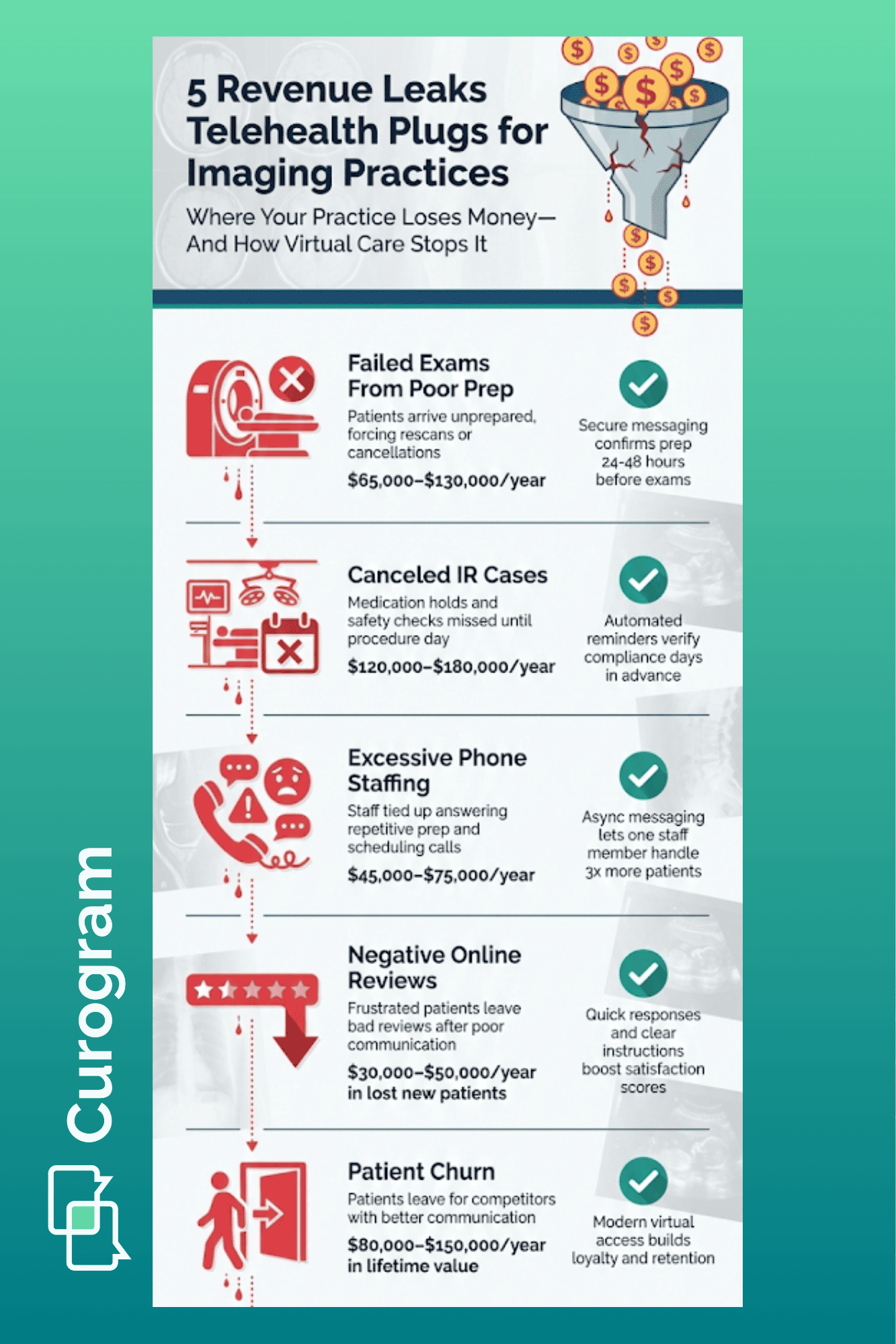
Let's say your practice does 50 MRIs per week. If 10% fail due to prep issues, that's five lost studies. At $500 per scan, you're losing $2,500 every week. That's $130,000 per year walking out the door.
Now, imagine you cut that failure rate in half with better virtual outreach. You've just recovered $65,000 in annual revenue without adding a single new patient.
Your technologists also benefit. They spend less time explaining why a scan can't happen. They move through the schedule faster. Everyone's day gets easier.
IR procedures are where the real money is. A single embolization or ablation can bring in $5,000 or more. But these cases are also the most sensitive to prep failures.
Blood thinners are a common problem. If a patient didn't stop their medication on time, the case gets canceled. No exceptions.
Telehealth helps you confirm medication holds days in advance. You send a message reminding the patient. You ask them to confirm compliance. If there's a problem, you catch it early enough to reschedule without losing the slot.
Safety checks work the same way. Allergies, implants, lab values—all of these can be verified through secure messaging. Your staff doesn't have to track down patients by phone. The communication happens in a documented, efficient channel.
One canceled IR case can cost more than an entire day of simpler exams. Saving just two or three cases per month can add $10,000 or more to your bottom line.
When prep compliance improves, your schedule becomes more reliable. You know which patients are ready. You know which ones need extra attention.
This predictability changes how you plan your day. You can batch similar exams together. You can staff more accurately. You can avoid the scramble that happens when cases fall through at the last minute.
Improved planning reduces operational waste. You're not paying techs to stand around. You're not rushing to fill empty slots. You're running a tighter ship.
Over time, this efficiency compounds. Staff morale goes up because the chaos goes down. Patients notice that things run on time. Your reputation improves.
Telehealth isn't just about adding a new service. It's about making your existing services work better. When you expand access with StreamlineMD telehealth, you create a system where prep, scheduling, and execution all align.
This alignment is where revenue protection happens. Not in big dramatic changes, but in dozens of small wins every week. Fewer failed exams. Fewer canceled procedures. Fewer frustrated patients.
These wins add up to real money. And they come from a single investment in better communication.
Practices that still rely only on phone calls and paper handouts are leaving this money on the table. The hybrid care workflow closes that gap. It gives you control over prep compliance in a way that phone calls never could.

Staffing is one of your biggest expenses. Every hour your team spends on low-value tasks is an hour that costs you money. Telehealth cuts those hours down. The savings show up fast.
Think about how your front desk spends their day. A big chunk goes to answering phones. Prep questions. Appointment confirmations. Directions to your facility. Rescheduling requests.
Each call takes three to five minutes. Some take longer. And during busy periods, the phone never stops ringing.
This creates a staffing problem. You need enough people to handle peak volume. But during slow times, those same staff have little to do. You're paying for coverage you don't always need.
Telehealth shifts much of this volume to virtual messaging. Patients can ask questions through a secure chat instead of calling. They can confirm appointments with a quick text response. They can upload forms without waiting on hold.
This change has a multiplier effect. One staff member can handle 10 text conversations in the time it takes to complete three phone calls. You get more done with the same headcount.
Let's run some numbers. Say your practice handles 200 prep-related calls per week. Each call averages five minutes. That's over 16 hours of phone time every week—nearly half a full-time position.
If telehealth moves 60% of those calls to messaging, you free up almost 10 hours per week. That's time your staff can spend on patient intake, insurance verification, or other high-value work.
Over a year, those hours add up to real savings. You might avoid hiring an extra person. You might reduce overtime. Either way, your labor costs go down.
Phone calls demand immediate attention. When the phone rings, someone has to answer it. That interrupts whatever else they were doing.
Asynchronous messaging works differently. A patient sends a question. Your staff responds when they have a moment. There's no pressure to answer instantly.
This might sound like a small change. But it transforms how your team works. Interruptions are productivity killers. Studies show it takes over 20 minutes to fully refocus after being interrupted. In a busy front office, interruptions happen constantly. Staff never get into a flow.
With messaging, your team can batch their communication work. They handle five or six messages in a focused 15-minute block. Then they move on to other tasks without breaking stride.
The result is more work completed in less time. Staff feel less frazzled. Patients still get quick responses. Everyone wins.
Messaging also creates a record. You can see exactly what was communicated and when. Phone calls disappear into thin air. Messages stay in the system. This documentation helps with quality control. If a patient claims they never received prep instructions, you can pull up the message thread. That protects your practice and improves accountability.
Training new hires is expensive. It takes time away from your experienced staff. And phone-based communication is one of the hardest skills to teach.
Phone etiquette is tricky. New staff need to learn how to handle upset callers. They need to know when to put someone on hold. They need to memorize scripts and protocols. It can take weeks before they're comfortable.
Telehealth simplifies this process. Virtual workflows are more standardized. Your team can use message templates for common questions. They can review their responses before sending. They have time to look things up.
This lowers the training burden significantly. New staff become productive faster. They make fewer mistakes. And they don't have to deal with the stress of live phone conversations while they're still learning.
For practices with high turnover, this matters a lot. Every time you hire someone new, there's a ramp-up period where productivity dips. Telehealth shortens that period.
You also get more consistency. When everyone uses the same templates and workflows, patients receive the same information every time. There's less variation based on who happened to answer the phone.
Consider a mid-sized vascular surgery practice with three locations. Before telehealth, their call center handled over 400 calls per day. Wait times averaged eight minutes. Patients complained constantly.
After implementing virtual messaging, call volume dropped by 45% within three months. Wait times fell to under two minutes. Patient satisfaction scores jumped by 20 points.
The practice didn't reduce staff. Instead, they redirected those hours toward patient outreach and care coordination. They started doing proactive check-ins with high-risk patients. Readmission rates declined.
The telemedicine ROI showed up in multiple ways. Lower phone burden. Better patient experience. Improved clinical outcomes. All from a single workflow change.
There's one more staffing cost that often gets overlooked: burnout.
Front desk staff in busy imaging practices face constant pressure. The phones ring nonstop. Patients are often frustrated or confused. The work feels endless.
This leads to turnover. And turnover is expensive. Recruiting, hiring, and training a new staff member can cost $5,000 or more. If you lose two or three people per year, that's $15,000 in direct costs alone.
Telehealth reduces the pressure. Staff have more control over their workflow. They can take a breath between messages. They don't have to absorb the emotional energy of every upset caller.
Happier staff stay longer. They do better work. They create better patient experiences. The benefits ripple outward.
When you expand access with StreamlineMD telehealth, you're not just helping patients. You're helping your team. You're creating a work environment that's sustainable over the long haul.
The hybrid care workflow isn't just about efficiency. It's about building a practice where good people want to work. That's an investment that pays dividends for years.
Telehealth doesn't just help front office staff. It improves operations across your entire practice. From techs to nurses to physicians, everyone benefits when communication flows better.
Patients have questions. Lots of them. What should I eat before my scan? Can I take my morning pills? Where do I park?
In a phone-based system, these questions create bottlenecks. Patients call, wait on hold, and tie up staff time. Simple questions take five minutes to answer.
With telehealth, patients send a quick message. Staff respond in seconds. The question is resolved without a phone call.
This reduces backlogs on your call center lines. It frees up phones for more complex issues. And it gives patients the quick answers they want.
Faster answers also improve patient confidence. When someone gets a clear response within minutes, they feel cared for. They arrive ready and relaxed instead of anxious and confused.
Imaging practices rarely work in isolation. Radiologists coordinate with IR physicians. Nurses communicate with techs. Everyone needs to be on the same page about prep protocols.
Telehealth creates a central communication channel. Prep guidelines are standardized. Everyone references the same information. There's less room for error.
This matters especially for complex cases. A patient scheduled for an IR procedure might have questions that span multiple departments. Virtual messaging lets the right team member respond without playing phone tag.
Better coordination means fewer surprises on procedure day. When radiology, IR, and nursing teams align on prep, patients arrive ready. Cases run on time.
The worst problems are the ones you discover too late. A patient who didn't fast. A medication that wasn't stopped. A form that never got signed.
These issues blow up your schedule. Techs scramble to figure out next steps. Other patients wait longer. Stress levels spike.
Telehealth catches these problems early. You verify prep days in advance. You confirm medication compliance. You collect signatures before arrival.
Late clarifications and last-minute calls decline. Your day runs smoother. Technologist productivity increases because they're scanning instead of troubleshooting.
Satisfied patients spend more money at your practice. They come back. They refer friends. They leave good reviews. Patient experience isn't just about being nice. It's about revenue.
Patients hate waiting on hold. They hate leaving voicemails that never get returned. They hate showing up unprepared because nobody explained what to do.
Telehealth solves all three problems. Patients get quick answers through messaging. They feel informed and supported. They arrive knowing exactly what to expect.
Satisfaction scores rise when communication improves. And those scores matter for reimbursement, referrals, and reputation.
Vascular and IR procedures are scary for patients. They're facing serious diagnoses. They have real fears about outcomes.
Direct access to staff improves trust. When a patient can message your team with a concern, they feel less alone. That emotional support is valuable.
Lower anxiety also leads to better compliance. Calm patients follow prep instructions more carefully. They show up on time. They cooperate during procedures.
Word of mouth still drives healthcare decisions. A strong online rating brings in new patients. A weak one sends them elsewhere.
When patients have a good experience, they tell people. They write positive reviews. They recommend your practice to family members.
Telehealth creates more opportunities for positive interactions. Every quick answer is a chance to impress. Every smooth visit is a reason to recommend.
Stronger reputation increases patient acquisition without extra marketing spend. That's pure telemedicine ROI.
Imaging practices handle sensitive patient data every day. Compliance isn't optional. And poor communication creates real risk.
Telehealth platforms built for healthcare meet strict security standards. Messages are encrypted. Access is controlled. Patient data stays protected.
This matters because phone calls and paper handouts are hard to secure. A voicemail with PHI can be overheard. A fax can go to the wrong number. Virtual messaging eliminates these risks while supporting high-volume workflows.
When every staff member writes their own prep instructions, errors happen. One person says "fast for six hours." Another says "no food after midnight." Patients get confused.
Telehealth lets you create standardized templates. Every patient receives the same accurate instructions. There's no guessing. No variation. Just clear, repeatable communication.
This reduces clinical miscommunication risk. It protects patients. And it protects your practice from liability.
Every virtual interaction gets logged. You have a clear record of what was communicated and when. This documentation supports audits and quality programs.
If a patient claims they never received instructions, you can pull up the message. If a payer questions your processes, you have proof of compliance. All interactions are tracked and stored securely.
The benefits of telehealth compound over time. Early wins turn into lasting advantages.
Patients return to facilities that communicate well. When someone has a good experience, they book their next exam with you. They don't shop around.
Retention drives lifetime value. A patient who stays with your practice for 10 years is worth far more than a one-time visitor. Telehealth builds the relationships that keep patients coming back.
Many imaging markets are crowded. Patients can choose from multiple providers. You need something that sets you apart.
Telehealth enhances perceived quality and convenience. Patients notice when they can message instead of call. They appreciate the modern experience. That perception drives referrals and growth.
If you plan to add locations or expand services, you need systems that scale. Phone-based communication doesn't scale well. You need more staff for every new site.
Telehealth grows with you. The same platform handles 100 patients or 1,000. You can expand across multiple locations without multiplying your communication headaches.
Telehealth works best when combined with other digital workflows. StreamlineMD integrates with tools that amplify your efficiency gains.
HIPAA-compliant texting lets you reach patients on their phones without compromising security. Mass texting helps you notify large groups about schedule changes or office updates. Appointment reminders reduce no-shows by sending automated alerts before each visit.
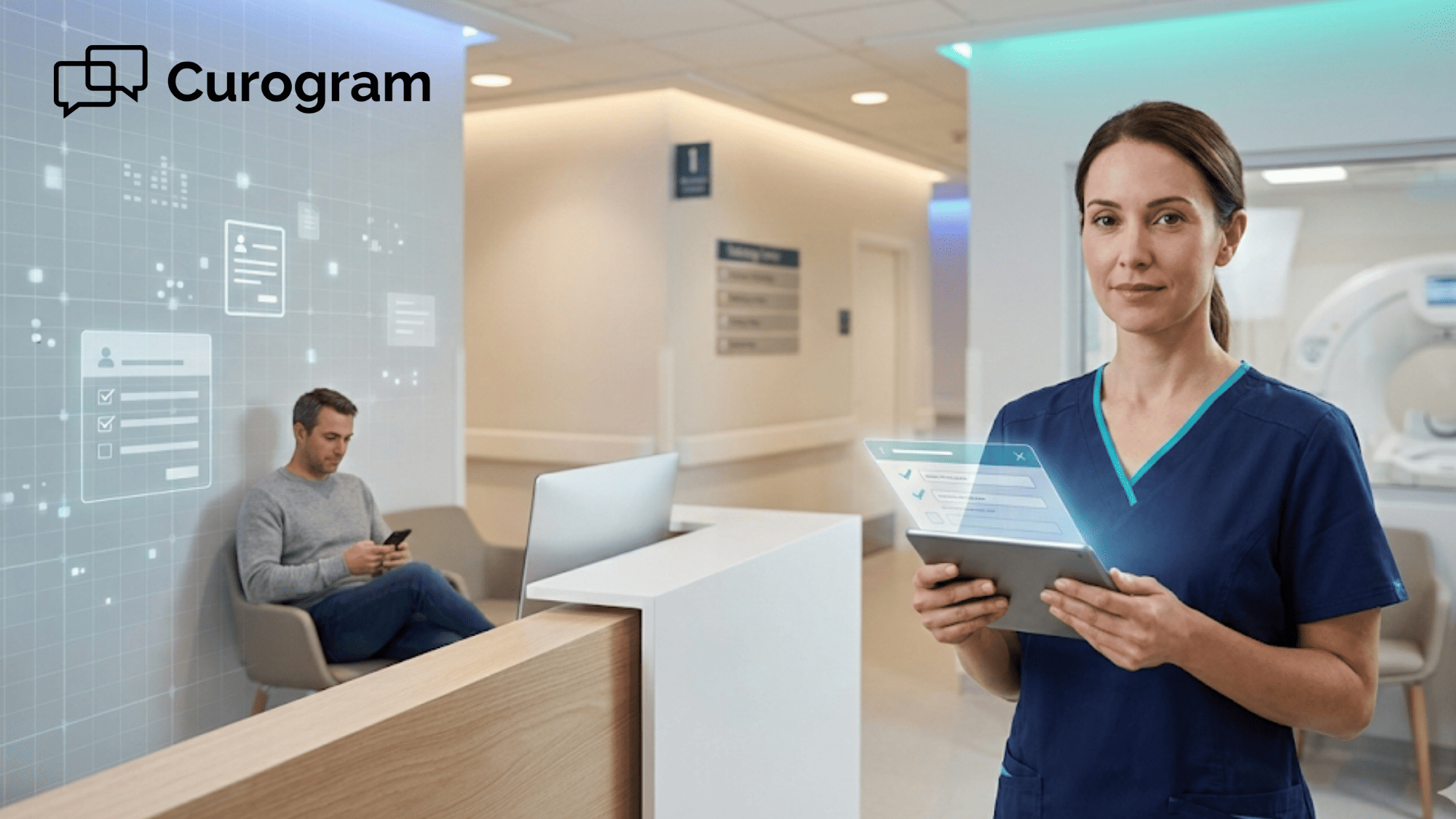
Reputation management tools help you collect reviews and monitor your online presence. Online patient forms let people complete paperwork before they arrive. Text-to-Pay simplifies billing and speeds up collections.
Each of these workflows connects with telehealth. Together, they create a communication ecosystem that saves time and money at every step. The financial gains multiply when these systems work in concert.
How Curogram Powers Telehealth for StreamlineMD Practices
StreamlineMD practices need a telehealth partner built for their specific workflows. That's where Curogram comes in.
Curogram was designed for high-volume specialty practices. It integrates directly with StreamlineMD, so patient data flows seamlessly. Your team doesn't toggle between systems. Everything works together.
The platform supports HIPAA-compliant messaging, video visits, and automated outreach. You can send prep reminders, collect forms, and answer questions—all from one dashboard. Staff learn the system quickly. Patients find it easy to use.
For radiology, vascular, and IR practices, Curogram addresses the exact pain points that drain revenue. Prep verification happens through secure text. Medication hold confirmations are documented automatically. Questions get answered without phone calls.
The results speak for themselves. Practices using Curogram report fewer cancellations, lower call volume, and higher patient satisfaction. The hybrid care workflow becomes simple to manage.
Curogram also supports the related automations that multiply your investment. Appointment reminders, mass texting, Text-to-Pay, and reputation management all live in the same platform. You get a complete communication stack, not just a telehealth add-on.
When you expand access with StreamlineMD telehealth through Curogram, you're choosing a solution built for your needs. The telemedicine ROI shows up in daily operations and long-term growth.
Setup is straightforward. Curogram's team handles the integration with your existing StreamlineMD system. Training takes hours, not weeks. And support is available when you need it.
If you're ready to protect revenue, cut costs, and improve patient experience, Curogram makes it happen. The platform turns telehealth from an idea into a working system that delivers real results.
Communication gaps cost imaging practices real money every day. Missed prep leads to failed exams. Phone-heavy workflows drain staff time. Patients leave frustrated and write bad reviews. Telehealth closes these gaps.
When you expand access with StreamlineMD telehealth, patients arrive prepared. Staff spend less time on the phone. Procedures stay on schedule. Revenue stops leaking through preventable failures.
The hybrid care workflow combines in-person care with virtual touchpoints. You reach patients before problems develop. You answer questions without playing phone tag. You document everything automatically.
The telemedicine ROI is measurable. Fewer cancellations mean more billable studies. Lower call volume means lower staffing costs. Better patient experience means stronger reviews and more referrals.
These gains compound over time. Patients who feel cared for come back. Staff who feel less stressed stay longer. Practices that communicate well grow faster.
Modern imaging demands modern communication. Phone calls and paper handouts worked in the past. They don't work now. Patients expect digital access. Your competitors are moving forward.
StreamlineMD plus Curogram creates the scalable, efficient system your practice needs. The integration is seamless. The workflows are proven. The results are real.
You've seen the numbers. You understand the opportunity. The only question is whether you'll act on it.
Every week you wait is another week of lost revenue and unnecessary friction. Every month is another chance for competitors to pull ahead. The solution exists. The technology works. The ROI is clear.
Book your demo today to see how Curogram and StreamlineMD telehealth improve financial and operational performance for your practice.
Patients feel less anxious when they can message staff directly with questions. Quick, clear answers build trust. This reduces stress before high-acuity procedures and leads to better satisfaction ratings.
Curogram integrates directly with StreamlineMD, so data flows automatically. It also includes appointment reminders, reputation management, and Text-to-Pay in one platform. You get a complete communication system, not just video visits.
Most practices see reduced call volume and fewer cancellations within the first three months. Financial gains often appear within 90 days as prep compliance improves and staff efficiency increases.
💡 Online patient forms help StreamlineMD radiology, vascular, and IR practices save money and boost revenue. Faster check-in cuts wait times and...
💡 Imaging centers using StreamlineMD can cut no-shows and boost prep success with automated reminders. Curogram's platform sends timely, clear...
💡 Automated appointment reminders help imaging centers using Veradigm reduce no-shows and improve daily operations.Key Benefits: Cut missed...