10 min read
How SmartCare EHR Text-to-Pay Setup Speeds Your Billing Workflow
Mira Gwehn Revilla
:
June 23, 2026
To get started:
- Set your payment amounts, including copays and sliding-scale fees.
- Choose your triggers, such as "after each session."
- Write a short message template with a payment link.
- Turn on reminders for any unpaid balance.
- Track paid and pending payments in one dashboard.
Paper statements are quietly draining your practice. Each month, your billing team prints, folds, and mails them. Then most come back unpaid. For behavioral health organizations on thin margins, that is a serious leak.
The math is hard to ignore. Mailing statements can cost a practice $800 to $1,000 per location each month. Yet paper billing often collects only about 20% of what is owed. You spend more to collect less.
The problem grows worse for your clients. Many people you serve face housing instability or serious mental illness. A statement mailed to an old address may never arrive. A client managing substance use or court-mandated care already tracks enough.
So the bill goes unseen. The balance grows. The next visit feels heavier, and some clients drop out. A billing gap quietly becomes a treatment gap. The care happened, but the dollars never came in.
SmartCare EHR handles your clinical work well. It stores notes, claims, and records that keep your practice running. But SmartCare was built for documentation, not for chasing payments through the mail.
That is where text-to-pay changes the picture. Almost everyone reads a text within minutes. A secure link meets clients where they already are, on their phone. No stamp, no envelope, no long wait.
This guide shows how a SmartCare EHR text-to-pay setup improves your billing workflow. You will see how to configure amounts, triggers, and templates. You will learn how Curogram works alongside SmartCare, not in place of it.
The goal is simple. Spend less on paper. Collect more of what you earn. And make paying easier for the clients who need that ease the most.
By the end, you will have a clear, practical path to faster collections by text. Let us start with the real cost of paper.
The Villain: Billing Staff Buried in Paper with 20% Returns
SmartCare EHR does the clinical heavy lifting well. It holds your notes, claims, and treatment records in one place. Your team trusts it to keep care and billing organized. The gap is not in your records. It is in how the bill reaches the client.
After a session, the balance lives in SmartCare. But the client is already gone. So your billing staff falls back on paper. They print the statement. They fold it, stuff the envelope, and add a stamp. Then they mail it and wait.
The Wait is the Trap
Mail is slow, and many statements never get read. People move. Addresses change. The bill sits in a pile or gets tossed with the junk mail.
Walk through what your staff faces each cycle. They print stacks of statements. They check addresses by hand. They mail round one, then wait two weeks. When nothing comes back, they mail round two. Some practices mail three or four times before they give up.
|
Consider a simple example: Say one location mails 500 statements a month. At a 20% collection rate, only 100 clients pay. The other 400 balances roll over or vanish. Next month, staff repeat the cycle, often for the same accounts. Each round costs money. Paper, ink, envelopes, and postage add up fast. Staff hours add up even faster. Industry estimates put paper statement costs near $800 to $1,000 per location each month. Over a year, that is close to $12,000 for a single site. |
The return on that spend is poor. Paper billing often collects only about 20% of the balances owed. You pay more and recover less. That is the collections drain in plain terms.
Now add the human cost. Many behavioral health clients face housing instability. A statement mailed to a shelter or old address may never arrive. A person with serious mental illness has enough to manage. So does someone in court-mandated treatment or substance use recovery.
For these clients, a paper bill is easy to miss. The balance grows in silence. The next visit feels heavier. Some clients skip that visit to avoid a bill they cannot pay all at once. Others stop answering calls about money they do not have.
Where Billing Pain Becomes Care Pain
A missed payment can lead to a missed appointment. A missed appointment breaks the rhythm of treatment. For people who need steady support, that break can be costly. Continuity of care suffers, and so do outcomes.
Your billing staff feel the weight too. They spend hours on a task that returns little. Instead of working complex claims, they chase paper. That low-value grind wears people down. Over time, it leads to burnout and turnover, which costs you even more.
Picture the end of a busy month. Your team has mailed hundreds of statements and called dozens of clients. The aging report still shows large unpaid balances. Effort went up, but collections barely moved. That is the trap working exactly as designed.
Meanwhile, the revenue you earned stays unpaid. The care happened. The work was real. But the dollars never reached your practice. This is the villain behind so many behavioral health budgets. It is not your clinical care, and it is not SmartCare EHR. It is the paper statement trap, slow and costly, and easy for clients to miss.
The good news is simple. This problem has a clear fix. The next section shows how to close the gap with text.
The Guide: Setting Up Text-to-Pay for Behavioral Health
Curogram is the revenue recovery partner that closes the gap paper leaves open. It is a HIPAA-compliant platform that swaps mailed statements for secure text links.
Clients get a payment request by SMS and pay in seconds. Many practices see collection rates double or triple after the switch.
Why the big jump? Texts get read. Almost everyone opens a text within minutes, while paper bills sit unread for weeks. When the path to pay is short, more people finish it.
The feature that drives this is Curogram Text-to-Pay. It sends each client a secure link tied to their balance. They tap, pay by card, and you see the payment land. No paper, no portal logins, no long hold times.
How a SmartCare EHR Text-to-Pay Setup Works in Practice
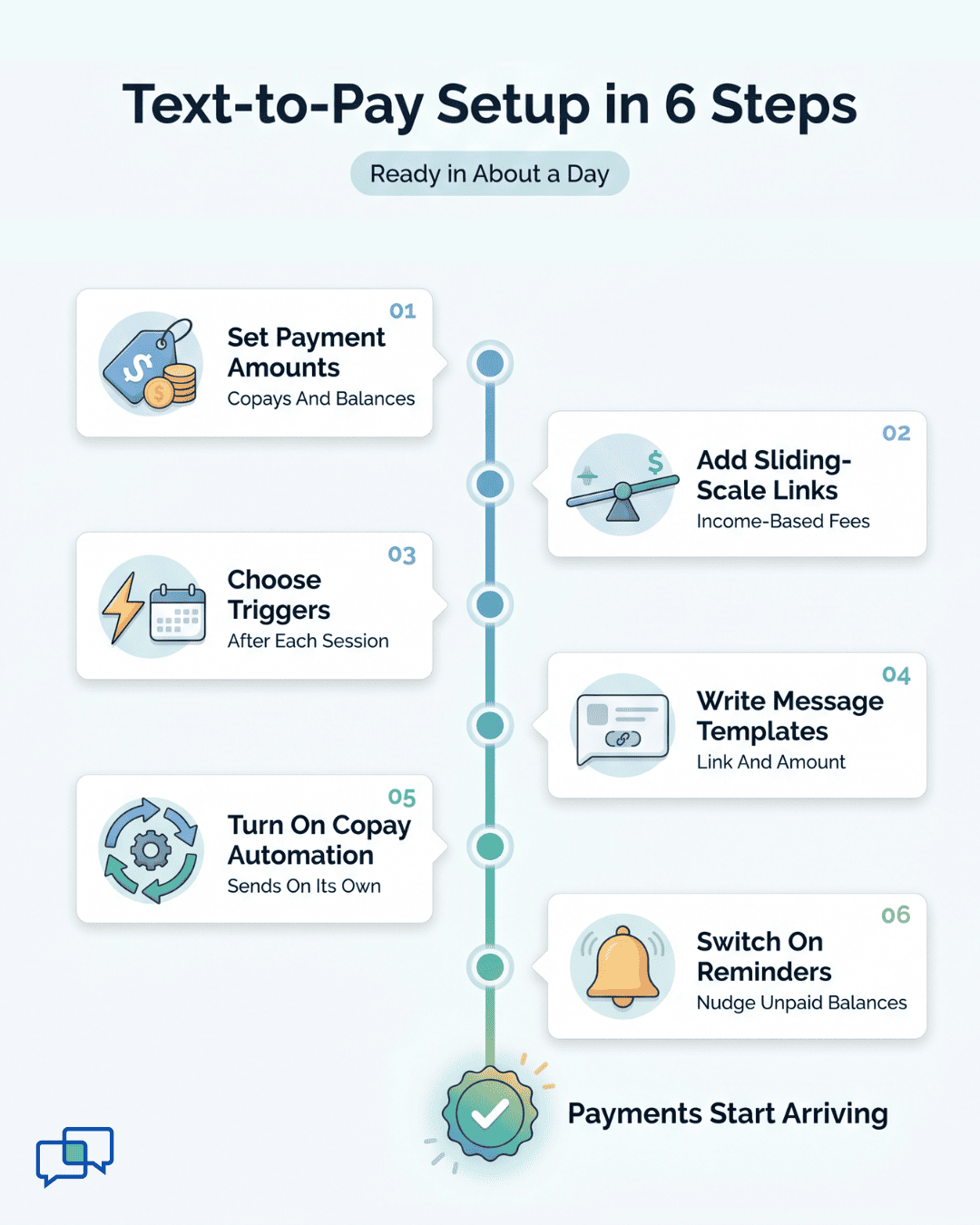
The steps are quick, and no SmartCare API is needed:
- Set your payment amounts. Add fixed copays and custom balances.
- Build sliding-scale payment links for clients on income-based fees.
- Choose your triggers, like "after each session" or "on balance due."
- Write short message templates with the link and amount.
- Turn on copay collection automation so requests send on their own.
- Switch on reminders for any unpaid balance.
Your SmartCare payment setup stays focused on clinical billing and claims. Curogram handles the client-facing side. Clinical notes and records never leave SmartCare. Payment and messages flow through Curogram instead.
Think of it as two tools with clear roles. SmartCare is your system of record. Curogram is your channel to the client. They run side by side, not on top of each other. You add a payment path without touching your clinical setup.

How SMS Billing Workflow Fits Behavioral Health
Your clients live on their phones, not in their mailboxes. A text reaches them at a shelter, a job site, or a friend's home. The message moves with them.
A simple behavioral health text payment configuration also protects privacy. For 42 CFR Part 2 organizations, the text shows only a link and an amount. It names no service and no diagnosis. The client sees a payment request, nothing more.
That fit matters for the people you serve. Clients with serious mental illness need fewer barriers, not more. People in substance use recovery face enough friction already. Those in court-mandated care juggle many demands at once.
For CCBHCs with wide, complex caseloads, the gain adds up across thousands of visits. Small frictions, removed at scale, free real staff time and real dollars. The same short text that collects a copay can also nudge a missed balance.
Reminders Matter as Much as the First Request
A gentle follow-up text, sent a few days later, catches clients who meant to pay but forgot. You set the timing once, and the system handles the rest. No one on staff has to remember who still owes.
Some worry that a text feels cold or impersonal. In practice, the opposite is true. A short, respectful text on the client's own phone feels easier than a formal letter. It lets people pay without shame, on their own time.
You can also accept payment in parts. A client paying $10 today beats a $0 paper bill ignored for months. Text-to-pay makes that small, steady progress simple.
The result is a billing process built around the client, not the post office. You stop guessing whether a statement arrived. You start seeing payments come in within hours, not weeks. Next, we will look at what changes once payments arrive by text.
The Success: What Changes When Payments Arrive via Text
When payments arrive by text, the billing office feels different. The work shifts from chasing paper to managing results. Let us look at the three biggest changes:
1. You Erase a Steady Monthly Cost
Paper statements run near $800 to $1,000 per location each month. Text links cut most of that spend. There is no paper, no postage, and far less printing. A practice with three sites could save tens of thousands a year.
Run the math for one location. Mailing 500 statements may cost about $900 a month. That is roughly $10,800 a year, just to send bills. Text-to-pay removes most of that line item. The savings drop straight to your bottom line.
2. You Collect Much More of What you Earn
Paper billing often returns about 20%. Many practices see collection rates double or triple after moving to text. That can mean a jump from 20% to 40% or 60%.
Put that in dollars. Say you bill $50,000 in client balances a month. At a 20% paper rate, you collect $10,000. At a 50% text rate, you collect $25,000. That is $15,000 more, from the same care already given.
Here is a simple before-and-after view.
|
Measure |
Paper statements |
Text-to-pay |
|
Time to reach client |
1 to 2 weeks |
Minutes |
|
Typical collection rate |
About 20% |
2 to 3X higher |
|
Cost per location each month |
$800 to $1,000 |
Far lower |
|
Client effort to pay |
Find checkbook, mail it |
Tap a link, pay by card |
|
Staff effort |
Print, stuff, mail, repeat |
Set triggers, monitor |
3. Your Billing Staff Get Their Time Back
They stop printing and stuffing envelopes. The copay collection automation handles routine requests on its own. That frees skilled staff to work complex claims and denials that truly need a person.
This is where the real value hides. A trained biller chasing $40 copays is costly work. Move that task to an automated text, and the same biller can fight a denied claim worth far more. You spend staff hours where they pay off most.
There is a staffing win worth naming. A biller freed from envelopes can chase denied claims instead.
One recovered claim can be worth hundreds of dollars. That is a far better use of skilled time than stuffing mail. Over a year, that shift alone can fund part of a salary.
Your aging report tells the story over time. The 60-day and 90-day columns shrink. Balances clear closer to the date of service. Cash flow becomes steadier and easier to plan around.
None of this asks your clinicians to change how they work. Documentation stays in SmartCare, exactly as before. The billing shift happens in the background, through Curogram. Clinicians see calmer clients and fewer money worries at the door.
Add it all up and the office runs leaner. Costs fall. Collections rise. Staff time goes to high-value work. And clients face one less barrier to care. That is what changes when payments arrive by text.
The gains do not stop at lower costs and faster cash. They add up to real dollars you can estimate ahead of time. Run your own numbers and see the potential ROI in increasing payment collection for your practice.
.png?width=2000&height=1125&name=How%20SmartCare%20EHR%20Text-to-Pay%20Setup%20Speeds%20Your%20Billing%20Workflow-inline2%20(1).png)
How Curogram Recovers the Revenue Paper Statements Leave Behind
Curogram's Text-to-Pay turns every session into a chance to get paid. The moment a balance is due, a secure link can go out by text. The client taps, pays by card, and the balance clears. No envelope, no portal, no wait.
The link is built for behavioral health from the start. It carries only an amount and a secure payment page. It names no service and no diagnosis. That keeps messages safe for 42 CFR Part 2 organizations and respectful for every client.
Sliding-scale payment links make fair billing simple. Each link carries the exact income-based fee, so clients never overpay. Staff send the right amount in seconds, with no manual math.
Behind the scenes, a single dashboard tracks it all. Staff see paid, pending, and outstanding balances in real time. They can filter by date, amount, or status to manage the day's billing from one screen. Nothing slips through the cracks.
Automation keeps the whole process light on staff. You set the rules once, and the system sends each request and reminder on time. No one has to track who owes or mail a second notice. The work that used to fill hours now runs quietly in the background.
The proof shows up in client behavior. Based on our internal data, more than 75% of clients confirm appointments by text. That same trust drives payments. When the ask is short and the path is clear, people respond.
Best of all, Curogram works alongside SmartCare EHR, not on top of it. Your clinical records stay in SmartCare. Your payments and messages flow through Curogram. Together, they help you collect more, spend less, and keep care moving forward.
Conclusion: Eliminate Paper Statements and Recover Revenue
SmartCare EHR is the clinical backbone of your practice. It holds your notes, claims, and records with care. What it does not do is carry the bill to the client. That last step is where revenue slips away.
Text-to-pay closes that gap. It extends SmartCare's reach all the way to the client's phone. The session ends, a secure link goes out, and payment arrives in hours. No stamps, no waiting, no guesswork.
Think of the split in simple terms. SmartCare EHR is for your clinical data. Curogram is for your clients' convenience. Together, they build a practice that is both clinically strong and easy to reach.
The payoff is real. You cut paper statement costs that drain your budget. You collect more of what you already earned. And you free billing staff to work the complex claims that need a human touch.
For behavioral health clients, the gain is personal too. A short text on their own phone feels easier than a formal letter. It lets people pay small amounts, on their own time, without shame.
The recovered dollars do not stop at billing. When payments and reminders work together, fewer clients drop out of care. Closing the billing gap helps close the treatment gap as well. That is a win for your margins and your mission.
Cut paper statement costs and double your collection rate. Schedule a demo today and find out what text-to-pay could recover for your practice.
Frequently Asked Questions
Text-to-Pay keeps every payment message free of clinical detail. The text shows only a secure link and an amount, with no service or diagnosis named. Processing is encrypted and meets PCI-DSS standards, which suits 42 CFR Part 2 organizations well.
Basic setup can be finished within a single day. Curogram gives you default payment templates and processing ready to go. You can add custom sliding-scale workflows and automated reminder sequences later, step by step, as your team grows comfortable.
Curogram's dashboard shows real-time payment status for every text sent. Staff see which clients have paid, which are pending, and which still owe. You can filter by date, amount, and status to manage the whole billing workflow in one view.
Text links collect more because people read texts within minutes, not weeks. A paper bill can sit unread or reach an old address. A link lets clients pay in seconds, right from their phone, with no login required.
Staff can attach sliding-scale payment links matched to each client's income-based fee. The link carries the exact amount owed, so clients never overpay. This keeps fair, fee-based billing simple and removes the guesswork from collecting reduced balances.