9 min read

5-Minute Clinical Consultations | RamSoft Telemedicine | Curogram

5-Minute Clinical Consultations | RamSoft Telemedicine | Curogram
💡 Imaging center staff spend 2–3 hours daily on phone tag — chasing patients before procedures, coordinating with referring physicians, and managing last-minute cancellations.     

Most of this communication happens through voicemails that go unreturned.

Staff-initiated video consultations, sent via a simple text link, replace that phone tag with face-to-face conversations that take about 5 minutes. No app downloads. 

No portal logins. Patients tap a link and connect instantly.

When integrated into the RamSoft workflow, this pre-procedure consultation model reduces day-of cancellations by up to 40%, reclaims hours of staff time each day, and improves scanner utilization across every location.

Imagine this.

It is 7:45 in the morning. Your MRI suite opens in 15 minutes. The phone is already ringing.

A patient is calling for the third time this week — anxious about claustrophobia, not sure she can go through with the scan. Your nurse coordinator has been trying to reach a different patient about a contrast allergy flagged in his intake form.

The referring physician's office left a voicemail yesterday asking for verbal results on an urgent finding. And your scheduler just found out that a non-English-speaking patient's family never got the prep instructions because nobody could get them on the phone in time.

All of this is happening before the first scan of the day.

None of it is unusual. In fact, it is Tuesday.

This is the reality your imaging center staff live in every single day. And the frustrating part is that most of these conversations do not take long.

Clarifying a contrast allergy concern? Five minutes. Reassuring an anxious patient about the MRI process? Maybe seven. Connecting a radiologist with a referring physician about an urgent finding? Under ten minutes, if you can actually reach them.

The problem is not the conversations themselves. It is the channel you are using to have them.

The phone works fine for a lot of things. Real-time clinical coordination before a procedure is not one of them. Voicemails stack up. Callbacks miss. Staff scramble. Patients show up unprepared — or they do not show up at all.

And when a patient cancels the morning of a procedure, that is not just an inconvenience.

That is 45 to 60 minutes of empty scanner time, with no revenue attached to it, and a full hour of cleanup coordination your team now has to manage on top of everything else.

For imaging centers running on RamSoft, this communication gap is a significant and solvable inefficiency.

The infrastructure is world-class. The workflow tools are advanced.

But there has been no clear pathway for the kind of real-time, face-to-face clinical conversations that prevent these day-of breakdowns.

Until now.

Why Pre-Procedure Phone Tag Is Costing Your Imaging Center More Than You Think

Every imaging center deals with it. The question is whether you are measuring what it actually costs.

The Hidden Hours

Think about the numbers for a moment. If your staff spend just 2.5 hours per day on phone tag — leaving voicemails, waiting for callbacks, repeating the same information to patients who missed the first call — that adds up to roughly 12.5 hours per week.

Per team member. For a center running five clinical staff, that is over 60 hours of coordinating time each week spent on a channel with a notoriously poor response rate.

That is not just a morale problem. That is a throughput problem.

Staff Time Lost to Phone Tag

A team of 5 clinical staff spending 2.5 hrs/day on phone tag burns through 62.5 hours per week — time spent on a channel with a notoriously poor response rate.

That is not a scheduling problem. That is a communication infrastructure problem.

The Revenue You Do Not See Leave

Here is the part that hits harder.

Each day-of cancellation from an anxious or unprepared patient wastes 45 to 60 minutes of scanner time.

At a conservative reimbursement rate of $400 per scan slot, a single preventable cancellation per day costs your center roughly $2,000 per week — or over $100,000 per year — in lost scanner revenue alone.

These are not worst-case projections.

They are the quiet math that runs in the background of an imaging center that relies entirely on the phone to manage pre-procedure clinical communication.

And here is what makes it worse: most of these cancellations are preventable. Anxiety-driven no-shows. Unprepared patients who did not get their prep instructions. Contrast allergy concerns that were never resolved because nobody could reach the patient before they showed up.

The Cost of One Preventable Cancellation

At $400 per scan slot and 1 cancellation per day, your center is leaving roughly $2,000/week — or $100,000+/year — on the table.

And that figure does not include the hour of coordination cleanup that follows each one.

A 5-minute video conversation — started by your staff the day before the procedure — would have stopped most of them from happening.

Why the Phone Keeps Failing Your Team

The phone is not a bad tool. It is just the wrong tool for this kind of work.

A Typical Morning, on Repeat

Pre-procedure clinical communication is urgent, time-sensitive, and sometimes complex.

You need to assess whether a patient is a good candidate for contrast. You need to walk a nervous patient through what to expect in the scanner. You need to connect a radiologist directly with a referring physician about a critical finding.

None of these things work well on hold or through voicemail.

Walk through a typical morning at any busy imaging center.

A nurse coordinator tries to reach a patient about a documented contrast allergy.

She calls twice before 9 a.m. No answer. She leaves a voicemail.

The patient sees a missed call from an unknown number and ignores it. The patient shows up the next morning for the CT. The allergy was never confirmed or addressed. The study gets cancelled. The scanner sits empty.

Nobody failed in that story. The system failed.

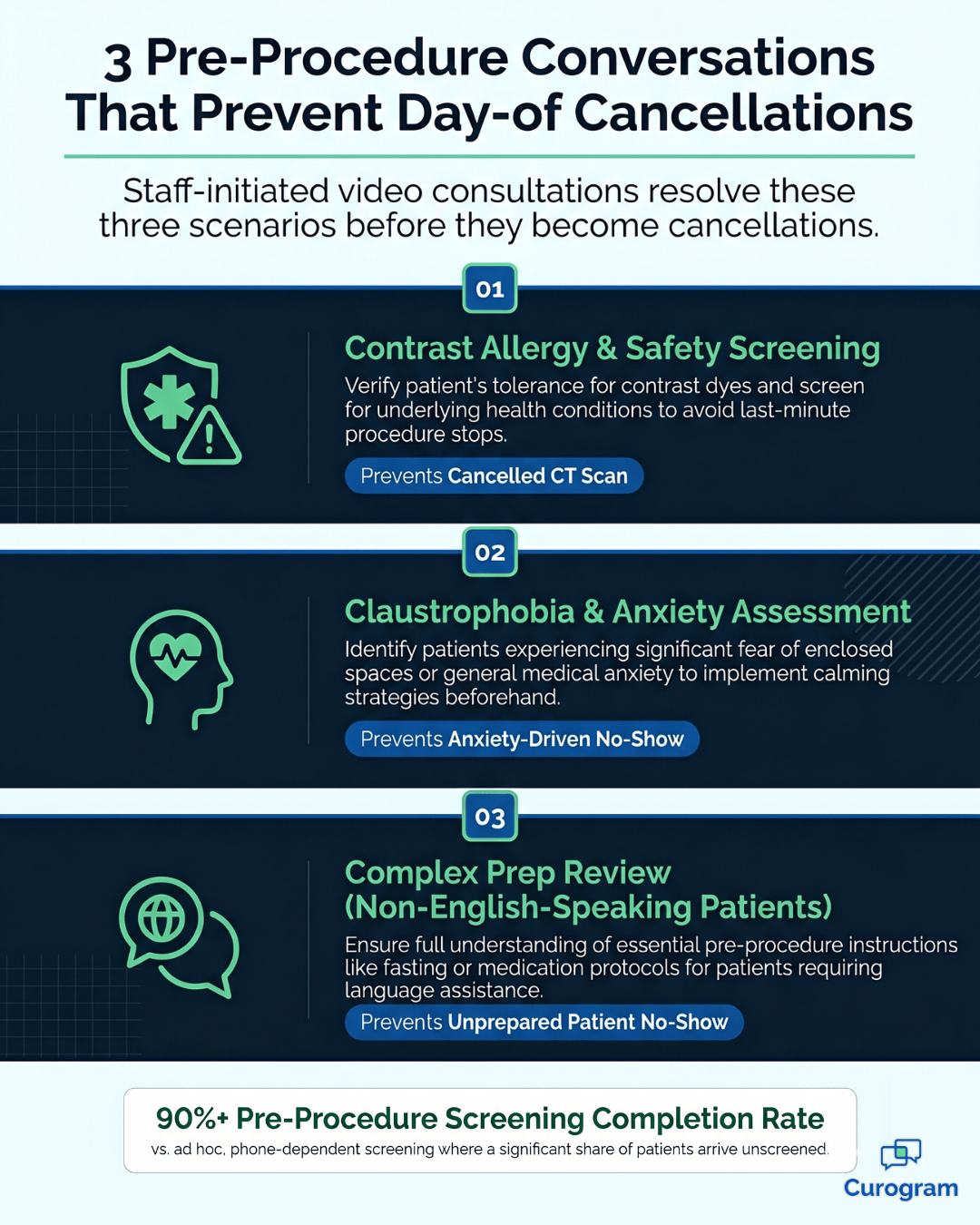
Pre-procedure screening types that prevent imaging center cancellations

Where the Phone Falls Short

The phone creates a chain of missed connections that feel manageable until you look at how often it happens.

Research from healthcare operations teams suggests that imaging centers field an average of 30 to 50 pre-procedure-related phone calls per day.

A significant portion of those require multiple attempts before reaching the right person.

The conversations that fall through the cracks most often include:

  • Contrast allergy and safety screenings that go unconfirmed before a CT
  • Claustrophobia or anxiety disclosures that never make it to the technologist
  • Prep instruction reviews for patients who need more than a printed handout
  • Urgent finding callbacks to referring physicians that sit in a voicemail queue for hours

Each failed attempt requires follow-up. Each follow-up eats into the time your technologist workflow efficiency depends on.

Referring Physician Response Time

When coordination happens by phone, it is common for urgent finding callbacks to take hours to days before the referring physician responds.

That delay does not just slow down care — it strains the referring relationship and puts your center at a disadvantage against competitors who communicate faster.

It sounds like a small friction. It is not. At scale, it is the single biggest source of daily inefficiency that imaging center staff do not have a proper tool to solve.

RamSoft provides excellent imaging infrastructure. Its AI reads the study.

Blume, its patient-facing platform, gives patients access to their results through a ChatGPT-powered interface.

But neither RamSoft nor Blume provides a pathway for the real-time clinical conversations that need to happen before a patient even walks through the door.

That is the gap. And it is costing your center hours every single day.

Staff-Initiated Video Consultations

The solution is not a new phone system. It is not a patient portal with a messaging inbox that nobody checks. It is a text link.

How It Works in Practice

Here is how it works. Your staff opens the Curogram dashboard — the same platform they use for appointment reminders and intake forms — and sends a patient a text message.

The message includes a link. The patient taps it. A video call opens directly in their browser.

No app download. No account creation. No password. The conversation happens immediately.

That is the full workflow. From the staff side, it takes under a minute to initiate. From the patient side, it takes a single tap.

This is what Curogram brings to the RamSoft environment:

A staff-initiated video consultation layer that sits directly on top of the existing workflow. It does not replace anything your team already does.

It replaces the one thing that was never working — the phone tag.

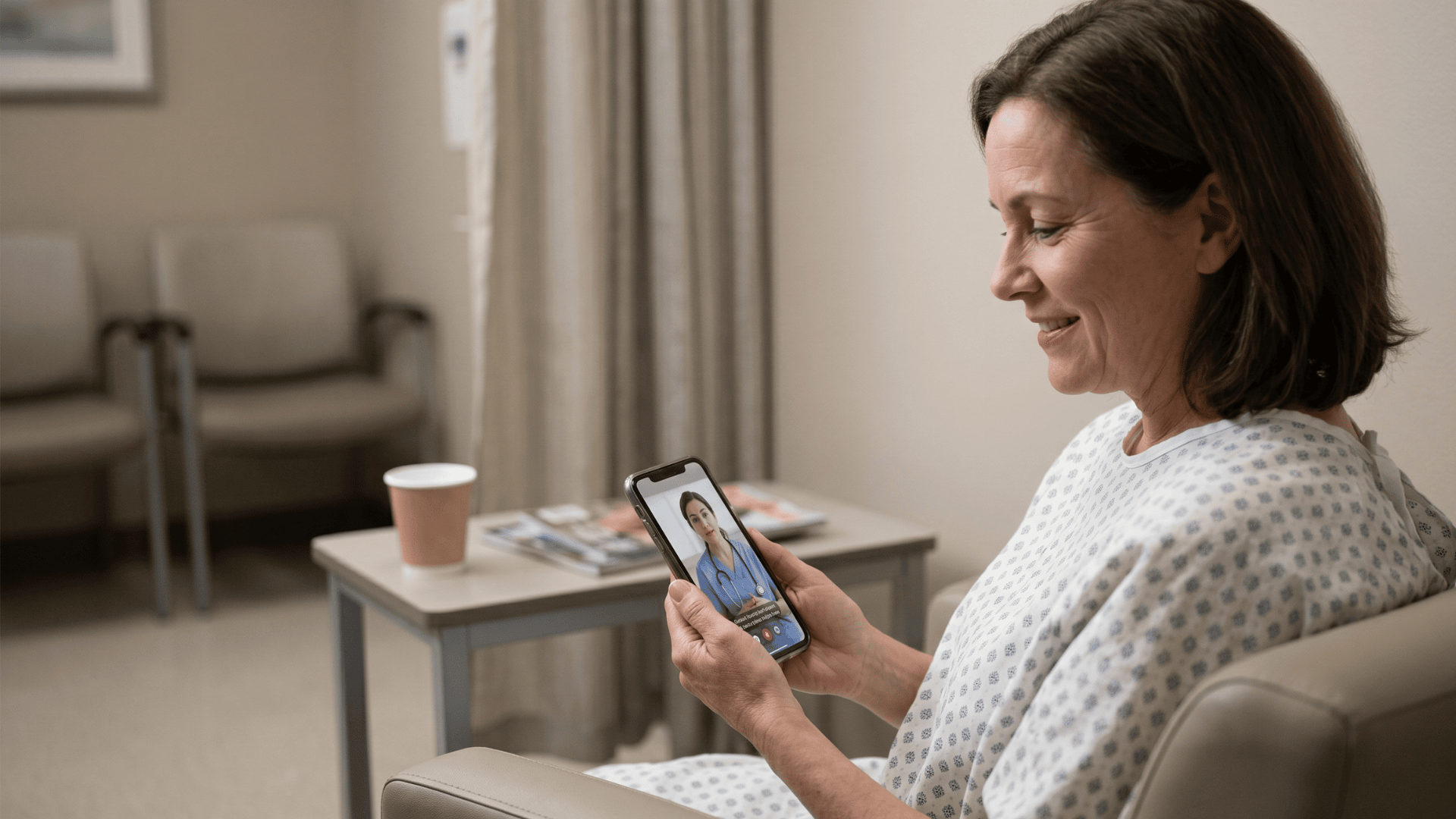
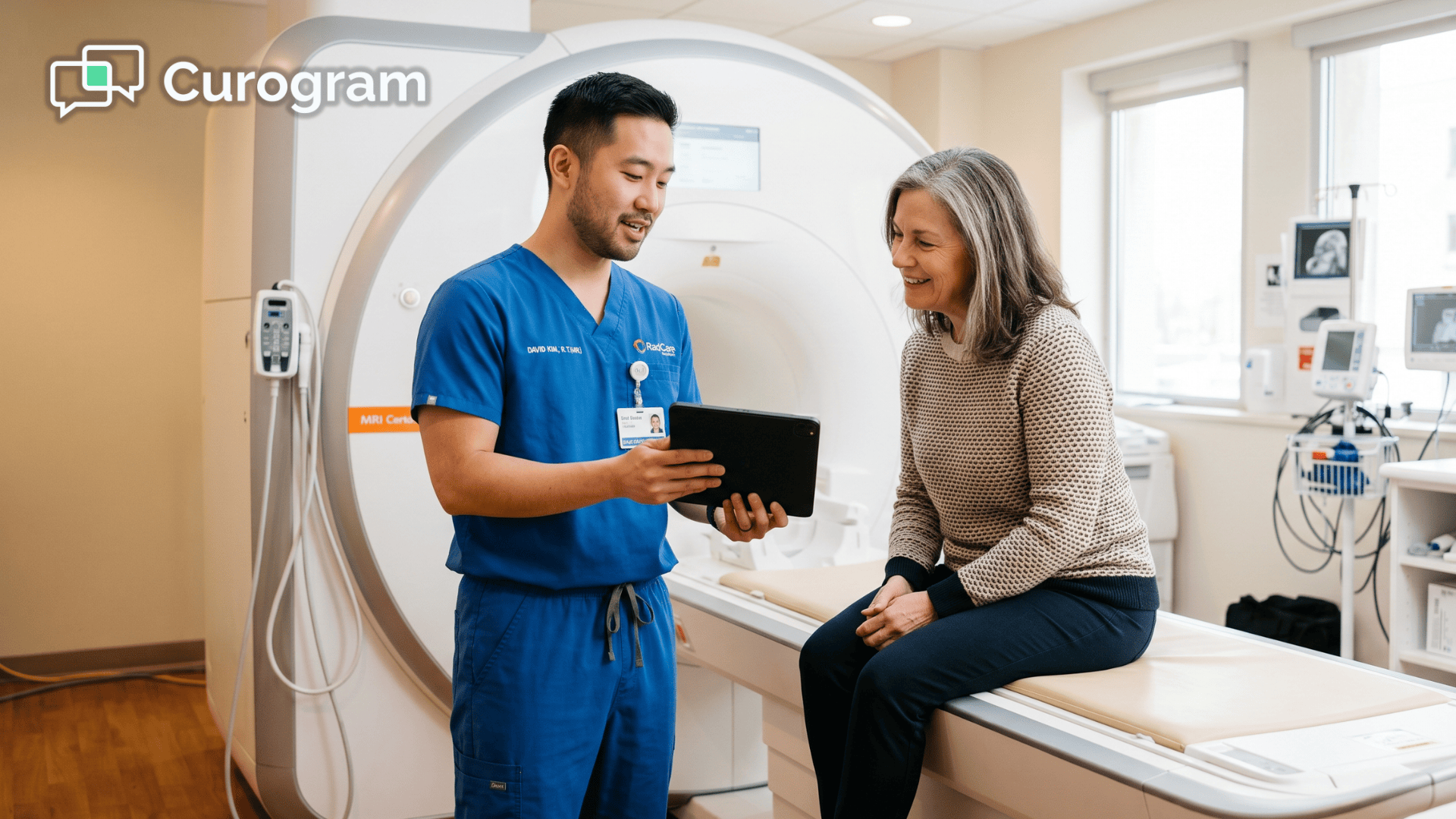
Patient reviewing pre-procedure video consultation on smartphone before MRI

Three Consultation Modes, One Platform

There are three primary consultation modes built into the workflow:

  • Pre-procedure screening: contrast allergy confirmation, claustrophobia assessment, complex prep instructions for non-English-speaking patients or families
  • Results discussion: a radiologist walks a patient through findings face-to-face, without scheduling a separate in-person visit
  • Referring physician consultation: a radiologist connects directly with a referring provider to discuss an urgent finding in real time — cutting turnaround from days to minutes

Each conversation is initiated by staff, not waiting for a patient to reach out first. That shift — from reactive to proactive — is what closes the gap between a scheduled procedure and a completed one.

Pre-Procedure Screening Completion

Centers using proactive staff-initiated video outreach before procedures see pre-procedure consultation completion rates reach 90%+ — compared to the ad hoc, phone-dependent approach where a significant share of patients arrive unscreened or unprepared.

Built for Multi-Location Scale

For multi-location imaging centers, Curogram also supports standardized consultation protocols across every site.

A VP of Operations can track pre-procedure consultation rates, day-of cancellation trends, and referring physician engagement metrics network-wide, all from a single dashboard that works alongside the RamSoft telemedicine integration.

Healthcare everywhere! Launch a pervasive telehealth platform that's easy for both providers and patients with Curogram.

All consultation activity runs through HIPAA-compliant for telemedicine infrastructure. Notes from video calls can be added to patient records.

Video links are generated and sent from the same platform your team already uses for reminders — so there is no new tool to learn and no additional login to manage.

What the Numbers Look Like When You Stop Relying on the Phone

When imaging centers shift from reactive phone coordination to proactive video consultation, the change shows up in three specific places: cancellation rates, staff hours, and referring physician response time.

Fewer Cancellations, More Recovered Revenue

Day-of cancellations drop when patients receive a pre-procedure consultation 24 to 48 hours before their study. Imaging centers that implement staff-initiated video outreach before procedures report reductions in anxiety-driven no-shows and day-of cancellations of up to 40%.

For a center that currently loses one scan slot per day to cancellation, that 40% improvement alone recovers roughly $40,000 to $50,000 in scanner revenue annually.

Staff Get Their Time Back

Staff reclaim meaningful time. When the pre-procedure screening telemedicine model is running, clinical conversations that previously required 5 to 6 phone attempts and a 24-hour turnaround happen in a single 5-minute video call.

For a team spending 2.5 hours per day on phone tag, shifting even half of that to video consultation recovers over an hour of productive staff time daily — time that goes back into direct patient care, scheduling, and throughput.

Referring Physician Relationships Improve

Referring physician communication tightens up.

When radiologists can send a radiology staff video consultation link directly to a referring physician's mobile device, response time on urgent findings drops from a day or more to minutes.

That faster loop supports stronger referring relationships and positions your center as the easier, more responsive partner to work with.

This is the difference between an imaging center where staff are managing fires all morning and one where the day starts with every patient already prepared, every referring physician already looped in, and every scanner slot filled by someone who knows exactly what to expect.

The shift is not complicated. It is a text link. The imaging center referring physician communication model does not overhaul anything — it fixes the one thing that was always broken.

Stop Losing Scanner Revenue to Voicemail — See It in Action

Every day your imaging center staff spend 2 to 3 hours chasing patients and referring physicians by phone is a day where scanner utilization, team morale, and patient experience all take a quiet hit.

Most of that time is spent on clinical conversations that could be resolved in 5 minutes — if there was a faster, more reliable way to have them.

There is now.

Curogram's staff-initiated video consultation workflow is purpose-built for the kind of pre-procedure communication that prevents day-of cancellations, closes the loop with referring physicians faster, and gives anxious patients the face-to-face reassurance they need before their study.

The whole thing starts with a text. No apps. No portals. No extra training.

RamSoft handles the imaging. Blume explains the report. Curogram lets your team have the clinical conversation — face-to-face, in 5 minutes, via a text link your patient is already looking at on their phone.

The math is not complicated. If you prevent even one day-of cancellation every other day, you recover roughly $50,000 to $60,000 in annual scanner revenue.

If your staff reclaim just one hour per day from phone tag, that is 260 hours of productive clinical time per year going back into the work that actually grows your center.

That is not a hypothetical. That is what happens when you replace voicemail with video.

For multi-site imaging centers, the impact scales with every location you add. Standardized pre-procedure consultation protocols. Network-wide visibility into cancellation trends and referring physician engagement.

All of it built into the same dashboard your team already uses.

If you are ready to see how this works inside your RamSoft environment, the next step is straightforward. Schedule a Demo with Curogram and walk through exactly how staff-initiated video consultations would fit into your workflow — from the first text your nurse sends to the moment your scanner starts the study.


Frequently Asked Questions

Is Text-Link Video Telemedicine HIPAA Compliant?

Yes. All text-link video consultations use enterprise-grade encryption for data in transit and at rest. Video sessions are not recorded or stored unless staff explicitly enable recording with patient consent. HIPAA-compliant audit logs track all consultation activity. Integration with RamSoft ensures patient records remain secure and de-identified at every step.

How Much Training Do Staff Need?

Minimal. Staff send a text message with a pre-generated link. That is it. Patients tap, video opens, conversation happens. No special IT infrastructure, no portal logins, no software installation required. Training takes about 15 minutes.

How Do Consultations Get Scheduled?

There are two modes. On-demand means staff text a patient anytime for an immediate conversation. Scheduled means staff set a specific video consultation time the same way they schedule appointment reminders. Integration with RamSoft scheduling ensures consultations sync with patient appointments. Staff see everything in the unified Curogram dashboard — no switching between systems.

Can Referring Physicians Join a Video Consultation Directly?

Yes. Staff can send a clinical consultation text link to a referring physician's mobile device the same way they send one to a patient. The physician taps the link, the video opens in their browser, and the conversation with the radiologist happens immediately. No app, no login, no scheduling friction on their end. This is particularly useful for urgent findings that need real-time discussion rather than a phone chain.

Does This Work for Non-English-Speaking Patients?

It works well for that use case. Video gives staff a face-to-face channel where they can use interpretation services, communicate visually, and confirm patient understanding in a way that a phone call simply cannot replicate. For imaging centers serving diverse patient populations, this is one of the more meaningful advantages of video over phone — especially for complex prep instructions where misunderstanding a step can result in a cancelled or repeated study.


RamSoft Telemedicine: Video Consultations Via Text Link

RamSoft Telemedicine: Video Consultations Via Text Link

💡 RamSoft imaging center telemedicine video consultation text link HIPAA solutions close the communication gap that drives patient anxiety, day-of...
Read More
RamSoft Patient Text Access | No App for One Visit

RamSoft Patient Text Access | No App for One Visit

💡 Most imaging patients are one-time visitors. They're referred, they schedule, they get scanned — and they leave. They won't download a patient...

Read More
RamSoft Patient Texting | 2-Way HIPAA Beyond Blume

RamSoft Patient Texting | 2-Way HIPAA Beyond Blume

💡 RamSoft imaging center patient texting with two-way HIPAA communication solves a critical gap: most imaging patients never download the Blume...

Read More