


11 min read
Stop Chasing Copays | Text-Based Collection for Imaging Centers
Aubreigh Lee Daculug
:
April 20, 2026
Table of Contents
In RamSoft-powered centers, billing teams spend up to 80% of their time printing statements, dialing patients, and entering payments by hand — work that drains revenue and morale alike.
Curogram’s text-to-pay integrates with RamSoft, automates SMS payments, and posts results back automatically—boosting first-pay capture from 60% to 85%, cutting costs by 60%, and saving ~12 staff hours weekly.
The result: billing staff stop acting like a collection agency and start doing the strategic revenue work they were hired to do.
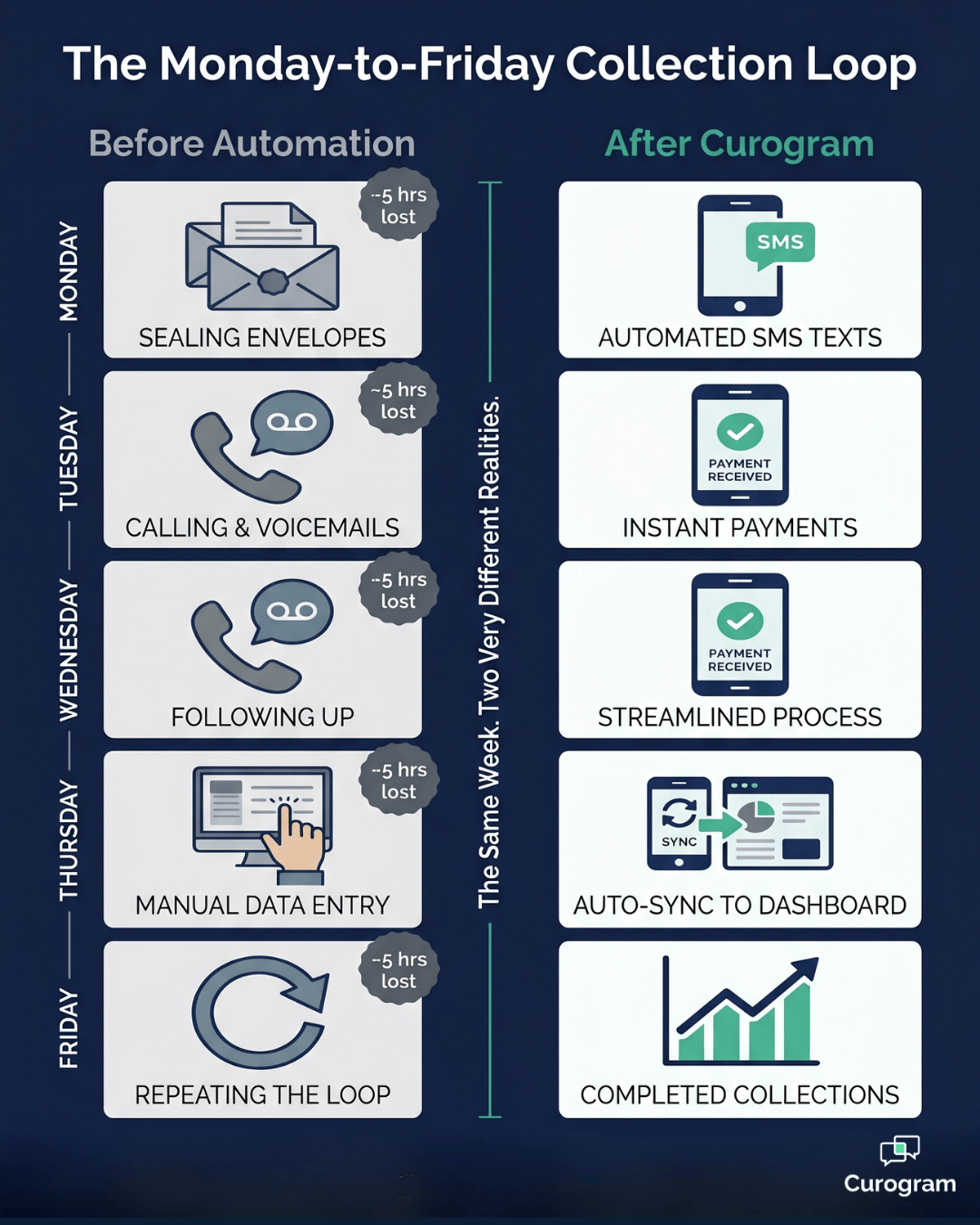
Picture your most experienced billing specialist on a Monday morning.
She's not reviewing denial trends or chasing a high-dollar insurance claim. She's printing 300 paper statements, stuffing them into envelopes, and hoping patients actually open them.
By Tuesday, she's on the phone. Leaving voicemails. Navigating hold music. Logging every attempted call by hand.
By Thursday, she's manually entering the handful of payments that came in — because your payment processor doesn't talk to RamSoft automatically.
Friday arrives, and the cycle resets with a fresh batch of new charges.
This isn't a staffing problem. It's a systems problem. And it's bleeding your imaging center dry in ways that don't always show up cleanly on a revenue report.
Here's what it actually costs.
Your center likely collects only about 60% of copays in the first 30 days. Each unpaid balance triggers at least one collection call. Each call eats 5 to 10 minutes of staff time.
Multiply that by a full week's worth of visits, and you're looking at more than $150,000 per year in pure collection overhead — before you factor in the revenue that simply never gets collected at all.
Think about that for a moment.
You hired skilled billing staff to optimize your revenue cycle. Instead, they're running a collection agency inside your imaging center.
The frustration is real. Staff trained in medical billing, denial management, and insurance verification spend their days leaving voicemails for patients who owe $35 copays. The high-value work — coding review, pre-authorization, payer contract analysis — sits undone.
Meanwhile, the imaging center revenue cycle quietly underperforms month after month.
The good news?
The problem isn't unfixable. It just requires the right tool in the right place. And as you'll see, the fix is simpler than you might expect.
When Your Billing Team Becomes a Collection Agency
RamSoft is a powerful platform. It handles scheduling, imaging workflows, and billing with real sophistication.
But here's the part nobody talks about:
Patient payment statements sent through a billing portal are easy to ignore.
Patients don't log in.
They don't check their portal. They wait for a paper bill, lose it, and eventually get a phone call they'd rather avoid.
That's where your billing staff gets stuck.
A Week in the Life of Manual Collection
The weekly rhythm at most RamSoft imaging centers follows a predictable — and exhausting — loop:
- Monday: Print and mail statements in bulk.
- Tuesday–Wednesday: Make outbound collection calls, leave messages, document everything manually.
- Thursday: Process whatever payments trickled in.
- Friday: Reconcile, re-queue unpaid balances, and start over.
This is what radiology billing automation is supposed to eliminate. Yet for most imaging centers running manual workflows, this loop never ends. It just gets slightly more demoralizing each week.
The Time Drain Hiding in Plain Sight
The math is punishing.
Consider a mid-sized imaging center handling 200 patient visits per week.
If 40% of copays aren't collected in the first 30 days, that's 80 patients per week going into a follow-up queue.
At 7 minutes per collection attempt, that's nearly 9 hours of staff time per week — just on initial follow-up.
Add re-attempts, manual entry, and reconciliation, and you're well over 12 hours per week per staff member burned on tasks that generate zero net-new revenue.
| Activity | Time Per Patient | Weekly Volume | Weekly Hours Lost |
|---|---|---|---|
| Outbound collection call | 7 min | 80 patients | 9.3 hrs |
| Manual payment entry | 3 min | 40 payments | 2.0 hrs |
| Statement printing & mailing | 2 min | 200 patients | 6.7 hrs |
| Reconciliation & re-queuing | 4 min | 80 patients | 5.3 hrs |
| Total | ~23 hrs/week |
That's more than half a full-time employee's week. Gone. Not on strategy. Not on revenue recovery.
On a manual copay collection workflow that a well-configured system should handle automatically.
And for billing directors managing multiple sites?
Multiply that by the number of locations. Coordinating collection status across five or ten RamSoft sites using spreadsheets and phone check-ins is its own full-time job.
The Real Cost Hiding Behind "We'll Follow Up"
The dollar figure that gets cited is $150,000 per location per year in collection overhead. That number is worth unpacking, because it's easy to dismiss a round number without understanding where it comes from.
What Staff Time Actually Costs
Here's how to build it from the ground up.
The average imaging center billing specialist earns around $22 to $28 per hour fully loaded with benefits.
If 12 hours per week are spent on manual copay collection tasks, that's roughly $17,000 to $21,000 per year in staff cost per person — just for collection activity.
Add a second person doing similar work, and you're at $34,000 to $42,000 in direct labor before you touch printing costs, postage, or payment processing fees.
The Revenue That Quietly Walks Out the Door
Now layer in the revenue that never gets collected. If your center sees 800 patients per month with an average copay of $40, and you're only collecting 60% of those in 30 days, that's $12,800 in outstanding copays each month.
Some of that comes in eventually. Some of it doesn't — especially after 90 days, when collection rates for patient-owed balances drop sharply. For your imaging center revenue cycle, even recovering an additional 15% of outstanding balances translates to roughly $23,000 in additional revenue per year, per location.
That's money that already belonged to you.
The staffing cost and the lost revenue together explain why billing directors feel like they're running on a treadmill. The work is constant. The results feel thin. And the staff doing it know they're capable of so much more.
Why the Standard Billing Playbook Isn't Keeping Up
Here's where it's worth being honest about the limits of traditional billing workflows. Each of the tools most imaging centers rely on has a real and well-documented ceiling.
Three Channels. Three Dead Ends.
Paper statements
Have a notoriously low open rate. Industry estimates put it around 30% to 40% for medical billing mail — meaning the majority of statements you print and pay to mail never result in patient engagement.
Patients have moved, lost mail, or simply set the envelope aside with every intention of dealing with it later.
Phone calls
Do better, but not by much. Most collection calls go to voicemail.
Of the patients who do pick up, many request a callback at a better time — which means re-queuing that account and trying again. Each attempt burns staff time without guaranteed results.
Online payment portals
Seem like the obvious solution. And they would be — if patients actually used them.
The reality is that most patients don't remember their login credentials for a healthcare billing portal they visit maybe twice a year. If logging in requires three steps and a password reset, most people abandon the process entirely.
It sounds convenient. It usually isn't.
What's missing is a channel that meets patients where they already are — one with near-universal open rates, no login required, and a payment path so simple it takes less than 60 seconds to complete. Manual workflows built around mail and phone calls weren't designed for how patients communicate today.
That gap is exactly where automated payment reminders for radiology come in.
What Automated Text-to-Pay Actually Does Inside Your Workflow
Curogram's text-to-pay system is built specifically to close the gap between billing data and patient action — without adding work to your staff's plate.
How the Payment Sequence Works
Here's how it works in practice. Curogram connects to your RamSoft billing system via API and reads outstanding copay data daily.
When a balance is identified, Curogram automatically triggers a structured SMS payment sequence:
- Day 1: A clear, friendly payment request goes out via text with a one-tap secure payment link.
- Day 3: A short reminder follows if no payment has been made.
- Day 7: A final reminder is sent with an option to reach patient support if the patient has questions.
No manual setup per patient. No staff intervention required.
The sequence fires automatically based on billing data, and collected payments post back to RamSoft within hours — no manual entry, no sync gaps, no end-of-day reconciliation pile.
Built for Simplicity — and Compliance
The payment link itself is designed around one goal:
Remove every possible reason for a patient to delay. Patients don't need to create an account, remember a password, or navigate a portal.
They tap a link, confirm the amount, and pay. The whole process takes under a minute on a smartphone.
This is also where the compliance piece matters. Curogram's platform is fully HIPAA compliant. Payment information never travels through SMS — only a secure, encrypted one-time link does.
The platform is PCI-DSS Level 1 certified, and every sequence complies with TCPA regulations governing patient communication. Consent is required before any message is sent.
For your billing staff, the experience shifts immediately. Instead of managing a stack of collection call lists, they monitor a real-time dashboard showing payment status across all active accounts — no outbound calls required to find out where things stand.
The Smart Scheduling Feature That Maximizes What You Collect
Curogram's automated payment reminders for radiology don't run on a single fixed schedule.
The platform's Smart Payment Scheduling feature learns your center's payment patterns over time and adjusts message timing to maximize conversion rates for your specific patient population.
Some patient groups respond immediately to a first-day message. Others are more likely to pay on day five or six. Smart Payment Scheduling identifies those patterns and optimizes accordingly — not as a blanket rule, but based on real behavior data from your RamSoft site.

When a Payment Doesn't Go Through
The system handles payment failures thoughtfully too. If a payment attempt doesn't go through, Curogram's retry logic sends a graceful follow-up rather than a hard error message.
If a patient opts in for voice communication, the system can fall back to a phone call. The goal at every step is to give patients the easiest possible path to resolving their balance — because a patient who pays is always better than a patient who avoids.
Multi-Location Visibility in One Dashboard
For billing directors managing multi-location centers, this is where the value compounds fast.
Curogram's enterprise dashboard aggregates collection metrics across all your RamSoft sites in one place.
You can see collection rates, revenue trends, and workflow efficiency at every location — without coordinating across five separate phone calls or spreadsheet updates.
Text payment for RamSoft-integrated centers that operate at scale is exactly what this feature was built for.
The Numbers That Make the Business Case Clear
Let's put the impact into concrete terms for a single-location imaging center running RamSoft.
Baseline (before automation):
| Metric | Current State |
|---|---|
| First-payment capture rate | 60% |
| Staff hours lost to manual collection | ~23 hrs/week |
| Estimated annual collection overhead cost | $150,000+ |
| Patient contact method | Paper statements + phone calls |
After Curogram text-to-pay integration:
| Metric | After Automation |
|---|---|
| First-payment capture rate | 85% |
| Staff hours reclaimed per week | ~18–20 hrs |
| Reduction in collection overhead | 60% |
| Additional annual revenue recovered | ~$23,000–$35,000 per location |
What the 85% Capture Rate Actually Means
The 85% first-payment capture rate is the number that changes everything.
When you move from 60% to 85% collection in the first 30 days, you're not just collecting more — you're also dramatically reducing the number of accounts that age into the 60- and 90-day buckets, where recovery rates drop off sharply.
Balances that reach 90 days have a collection rate of around 26%, according to industry estimates. Balances collected in the first 30 days cost a fraction of what late-stage collection efforts do.
For your team, the 12 hours of reclaimed staff time per person per week is the shift that changes daily experience.
That's time now available for insurance denial management, pre-authorization verification, and coding review — the work that grows margins instead of just chasing what you're already owed.
For a multi-location center running five RamSoft sites, scaling these numbers up reveals why billing staff efficiency for RamSoft-powered centers at the enterprise level is such a clear strategic priority.
Five locations, 60% cost reduction in collection overhead, $150,000 per location — the math gets large quickly.
From Collection Agents to Revenue Strategists
The shift that Curogram enables isn't just operational. It's cultural.
Billing staff hired for their knowledge of payer contracts, denial codes, and revenue cycle strategy didn't sign up to spend their days navigating voicemail trees and manually logging call attempts.
When that's the reality of the job, the best people leave. Those who stay feel underutilized. Morale suffers, and the high-value work goes undone.
What Your Team Can Do With 12 Hours Back
Radiology billing automation changes the dynamic. When the collection sequence is fully automated and self-managing, your billing staff have a new job description in practice — even if the title stays the same.
Here's where that reclaimed time actually goes:
- Chasing insurance denials and recovering reimbursements that would otherwise lapse
- Catching coding errors before claims are submitted, reducing rework and write-offs
- Verifying patient coverage before service, so copay surprises don't become collection problems later
- Identifying revenue leakage patterns across your imaging center network
That's not a marginal improvement to your revenue cycle. That's a structural one.
Billing staff efficiency for RamSoft-powered centers doesn't come from working faster — it comes from redirecting attention toward work that generates returns, instead of just recovering what was already earned.
A Better Experience for Patients Too
Patients notice the change. Instead of receiving five phone calls from a number they don't recognize, they get one text message with a clear, easy way to pay.
The interaction feels modern and respectful. That matters for patient relationships and retention, especially in markets where patients have imaging center choices.
Your Billing Team Was Hired to Grow Revenue — Let Them
Here's the simple truth behind all of this: every hour your billing staff spends on manual copay collection is an hour not spent on the work that actually grows your imaging center's margin.
It's not a small trade-off. It's 23 hours per week, per location, of strategic capacity being redirected into a task that should take no staff time at all.
That's the real cost of an unautomated collection workflow — not just the $150,000 in overhead, but everything your team could have done with those hours.
Curogram's imaging center billing staff payment collection workflow automation for RamSoft was designed to fix exactly this. It takes the copay churn off your team's plate entirely.
Automated text sequences go out based on your RamSoft billing data, payment links are one-tap and HIPAA-secure, collected payments post back automatically, and your billing staff wake up to a dashboard instead of a call list.
The math is clear.
An 85% first-payment capture rate. A 60% drop in collection costs. Up to $35,000 in additional revenue recovered per location per year.
Twelve or more staff hours reclaimed every week — redirected to denial management, coding accuracy, and revenue cycle strategy.
That's not an incremental improvement. That's a different way of running your billing operation.
If your team is still printing statements and leaving voicemails this week, there's a better path available right now.
Curogram's Smart Payment Scheduling integrates with your RamSoft workflow and starts returning results within 30 days — no rip-and-replace, no months-long implementation.
Schedule a Demo today and see how multi-location imaging centers are reclaiming staff time, recovering revenue, and letting their billing teams do what they were actually hired to do.
Frequently Asked Questions
Yes. Curogram's text-to-pay system is fully HIPAA compliant and uses encrypted payment links. Patient payment information never passes through SMS — only a secure, one-time link does. The platform is PCI-DSS Level 1 certified, which means your RamSoft center and your patients meet the highest available security standards for digital payment processing. Consent is always required before the first message is sent.
Yes. Curogram connects to RamSoft via API and syncs outstanding copays automatically based on your billing data. Payments can be processed through your existing payment processor or through Curogram's integrated processor — your choice. Collected payments post back to RamSoft within 24 hours, and your billing staff can monitor real-time collection status in the centralized dashboard without logging into a separate system.
Absolutely. Curogram's enterprise dashboard aggregates payment collection metrics across all your RamSoft locations in a single view. You can see collection rates, revenue trends, and reclaimed staff time across your entire network — making it the right fit for imaging center chains and multi-specialty practices that need visibility without the coordination overhead.
Implementation is designed to be low-friction. Curogram connects to RamSoft via API, and most imaging centers are up and running within a few weeks — no rip-and-replace of your existing systems, no lengthy onboarding period. Your billing staff can learn the dashboard in under 10 minutes, and because the automated sequences run in the background, day-to-day workflow disruption is minimal. The system works alongside your team, not instead of it.
Curogram's sequence is built with fallback logic for exactly this situation. If a patient doesn't engage after the full SMS sequence, the system flags the account for staff review in the dashboard. Your team can then decide whether to make a personal outreach attempt, escalate the balance, or route it through a secondary collection process. The goal is to handle the majority of collections automatically — and surface the exceptions clearly so your staff can focus their time where it actually matters.