


8 min read

Know What You Owe | Patient-Friendly Radiology Billing

Know What You Owe | Patient-Friendly Radiology Billing
💡 Radiology patient billing experience for text payment at imaging centers using RamSoft is frequently broken by delayed, confusing statements that arrive months after care.   

Patients receive bills from facility names they don't recognize, with charges they can't understand — and no simple way to pay.

Curogram solves this by sending clear, plain-language payment texts at three key moments: before the study, on the day of the appointment, and within 48 hours after the study.  

Imaging centers using this approach through RamSoft's Blume integration report collection rates above 85%, average payment times of around 30 seconds, and dramatically fewer billing disputes compared to traditional paper billing.

Imagine this.

A patient comes in for an MRI on a Tuesday morning. The technologist is kind. The study goes smoothly. The patient leaves feeling fine — maybe even relieved that it's done.

Then March arrives.

A statement shows up in the mail.

The name on the envelope doesn't match the imaging center the patient remembers visiting. The charges are listed as "tech fee" and "facility charge," with no explanation. The patient stares at it, confused. Then sets it aside.

A second statement arrives. Then a third — this one with a collections warning.

Now the same patient who had a perfectly good experience is on the phone, frustrated and suspicious.

They file a dispute. They leave a one-star review. They never come back for the follow-up scan their doctor ordered.

And here is the part that stings most: your care was never the problem.

This scenario plays out constantly at imaging centers across the country. The clinical side runs well. The billing side quietly undoes all of it.

Patients don't separate the two — they experience your center as one thing, and when the billing feels adversarial, the entire encounter gets rewritten in their memory.

The numbers make this hard to ignore. Traditional paper billing collects between 40% and 60% of what is owed.

For every $100 in legitimate patient balances, $40 to $60 may simply walk out the door — not because patients refused to pay, but because the process made it too confusing, too delayed, and too easy to ignore.

For imaging centers using RamSoft, the radiology patient billing experience around text payment has become the defining gap between centers that recover revenue and centers that don't.

The technology to fix this already exists. The question is whether your billing workflow is actually using it.

When a Great Scan Turns Into a Billing Nightmare

The irony of imaging center billing is this: you do the hard part exceptionally well. Sophisticated equipment, trained technologists, a sterile and professional environment — and then a billing system designed in the 1990s handles the financial relationship with your patient.

Think about what that actually looks like from the patient's side.

They receive a bill 60 to 90 days after the study, from a legal entity name that may be completely different from the center's public-facing brand.

The itemized charges use abbreviations and billing codes that mean nothing to a non-clinical reader.

There's no context, no explanation, and no easy way to pay — just a mailing address and a phone number that routes to a billing department with long hold times.

Most patients don't dispute these bills because they think the charge is wrong.

They dispute them because they genuinely don't understand what they're being charged for. That confusion is expensive.

Consider a mid-sized imaging center billing 1,500 patients per month with an average patient balance of $180. At a 45% collection rate — fairly typical for paper billing — that center collects roughly $121,500 per month.

Raise the collection rate to 85% with a transparent, text-based approach and collections jump to $229,500 per month.

That's more than $100,000 in additional monthly revenue from the same number of patients, for care that was already delivered.

The math is straightforward. The friction is what's costing you.

The Hidden Costs That Don't Show Up on a Statement

The lost revenue is just one layer of the problem. Underneath it is a set of operational costs that quietly drain your staff's time and your center's reputation.

When patients receive confusing bills, they call. If even 10% of your 1,500 monthly patients call in with billing questions, that's 150 calls per month.

12–20 minutes

That's how long the average billing dispute call takes to resolve — per patient. At 150 calls a month, that's between 30 and 50 hours of staff time spent on conversations that transparent billing would have prevented entirely.

Then there is the reputational damage. A patient who disputes a bill often doesn't separate the billing experience from the clinical experience.

They leave a review about the overall center. Referring physicians hear about it. Your pipeline of follow-up imaging referrals — which represents some of the most reliable revenue an imaging center can earn — starts to erode.

None of this gets tracked on a billing report. But all of it is real.

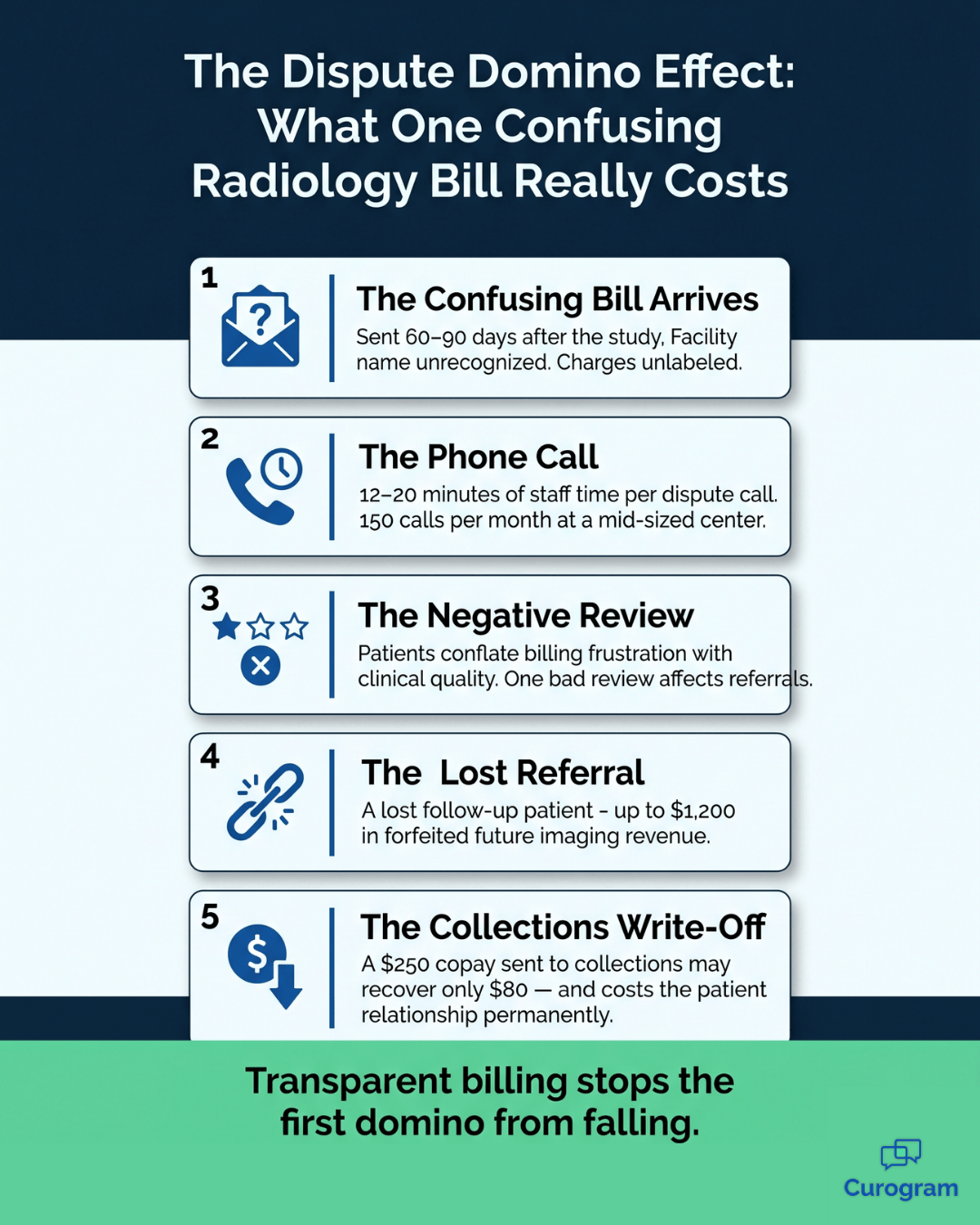
Infographic showing how a confusing radiology bill triggers disputes, lost revenue, and bad reviews

Why Billing Portals and Paper Statements Keep Failing

You might be thinking:

We have an online portal. Patients can log in and pay anytime.

It sounds simple. It isn't.

Under 30%

That's the typical portal adoption rate for billing-specific tasks in healthcare. Patients forget their login. They set up a password, lose it, and never reset it. They open the link on their phone and the portal isn't mobile-optimized. They get three steps in and give up.

The portal exists. The payment doesn't happen.

Paper statements have the same problem from the opposite direction — too much friction, too much delay, too little clarity.

By the time a statement arrives, the patient has mentally moved on from the appointment. The charge feels disconnected from the care they received. Without context or an easy payment path, the default behavior is to ignore it.

And collections agencies?

They collect pennies on the dollar, damage your patient relationship permanently, and cost you the referral revenue that patient would have generated.

Turning a $250 copay over to collections might recover $80 — and lose you a patient worth $1,200 in future imaging revenue.

The transparent billing experience that imaging centers need is not a portal upgrade. It's a fundamental shift in when, how, and with how much clarity you communicate about money.

A Simpler Path: Text-Based Billing That Meets Patients Where They Are

Here's what changes when you move the imaging center patient payment conversation to text.

Patients already have their phones. They read text messages — open rates for SMS consistently exceed 90%, compared to roughly 20% for email.

There's no login, no forgotten password, no app to download.

A text arrives, the patient reads it, and they either pay immediately or they don't. But at least they saw it.

For imaging centers integrated with RamSoft, Curogram's text-based billing approach works across three specific moments in the patient journey — and each one matters.

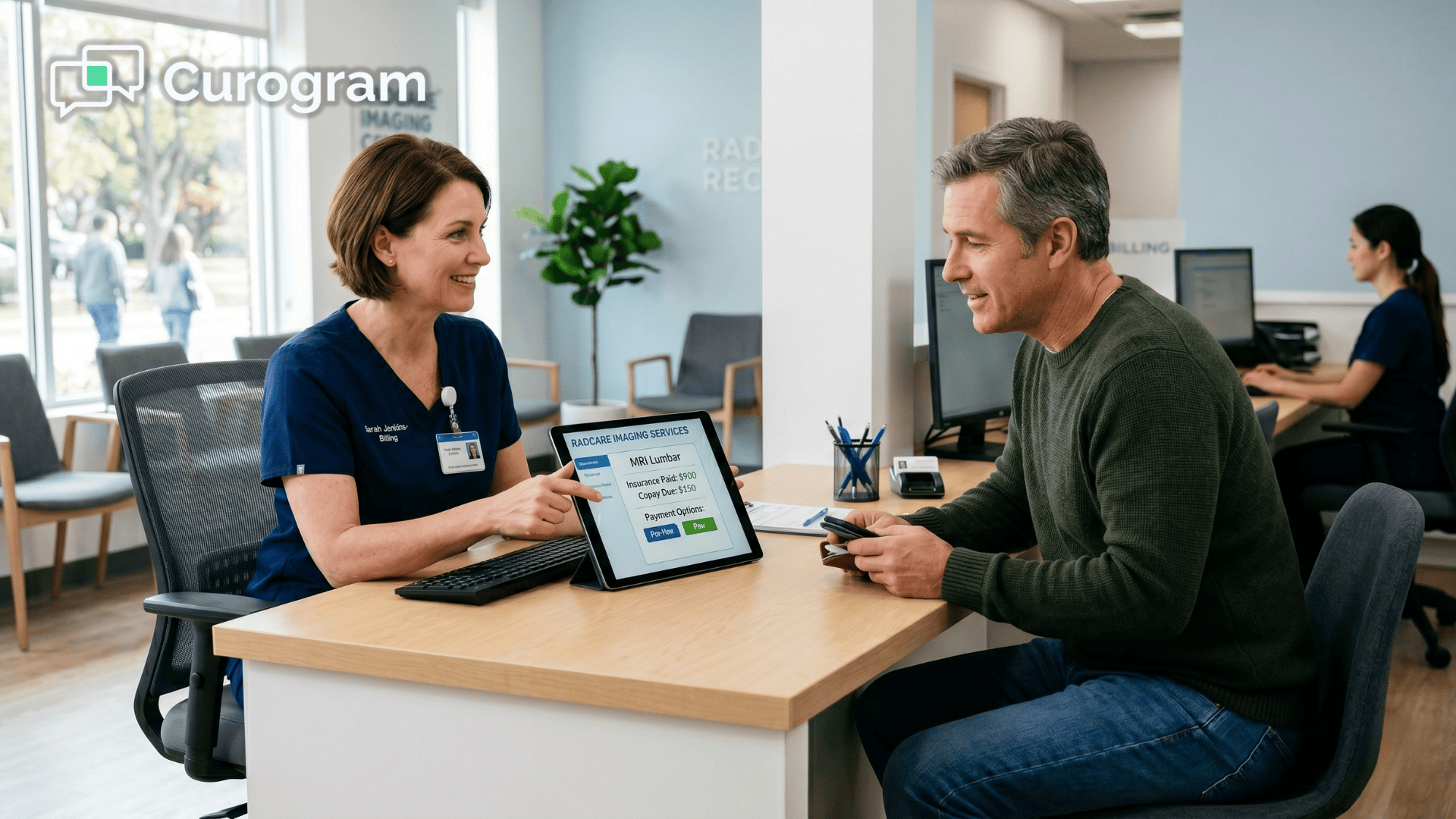
Imaging center staff explaining billing charges to a patient on a tablet at reception

Before the study:

The patient receives a message explaining their expected copay in plain language.

Something like:

"Your MRI copay is $250. No surprises. Tap here if you have questions before your appointment."

This sets an expectation before money ever changes hands. Patients who know what they'll owe are far less likely to dispute the charge later. This is the foundation of transparent billing — clarity before confusion has a chance to form.

On the day of the study:

A confirmation text goes out once the study is complete, confirming the actual charge and offering an immediate payment option. The patient is still in a mindset of engagement with your center. The care is fresh.

This is the best possible moment to collect.

Within 48 hours after the study:

A follow-up payment text goes out if the balance is still open. It includes a one-tap payment linkno portal, no phone call, no statement to open.

The patient taps, enters their payment method once (securely tokenized, PCI-DSS compliant), and receives an instant confirmation.

Get paid faster! Strengthen your balance sheet by simplifying patient payments via secure SMS with Curogram.

Three moments. One clear message at each. No confusion, no delay, and no collections agency.

What the Payment Experience Actually Looks Like for Your Patient

The entire radiology copay management process — from charge notification to paid balance — takes about 30 seconds for the patient.

They get a text. They tap the link. They see a plain-language breakdown of their charge. They tap to pay with a saved card. They receive a confirmation. Done.

60–70% fewer disputes

Imaging centers that send clear, plain-language charge explanations before and after the study see dispute rates drop by 60–70% compared to paper billing. When patients understand what they owe and why, there's nothing left to fight about.

Compare that to the traditional path: paper bill arrives six weeks later, patient calls to ask what "facility charge" means, they're put on hold, they hang up frustrated, and the balance ages into collections.

What Transparent Billing Actually Delivers: Results, Not Promises

The numbers tell a clear story. This isn't a marginal improvement — it's a structural shift in how revenue flows through your center.

For a center billing 1,500 patients per month at an average balance of $180, the shift from a 50% to an 85% collection rate means roughly $94,500 in additional monthly revenue.

Over a year, that's more than $1.1 million in recovered patient balances — from care your team already delivered.

That's not a minor operational improvement. That's a meaningful financial outcome driven entirely by changing when and how you communicate about payment.

What Patients Do After a Clear Billing Experience

The revenue impact extends beyond the bill itself. Patients who experience transparent billing — who receive a clear explanation of their charge, pay easily, and get a prompt confirmation — consistently report higher satisfaction with the overall care experience.

Higher satisfaction means two things for your center.

First, they return. Follow-up imaging orders are a significant driver of revenue, and patients who feel well-treated follow through on their referrals.

Second, they refer. A patient who says "the imaging center was great, and even the billing was easy" is one of the most effective marketing assets a center can have.

Curogram's text-based billing turns the moment of payment from a point of friction into a point of trust.

Stop Letting Billing Undo Your Best Clinical Work

Your imaging center has invested in great equipment, trained staff, and a strong clinical reputation. Don't let a billing workflow from two decades ago be the thing that sends patients to your competitor.

The radiology patient billing experience around text payment has changed. Patients expect clarity.

They expect speed. They expect to pay from their phone in the same way they pay for everything else.

When you meet that expectation, you collect more, dispute less, and build the kind of patient loyalty that generates referrals for years.

Curogram integrates directly with RamSoft's Blume platform to deliver text-based billing at the right moments — before, during, and after the study — with zero portal friction and full HIPAA and PCI-DSS compliance. Your staff doesn't need to change their workflow. Your patients don't need to download anything.

The billing just works the way it should have been working all along.

Think about the gap between a 50% and 85% collection rate and what it means for your center every single month. Then think about the patient who had a perfect scan, received a confusing bill 90 days later, called to dispute it, left a negative review, and never came back.

You can't afford the billing experience you have right now.

Schedule a Demo with Curogram today and see exactly how imaging centers using RamSoft are collecting 85%+ of patient balances within 48 hours — and turning billing from the weakest part of the patient experience into one of the strongest. 


Frequently Asked Questions

Does text-to-pay comply with HIPAA and PCI standards?

Yes. All payment links are encrypted and PCI-DSS compliant, and they are sent over secure channels. Patient identity is verified before payment options appear, and transaction data is never stored in plain text. Curogram maintains HIPAA BAA compliance across all billing integrations, so your center stays protected on both the clinical and financial compliance sides simultaneously.

Will patients actually adopt text-based billing over portals or paper bills?

Yes — and the adoption curve is faster than most centers expect. Research shows that 85%+ of patients prefer text communication for actionable tasks like payment. Most imaging centers using RamSoft's Blume see patient adoption rates of 70–90% for text-to-pay within the first 30 days. The reason is simple: it eliminates portal login friction and reaches patients on the primary communication channel they already use every day.

What happens if a patient disputes a charge after paying via text?

Dispute resolution follows the same standard process — patients go through normal claims channels. But in practice, text-to-pay prevents most disputes before they start. When patients see their charges explained in plain language before the study and confirmed afterward, dispute rates drop by 60–70% compared to paper billing. Clarity at the right moment is the most effective dispute-prevention tool an imaging center can deploy.

How does Curogram's text-to-pay integrate with RamSoft's billing system?

Curogram syncs directly with RamSoft's billing infrastructure — there's no separate app, no manual data entry, and no duplicate reconciliation work for your staff. When a patient completes a payment via the text link, it posts automatically to the RamSoft billing record. Your team sees it in real time, the balance closes, and the workflow continues without interruption. Setup is straightforward, and staff training typically takes less than an hour.

Can text-to-pay handle partial payments or payment plans?

Yes. Not every patient can pay a full balance in one transaction, and forcing them to often means collecting nothing at all. Curogram's text-based billing supports flexible payment options, including partial payments and structured payment plans, all manageable through the same SMS conversation. Patients appreciate the flexibility, and your center benefits from consistent collection rather than a lump-sum-or-nothing outcome. It's a practical approach that matches how patients actually manage healthcare costs today.