

Managing Patient Feedback for Cerbo Practices: A Reputation Guide
💡 Managing patient feedback for Cerbo practices means using internal surveys to catch problems before they go public. Send a quick text survey...
A single bad review can sting. It sits on your Google profile for years, pushing new patients away before they even call your office.
The worst part? That review might stem from one rough day, not the quality of care you provide.
Most clinics try to fight fire with fire. They ask every patient for a review and hope the good ones drown out the bad.
But hope is not a strategy. What if you could catch the complaint before it ever reaches Google or Yelp?
That is the core idea behind the "private release valve." When you give frustrated patients a safe, private place to share their anger, they rarely feel the need to blast you online. They just want to be heard.
This article shows how practices using Prime Clinical can mitigate negative patient reviews through Curogram's smart routing survey system.
You will learn the exact workflow, the psychology behind it, and how to turn a complaint into a loyal patient. If your practice has ever lost sleep over a harsh online review, this guide is for you.
Every practice has off days. A chart gets lost, a phone rings too long, or a waiting room fills up past the breaking point.
These things happen. But in today's digital world, one bad moment can leave a stain that lasts for years on your public profile.
Think about the last time you had a bad experience at a store or clinic. You were upset, and you wanted someone to know. If no one asked, you might have gone to Google or Yelp to share your frustration. Your patients do the same thing.
The danger is all about timing. A patient who waits 45 minutes is frustrated the moment they walk out.
If the first prompt they see is "Rate us on Google," they will unload. They are not thinking about the kind nurse or the thorough exam. They are stuck in the wait.
There is a short window right after a visit when emotions are at their peak. If a patient had a bad time, this is the moment they are most likely to act on it. A Prime Clinical patient satisfaction survey sent at the right time can catch these feelings before they spill onto a public review site.
The trick is to use that window wisely. Instead of pointing them straight to Google, route them to a private channel. This is how smart practices handle patient complaints before they go public.
A single scathing review that mentions "rude staff" or "long wait" can push away dozens of prospects. Studies show that over 70% of patients check reviews before booking. One harsh review can cost a practice thousands in lost revenue over time.
This is not just about hurt feelings. It is a real financial hit. Your reputation protection strategy must account for bad days, not just good ones. The goal is to make sure those bad days do not become permanent marks on your public profile.
The Real Cost of Unfiltered Feedback
When feedback goes straight to a public site with no filter, the damage is fast and hard to undo. Google reviews stick around. Even if you reply with grace, the star rating still drags your average down.
Clinics that rely on Prime Clinical already have strong systems for scheduling and charting. But without a reputation protection strategy, all that clinical excellence stays hidden behind a low star count.
Research shows that a drop from 4.5 to 3.5 stars can cut new patient calls by up to 40%. That is not a small dip. For a busy practice, it can mean tens of thousands in lost yearly revenue.
The math is simple. Every bad review that could have been caught in private is a missed chance. If you can handle patient complaints before they land on Google, you protect both your revenue and your team's morale.
Bad public reviews do not just hurt the bottom line. They hurt the people who work hard every day. Front desk staff and nurses who see themselves called out by name often feel defeated and burned out.
A service recovery approach inside a medical practice helps shield your team. When complaints come through a private channel, staff can learn and grow without the sting of public shame. This keeps your team engaged and your turnover low.

The idea behind smart routing is simple: ask patients how they feel, then point them in the right direction based on their answer.
Happy patients go to Google. Unhappy patients go to a private form. This is the core of the internal feedback loop that keeps your reviews clean.
The workflow starts right after the visit. Curogram sends an SMS text that asks the patient to rate their visit on a scale of 1 to 5. The question is short and easy to answer on any phone.
Patients who tap a 4 or 5 get a follow-up message: "Great! Click here to share your experience on Google."
This nudge catches happy patients at the peak of their good feelings and turns them into public advocates.
Patients who tap a 1, 2, or 3 see a different message. It says: "We're sorry to hear that. Please tell us what went wrong here." The link goes to a private feedback form, not a public review page.
This is the fork in the road. One path builds your public star count. The other captures the complaint in a safe, private space where your team can act on it. The patient never feels ignored because they have a place to share their thoughts.
Timing matters more than most people think. Sending the survey within 30 minutes of checkout captures raw, honest feedback. Wait too long, and the patient may forget the details or, worse, vent on Google first.
Curogram lets you set the delay to match your workflow. Some clinics send the text right at checkout. Others wait 15 minutes to give patients time to settle. Either way, the goal is to beat Google to the punch.
Most angry patients do not want to harm your practice. They just want to be heard. The moment you give them a private text box, the urge to post on a public site drops fast.
This is the same psychology behind any feedback system. People vent when they feel no one is listening. A simple private form tells them: "We care, and we want to fix this." That message alone can prevent a 1-star review.
When a patient fills out a private form, they feel heard right away. They have put their frustration into words, and someone at the clinic will read it. That sense of closure is often all they need.
Without this outlet, the only way for them to feel heard is through a public review. By creating a private release valve, you remove the need for them to go public. It is a win for both the patient and the practice.
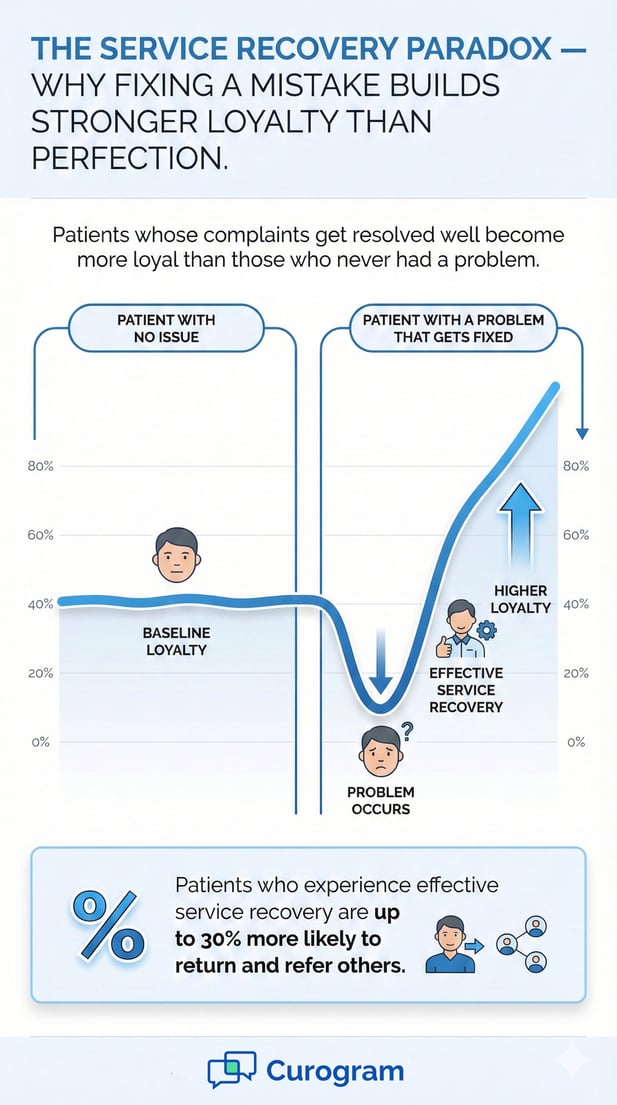
The Harvard Business Review has written about something called the "Service Recovery Paradox." It says that a customer who has a problem that gets fixed well often becomes more loyal than one who never had a problem at all.
This applies directly to your practice. When you catch a complaint through the internal feedback loop and fix it fast, that patient may become one of your strongest fans. The key is speed and sincerity in your response.
Catching a complaint is only half the battle. What you do with it next is what matters most. Curogram turns each piece of negative feedback into an action item that your team can track, respond to, and resolve.
This is where service recovery in a medical practice goes from theory to daily habit.
The Dashboard Alert System
When a patient submits a low score, the feedback does not sit in a file. It triggers a real-time alert to the office manager or team lead. This means your team can act within minutes, not days.
The alert lands in a central dashboard that shows the patient's name, their score, and their written comments. There is no need to dig through email or check multiple apps. Everything is in one place and ready for action.
Real-Time Alerts That Drive Fast Action
Speed is everything in service recovery. A patient who gets a personal reply within the hour feels cared for. One who waits three days feels forgotten. The dashboard's alert system is built for the former.
Your manager can see the complaint, read the details, and start a two-way text within minutes. This direct line of contact shows the patient that their voice matters. It also gives the manager a chance to fix the issue before it grows.
One complaint about wait times is a blip. Five in one week is a trend. The dashboard lets you spot these patterns early so you can fix the root cause, not just the symptom.
For example, if several patients report long wait times on Monday mornings, you know it is a scheduling issue. You can audit your Prime Clinical schedule and adjust your booking slots. This kind of data turns reactive fixes into lasting change.
Once the alert arrives, the next step is outreach. The goal is not to make excuses. It is to listen, apologize, and share what you plan to do about it. Patients respect honesty more than polish.
The manager replies by two-way text through Curogram. A typical message might say: "I saw your note about the wait time. I apologize. We are reviewing our schedule to fix this." Short, personal, and direct.
When a patient receives a personal text from the clinic, the tone of the relationship shifts. They go from feeling ignored to feeling valued. This single act can turn a detractor into an advocate.
Some practices report that patients who receive a personal service recovery text are more likely to rebook and to refer friends. The effort to handle patient complaints through a private channel pays for itself in loyalty and word of mouth.
After the reply, it is smart to log the exchange in the patient's chart inside Prime Clinical. This ensures the provider is aware of the issue before the next visit. It also creates a paper trail that shows your practice takes feedback seriously.
When the patient comes back, and the doctor says, "I heard about your wait last time, and I'm sorry," the impact is huge. That follow-through completes the service recovery cycle and cements the patient's trust in your practice.
When you text a patient about a complaint, you may touch on visit details that fall under HIPAA rules. Curogram's two-way texting platform is built to be HIPAA-compliant, so your team can have these talks without risk.
This is a key reason to use a dedicated texting tool instead of personal phones or standard SMS. Every message is encrypted and logged, which protects both the patient and the practice.
For clinics that want to text dissatisfied patients to fix the relationship, secure texting is a must.
Standard text messages are not encrypted. If a staff member texts a patient from a personal phone about a visit, that conversation could be exposed in a data breach. HIPAA fines for this kind of mistake can reach tens of thousands of dollars.
Curogram removes this risk. The platform encrypts every message and keeps a secure log. This gives your team the freedom to reach out to upset patients without worrying about compliance.
A strong internal feedback loop is only as safe as the tools behind it. When you pair Curogram's HIPAA-compliant texting with Prime Clinical's charting system, you create a closed circuit. Complaints come in, get resolved, and get logged, all within secure systems.
This closed-loop approach also helps during audits. If a patient ever claims they were not heard, you have a clear record of every step you took to address their concern.

You cannot stop complaints from happening. Bad days are part of running a practice. But you can control where those complaints land, in your private dashboard or on your public Google profile.
The practices that thrive online are not the ones with zero complaints. They are the ones who route complaints to the right place.
A smart routing system acts as a firewall around your reputation, keeping private issues private and letting public praise shine.
When you combine Curogram's survey tools with your Prime Clinical system, you build a reputation protection strategy that works every day on autopilot. Happy patients boost your stars. Unhappy patients get heard and helped. Everyone wins.
Most practices only think about reviews after a bad one shows up. By then, the damage is done. A proactive approach means you are always asking, always listening, and always routing feedback to the right channel.
This shift from reactive to proactive is what sets top-rated practices apart. When you mitigate negative patient reviews through Prime Clinical and Curogram, you take control of your online story.
Every day without a system like this is another day a potential 1-star review can slip through. Protect your brand, your team, and your future patients by taking action today.
If your practice uses Prime Clinical and you want to build a firewall around your reputation, the smart routing demo is a great place to start.
Protect your brand. Watch the Smart Routing Demo to see how Curogram filters feedback for Prime Clinical practices.
Smart routing sends a quick SMS survey after each visit. Patients who score low get directed to a private form instead of Google.
This catches complaints before they go public. The office manager can then respond through two-way text to fix the issue fast.
Sending the survey within 30 minutes of checkout captures honest, real-time feelings. If you wait too long, the patient may vent on Google first. The goal is to reach them while the experience is still fresh. Early contact also shows the patient you care about their visit.
Most upset patients just want to be heard. A private form gives them a safe space to share their frustration right away.
Once they have vented in private, the urge to post on a public site drops. This protects your star rating without silencing the patient.
After responding to a complaint through Curogram, the manager can add a note to the patient's chart in Prime Clinical. This ensures the provider knows about the issue before the next visit. It also creates a record that proves your practice listens and acts on feedback.
Patient complaints often include visit details protected by HIPAA. Standard SMS is not encrypted and could expose sensitive data.
Curogram's platform encrypts every message and keeps a secure log. This lets your team text patients about concerns without risking a compliance violation.
💡 Managing patient feedback for Cerbo practices means using internal surveys to catch problems before they go public. Send a quick text survey...
💡 Automated Google reviews for Prime Clinical Systems let medical practices send SMS review requests right after each patient visit.By syncing with...
💡 Reputation management in InSync helps behavioral health practices manage online presence. With automation, you can collect more positive reviews...