
1 min read
Grow CollaborateMD Reviews, Zero Staff Effort
 Jo Galvez : Jul 6, 2026, 10:00:00 AM
💡CollaborateMD has no built-in review tools, so the review ask falls to busy staff. Curogram fixes this gap. It helps CollaborateMD practices...

A patient grabs their phone and types "best doctor near me." Google shows three results at the top. Two of those spots belong to your rivals. The third? It could be yours, but it's not.
That's the harsh truth for many clinics running on Prime Clinical. You may have great doctors, a clean office, and loyal patients.
But none of that matters if Google can't see you. When it comes to local SEO for Prime Clinical practices, your online reviews are the single biggest lever you can pull.
Think of reviews as your digital curb appeal. A home buyer won't walk through the door if the yard is bare.
n the same way, a patient won't click your name if your review count looks thin. Google treats reviews as proof that real people trust you, and it rewards that proof with higher placement.
The impact of reviews on local search is hard to ignore. Studies show that review signals account for roughly 15–20% of the Map Pack algorithm.
That means volume, speed, and freshness of reviews all shape where you land on the page. A clinic with 200 recent reviews will almost always outrank one with 12 stale ones, even if the smaller clinic has a perfect 5-star rating.
So what can you do about it? The answer lies in automated review generation that ties directly to your Prime Clinical schedule. By asking each patient for feedback right after their visit, you build a steady stream of trust signals that Google loves.
In this guide, we'll break down how the Map Pack works, why your practice may be invisible right now, and how to fix it without lifting a finger at the front desk.
Every day, patients search Google for care near them. The practices that show up first win those clicks, those calls, and those new bookings.
If your clinic doesn't appear in the top three results, you are losing ground to rivals who may not even be as good as you. Understanding how medical practice online visibility works is the first step to fixing it.
When someone types "best pediatrician near me," Google doesn't just show a list of blue links. It shows a map with three pinned locations at the very top. This is the Map Pack, and it gets most of the clicks.
Here's what a typical result might look like. Slot one goes to a new urgent care with 4.8 stars and 200 reviews. Slot two is a rival clinic at 4.6 stars with 150 reviews.
Slot three is your practice at 4.9 stars, but with just 12 reviews. Despite having the best rating, your low count pushes you down.
Many doctors believe a perfect score is all they need. But Google weighs review count just as much as star average.
A 4.7 with 300 reviews sends a stronger signal than a 5.0 with 10 reviews. Volume tells Google that many patients trust this place, not just a handful.
A thin review profile also raises doubt in the minds of real patients. People often skip past a listing with very few reviews because it feels unknown. More reviews mean more social proof, and more proof means more clicks.
It's not only about how many reviews you have. It's about when they were posted. If your last review came in six months ago, Google sees your profile as stale. Fresh reviews are a sign of an active, thriving practice.
Think of it like a restaurant with no recent diners. Even if the food is great, an empty dining room raises red flags. The same is true for your Google listing. Recency is a core part of what Google values when it ranks results.
Where Your Practice Actually Lands
Below the Map Pack sits a link that says "View More." This is where most invisible clinics end up. Reports say that fewer than 5% of users scroll past the top three to click that link. That means 95% of your possible new patients never see your name.
For practices trying to increase patient acquisition Prime Clinical tools that can help with is a problem that compounds over time. Every week you sit in the "View More" list, your rivals collect the patients you should be seeing.
The first Map Pack result might grab nearly 25% of all local clicks. The second takes about 15%. By the time you get to position four or five, clicks drop to low single digits. If you're not in the top three, you're almost invisible.
This click gap means the rich get richer. Practices in the top spots get more patients, more reviews, and even better rankings as a result. The cycle feeds itself, and breaking in from the outside requires a clear plan.
Every new patient has a lifetime value that can run into thousands of dollars. When your practice misses out on just five new patients per week, the revenue loss stacks up fast. Over a year, that could mean tens of thousands of dollars left on the table.
Paid ads can fill some of that gap, but they stop working the moment you stop paying. Reviews, on the other hand, keep working for you around the clock. Investing in your review profile is one of the smartest long-term moves for any clinic.
Google's local ranking formula is not a mystery. It relies on three core signals that you can learn, measure, and improve.
Once you know what the algorithm looks for, you can shape your review strategy around those Google Map Pack ranking factors for doctors that make the biggest difference.
Google uses three main factors to decide which practices show up in the Map Pack. These are relevance, distance, and prominence. Each one plays a role, but only one gives you real control over your rank.
Relevance is about how well your listing matches the search. If someone looks for a "family doctor," your profile needs to say that clearly.
Prime Clinical keeps your data accurate, which helps here. Distance is simply how close the searcher is to your office, and you can't change that.
Prominence measures how well-known and trusted your practice is online. Google looks at links, citations, and directory listings.
But the heaviest weight goes to your reviews. A practice with more recent, positive reviews will outrank one with fewer, older ones.
This is where local SEO for Prime Clinical practices gets exciting. You can't move your office closer to every searcher.
You can't force Google to find you more relevant than a rival. But you can grow your reviews, and that's often enough to leap past the competition.
Google cares about freshness. A steady trickle of five reviews per week beats a one-time blast of 100 reviews. The algorithm wants to see that patients are visiting your office right now, not just that they did so two years ago.
This is the "recency signal" that many practices overlook. Even if you once had a strong review profile, letting it go quiet can hurt your rank.
The impact of reviews on local search is ongoing. You need to keep the flow alive to stay on top.
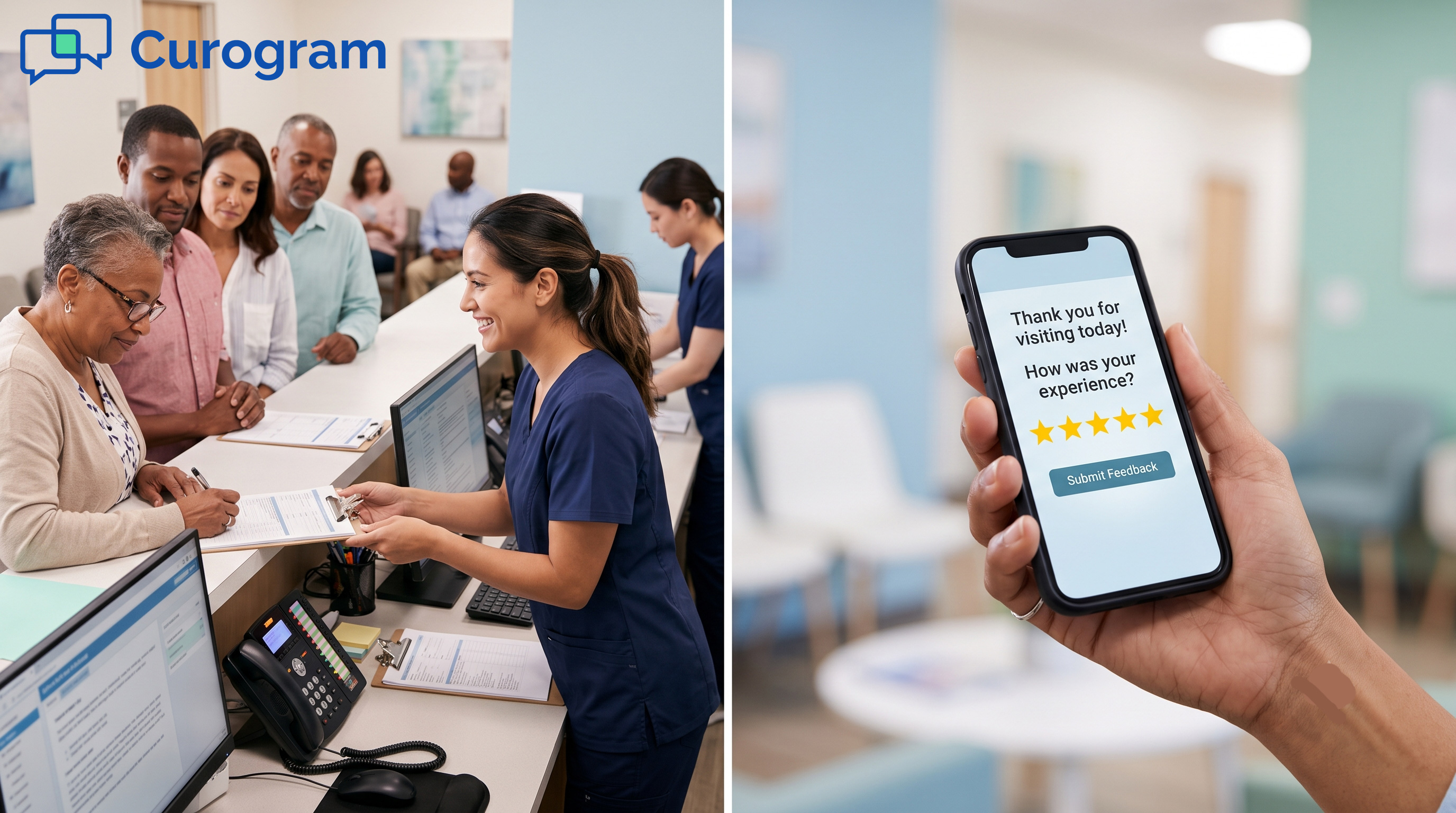
Curogram connects to the daily Prime Clinical Intellect schedule and sends a review request by text right after each visit.
There's no extra step for your staff. The whole process runs on its own once it's set up.
This automated review generation creates a natural, organic drip of new reviews. Because the requests are tied to real visits, the timing and pacing look genuine to Google. There's no spike, no gap, just a steady rhythm that mirrors your actual patient volume.
Imagine your practice sees 30 patients a day. If even 10% of them leave a review after getting a text, that's three new reviews daily. Over a month, that adds up to about 60 fresh reviews, enough to shift your position in the Map Pack.
Compare that to a practice that does nothing. They might get one review per month from a patient who felt strongly enough to go out of their way. The math is clear: small, steady gains beat rare, random feedback every time.
A healthy review profile isn't just about volume. It's about balance. A mix of recent dates, varied star ratings (mostly positive), and honest patient words all signal trust. Google's algorithm is smart enough to spot fake patterns, so real feedback from real patients is always the safest path.
Curogram helps you maintain this balance by only reaching out to patients who actually visited. That way, every review traces back to a genuine experience, which keeps your profile clean and your rank climbing.

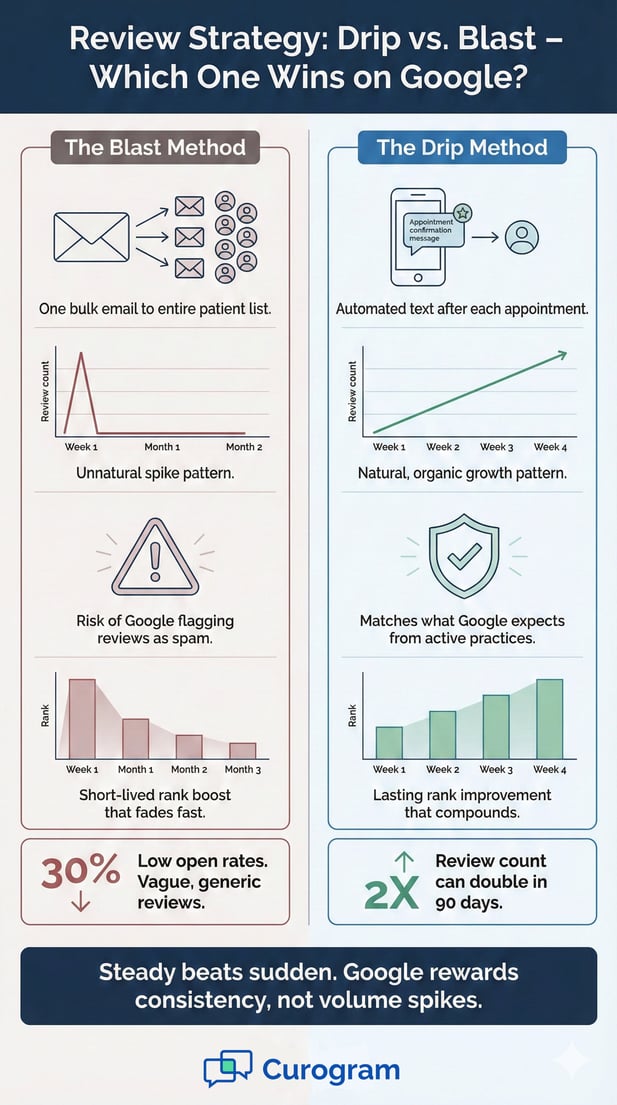
Not all review strategies are built the same. Some practices try to boost their count with a single mass email to every patient on file.
Others use tools that send requests day by day, visit by visit. The difference between these two methods can mean the gap between rising to the top and getting flagged by Google.
Why Manual Campaigns Fall Short
Many practices still use the blast method. Once or twice a year, someone on the team sends a mass email asking every past patient to leave a review. It sounds fast. It sounds easy. But it almost always backfires.
Google's systems are built to detect sudden, unnatural spikes in review activity. When a clinic goes from zero reviews in a month to 80 in a single week, that pattern looks suspicious.
At best, some of those reviews may be filtered out. At worst, Google can flag your profile for spam-like behavior.
The Spam Risk of Bulk Sends
Bulk email blasts carry more risk than most people realize. Many patients ignore mass emails, so your open rates tend to be low. The ones who do respond often leave vague, generic reviews that don't help your ranking much.
There's also a timing issue. When all reviews land in the same week, Google can see the cluster. This doesn't match the organic pattern of a busy practice that earns feedback visit by visit.
The result is a short bump that fades fast, plus the risk of penalties that can hurt your medical practice's online visibility.
Patients who receive a review request months or even years after a visit feel disconnected from the experience. They can't recall the details, and they're less likely to write something useful. Their response rate drops, and so does the quality of the feedback you collect.
Compare that to a patient who just walked out of your office 30 minutes ago. The visit is fresh. The feelings are real. They're far more likely to write a quick, genuine review that carries weight with both Google and future patients.
How the Automated Drip Works
Curogram takes a different approach. Instead of one big push, it sends a short text message to each patient right after their visit is marked complete in Prime Clinical.
The message is simple, personal, and easy to act on. One tap, and the patient lands on your Google review page.
Because the system is tied to your live schedule, it runs every day without any work from your staff.
There's no list to build, no email to draft, no campaign to launch. It just works in the background, quietly growing your review count day after day.
The beauty of the drip method is that it creates linear, predictable growth. Your review count rises in step with your patient volume.
If you see more patients in flu season, you get more reviews during flu season. The pattern is natural, and Google rewards that.
Over time, this steady growth builds what some call "domain authority" for your listing. Google begins to see your practice as a trusted, active presence in the area.
That authority compounds, making it easier to hold your Map Pack spot even as rivals try to catch up.
Practices that switch from blasts to drips often see their review count double within the first 90 days. More importantly, they see their Map Pack rank climb within weeks.
The lift is real, and it tends to stick because the growth pattern doesn't trigger any red flags.
You can track this progress right inside your Google Business Profile. Watch your review count, your average rating, and your search impressions over time.
The numbers tell the story, and the story is one of sustainable growth tied to actual patient volume.
Beyond rankings, the drip method also protects your reputation. Because you're asking patients right after a visit, you catch issues early.
If someone had a bad experience, the feedback comes to you first through Curogram's internal routing, not through a public one-star post.
This gives your team a chance to resolve the issue before it hits Google. It's a safety net that turns what could be a negative review into an internal ticket. That kind of proactive management is key to long-term medical practice online visibility and trust.
When Curogram detects a low score in its pre-screen survey, it routes that patient's response to your office manager instead of Google.
This means your team can reach out, address the concern, and recover the relationship before any harm is done.
This closed-loop system protects your online reputation while still giving you honest, useful feedback. You keep learning from your patients, and your Google profile stays strong.
Over time, automated review generation becomes part of your practice culture. Patients start to expect the follow-up text.
Staff stop worrying about asking for reviews themselves. The process becomes routine, and the results keep growing without any extra effort.
That kind of built-in system is what separates practices that rank well once from practices that rank well forever. It's not a one-time fix, but a habit that pays off month after month.

Most marketing dollars vanish the moment you stop spending. Paid ads, social posts, and flyers all have a shelf life.
However, reviews are different. They stay on your profile, keep working, and keep drawing patients to your door long after they were written.
Think of each review as a small piece of property you own online. Once it's there, it works for you around the clock. It shows up in searches, builds trust with strangers, and pushes your rank higher. No ad can do that for free, forever.
For practices looking to increase patient acquisition, Prime Clinical users should think of reviews as a long-term asset. Every five-star review is a vote of confidence that Google counts, patients read, and rivals can't take away.
Paid ads are like renting a billboard. The moment your budget runs out, the sign comes down. Reviews, on the other hand, stay put. They keep attracting eyes, clicks, and calls even on weekends and holidays.
Shifting your focus from paid ads to earned reviews is one of the smartest moves a clinic can make. The cost is lower, the return is higher, and the results last far longer.
The best time to start was a year ago. The second-best time is right now. Every day you wait is a day your rivals collect reviews that push them further ahead.
Curogram makes it easy to get started. It plugs into your Prime Clinical schedule, sends texts after each visit, and handles the rest.
Climb the rankings. See the SEO Impact to learn how automated reviews drive patient growth for Prime Clinical users.
1 min read
Jo Galvez : Jul 6, 2026, 10:00:00 AM
💡CollaborateMD has no built-in review tools, so the review ask falls to busy staff. Curogram fixes this gap. It helps CollaborateMD practices...
1 min read
Jo Galvez : Jun 18, 2026, 8:00:01 AM
💡Proven EHR Google Reviews automation for behavioral health is not built in. Proven EHR runs your clinical and billing work well. But it has no...

1 min read
Jo Galvez : Jun 11, 2026, 12:00:01 PM
💡 Behavioral health practices using TherapyNotes Google Reviews automation can now earn 5-star reviews without the awkward ask.Google is the top...