1 min read
Patient Recall for Multi-Location eCW Groups | Curogram
💡 Patient recall campaigns for multi-location eClinicalWorks groups pull lapsed patients out of each site's eCW visit history. Texts then bring...
8 min read
Mira Gwehn Revilla
:
August 20, 2026
1,240 patients came back to one multi-location practice because of a text message. None of them were new.
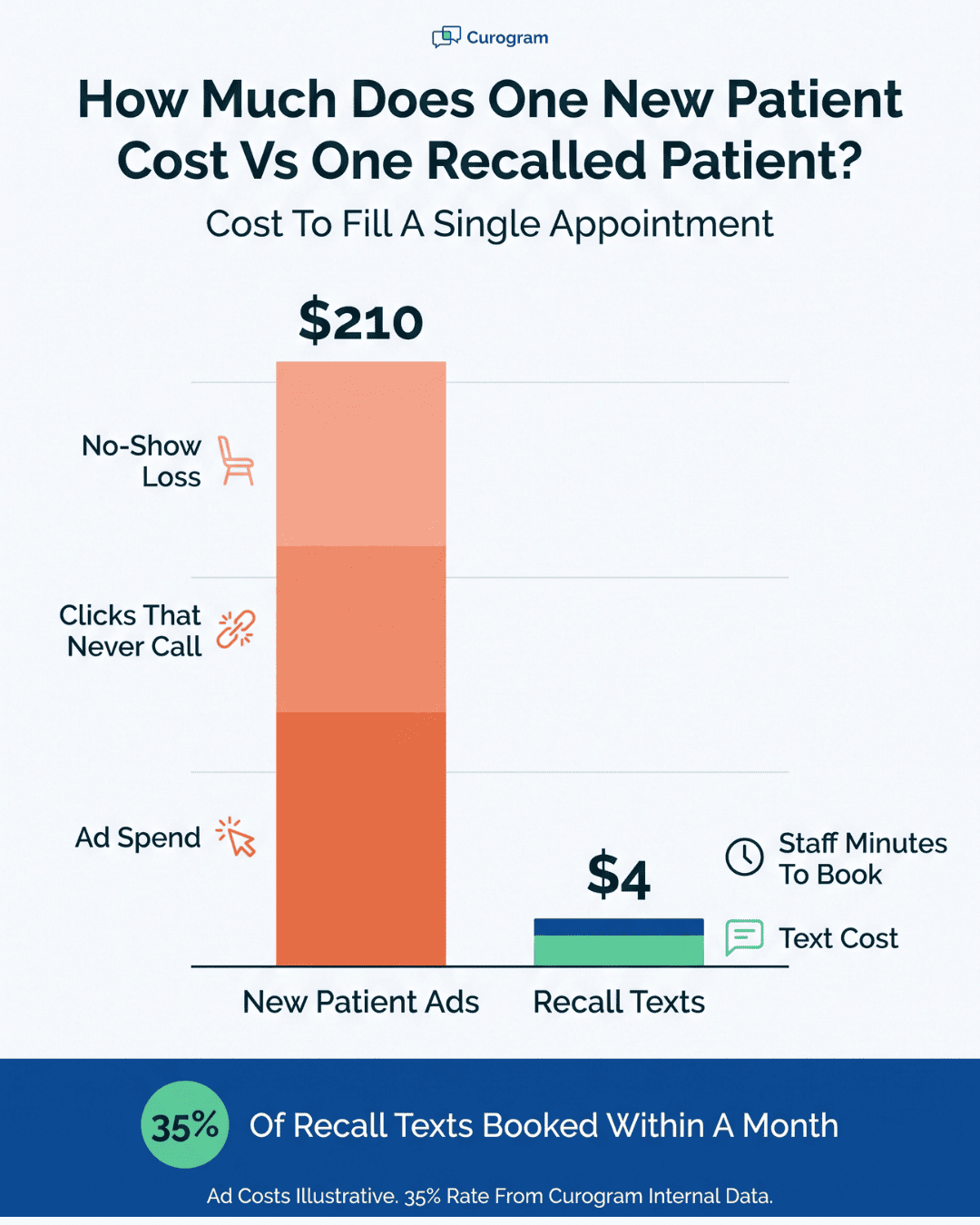
Each one already had a chart, a history, and a follow-up that nobody had chased. Based on our internal data, 35% of the patients who got that recall message booked within a month.
Run the same math on your own group. Pull every patient with no visit in 18 months, office by office, and add it up. Five small offices usually clear a few thousand names. Those names cost nothing to reach, and they already trust your providers.
The ad budget, meanwhile, goes to people who have never heard of you.
We think that ordering is backwards. Patient recall campaigns for multi-location Practice Fusion groups outperform acquisition because the hard part is finished. Trust exists. Insurance sits on file. The chart is already built.
Staffing is what stops most groups. Working a lapsed list by phone eats hours no small office has. So the project slides to a slow week that never shows up, then slides again.
Meanwhile the same names age out quietly. A patient who missed one annual physical usually misses the next one too. By month 30 she has a new primary care doctor two miles away, and her chart in your system stops updating for good.
Patient panel leakage recovery starts with that count, not with a campaign calendar. Once you have the number, what's left is segmentation, timing, and a reply volume your front desk can handle.
Last visit date sits on every chart in Practice Fusion. So does visit type, the rendering provider, and the office where care happened. Sort a patient list by that date and the lapsed panel shows up in about a minute.
Then the list sits there.
A five-provider office with one scheduler is already handling inbound calls, prior auths, refill requests, and the check-in line.
No afternoon exists for dialing 300 people last seen in spring. Recording attrition costs zero staff time. Reversing it costs hours the schedule doesn't contain.
So the report gets exported, admired, and saved to a shared drive. Six months later someone runs it again and the number is bigger.
A patient with type 2 diabetes cancels her April follow-up on a Tuesday. She tells the front desk she'll call back after her work trip. Nobody creates a task, because there's no task to create in a system built to record what already happened.
She doesn't call back. Neither does anyone from the office.
By November her A1c is 19 months old and her refills have run out. She types "doctor near me" into her phone. She lands at the urgent care two exits down, which the group also happens to be bidding against on that exact search.
Nothing dramatic happened. One rebooking conversation didn't occur, and a ten-year patient relationship ended in silence.
Individually, each office looks fine. A few hundred names, easy to shrug off. Added together across a group, the panel tells a different story.
A five-office family practice group usually counts something like this. The figures below are illustrative example math, not client data:
|
Office |
Active patients |
No visit in 18 months |
Share of panel |
|
Northside |
3,100 |
640 |
21% |
|
Riverbend |
2,400 |
520 |
22% |
|
Elm Street |
1,900 |
430 |
23% |
|
Southgate |
2,700 |
610 |
23% |
|
Crossings |
1,600 |
380 |
24% |
|
Group total |
11,700 |
2,580 |
22% |
2,580 people. Every one has a chart, a payer on file, and a provider they've met. That's the lapsed patient win-back small group practices keep postponing, sitting in plain sight across five databases.
Board reports usually track new patients per month. That number can hold steady for two years while the panel drains underneath it.
Say each office adds 22 new patients a month and loses 24 to attrition. The monthly report looks stable. Net panel size falls by 120 patients a year across five offices, and nobody flags it, because nothing in the report counts departures.
Attrition rarely announces itself. Patients don't send a transfer request or ask for records. They simply stop appearing on the schedule, and the schedule looks full anyway because acute visits fill the gaps.
Two years of that leaves a group paying more per new patient while the panel it already built keeps shrinking.

Practice Fusion patient reactivation outreach gets reliable when it stops depending on someone remembering. Curogram runs recall as standing infrastructure. Rules get defined once, sends fire on a schedule, and replies land in a shared inbox.
Recall automation text campaigns replace the call-list project entirely. One rule might read: 14 months past the last preventive visit, age 18 or older, nothing on the books. That rule keeps producing names every Monday whether anyone thinks about it or not.
Message templates are written once at the group level. Each office inherits them. Nobody at Riverbend drafts a private version of the annual physical text, and nobody at Crossings forgets to send one.
Governance matters more than it sounds. One approved wording across five offices means one compliance review instead of five. When the group updates that template, every location gets the change the same day.
Segments are built from what Practice Fusion already stores, so targeting is as precise as the chart is.
|
Recall type |
Fires when |
Held out of the send |
|
Well-child check |
13 months since last well visit, patient under 18 |
Adults, anyone with a future well visit booked |
|
Annual physical |
14 months since last preventive visit, age 18+ |
Patients scheduled in the next 60 days |
|
Chronic care follow-up |
7 months past a diabetes or hypertension visit |
Patients seen at any group office last month |
|
Unrebooked cancellation |
Canceled 30 or more days ago, nothing rebooked |
Patients who already called back and booked |
Exclusions do more work than most groups expect. Drop the age filter and a well-child recall reaches a 62-year-old man, which makes the practice look careless.
Drop the cross-office holdout and a patient who saw a partner provider at Southgate last week gets told she's overdue.
Wording decides the reply rate. A recall text that reads like a marketing blast gets deleted, so keep it short, local, and specific about the visit.
Something close to this works for an overdue physical:
Hi Maria, this is Elm Street Family Medicine. Our records show you're due for your annual physical with Dr. Patel. Want us to find you a time? Reply STOP to opt out.
Wording gets tested per office over the first few hundred sends, rather than guessed once and frozen.
Skip the incentives and urgency lines. "Limited slots available" reads like retail and gets treated like retail.
Patients answer numbers they recognize. A text from the Elm Street line reads like the clinic. A text from an unfamiliar toll-free number reads like spam and gets swiped away.
Curogram sends each office's recall from that office's own number, with that office's name in the message. Group governance sits behind it. Local identity sits in front of it.
Reply routing follows the same logic. A response to the Northside send lands in the Northside inbox, visible to whoever covers the desk that hour.
When Northside is slammed, staff at another location can see the queue and book the appointment anyway, since the inbox is shared across the group.
Sending 640 texts at 8 a.m. is how a two-person desk stops answering the phone by 9:15.
Curogram throttles the send. Cap it at 60 messages a day per office. At a 35% reconversion rate that's roughly 21 booking conversations spread across a workday, which fits between check-ins.
Staggering matters across offices too. Northside runs its list this week and Riverbend runs next week, so no single scheduling pool absorbs five queues at once.
A recovered appointment that no-shows isn't recovered. Patients who book from a recall message flow into the governed reminder and confirmation sequence.
That's the same sequence carrying a 75%-plus average confirmation rate among Curogram clients, based on our internal data.
Atlas Medical Center cut no-shows from 14.20% to 4.91% in three months using it. Applied to reactivated patients, that gap decides whether you filled a slot or reopened one.
One multi-location practice sent SMS recalls to patients who hadn't scheduled a follow-up inside the recommended window. 35% of them booked an appointment within a month. 1,240 patients were seen from recall messages alone, based on our internal data.
Set that beside a paid search campaign. A 3% landing page conversion rate is respectable in healthcare marketing. The reconversion rate recall produces is more than ten times that, drawn from a list the group already owns.
Below is how a group works the 2,580-name panel from the earlier table. Volumes are illustrative; the 35% rate comes from our internal data.
Week 1. Pull lapsed lists per office. Dedupe across locations, since patients seen at two sites appear twice. Group total drops to about 2,400 unique names.
Week 2. Northside pilots alone: 640 names at 60 a day, roughly 11 business days of sending. Expect close to 20 booking replies daily.
Week 3. Read the replies. Two questions keep repeating: "do I still owe a balance?" and "is Dr. Patel still there?" Both answers get added to the template.
Weeks 4 through 8. Riverbend, Elm Street, Southgate, and Crossings run staggered, one starting each week.
Week 9. Roughly 840 booked visits sit on the schedule. They spread across two months of appointment slots instead of landing in one panicked fortnight.
Automated Recall Campaigns turn a lapsed list into a standing process. Rules get written once at the group level. They then run against each office's Practice Fusion visit data, week after week.
Segmentation uses four inputs: time since last visit, visit type, provider, and office. A group can set a well-child recall at 13 months, an annual physical recall at 14, and a chronic care recall at 7. Each one carries its own message and its own exclusions.
Sending respects the office. Messages go out from the local number patients already have saved, signed with that office's name. Daily volume is capped to what the desk can handle, and offices run staggered so five queues never arrive on one Monday.
Replies route to the shared inbox. Any staff member with access can book the appointment right in that thread. No transfer, no callback, no voicemail tag.
Consent and opt-out are handled for you. A patient who replies STOP drops out of future sends across every office in the group, not just the one that texted her.
Booked patients then enter the reminder sequence, so a recovered visit gets confirmed like any other. Reporting breaks out sends, replies, and bookings by office. Within two weeks it's obvious whether Elm Street's wording beats Southgate's.
That's how a group gets to the number worth pointing at: 35% of recall recipients booking within a month, based on our internal data.
Your Practice Fusion database is the cheapest growth channel you own. It's also the one nobody has been assigned to work.
Do the count this week. One filter per office: 18 months, no future appointment. Add the five numbers together and look at the total.
That total is your recall audience. It has payers on file and providers it already knows. No acquisition cost is attached to any of it.
Practice Fusion holds your patient records. Curogram supplies the reason those patients come back.
Book a demo and we'll size the reactivation opportunity from your own panel, office by office.
Recall texts to your own patients count as care-related messages, so different consent rules apply than for marketing blasts. Curogram captures consent and honors opt-outs across every office in the group. Message content and reply threads stay inside a HIPAA-compliant platform. Opt-out wording rides on each send, so one word stops future texts.
Segments come from visit history: months since the last visit, visit type, provider, and office. Rules pair those fields with holdouts. A well-child recall skips adults and skips anyone already booked in the next 60 days. Groups write the rule once, and it keeps producing fresh names weekly without anyone running a report.
Daily caps control it. Send 60 messages a day at a 35% reconversion rate and you get about 21 booking conversations, spread across a full workday. Offices also run staggered rather than all at once, so one scheduling pool never absorbs five queues. A shared inbox lets a quieter location book for a busy one.
Cost and response both favor recall. A lapsed patient already trusts the provider, has insurance on file, and needs no pitch about your practice. Based on our internal data, 35% of recall recipients booked within a month. Paid search rarely gets close to that. One multi-location practice saw 1,240 patients from recall texts alone.
Replies start the same afternoon the first batch goes out. Bookings build over roughly four to eight weeks as offices run staggered lists. That spread pushes recovered visits across future schedule capacity instead of jamming one week. Most groups pilot a single office, adjust wording after the first hundred replies, then roll out everywhere.
1 min read
💡 Patient recall campaigns for multi-location eClinicalWorks groups pull lapsed patients out of each site's eCW visit history. Texts then bring...
1 min read
💡 Curogram's text-based recall engine reaches every dormant patient in your Dolphin database at once. It turns printed overdue lists into scheduled...
1 min read
💡 CureMD patient recall mass messaging beyond portal users reaches the patients your CureMD tools miss: the large share of your panel who never log...