18 min read

Telehealth for Oracle Health Systems

Telehealth for Oracle Health Systems
💡 Telehealth for Oracle Health systems expands access to care without requiring physical expansion. It supports virtual visits at scale while maintaining reliability and compliance. 
  • Increased appointment availability across locations
  • Reduced no-shows through automated reminders
  • Secure delivery of visit links and instructions
  • Better follow-up care after discharge
  • Lower operational burden on staff
Modern health systems need telehealth infrastructure that integrates with existing workflows. This ensures consistent virtual care delivery while protecting patient information.

A patient misses a follow-up appointment because they couldn't find the visit link. A provider waits in a virtual room, but the patient never connects. Staff spend hours fielding calls about telehealth access issues.

These scenarios happen daily in health systems. They waste time, delay care, and frustrate everyone involved.

Telehealth is no longer a backup option. It's core infrastructure for modern healthcare delivery. Oracle Health systems rely on virtual care to serve more patients, expand geographic reach, and maintain continuity between visits.

However, telehealth only works when it's reliable. Failed virtual visits create the same problems as missed in-person appointments. Patients don't get the care they need. Providers lose valuable time. Staff scramble to reschedule.

The challenge isn't whether to offer virtual care. It's how to deliver it at enterprise scale without adding chaos to already complex workflows.

Large health systems face unique telehealth demands. They serve thousands of patients across multiple locations. They manage diverse care teams with different specialties and schedules. They must maintain strict compliance standards while keeping operations smooth.

Generic telehealth tools don't meet these needs. They lack the integration, governance, and reliability that enterprise environments require.

This is where purpose-built telehealth infrastructure makes a difference. When virtual care aligns with Oracle Health workflows, it expands access without expanding problems. Patients receive clear visit instructions. Providers experience fewer disruptions. Staff spend less time troubleshooting connection issues.

The result is virtual care that actually works. Appointments happen as scheduled. Follow-ups occur consistently. Care continues without interruption.

This guide explores how telehealth for Oracle Health systems delivers reliable virtual care at scale. You'll see how modern telehealth infrastructure expands access, improves visit completion, and supports care continuity. You'll also learn why standardized workflows reduce operational friction for both staff and providers.

Why Telehealth Is Now Core Access Infrastructure

Telehealth has moved from pilot programs to permanent infrastructure. Health enterprises that treated virtual care as temporary are now building it into long-term operations using advanced automation systems.

The numbers tell the story. Even after the peak of emergency adoption, virtual visit volume remains high. Patients expect the option to connect with providers remotely. They want flexibility in how they access care.

Oracle Health environments face this reality daily. Patient demand for virtual visits continues. But meeting that demand requires more than just offering video calls. It requires systems that handle volume, maintain quality, and integrate with existing workflows.

The Shift From Pilot Programs to System-Wide Virtual Care

Early telehealth adoption happened fast. Health systems launched virtual care quickly to meet urgent needs. Many used temporary solutions that worked well enough during crisis conditions.

However, temporary solutions don't scale. As virtual visit volume stabilized at higher levels, systems needed permanent infrastructure. They needed telehealth workflows that could handle thousands of appointments per month without constant manual intervention.

This shift changed how health systems think about virtual care. It's no longer a special project managed by a small team. It's a core service that must work as reliably as in-person appointments.

Oracle Health systems now operationalize telehealth alongside traditional care delivery. They build virtual visits into standard scheduling flows. They train staff on telehealth protocols. They establish quality standards for virtual care interactions. This approach treats telehealth as essential infrastructure, not optional technology.

Consider this:

Say, a large health system serves 50,000 patients. If just 20% of appointments shift to virtual care, that's 10,000 virtual visits per month. Each visit requires scheduling, reminders, secure link delivery, and connection support.

Without standardized workflows, this volume creates chaos. Staff manually send links. Patients call with technical questions. Providers deal with failed connections. The system becomes harder to manage as volume increases.

With proper infrastructure, the same volume flows smoothly. Automated systems handle visit preparation. Patients receive clear instructions at the right time. Staff focus on care coordination instead of technical support.

The difference between these scenarios is infrastructure investment. Systems that build reliable telehealth foundations can scale virtual care without scaling problems.

Failed or inconsistent telehealth workflows create real care gaps. A patient who can't connect to a virtual follow-up might skip the appointment entirely. A provider stuck in technical troubleshooting has less time for patient care. A staff member managing telehealth manually can't handle other responsibilities.

These gaps compound over time. Missed follow-ups lead to worse outcomes. Provider frustration reduces engagement. Staff burnout increases turnover.

Enterprise-grade telehealth prevents these gaps. It delivers consistent virtual care experiences regardless of volume. Patients know what to expect. Providers trust the technology. Staff maintain manageable workloads.

This reliability matters most in complex care scenarios. A patient managing diabetes needs regular check-ins. A post-surgical patient requires careful monitoring. A specialist consultation might serve patients hundreds of miles away.

Each scenario demands telehealth that works every time. There's no room for technical failures or workflow confusion when health outcomes depend on connection quality.

Oracle Health systems that invest in reliable telehealth infrastructure gain strategic advantages. They expand access without building new facilities. They serve more patients with existing staff. They maintain care quality across virtual and in-person channels.

Most importantly, they avoid the hidden costs of failed virtual care. Every missed connection, technical support call, and rescheduled appointment represents wasted resources. Reliable infrastructure eliminates this waste while improving patient experience.

How Telehealth Expands Access Without Expanding Facilities

Health systems face constant pressure to serve more patients. Traditional solutions involve building new facilities, hiring more staff, or extending hours. These approaches require significant capital investment and long timelines.

Telehealth offers a different path. Virtual visits increase capacity using existing resources. A provider can see patients across multiple locations without traveling. An exam room doesn't sit empty while providers conduct virtual appointments from their offices.

This efficiency translates to real access improvements. Patients get appointments sooner. Geographic barriers shrink. Care reaches populations that previously faced significant obstacles.

Supporting Remote and Underserved Patient Populations

A patient living 90 minutes from the nearest specialist faces a choice. They can spend three hours driving for a 15-minute follow-up, or they can skip the appointment. Many choose to skip.

Telehealth eliminates this choice. The same patient connects from home in minutes. They receive the same quality consultation without the travel burden. Follow-up care happens consistently instead of sporadically.

This matters especially for underserved populations. Rural patients often lack nearby specialty care. Patients with mobility challenges struggle with transportation. Working parents can't easily take half days off for brief appointments.

Virtual visits solve these problems directly. A rural patient accesses specialty care without traveling to urban centers. A patient with limited mobility connects from home. A working parent joins a virtual visit during lunch break.

The impact extends beyond individual convenience. When patients can actually attend appointments, they receive better care. Chronic conditions get managed properly. Post-discharge follow-ups happen as scheduled. Treatment plans stay on track.

Oracle Health systems serving diverse geographic areas see clear benefits. A single health system might span urban, suburban, and rural communities. Telehealth brings consistent access to all of them.

Consider a cardiology practice managing patients across a 200-mile service area. Before reliable telehealth, follow-up care concentrated near the main hospital. Patients in distant towns had limited access to regular check-ins.

With systematic virtual care, the practice maintains consistent touchpoints with all patients. Distance no longer determines care quality. Every patient gets the same level of monitoring and support.

Reducing Unnecessary In-Person Visits

Not every appointment requires a physical exam. Many visits involve discussions about symptoms, medication adjustments, or test result reviews. These interactions work well virtually.

Telehealth enables better visit triage. Patients needing hands-on care come to the clinic. Patients needing conversation connect virtually. This sorting improves efficiency across the entire system.

Providers spend less time on low-complexity visits that don't require in-person care. That time becomes available for patients who genuinely need physical exams or procedures. The result is better resource allocation.

Facility congestion decreases. Waiting rooms handle fewer patients. Parking becomes easier. The clinic environment improves for everyone who does need in-person care.

Staff workloads shift too. Instead of coordinating complex logistics for simple follow-ups, they focus on patients with greater needs. A medical assistant can support more complex in-person visits when they're not managing routine virtual appointments.

This efficiency compounds across large health systems. A system conducting 5,000 virtual visits per month frees up significant in-person capacity. Those 5,000 appointment slots become available for new patients or complex cases.

The math works in favor of virtual care.

For example:

A provider conducting six virtual visits per day creates space for six additional in-person appointments per day elsewhere in the system. Over a month, that's 120 additional slots. Over a year, that's 1,440 appointments.

Multiply this across dozens of providers, and the capacity increase becomes substantial. All without building new exam rooms or extending clinic hours.

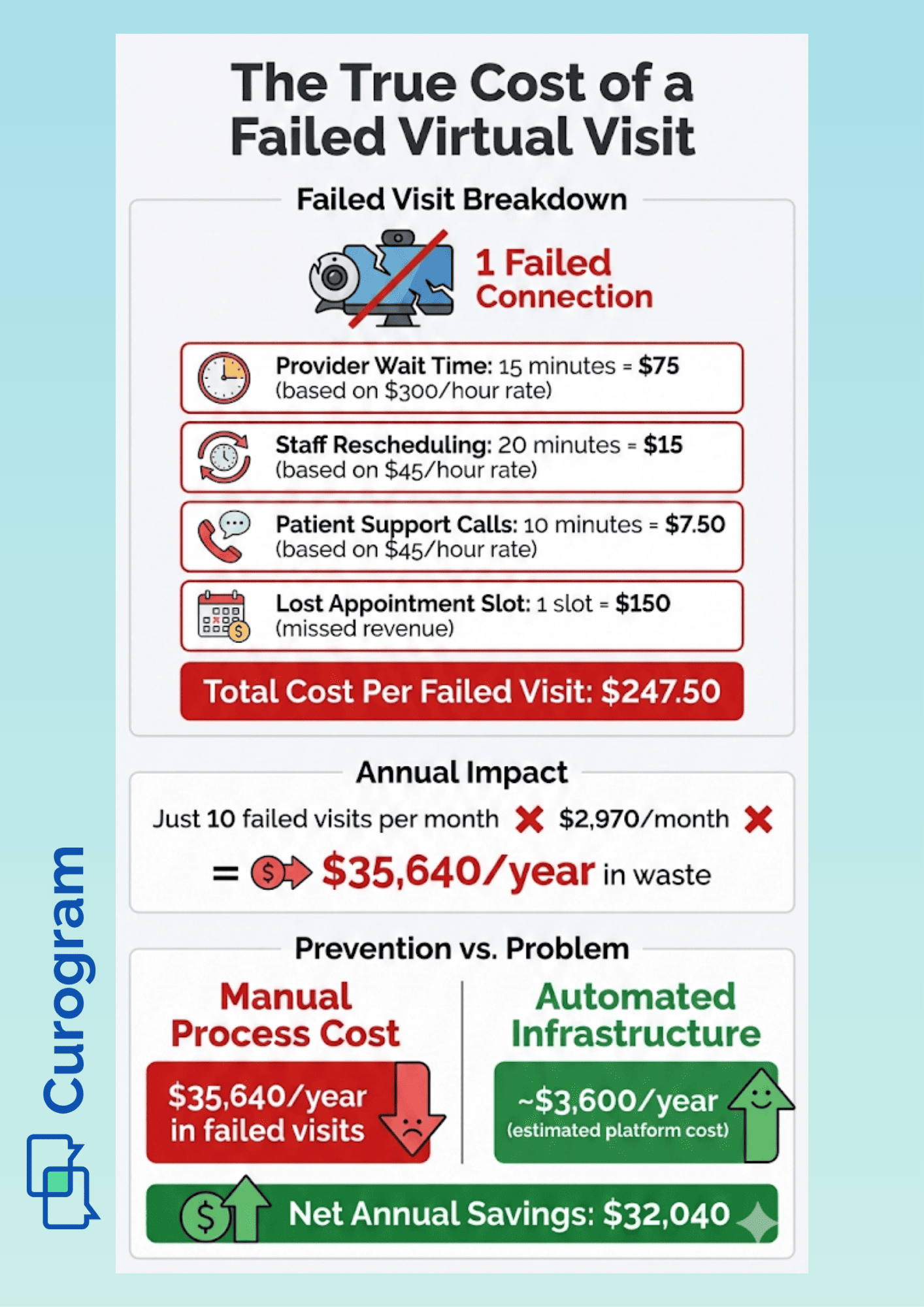
Cost breakdown infographic comparing failed virtual visit expenses versus automated telehealth infrastructure investment

Improving Telehealth Reliability at Enterprise Scale

A failed virtual visit costs more than the appointment time. The patient wastes time trying to connect. The provider sits idle while troubleshooting. Staff handle frustrated calls afterward. Then everyone must reschedule and try again.

This cycle repeats whenever telehealth workflows fail. Each failure erodes trust in virtual care. Patients start requesting in-person visits even when virtual would work better. Providers become skeptical of telehealth efficiency. Staff view virtual care as extra work instead of a time-saver.

The root cause is usually workflow inconsistency. Different departments send visit links differently. Instructions vary by provider. Technical support is reactive instead of preventive. No one owns the end-to-end virtual visit experience.

Enterprise-scale telehealth demands standardization. Every patient receives the same clear process. Every provider follows the same workflow. Every visit has the same quality controls.
This consistency transforms virtual care reliability.

Delivering Clear Telehealth Visit Instructions

Patient confusion is the most common cause of failed virtual visits. A patient doesn't know where to find the visit link. They click it too early and think it's broken. They can't locate the link in their email. They use the wrong device.

Each confusion point creates friction. Some patients persist through the problems. Others give up and call for help. A few simply miss the appointment.

Clear instructions prevent most of these issues. Patients need to know exactly what will happen and when. They need simple steps that work for non-technical users. They need information delivered at the right time.

Effective virtual visit preparation starts days before the appointment. A patient receives their first reminder with basic information: the appointment time, what to expect, and what they'll need (device with camera and internet connection).

A day before the visit, they receive the actual connection information. The message includes the visit link and simple instructions: "Click this link five minutes before your appointment time. You'll join a virtual waiting room. Your provider will connect with you at your scheduled time."

The morning of the visit, they get a final reminder. This message reinforces the timing and includes the link again. It also provides troubleshooting information: "If you have connection problems, call this number for immediate support."

This three-touch approach balances preparation with clarity. Patients aren't overwhelmed with information weeks in advance. They receive key details when they're most relevant.

The content of instructions matters as much as the timing. Generic technical documentation confuses more than it helps. Patients don't need to understand video conferencing technology. They need to know three things: where to click, when to click, and who to call if it doesn't work.

Consider the difference between these instruction sets:

  • Unclear approach: "Access the patient portal using your credentials. Navigate to the appointments section. Locate your upcoming telehealth appointment. Click the video conferencing icon. Ensure your browser permissions allow camera and microphone access. Join the waiting room. Wait for your provider to initiate the connection."
  • Clear approach: "Click the link below at 2:55 PM. You'll join a virtual waiting room. Dr. Smith will connect with you at 3:00 PM."

The second version gives the same essential information in three simple sentences. It removes unnecessary steps and technical jargon. It tells patients exactly what action to take and what will happen next.

Large health systems conducting thousands of virtual visits per month can't afford unclear instructions. A 5% confusion rate on 5,000 monthly visits means 250 failed connections. Each requires staff intervention, patient callbacks, and rescheduling.

Clear, standardized instructions reduce this failure rate dramatically. When patients know exactly what to do, connection rates can reach 95% or higher. The improvement directly reduces support burden and improves patient satisfaction.

Reducing Missed and Failed Virtual Visits

Even with clear instructions, patients forget appointments. They overlook emails. They lose track of visit links. They remember the appointment but can't find the connection information.

Automated reminders solve most of these problems. But reminder effectiveness depends on delivery method, timing, and content.

Text message reminders significantly outperform email alone. Patients check texts more frequently than email. Text open rates typically exceed 90% within minutes of delivery. Email open rates average 20-30% and often take hours or days.

For virtual visits, text delivery of visit links makes particular sense. The patient receives the link directly on their phone. They can click it immediately from the device they'll likely use for the visit. There's no searching through email folders or copying links between devices.

Timing also matters. A reminder sent a week early might be forgotten by appointment day. A reminder sent ten minutes before the visit doesn't give patients time to prepare. The optimal timing balances advance notice with proximity to the actual appointment.

Most health systems find success with a 24-hour reminder plus a 2-hour reminder. The 24-hour message sets expectations and allows schedule adjustments if needed. The 2-hour message serves as the final prompt to connect.

For Oracle Health environments managing complex appointment schedules, automated reminder systems integrate with existing scheduling workflows. When a staff member books a virtual visit, the reminder sequence triggers automatically. No manual follow-up required.

This automation matters at scale.

For example:

A practice with 100 virtual visits per week would need to manually send 200 reminders if using a two-reminder approach. Over a year, that's 10,400 manual messages. Automation eliminates this workload entirely.

The reliability impact extends beyond convenience. Patients who receive consistent reminders develop trust in the system. They know they'll get the information they need when they need it. This trust increases virtual visit completion rates over time.

Consider this:

A patient who successfully connects to three virtual visits in a row. Each time, they received clear reminders at the right time. Each time, the connection process worked smoothly. By the fourth visit, they're confident in the system. They don't need to call with questions. They don't worry about technical problems.

This confidence accumulates across the patient population. As more patients have positive virtual care experiences, overall system efficiency improves. Fewer support calls. Higher completion rates. Better resource utilization.

Supporting Care Continuity Between Visits

Healthcare outcomes depend on what happens between appointments. A patient leaves the hospital with discharge instructions. They start a new medication regimen. They begin physical therapy exercises. Success requires consistent follow-through.

Traditional care models struggle with this continuity. Patients go home and face questions. They're unsure if symptoms are normal. They forget instructions. Small problems go unaddressed until they become larger ones.

Telehealth bridges this gap. Quick virtual check-ins catch issues early. Patients get answers without scheduling full appointments. Providers monitor progress without requiring clinic visits.

Enabling Post-Visit and Post-Discharge Follow-Ups

Hospital readmissions often result from inadequate follow-up care. A patient doesn't understand their discharge instructions. They experience unexpected symptoms and don't know if they should worry. They struggle with new medications.

A virtual check-in three days post-discharge addresses these concerns early. The provider assesses how the patient is doing. They clarify any confusion about medications or care instructions. They identify warning signs before they escalate.

This simple intervention can prevent emergency room visits and readmissions. A patient experiencing mild post-surgical discomfort gets reassurance that it's normal. A patient struggling with medication side effects gets dosage adjustments before stopping treatment entirely.

Moreover, most post-discharge complications emerge in the first week. A virtual check-in during this window catches problems when they're still manageable. The patient feels supported. The provider maintains oversight. Readmission risk drops.

Oracle Health systems tracking readmission rates see measurable improvements when systematic virtual follow-ups are in place. The intervention is simple, but the impact is significant.

Supporting Chronic and Ongoing Care

Chronic disease management requires regular touchpoints. A diabetes patient needs consistent monitoring. A heart failure patient requires ongoing assessment. A patient managing depression benefits from frequent check-ins.

Traditional care models space these touchpoints months apart. Patients see their specialist every three to six months. Between visits, they're largely on their own.

Telehealth enables more frequent monitoring without overwhelming clinic capacity. A patient might have monthly virtual check-ins supplemented by quarterly in-person visits. The provider stays informed about the patient's progress. The patient feels supported rather than isolated.

These regular virtual touchpoints improve adherence. When patients know they'll discuss their progress next week, they're more likely to follow their care plan. The accountability helps, as does the opportunity to ask questions between major appointments.

Consider this:

A patient is managing hypertension. Their cardiologist sees them in person every six months. Between visits, they have monthly virtual check-ins to review blood pressure logs and discuss any concerns.

During one virtual visit, the patient mentions increasing fatigue. The provider recognizes this as a potential medication side effect and adjusts the prescription. This early intervention prevents the patient from stopping their medication or experiencing complications.

Without the virtual check-in, this issue might have gone unaddressed for months. The patient would have either struggled with side effects or stopped treatment. Either outcome leads to worse health results.

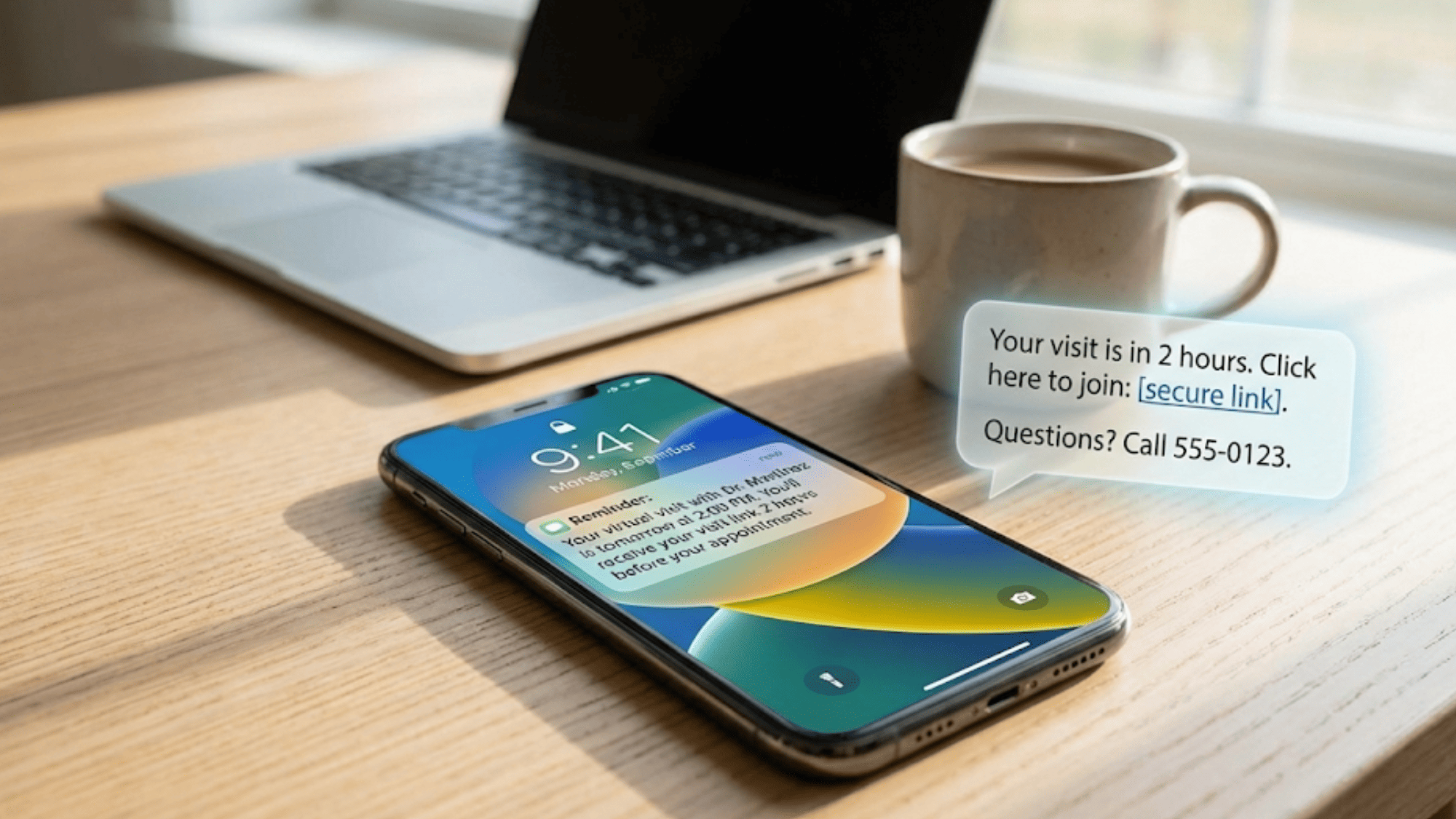
Smartphone displaying automated telehealth appointment reminder text message with visit link and instructions

Reducing Operational Friction for Providers and Staff

Telehealth should reduce workload, not increase it. When virtual care adds complexity to provider schedules or creates extra tasks for staff, adoption suffers. People revert to familiar in-person workflows even when virtual would work better.

The key is integration. Telehealth workflows must fit naturally into existing operations. Scheduling a virtual visit should be as simple as scheduling an in-person appointment. Sending visit links should happen automatically. Connection support should be minimal.

When these elements align, telehealth becomes easier than traditional care delivery for many appointment types.

Simplifying Scheduling and Visit Coordination

Staff spend significant time coordinating appointments. They call patients to confirm. They send appointment details. They answer questions about location, parking, and preparation.

Virtual visits eliminate many of these tasks. Patients don't need directions to the clinic. There are no parking instructions. Location-specific questions don't exist.

Automated systems handle visit detail delivery. When a staff member schedules a virtual appointment in Oracle Health, the system automatically sends visit links and instructions to the patient. No manual email composition. No copying and pasting links. No follow-up calls to confirm receipt.

This automation compounds across hundreds of appointments. A practice scheduling 200 virtual visits per month saves hundreds of staff hours annually. Those hours become available for higher-value tasks like care coordination or patient education.

Phone volume decreases too. Patients receive clear information automatically. They don't need to call asking "How do I join my appointment?" or "Where's my visit link?" Staff fields fewer routine questions and can focus on complex patient needs.

Protecting Provider Time and Capacity

Provider time is the most valuable resource in healthcare. Every minute a provider spends waiting for a patient to connect is a minute unavailable for actual care delivery.

Failed virtual visits waste this time directly. A provider logs into the virtual room at the scheduled time. The patient doesn't appear. The provider waits five minutes, then ten. Eventually they move on, but the time slot is lost.

Reliable telehealth systems prevent this waste. Clear instructions and automated reminders ensure patients connect on time. When patients do encounter technical issues, support systems resolve them quickly without involving the provider.

The impact on provider schedules is substantial. A provider conducting eight virtual visits per day with a 90% connection rate loses nearly an hour to failed appointments each day. At 95% reliability, that drops to 24 minutes. At 98% reliability, it's under 10 minutes.

This efficiency improvement allows providers to see more patients or reduces their working hours. Either outcome benefits the system. More patient capacity or reduced provider burnout both support long-term sustainability.

Integrating Telehealth Into Oracle Health Workflows

Standalone telehealth tools create workflow problems. Staff must switch between systems. Information doesn't sync automatically. Processes that should be simple become complicated.

Integration solves these problems. When telehealth capabilities align with Oracle Health workflows, virtual care becomes a natural extension of existing operations.

Supporting Scheduling, Intake, and Follow-Up

The patient journey should flow smoothly regardless of visit type. A patient scheduling a virtual appointment uses the same process as scheduling an in-person visit. They receive appointment confirmations through familiar channels. They complete intake forms the same way.

This consistency reduces confusion and training burden. Staff don't need separate workflows for virtual visits. Patients don't encounter different processes for different appointment types.

Digital intake forms can be completed before virtual visits just as they are before in-person appointments. The provider reviews this information ahead of time. The actual appointment focuses on discussion and care planning rather than information gathering.

Follow-up communication flows naturally too. After a virtual visit, the patient receives care summaries, next steps, and follow-up scheduling information through the same channels as in-person care.

Enabling Scalable Virtual Care Automation

Enterprise healthcare requires standardized, repeatable workflows. One-off solutions don't scale. Manual processes create bottlenecks. Systems need automation that handles volume reliably.

Scalable telehealth automation triggers on standard events. An appointment is scheduled, reminders deploy automatically. A visit completes, follow-up messages send without manual intervention. A patient misses a connection, rescheduling workflows activate.

These automated responses maintain quality across thousands of interactions. Every patient gets the same reliable experience. No appointment falls through the cracks. No patient waits for manual follow-up.

Central governance ensures consistency across departments. The cardiology department and the primary care department use the same telehealth workflows. Patients moving between specialties encounter familiar processes. Staff transferring between departments don't need to learn new systems.

Maintaining Compliance and Governance in Virtual Care

Virtual visits involve protected health information. Every message, every video call, every piece of documentation must meet HIPAA requirements. Enterprise health systems can't compromise on this standard.

Delivering HIPAA-Compliant Virtual Visits

Secure communication channels protect patient privacy during virtual visits. Video connections must be encrypted. Visit links must be delivered through secure channels. Access must be controlled and auditable.

Consumer video tools don't meet these requirements. They're designed for convenience, not healthcare compliance. Using them for virtual visits creates unnecessary risk exposure.

Healthcare-specific telehealth platforms build in required protections. Communications are encrypted by default. Access controls prevent unauthorized viewing. Audit trails document who accessed what information and when.

These protections work automatically in the background. Providers and patients don't need to think about encryption or security protocols. The technology handles compliance while maintaining a simple user experience.

Supporting Audit and Oversight Requirements

Healthcare organizations face regular audits and reviews. They must demonstrate compliance with privacy regulations, quality standards, and billing requirements. Virtual care creates new audit surface area.

Centralized telehealth systems make audit support straightforward. All virtual visit records exist in one place. Activity logs document participant actions. Reports can be generated quickly for review.

This centralized approach also supports quality oversight. Healthcare leadership can review virtual visit completion rates, patient satisfaction scores, and clinical outcomes. They can identify areas for improvement and track progress over time.

Without central systems, this oversight becomes nearly impossible. Virtual visit data scatters across multiple platforms and departments. Creating comprehensive reports requires manual data gathering from multiple sources.

Why Oracle Health Systems Use Curogram for Telehealth

Large health systems need telehealth infrastructure built for their scale and requirements. Generic tools work for small practices but break down in enterprise environments.

Curogram provides telehealth capabilities designed specifically for large healthcare organizations. It handles high visit volume while maintaining the reliability and governance that enterprise systems require.

A Scalable Telehealth Infrastructure

Reliability at scale requires purpose-built infrastructure. Systems must handle thousands of concurrent users. Workflows must trigger automatically without manual intervention. Performance must remain consistent regardless of load.

Curogram's architecture supports these requirements. Health systems conducting tens of thousands of virtual visits per month experience the same reliability as those conducting hundreds. Automated workflows scale without additional configuration.

Central governance gives IT teams and healthcare leadership the control they need. Security policies apply uniformly across the organization. Compliance standards are enforced automatically. Reporting provides visibility into virtual care operations.

Integration with Oracle Health workflows ensures telehealth fits naturally into existing operations. Staff use familiar tools. Providers work within known systems. Patients receive consistent experiences.

This integration reduces training burden and improves adoption. When telehealth capabilities exist within existing workflows rather than requiring separate platforms, everyone adopts them more quickly and uses them more effectively.


See How Telehealth Supports Oracle Health Systems

Telehealth has evolved from temporary solution to permanent infrastructure. Oracle Health systems now depend on virtual care to expand geographic reach, improve appointment access, and maintain consistent patient engagement between visits.

The impact is measurable. Virtual visits increase capacity without facility expansion. Automated workflows reduce staff burden while improving connection rates. Clear instructions and timely reminders transform patient experience and completion rates.

Most importantly, telehealth supports the continuity that drives better outcomes. Post-discharge check-ins prevent complications. Chronic care patients receive regular monitoring. Follow-up appointments happen consistently instead of sporadically.

This infrastructure advantage compounds over time. Systems with reliable telehealth workflows serve more patients, reduce operational friction, and maintain quality across virtual and in-person channels. 


How Curogram Delivers Reliable Telehealth for Oracle Health Systems


Curogram delivers enterprise-grade telehealth infrastructure that integrates directly with Oracle Health systems. Healthcare organizations use Curogram to expand virtual care access while maintaining the reliability and compliance that large-scale operations demand.

The platform handles complete telehealth workflows automatically. When staff schedule virtual appointments, Curogram sends visit links and instructions to patients through secure channels. Automated reminders ensure patients connect on time. Clear, simple instructions reduce technical confusion and support calls.

For providers, this automation means predictable, efficient virtual visits. Connection rates improve because patients receive clear guidance at the right time. Failed visits decrease because the system catches and resolves common issues before they disrupt appointments.

Provider time is protected because technology handles routine coordination tasks.
Staff workloads decrease as manual processes shift to automation. No more copying and pasting visit links. No more fielding calls about how to join virtual appointments. No more coordinating reminder schedules across different providers and departments.

Curogram's HIPAA-compliant infrastructure protects patient information throughout the virtual care journey. All communications are encrypted. Access is controlled and auditable. The platform meets enterprise security requirements without requiring special configuration or ongoing maintenance.

For healthcare leadership, central governance provides oversight across the organization. Virtual care operates according to standardized policies. Quality metrics are tracked consistently. Compliance is maintained systematically.

The platform scales with organizational needs. A health system conducting 1,000 virtual visits per month uses the same infrastructure as one conducting 50,000 visits. Performance remains consistent. Reliability stays high. Administrative burden doesn't increase with volume.

Integration with Oracle Health workflows means Curogram enhances existing systems rather than replacing them. Virtual care becomes a natural extension of established processes.  Adoption improves because staff and providers work within familiar environments.

This approach transforms telehealth from a technical challenge into a strategic advantage. Health systems expand access, improve efficiency, and maintain quality across both virtual and in-person care channels.

Conclusion

Telehealth is now essential infrastructure for Oracle Health systems. It's not optional technology or temporary accommodation. It's how modern healthcare organizations expand access and maintain care continuity.

The systems that succeed with virtual care treat it as seriously as in-person operations. They build reliable workflows. They standardize processes. They invest in infrastructure that scales with their needs.

Failed virtual visits and inconsistent telehealth experiences create the same problems as unreliable in-person care. Patients don't get treatment. Providers waste time. Staff handle preventable issues. The difference is that telehealth failures are easier to prevent with the right infrastructure.

With Curogram's telehealth integration, clear visit instructions reduce connection problems. Automated reminders improve attendance. Secure link delivery protects patient information. Integration with Oracle Health workflows eliminates friction. These elements combine to create virtual care that works reliably at enterprise scale.

The benefits extend across the organization. Patients access care more easily regardless of location. Providers conduct efficient virtual visits without technical disruptions. Staff focus on care coordination instead of troubleshooting. Leadership gains visibility into virtual care operations and outcomes.

Most importantly, care continuity improves. Post-discharge check-ins happen consistently. Chronic disease management includes regular touchpoints. Patients feel supported between major appointments. These ongoing connections prevent complications and improve long-term outcomes.

As telehealth volume continues growing, the gap widens between systems with reliable infrastructure and those without. Organizations that invest now in scalable, compliant, integrated telehealth capabilities position themselves for sustainable growth. Those that continue with ad-hoc solutions will face increasing operational strain.

Oracle Health systems have an opportunity to lead in virtual care delivery. The technology exists. The workflows are proven. The benefits are clear. The question isn't whether to prioritize telehealth infrastructure. It's how quickly to implement it.

Ready to explore how enterprise telehealth workflows improve efficiency? Book a demo today to see how Curogram supports better care workflows with Oracle Health.


Frequently Asked Questions

How does telehealth reduce readmission rates after hospital discharge?
Virtual follow-ups catch post-discharge complications early when they're still manageable. A provider can assess symptoms, clarify medication instructions, and adjust treatment plans during a brief video call. This early intervention prevents issues from escalating to emergency room visits or readmissions.
Why do automated reminders improve virtual visit completion rates?
Text reminders reach patients directly on the devices they'll use for virtual visits. High open rates and timely delivery ensure patients see connection instructions when needed. The 24-hour and 2-hour reminder sequence balances advance notice with proximity to appointment time, reducing both forgotten appointments and last-minute confusion.
How does telehealth increase appointment capacity without adding staff?

Virtual visits eliminate travel time between clinic locations and reduce time spent on routine follow-ups. Providers can conduct more appointments per day when they're not limited by physical location. Better visit triage also frees in-person slots for patients who genuinely need hands-on care.

What makes telehealth infrastructure different from consumer video tools?

Healthcare-specific platforms include built-in HIPAA compliance, encrypted communications, and audit trails. They integrate with health system workflows and support automated reminder sequences. Consumer tools lack these healthcare requirements and create compliance risks when used for patient care.

How does central governance improve telehealth quality across departments?

Standardized workflows ensure every patient receives the same reliable experience regardless of which department they visit. Central oversight allows leadership to track completion rates, identify problems, and implement improvements systemically. This consistency reduces training burden and improves overall virtual care quality.


Expanding Access and Growing Revenue with Telehealth in Ramsoft

Expanding Access and Growing Revenue with Telehealth in Ramsoft

💡 Ramsoft users can expand access and drive revenue with Curogram's integrated telehealth platform. Virtual consultations reduce patient no-shows...

Read More
Simplifying Radiology Follow-Ups with Telehealth in Exa

Simplifying Radiology Follow-Ups with Telehealth in Exa

💡 Virtual visits in Exa allow secure communication with patients at your convenience. When follow-ups happen only in person, many people skip...

Read More
Telehealth for Meditab IMS Practices

Telehealth for Meditab IMS Practices

💡 Telehealth for Meditab IMS practices breaks down access barriers that keep patients from getting the care they need. Virtual visits remove the...

Read More