


6 min read

Reaching Oracle Health Patients for Screenings via SMS | Curogram

Reaching Oracle Health Patients for Screenings via SMS | Curogram

💡 SMS-driven patient recall recovers $400K to $500K each year for enterprise healthcare systems by reaching patients that paper and portals miss. 

Paper recalls convert at only 8-12%, while SMS reaches 95% of patients with 30-40% action rates. 

A 50-location system using Curogram mass SMS recovered 1,240 patients in 90 days, generating $1.2M in revenue. Paper costs dropped 100%, and FTE workloads shrank by 2-4 positions. 


The result: 300-500% ROI in year one, with full payback in 90-120 days.


Picture this. Your clinical operations team mails out 5,000 paper recalls every quarter. Postage, printing, envelopes, staff hours. The bill lands somewhere between $40,000 and $50,000 a month.

Now look at the response. Only 8-12% of those patients act. The rest? Silence.

That silence has a price. For a 50-location enterprise system, it adds up to $352,000 to $736,000 in lost revenue every single year. Copays never collected. Deductibles forgotten. Follow-up visits that quietly disappear from the schedule.

Your COO sees the operational cost. Your CFO sees the revenue leakage.

And your Clinical Operations Director?

They are stuck managing paper lists, fielding confused phone calls, and wondering why the numbers never seem to move.

It sounds like a communication problem. It is actually a financial one.

The truth is, paper-based and portal-only recall programs reach only 30-40% of your patient panel.

That means 60-70% of potential revenue is sitting on the table, waiting for someone to pick it up. Meanwhile, the staff time spent maintaining manual workflows quietly burns through 2-4 full-time positions worth of work.

Here is the part that should get every executive's attention. Most enterprise systems already have the patient data they need to fix this. They just lack the channel to reach those patients fast, at scale, and in a way patients actually respond to.

That is where SMS changes the math. Not as a gimmick. Not as a "nice to have."

As a measurable, auditable revenue recovery engine that pays for itself within a quarter.

In this article, we will break down exactly how SMS-driven population health recovers $400K to $500K annually, eliminates paper costs, and frees up clinical staff for higher-value work.

The numbers are specific. The ROI is real.

Why Your Current Recall Program Is Quietly Bleeding Revenue

The 8-12% Problem Hiding in Your A/R Reports

Paper recall programs look productive on the surface. Statements go out. Mailrooms hum. The metrics, though, tell a different story.

For a 50-location system with 5,000 recall-eligible encounters per quarter, only 400 to 600 patients actually take action.

That leaves 4,400 to 4,600 patients in the silent majority. Their balances age. Their follow-up care lapses. Their revenue evaporates.

Average uncollected revenue per encounter sits between $20 and $40. Spread that across thousands of unreached patients, and you are looking at $88,000 to $184,000 in lost revenue per quarter. Annualized, that becomes $352,000 to $736,000 walking out the door.

The leakage usually breaks down into a few familiar buckets:

  • Unpaid copays from preventive and follow-up visits
  • Deductibles that age out of active collection
  • Balance-forward amounts on specialist encounters
  • Missed recalls that never convert into a scheduled visit

This is not theory. A/R aging analysis at large enterprises consistently shows that 60-70% of patient-owned balances trace back to poor reach, not legitimate disputes.

The patients are not refusing to pay. They simply never got the message, a known issue in healthcare communication barriers and patient non-response.

Why SMS Reconversion Rates Beat Everything Else

Now compare that to SMS. In a Curogram case study, a 50-location system with 8,000 overdue recall encounters ran an SMS broadcast campaign over three months.

The result: 2,800 patients took action. That is a 35% reconversion rate.

Channel Reach Action Rate Net Effective Reach
Paper mail 100% 8-12% 8-12%
Patient portal ~40% 25-35% 10-14%
SMS broadcast 95%+ 30-40% 28-38%

Average recovered revenue per patient came in at $420. Total incremental revenue: $1.176M. Cost of sending the messages? About $240.

That is a 4,900-to-1 ROI on messaging alone, before you count any operational savings.

The reason this works is simple. SMS reaches patients that paper and portals cannot. Combined, this is what makes population health SMS ROI revenue recovery FTE reduction such a measurable win for enterprise systems.

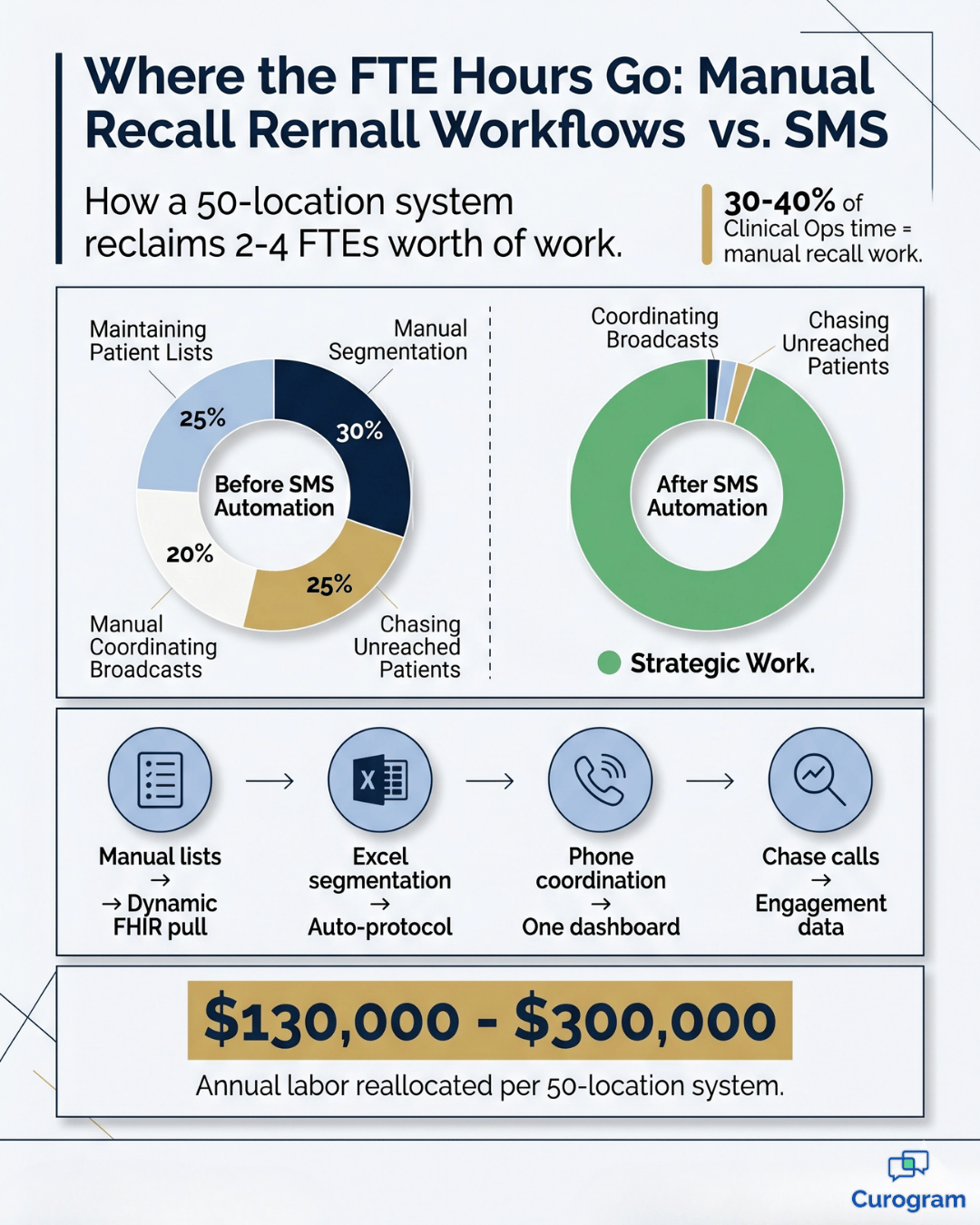
Infographic showing how SMS automation reduces manual recall workflow hours and reclaims 2-4 FTEs.

Quality Metrics, Star Ratings, and the Hidden Bonus Money

Beyond recalls, SMS-driven preventive campaigns deliver 25-40% uptake increases compared to portal-only outreach. Flu shots, cancer screenings, chronic disease check-ins.

These do not always generate immediate revenue, but they protect something equally valuable: your quality metrics.

Take HEDIS colorectal screening rates. A 50-location system with 15,000 Medicare patients can lift screening rates by 5-10% through SMS outreach. That is 1,500 to 2,500 additional screenings completed.

In practice, this translates to a 0.5 to 1.0 Star rating point improvement.

For your team, that means $200,000 to $400,000 in Medicare reimbursement bonuses you would otherwise miss.

SMS-driven population health is also the cleanest path to value-based payment readiness, because you finally have data to prove patient reach across underserved groups.

Revenue recovery is only one side of the equation. The other side is what SMS removes from your cost base.

The Hidden Costs Disappearing From Your Budget

Paper Statements: Cutting an Entire Line Item

Paper recall programs cost between $800 and $1,000 per location per month. Across 50 locations, that is $40,000 to $50,000 a month, or $480,000 to $600,000 a year. All for an 8-12% conversion rate.

SMS costs $0.01 to $0.03 per message. Sending 5,000 monthly recall messages runs $50 to $150. Same volume. Different universe.

Cost Category Paper Recalls (Annual) SMS Recalls (Annual) Savings
Per-location cost $9,600-$12,000 $120-$360 ~98%
50-location system $480,000-$600,000 $6,000-$18,000 $462K-$594K

This means a CFO can reallocate close to half a million dollars in year one. The savings hit in month one and stay stable.

No ramp-up. No phased reduction. Just immediate budget relief that can fund analytics, digital health, or patient experience investments.

Patient checking SMS healthcare appointment reminder on smartphone at home, smiling with ease.

FTE Reductions Where the Math Actually Lands

Clinical Operations staff at enterprise systems typically spend 30-40% of their time on manual recall workflows. For a 50-location system, that work consumes 2 to 4 full-time positions.

At $65,000 to $75,000 per fully burdened FTE, that is $130,000 to $300,000 in annual labor tied up in administrative tasks.

Most of that time is spent on the same handful of repeating tasks:

  • Maintaining and cleaning patient contact lists
  • Segmenting recalls by clinical criteria
  • Coordinating broadcast timing across locations
  • Chasing unreached patients by phone or letter

Curogram's mass SMS automation eliminates almost all of it. Patient lists pull dynamically from Oracle FHIR. Segmentation runs automatically by clinical protocol. Broadcasts schedule and track inside one interface. Follow-up runs on engagement data, not manual checklists.

Reach every patient in seconds. Use mass messaging for urgent closures, health alerts, or clinic news with a 98% open rate with Curogram.

Your staff stops being mailroom managers and starts being campaign strategists.

Call Center Volume That Quietly Adds Up

Then there is the call center. Confused patients call to ask about recalls they did not understand. They request copies. They call to pay after the third notification finally lands.

A typical 50-location system sees 200 to 300 such calls a month.

Average handle time: 4-6 minutes per call. At $15 an hour fully burdened, that is $3,250 to $6,750 per month in call center labor on recall questions alone. SMS cuts those calls by 60-70% because patients now have one-click payment links and self-service options.

The monthly savings here are modest, around $500 to $750. But aggregated across a year, you recover another $6,000 to $9,000.

Small line item. Real money. And it stacks neatly on top of the FTE and paper savings.

Ready to See Your Numbers? Schedule a Demo

The case for SMS-driven population health is not subtle. Paper recalls convert at 8-12%. SMS reconverts at 30-40%.

Paper costs $480,000 a year. SMS costs $18,000. Manual workflows consume 2-4 FTEs. Automation hands that capacity back to your team.

For a 50-location enterprise system, the combined impact looks like this.

Revenue recovery: $1.2M to $1.5M annually. Paper cost elimination: $462,000 to $594,000. FTE reallocation: $130,000 to $300,000. Quality metric bonuses: another $200,000 to $400,000 through HEDIS and Star rating improvements.

Total ROI in year one: 300-500%. Payback period: 90-120 days. And every dollar is auditable through Curogram's SOC 2 Type II and HIPAA-compliant reporting platform, so your CFO and compliance team can both sign off with confidence.

The harder question is not whether SMS works. It is how much longer your system can afford to leave 60-70% of its patient panel unreached.

Every quarter spent on paper-only recalls is another $88,000 to $184,000 in lost revenue. Every month of manual workflows is another payroll cycle funding work that should not exist.

Curogram was built by engineers who watched front-office and call-center workflows in real medical practices. The platform is HIPAA-compliant, integrates with almost any EMR, and trains your staff in under 10 minutes.

No long onboarding. No bloated implementation. Just a measurable shift from paper to performance.

If you are ready to see what your population health SMS ROI looks like with your own data, schedule a demo with Curogram today.

We will walk through your patient panel, recall volume, and current conversion rates, and show you exactly where the $400K to $500K is hiding.

If you are ready to see what your population health SMS ROI looks like with your own data, schedule a demo with Curogram today. We will walk through your patient panel, recall volume, and current conversion rates, and show you exactly where the $400K to $500K is hiding. 


Frequently Asked Questions

How quickly do we see ROI?

Paper cost elimination is immediate. You see savings in month one. Revenue recovery from SMS campaigns kicks in by week two or three of your first broadcast, with 50-60% of recovered revenue realized in the first month.

What if our patient population skews elderly with lower SMS adoption?

SMS adoption among patients 65+ is now above 80%. Smartphones and senior-friendly messaging apps have closed the gap. Even in older populations, SMS reach beats portal reach (which sits below 40% for this group).

How do we handle patient payment collection through SMS?

Curogram's SMS broadcasts can include secure payment links similar to text-to-pay functionality. Patients click, see their balance, and pay through a PCI-compliant portal that talks directly to your billing system.

How does Curogram stay HIPAA-compliant when sending mass SMS broadcasts?

Curogram is built on a SOC 2 Type II and HIPAA-compliant infrastructure, so every broadcast is encrypted in transit and at rest. Patient data never leaves the secure environment, and access is role-based with full audit trails.

Will SMS campaigns integrate with our existing EMR without a long IT project?

Curogram integrates with almost any EMR, including Oracle Health FHIR, Epic, athenahealth, eClinicalWorks, and most major systems. Patient lists pull dynamically, so your team is not exporting CSVs or maintaining duplicate records.