
.jpg?width=30&height=30&name=square-formal-photo%20(1).jpg) Mira Gwehn Revilla
Mira Gwehn Revilla
GE Centricity Clinics Improve Workflows with Mass Texting
 Aubreigh Lee Daculug : Dec 30, 2025, 11:00:00 AM
Learn how GE Centricity users automate patient recalls, updates, and outreach using Curogram’s HIPAA-compliant mass texting platform.

A snowstorm shuts down three clinics. Over 2,000 patients have visits booked for the next two days. Your call center has eight staff members. How do you reach everyone in time?
This is not a drill. It is a real problem that Oracle Health systems face every week. Weather events, system outages, and sudden schedule changes happen fast. Patients need to know right away. However, phone communication takes hours, emails go unread, and your staff cannot call thousands of people one by one.
Mass texting solves this. It sends one message to your entire patient list in seconds. Oracle Health systems serve large, complex patient groups. A single clinic closure can affect hundreds of people. A flu vaccine drive can reach tens of thousands. These are not small tasks. They need tools built for scale.
Enterprise patient communication at this level demands speed, reach, and control. You cannot rely on slow, manual methods. You need a system that works the moment you press send.
Mass texting for Oracle Health systems does exactly that. It delivers urgent updates to every patient's phone at once. Patients see the message. They know what to do and, therefore, do not need to flood your call lines with questions.
This blog will show you how mass texting works for large health networks. You will learn how it reduces call surges, keeps messages the same across all sites, and protects patient data. You will also see how it supports care gap outreach and preventive health efforts.
Oracle Health systems must talk to large patient groups quickly. When a clinic closes, thousands of people need to know. When a service goes down, patients need next steps. When a storm hits, schedules change fast.
Phone trees cannot keep up. Email sits unread in crowded inboxes. Manual outreach also takes long and leaves gaps. Delays cause confusion, which triggers patient calls, and calls flood your access teams at the worst time.
Mass texting fixes this. It sends clear, fast updates to every patient's phone. Text messages have a 98% open rate. Most people read texts within minutes. This means your message gets seen when it matters most.
Enterprise patient communication at scale requires tools that match the size of your network. Oracle Health systems often span dozens of sites. They serve patients across cities, counties, or even states. A single update might need to reach 50,000 people. Mass texting handles this without breaking a sweat.
Think about a real example: A major software update causes your patient portal to go offline for four hours. During that window, patients cannot check test results or message their care team. Without a mass text, what happens?
Patients try to log in. They fail. They call the front desk. They wait on hold. They call again. Your staff answers the same question over and over: "Is the portal down?"
Now, picture a mass text sent at the start of the outage. It says: "Our patient portal will be offline from 9 AM to 1 PM today. We are working to fix this. Thank you for your patience."
Patients see it. They know what is going on. They do not call. Your staff can focus on real issues. The crisis stays calm.
This same pattern plays out in many ways: Clinic closures, provider schedule changes, emergency weather events, and service line shutdowns. Any time, thousands of patients need the same update, mass texting is the answer.
Manual outreach is slow. Even with a team of ten, calling 5,000 patients takes days. Text messaging does it in seconds, and every patient gets the same clear message at the same time.
Call centers get hit hard during mass events. A single storm can spike call volume by 300% or more. Staff cannot keep up, so hold times grow. As a result, patients get frustrated. Some give up and show up at the wrong clinic at the wrong time.
Mass texting prevents this before it starts. It answers the question before the patient asks it. It gives clear next steps so patients know what to do. This keeps your call lines open for urgent needs.
Oracle Health systems also deal with mixed messaging. Different sites may send different updates. One clinic says the portal is down until noon. Another says 2 PM. Patients get confused and lose trust.
Mass texting enforces message control. You send one approved text to every patient. No one freelances, and no one sends the wrong info. Your brand stays strong and your patients stay informed.
The bottom line is simple: Oracle Health systems need to reach patients fast, at scale, with one clear voice. Phone calls and emails cannot do this, but mass texting can. It is not just a nice-to-have. It is a must-have for any health system that takes patient access and enterprise patient communication seriously.
Messages sent by text reach patients where they already are: their phones. Most adults carry their phones all day. They check texts far more often than email or voicemail. This makes texting the fastest way to share updates.
Mass texting for Oracle Health systems turns this habit into a strength. When you send a broadcast, it lands in the patient's pocket. They see it, read it, and act on it. This is how modern enterprise patient communication works. It meets patients on their terms. It does not ask them to log in, wait on hold, or check a portal they forgot the password for.
Timing matters in healthcare. A patient who shows up to a closed clinic wastes time and loses trust. A patient who misses a weather-related closure might drive through dangerous conditions. A patient who does not know about a schedule change may miss a needed appointment. Mass texting solves these problems by delivering updates the moment you send them.
Consider a few real scenarios:
Confusion kills trust. When patients hear different things from different sources, they do not know what to believe. This leads to more calls, more complaints, and more no-shows.
Mass texting brings message control to your whole network. You write one text. You approve it. You send it to every patient who needs it. Everyone gets the same words at the same time.
This is key for Oracle Health systems with many sites. Without a central tool, each clinic may send its own version of the update. One site says the portal is down until noon. Another says 3 PM. A third forgets to send anything at all.
With mass texting, you avoid this mess. Templates make this even easier. Your team creates approved messages for common events. Clinic closures. Weather delays. System outages. Vaccine drives. When something happens, you do not start from scratch. You pull up the template, fill in the details, and send.
This saves time and reduces errors. It also helps with staff training. New team members can send updates with confidence because the message is already written and approved.
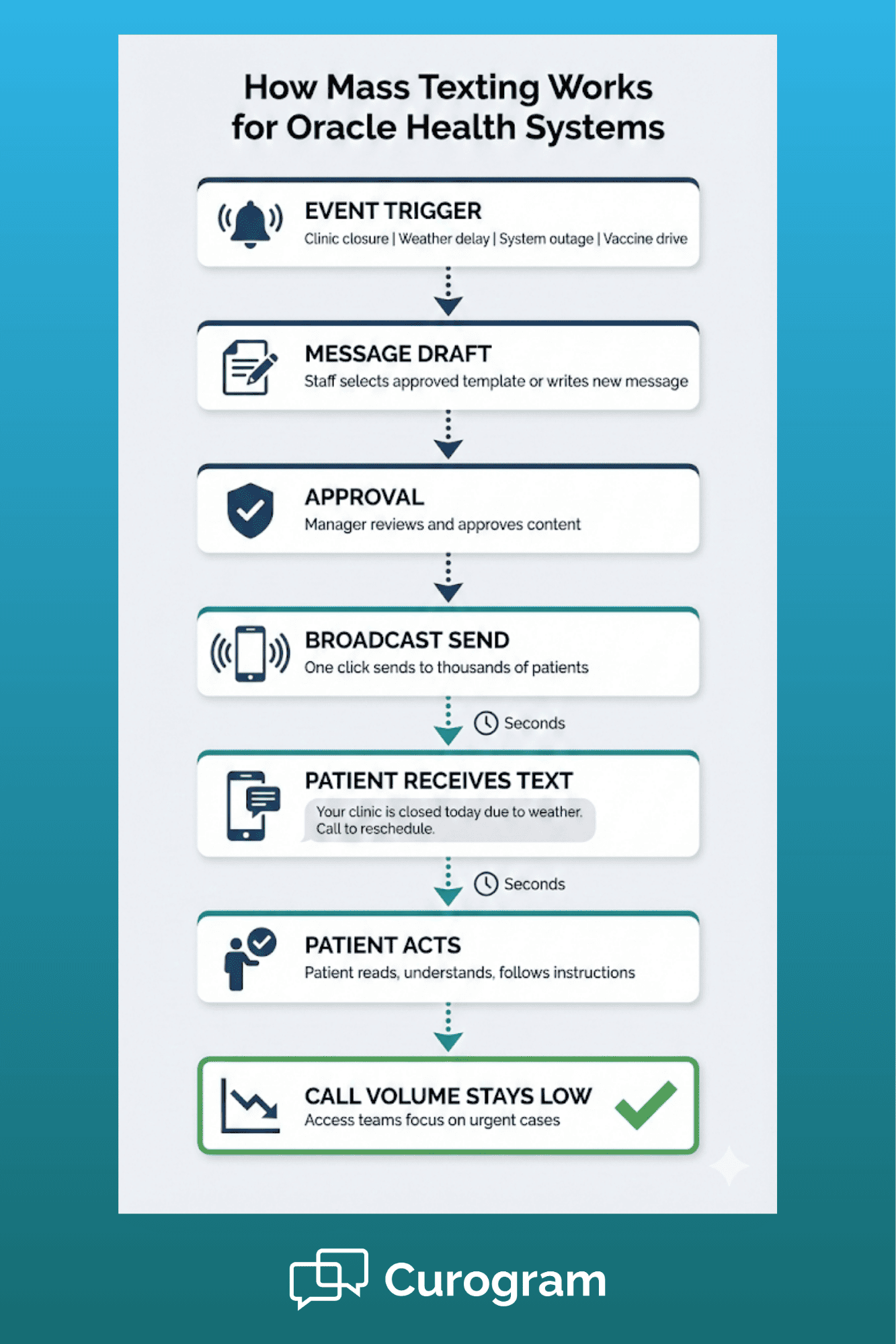
Uncertainty drives calls. When patients do not know what is going on, they pick up the phone. They want answers. They want to talk to a human. And when thousands of patients feel the same way at once, your call center drowns.
This is a daily risk for Oracle Health systems. A single event—a clinic closure, a system outage, a weather delay—can trigger a flood of inbound calls. Hold times spike. Staff burn out. Patients hang up and call back, making the problem worse.
Mass texting stops this cycle before it starts. It gives patients the answers they need before they call. It turns a crisis into a calm day at the office.
Let's walk through a real example. Your system rolls out a new patient portal. The old one goes offline at midnight. Some patients do not get the memo. They try to log in the next morning. They fail. They call.
By 8 AM, your call center has 200 calls in the queue. By 9 AM, it is 400. Staff are on the phone non-stop. Hold times hit 30 minutes. Patients post angry reviews on Google. Your team is stressed, and the day has barely begun.
Now, picture the same scenario with mass texting. The night before, you send a text: "Starting tomorrow, our patient portal has a new look. Log in at [link] to access your account. Need help? Call us at [number]."
Patients see the text. They know the change is coming. They click the link. Most log in without issue. The few who need help call, but the volume is manageable. Your staff have time to breathe. Patients get fast service. Everyone wins.
This is what proactive outreach looks like. You do not wait for patients to discover a problem. You tell them first. You give them next steps. You cut off the call surge before it starts.
Consider another example:
A winter storm is forecast for your region. You know roads will be bad. You know some clinics will close. You know patients will have questions.
You send a mass text at 6 AM: "Due to weather, all clinics in [County] are closed today. Patients with appointments will be called to reschedule. Stay safe."
By 8 AM, your call volume is normal. Patients got the update. They stayed home. They did not call to ask if their appointment was still on. Your staff handled reschedules in an orderly way. The storm passed, and so did the stress.
Compare this to a system without mass texting. Staff spend the entire morning on the phone. Patients show up to locked doors. Some drive through icy roads only to turn around. Trust drops, complaints arise, and staff morale is affected. The difference is not luck. It is planning. Mass texting gives you the tool to stay ahead of events instead of chasing them.
Patient access teams carry a heavy load. They schedule appointments, answer questions, handle complaints, and solve problems. On a normal day, they are busy. On a high-volume day, they are overwhelmed.
Mass texting lightens this load. It takes routine questions off their plate. It gives patients self-service options. It frees up staff to focus on complex cases that actually need human help.
Think about a common scenario:
Your system sends out appointment reminders by text. The reminder includes a link to confirm, cancel, or reschedule. Most patients tap a button instead of calling.
This simple change can cut call volume by up to 50%. Staff spend less time on the phone. Patients get faster service. Everyone saves time.
Now, apply this to a mass event. A vaccine clinic opens next week. You have 5,000 eligible patients. In the old model, staff call each one to offer an appointment. This takes dozens of hours. Many calls go to voicemail, and many patients never respond.
With mass texting, you send a single broadcast: "You are eligible for your annual flu shot. Click here to book your appointment: [link]."
Within 24 hours, 2,000 patients book on their own. Your staff follow up with the rest. The clinic fills up without burning out your team.
This is what efficient enterprise patient communication looks like. You reach more patients with less effort. You give patients the info they need to act on their own. You reserve staff time for the cases that truly need it.
Mass texting also helps with follow-up. After a visit, you can send a text asking if the patient has questions. You can send a link to a survey. You can remind them about next steps like lab work or imaging.
Each of these texts replaces a phone call. Over a year, the savings add up to hundreds of hours and thousands of dollars. Oracle Health systems serve large populations. This means large volumes of calls, questions, and complaints. Mass texting does not make these go away. But it does make them manageable.
When patients get clear info upfront, they do not need to call. When they can book, confirm, or cancel by text, they do not tie up the phone lines. When access teams can focus on urgent cases, they do better work and feel less stressed.
Health systems often struggle with mixed messages. One site says one thing. Another says something else. Patients do not know who to believe. This hurts trust and drives more calls. Mass texting brings message control to the whole network. You send one text to everyone. Every patient sees the same words. There is no room for confusion or error.
Oracle Health systems can span dozens of clinics. Each site has its own staff, its own workflows, and its own habits. Without a central tool, each site may craft its own updates. This leads to gaps.
For example, a system-wide outage hits the patient portal. One clinic texts patients right away. Another waits until noon. A third forgets to send anything. Patients who visit that third site have no idea what is going on.
With mass texting, you avoid this mess. The central team writes one message. It goes to every patient across every site. This also protects your brand. Patients expect a smooth experience from a large health system. Mixed messages make you look disorganized. Consistent messages build confidence.
Large health systems need controls. Not everyone should be able to send a mass text to 50,000 patients. The wrong message can cause panic, confusion, or legal risk.
Mass texting platforms support governance. You can set up approval workflows. A manager drafts the text. A leader reviews it. Only then does it go out. This keeps mistakes from slipping through.
Templates add another layer of control. Your team creates approved messages for common events. Staff do not write from scratch. They use the template, fill in the details, and send. This speeds up response time and reduces risk.
Audit trails also matter. Every message is logged. You know who sent what, when, and to whom. If a question comes up later, you have the records. For Oracle Health systems that must meet strict rules, this level of control is not optional. It is required. Mass texting gives you the tools to stay compliant while still moving fast.
Patient data must stay protected, even when you send messages to thousands of people. Consumer texting apps cannot do this. They lack safeguards. They put your system at risk. Mass texting built for healthcare is different. It follows HIPAA rules. It protects patient information. It keeps your enterprise patient communication safe.
HIPAA rules are clear. You cannot share protected health information through unsecured channels. A mass text that says "Your diabetes appointment is tomorrow" links a person to a health condition. This is a violation.
Compliant mass texting avoids this trap. Messages contain general info only. "You have an appointment tomorrow at 2 PM. Reply YES to confirm." There's no diagnosis, treatment details, and risk.
When you need to share sensitive info, a secure link works better. The text says: "You have a secure message from your care team. Click here to view." The patient logs in to a protected portal, and the data stays safe.
Every message leaves a trail. You can see what was sent, when, and to whom. This helps with audits. It also helps if a patient claims they never got an update.
Role-based access adds another layer. Only approved staff can send broadcasts. Others can view reports but not send messages. This reduces the chance of mistakes or misuse.
For Oracle Health systems, HIPAA compliance is not a nice-to-have. It is a must. Mass texting built for healthcare gives you the tools to protect patient data while still reaching thousands of people at once.
Mass texting is not just for emergencies. It also powers proactive care. Health systems can use it to close care gaps, boost preventive visits, and keep patients on track.
Oracle Health systems manage large patient panels. Many patients are due for screenings, vaccines, or checkups. Reaching them one by one takes forever. Mass texting speeds this up.
For example, you pull a list of 10,000 patients due for a flu shot. You send a single text: "It is time for your flu vaccine. Click here to book: [link]." Within days, thousands respond. Your care gap shrinks without endless phone calls.
The same approach works for mammograms, colonoscopies, A1C checks, and more. You identify the group and send the message, so the patients can act.
Patients who know what to expect do better. They show up on time, follow prep instructions, and do not miss steps.
Mass texting helps you share prep info before visits. A text might say: "Your procedure is in 3 days. Please review the prep guide here: [link]." Patients read the guide. They arrive ready. As a result, fewer visits get canceled or delayed.
This improves outcomes and saves time. Staff do not have to repeat instructions on the phone, patients feel supported, and everyone benefits. Population health depends on reaching people where they are. Mass texting does this better than any other tool.
Not all mass texting tools are built for healthcare. Some lack HIPAA safeguards. Others cannot handle the scale of a large health system. This is where Curogram differs.
Curogram was built for enterprise patient communication. It handles high-volume broadcasts without lag or failure. It integrates with EMR systems, including Oracle Health, so patient lists stay current.
The platform includes role-based access. Only approved staff can send broadcasts. Others can view reports but not send. This keeps control tight. Templates let you create approved messages for common events. Staff do not start from scratch. They use the template, add details, and send. As a result, response time and errors decrease.
Audit trails log every message. You know who sent what and when. This supports compliance and answers questions if they come up later.
Curogram also offers two-way texting for daily operations. Patients can reply. Staff can respond. This keeps communication flowing beyond just broadcasts. For Oracle Health systems that need speed, scale, and control, Curogram delivers. It is a platform built for the realities of large health networks.
Mass texting changes how Oracle Health systems handle patient outreach. It gives you speed, scale, and control in one tool. The results speak for themselves.
Faster reach means patients get updates when they need them. A system outage message arrives before the calls start flooding in.
Lower call volume frees up your access teams. When patients have answers, they do not call. Staff have time for cases that truly need human help.
Consistent messaging builds patient trust. Every site sends the same update. Your brand stays strong across the entire network.
Population health outreach also gets easier. Vaccine reminders, screening alerts, and care gap notices reach thousands with one send.
HIPAA compliance stays intact. Messages contain general info only. Secure links handle sensitive data. Audit trails log every send, so your system stays protected.
These benefits add up fast. Less stress on staff. Fewer missed messages. Better patient experience. Stronger outcomes across the board.
How Curogram Powers Mass Texting for Oracle Health Systems
Curogram is the most advanced HIPAA-compliant patient texting platform on the market. It integrates with almost any EMR, including Oracle Health, so your patient data flows smoothly.
The platform was built after watching front desk and call center teams work. Engineers saw the pain points: too many calls, too little time, and no good way to reach patients at scale. Curogram solves these problems.
Mass texting through Curogram is fast. You can reach tens of thousands of patients in seconds. Messages arrive on their phones within moments. Open rates hit 98%, far higher than email.
The system supports templates. Your team writes approved messages once. When an event happens, staff pull up the template, fill in details, and send. No delays. No guesswork. No mistakes.
Role-based access keeps control tight. Only approved users can send broadcasts. Others can view logs but not send. This protects your system from errors and misuse.
Every message is logged. You have a full audit trail. This helps with compliance reviews and answers patient questions if they arise.
Curogram also cuts phone call volume by up to 50%. Patients get clear info by text. They do not need to call for answers. Staff can focus on complex cases instead of routine questions.
The platform is easy to learn. Staff training takes as little as 10 minutes. This means fast onboarding and quick results.
For Oracle Health systems that want to improve enterprise patient communication, Curogram is the right choice. It is built for scale, designed for healthcare, and proven in real-world use.
Oracle Health systems face a simple truth. You cannot reach thousands of patients with phone calls and emails alone. The scale is too big. The stakes are too high. The old tools are too slow.
Mass texting fills this gap. It delivers urgent updates in seconds. It cuts call surges before they start. It keeps your message the same at every site. It protects patient data while reaching everyone who needs to know.
The benefits touch every part of your operation. Access teams breathe easier. Patients stay informed. Care gaps close faster. Compliance stays on track.
This is not about adding another tool. It is about building the right foundation for enterprise patient communication. Mass texting belongs at the core of how you reach patients during high-volume events.
Curogram makes this easy. The platform handles Oracle Health integrations. It scales to tens of thousands of patients. It gives you templates, approvals, and audit trails. Staff learn it in minutes.
Your patients expect fast, clear updates. Your teams deserve tools that match the size of your system. Mass texting delivers both.
Do not wait for the next storm, outage, or clinic closure to expose the gaps in your outreach. Book your demo now to see how Curogram supports better care workflows with Oracle Health.
 Aubreigh Lee Daculug : Dec 30, 2025, 11:00:00 AM
Learn how GE Centricity users automate patient recalls, updates, and outreach using Curogram’s HIPAA-compliant mass texting platform.

 Jo Galvez : Jun 25, 2026, 12:00:01 PM
Lapsed patients drift away, and schedule gaps go unfilled. See how Curogram runs mass text recalls for Azalea Health.

.jpg?width=30&name=square-formal-photo%20(1).jpg) Mira Gwehn Revilla : Feb 26, 2026, 1:00:01 PM
Mira Gwehn Revilla : Feb 26, 2026, 1:00:01 PM
Stop making manual confirmation calls. Learn how Curogram's automated patient reminders for MD Systems cut no-shows by 75% and save your staff hours.