
 Aubreigh Lee Daculug

For groups that keep ad budgets near zero, this is the whole growth plan. About 90% of new patient leads see your Google Business Profile before your website.
The threat is "The Invisible Location." That's a newer site with 12 old reviews that loses every "near me" search. One multi-location practice on Curogram earned 1,064 new five-star reviews in three months.
Twelve reviews. A 3.6-star rating. The newest comment is from last spring.
That's what a patient sees when they search for care near your newest location. Across the street, a franchise clinic displays 400 reviews and a 4.8 rating. The patient doesn't compare providers, staff experience, or clinical outcomes; they tap the bigger number and book.
Your care is consistent at every site. Your online reputation isn't.
This is the quiet problem inside many Office Ally groups. The founding location has collected years of goodwill on Google, because patients there have been leaving reviews for a decade, mostly without being asked. The newer locations never received that head start, so they sit low in local results with a few outdated comments.
Nobody sends you an invoice for this loss, and there's no line item for the patient who chose the franchise. But it happens every day, in every neighborhood you opened a location to serve.
About 90% of new patient leads see your Google Business Profile before they ever visit your website. For a lean group with almost no advertising budget, that profile is the front door, and reviews decide whether anyone walks through it.
Here's the encouraging part.
Those reviews are already earned, because your patients are satisfied and your teams deliver quality care at every site. The only thing missing is a consistent, simple way to ask.
That's where managing Google reviews for multiple Office Ally locations stops being a side task and becomes a system. Instead of hoping reviews appear, you request them after every real visit, monitor each location's rating in one place, and respond promptly from a single view.
This guide explains why newer locations become invisible, how a central review desk fixes the imbalance, and what results look like when every location gets found.
Why Your Newest Locations Keep Losing the "Near Me" Search
Care quality is usually consistent across a group. Review counts almost never are.
At the founding location, reviews pile up by accident, because loyal patients have had years to post and some leave feedback without ever being asked. At newer sites, that slow, organic build never had time to happen.
So you end up with a lopsided network: one strong profile and several weak ones. Call it "the original and the ghosts."
Here's how that gap often looks side by side. These figures are an illustrative example, not data from a specific group.
| Profile | Reviews | Rating | Newest review |
|---|---|---|---|
| Founding location | 310 | 4.7 | This week |
| Location opened 3 years ago | 41 | 4.2 | 2 months ago |
| Location opened last year | 12 | 3.6 | 7 months ago |
| Franchise clinic nearby | 400+ | 4.8 | Today |
In practice, your newest site loses before a patient reads a single word. Profiles with more reviews, higher ratings, and recent activity tend to rank higher in local results, and patients lean the same way when deciding where to book.
Consider someone searching "chiropractor near me" three blocks from your newest office. They see 12 reviews next to 400, and they tap the franchise. The location you opened specifically to win that neighborhood just lost its exact target, and nobody on your team will ever know it happened.
That's the real cost of the Invisible Location. It isn't one negative review; it's too few reviews, or stale ones, at the exact moment a decision gets made.
It's also why the local SEO clinic locations depend on starts with reviews, not website keywords. A polished website does little if the Google profile sitting in front of it looks abandoned.
For lean organizations, the stakes are even higher. Call it the multi-location Google Business Profile budget group: several listings, one administrator, and close to zero advertising spend.
With 90% of new patient leads meeting you on Google first, a weak profile is a closed front door that costs you patients daily and never appears on an invoice.
The irony is that the goodwill already exists. Patients at your newer sites are just as satisfied as those at the original location; their praise simply isn't being collected.
How a Central Review Desk Turns Every Location Into a Front Door
Fixing this doesn't take a marketing hire or an ad budget. It takes a system that asks every patient, at every location, at the right time.
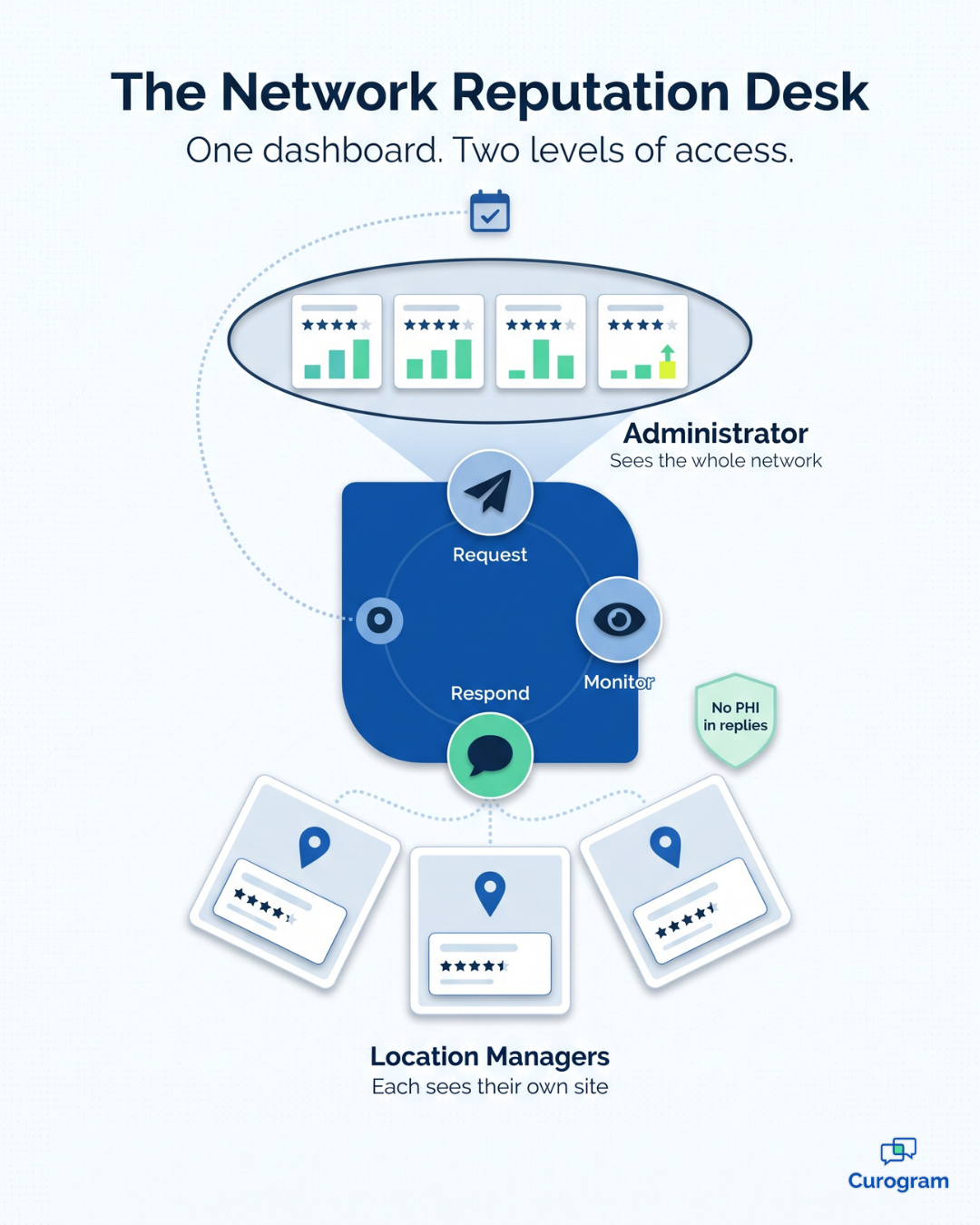
Curogram works as "The Network Reputation Desk." It's one dashboard where every location's reviews are requested, tracked, and answered. Office Ally keeps running your operations, while Curogram handles the first impression patients see on Google.
Review Requests That Follow Real Visits
A patient finishes a visit, then gets a short text with a link to that location's Google profile. Staff don't have to guess which listing to share or keep manual lists.
These are automated review requests Office Ally groups can tie to actual appointment activity. Because the timing follows real visits, the ask feels natural. Volume also grows with each site's traffic, so a busy location sends more requests and a quiet one still gets steady attention.
One View for the Group, One View per Site
The per-location rating dashboard shows each profile's review count, rating, and recent activity side by side.
Access is split by role:
- The administrator sees the whole group at a glance.
- Location managers see their own site's reviews and replies.
- Anyone who responds works from the same dashboard, with no PHI in any reply.
That split gives reputation a clear owner. Nobody has to juggle five Google logins or keep a spreadsheet of who replied to what.

Extra Push Where It's Needed Most
Not every location needs the same effort. Request campaigns can be tuned per site, so new and weak profiles build volume fastest while the founding location stays in maintenance mode.
This is what new location review building should look like. Instead of waiting years for goodwill to pile up, a site that opened last spring can start closing the gap in weeks.
Compliance Built Into the Ask
Every request goes to every patient, with no filtering by mood or survey score. That matters, because screening out unhappy patients before they can post, known as review gating, breaks Google's rules.
Requests carry no PHI and run through Curogram's HIPAA-compliant platform, with consent management built in.
What Changes When Every Location Gets Found and Chosen
The proof shows up in real results. One multi-location practice using Curogram's automated review requests earned 1,064 new five-star reviews in just three months, with about 90% of that practice's patients leaving five-star feedback.
That isn't a one-time spike. Because requests follow every completed visit, reviews keep accumulating week after week.
What could that look like for a single site? Here's an illustrative example:
- Your newest location sees about 300 visits a month.
- If 15% of patients who get a request leave a review, that's 45 new reviews a month.
- In 90 days, that site grows from 12 reviews to roughly 147.
- By month six, it passes 280, putting it within reach of the franchise across the street.
This means the location that used to be invisible starts appearing in local results. Fresh reviews signal to Google that the profile is active, and they reassure patients that the practice is busy and trusted.
The shift is easy to describe. You move from "the original and the ghosts" to "a group of strong front doors," where each site wins its own neighborhood searches instead of borrowing the founding location's reputation.
For your team, new patient volume increases at exactly the locations that needed it most, and it happens at zero additional marketing cost. This is the zero-budget patient acquisition reviews make possible: no ad spend, no agency, just goodwill your teams already earned, finally collected.
There's a quieter benefit, too. When the administrator can see every rating in one place, reputation becomes a number you track like any other growth metric. A dip at one location gets noticed in days rather than months, while there's still time to respond.
Start Collecting the Marketing Your Locations Already Earned
Every patient visit at every location creates a little goodwill. Most of it never makes it online.
That's the core problem with reviews in a multi-location group. They're a per-location asset you earn every day and almost never collect. The founding site gets credit by default, while newer locations stay hidden, even when the care they deliver is just as good.
Advertising budgets don't solve this. A consistent, automated system does.
Office Ally is designed to run your operations at a low cost.
Curogram is designed for the other side of the visit: the first impression a new patient forms before they ever call your office. One manages your workflow, and the other shapes how each neighborhood sees you, one visit and one location at a time.
When review requests go out after every real appointment, the numbers start moving. Weak profiles fill in, and ratings climb toward what your care actually deserves. Fresh reviews keep each listing active in local search, while your administrator watches the progress from one screen.
Here's a simple test.
Tonight, search Google for your newest location the way a patient would, and look at the review count, the rating, and the date of the most recent comment. That listing is exactly what every prospective patient in that neighborhood sees right now.
If the result makes you uncomfortable, you're not alone. Most groups have at least one Invisible Location, and the solution is closer than it looks.
Schedule a Demo with Curogram. We'll audit the review gap at each of your Office Ally locations and project your 90-day review volume using your actual visit counts. You'll see which sites need the biggest push and how quickly they can catch up.