
 Aubreigh Lee Daculug

It replaces "Shadow Texting," the habit of messaging patients from their own phones because official tools feel slow. The risk is highest in behavioral health, chronic care, and family medicine.
Because the governed channel is faster, staff choose it on their own. Curogram client data from clinical settings shows a 98% SMS open rate, so patients still get the message.
Your texting policy is probably solid. Your staff just aren't following it.
That isn't a discipline problem. It's a speed problem. When the official way to contact a patient takes four steps, people naturally reach for the phone already in their pocket.
The message goes out. The patient is satisfied. The work gets done.
It also leaves protected health information on a device you don't own, can't monitor, and can't erase.
This is the hidden gap behind HIPAA-compliant texting governance for Office Ally group practices. Office Ally manages your claims and clinical charts well. But daily patient conversations often happen somewhere else. Reschedules, reminders, and "running late" replies quietly end up on personal phones.
Consider what that looks like across five locations. Front desk staff, medical assistants, care coordinators, and therapy assistants each maintain their own private threads. None of it is logged. None of it is limited by role.
If one phone disappears, or one employee resigns, those patient conversations leave with them.
Now add a complaint, a subpoena, or an inquiry from the Office for Civil Rights. Someone requests every message your group sent to one patient. Could you produce it?
In a lean group, that question doesn't land on a compliance department. It lands directly on the owner's desk.
Staff meeting reminders won't solve it. Neither will stricter language in the employee handbook. People will always choose the tool that works, so the only lasting fix is making the compliant tool the faster one.
This guide explains how shadow texting develops and why it's so difficult to police. It also covers what a governed channel includes, what to ask every vendor, and how an audit-ready record changes your next records request. By the end, you'll understand how to make compliance the easy path for your entire team.
Shadow Texting: The Risk Hiding in Every Pocket
Shadow texting is any patient message sent outside your managed systems. It rarely starts as a choice to break the rules. It starts as a shortcut that actually works.
It's Already Happening at Every Location
Here's the hard truth.
Patient texting isn't a future decision your organization gets to make. It's already happening, and the only question is whether it runs on managed tools or personal phones.
Ask around, and you'll probably hear a similar story at each location. A patient texts a staff member's personal number once, and that thread becomes the default line. Before long, it's how half the daily schedule gets managed.
One Helpful Message, One Serious Exposure
Consider a therapy assistant who needs to change a session time. The official process requires four steps. Her phone requires ten seconds, so she sends a quick text.
The patient appreciates the convenience. But a behavioral health patient's identity, provider, and appointment now sit on an unmanaged device. Behavioral health texting privacy carries higher stakes, because one exposed message can reveal care a patient hasn't disclosed to family or employers.
In these specialties, a leaked conversation isn't a minor inconvenience. For the patient, it can become a genuine life event.
The Numbers Multiply Quickly
Here's an illustrative example, not a study result.
Say your group runs five locations with six patient-facing staff at each one. That's 30 personal phones, each sending about 10 patient texts daily.
Together, that's roughly 300 ungoverned messages every day. Over a typical 20-day work month, it adds up to approximately 6,000 texts.
This is the personal phone PHI risk staff carry every day without realizing it. None of those messages are logged, backed up, or connected to the patient record.
Why Policy Alone Falls Short
When a complaint or OCR inquiry asks for every message with a patient, you can't produce what you never captured. A lean group has no compliance department to absorb that gap. The responsibility lands on the owner's desk.
You can prohibit personal texting at every staff meeting. But behavior won't change if the policy makes daily work slower. Staff will always choose the channel that works, and right now that channel is ungoverned.
Meet the Compliance Backbone Your Group Has Been Missing
You can't ban convenient communication. What you can do is provide a sanctioned channel that wins on speed. That's the role Curogram plays for Office Ally groups as the Compliance Backbone.
When the secure channel is also the fastest option, you don't need to force adoption. Staff choose it on their own because it makes their day easier. That's how governance begins to enforce itself.
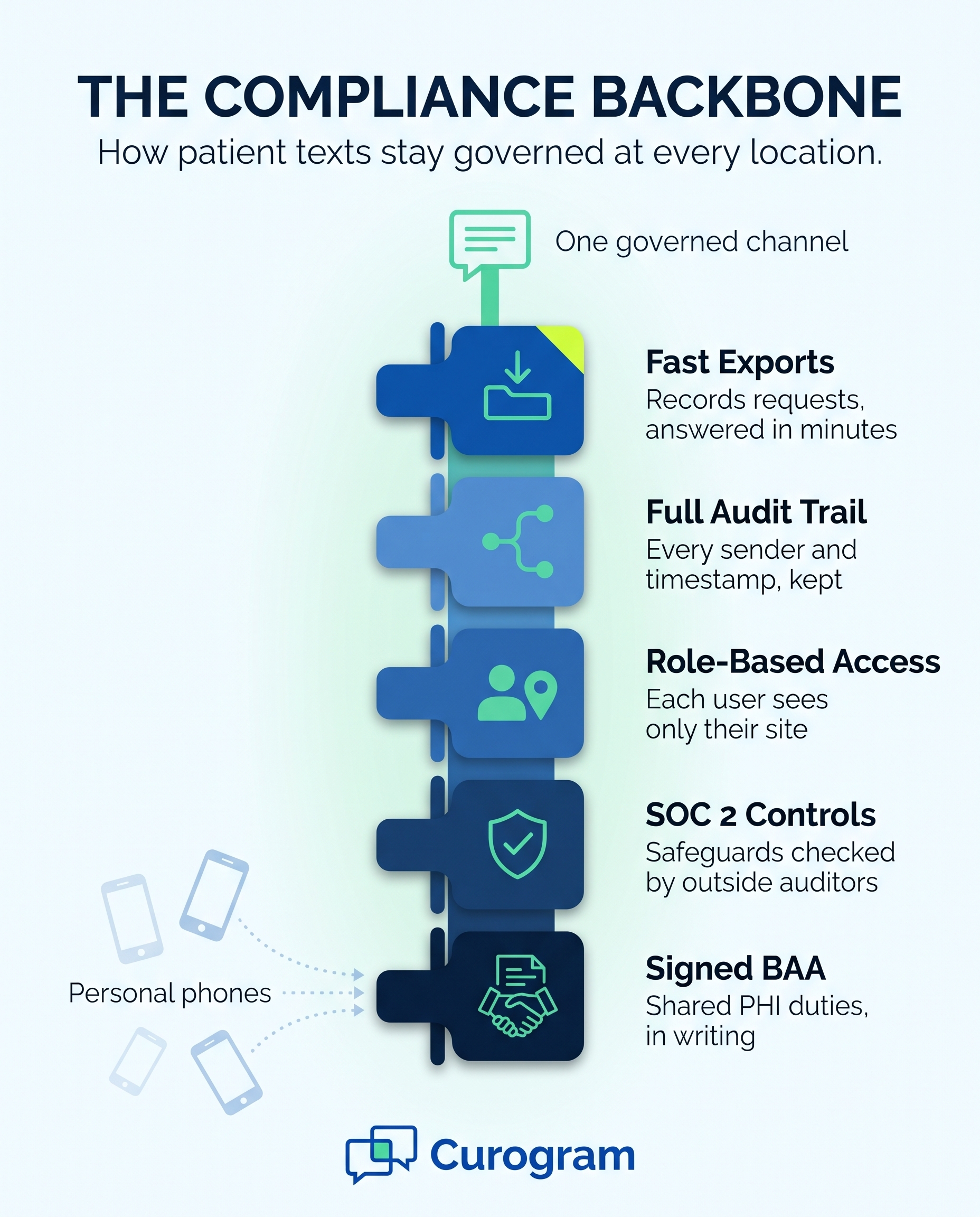
Here's how the core pieces work together:
| What Curogram Provides | What It Does | Why It Matters to the Owner |
|---|---|---|
| Role-based access | Limits each user to their location and duties | A front desk employee at one site can't browse another site's conversations |
| Complete audit trail | Records every message, sender, and timestamp | You can document who said what, and exactly when |
| Rapid exports | Retrieves a patient's full message history in minutes | Records requests become a quick task |
| Patient record connection | Links each conversation to the patient record | The compliant record is also the clinically complete one |
| SOC 2 security and a signed BAA | Covers security controls and HIPAA obligations | You gain a strong security setup without new hires |
The audit trail for patient texts across all your locations is usually the feature owners value most. It turns a scattered set of phones into one searchable record.
Most groups don't employ a dedicated security officer. The owner, an office manager, or a senior biller typically handles that responsibility on top of everything else. That's why patient texting compliance in a lean group has to depend on the platform, not on extra staff.
A SOC 2 patient messaging platform has already been tested by outside auditors on how it protects, stores, and controls access to data. Your group inherits those safeguards the day you go live.

One more point when you compare options. Signing with a BAA texting vendor is the floor, not the finish line. A BAA defines who is responsible for protecting PHI, but it doesn't pipaarove the tool is secure or that staff will use it.
So ask every vendor three practical questions. Can you limit access by location and role? Can you export a complete message history in minutes? Is it genuinely faster than a personal phone?
What Changes When the Safe Channel Is Also the Fast One
Here's the outcome every owner wants:
100% of patient text communication on governed, auditable infrastructure. It's a sentence you can finally say out loud and fully mean.
That shift happens because the old conflict disappears. Before, it was policy versus behavior. Now, the policy simply becomes the path of least resistance.
Here's what changes day to day:
- Staff keep their speed. Templated replies and routed queues make replies faster than typing on a personal phone.
- Patients still respond. Curogram client data from clinical settings shows a 98% SMS open rate.
- Phones ring less often. The same client data shows a 50% reduction in call volume.
- Front desk teams get time back. Clients have seen front desk output rise by 30% or more.
- Audits get easier. A documentation request turns into an export, not a dig through old phones.
Those gains matter for compliance, too. When staff save time on the governed channel, they have no reason to return to their personal phones. The workaround fades because the sanctioned tool is simply better.
Consider your next records request. Instead of asking staff to scroll through private threads, someone pulls a clean export in minutes. Every message, every sender, and every timestamp shows up in one place.
For your team, that means fewer last-minute scrambles and less pressure on the owner. For your patients, it means private conversations remain private, no matter which location they visit.
Stop Policing Phones and Start Governing the Channel
You can't ban convenient communication. Staff text patients because it works, and they'll continue until something works better.
That's the core lesson. Governance only holds when the compliant option is also the easiest one. A written policy can't compete with a phone in a pocket.
It helps to think of your tools in two lanes. Office Ally protects your claims and clinical chart data. Curogram manages the everyday patient conversations your staff already want to have, governed to the same high standard.
Together, they close the gap that shadow texting creates. Every message is logged. Every user is limited to their role and location. Every record is ready when someone asks for it.
So ask yourself one honest question. Could your group produce every patient text from last quarter, across every location, if a request arrived tomorrow?
If you paused before answering, that pause is your signal. It means some patient messages live on devices you don't control. It also means the owner is carrying risk that nobody can fully see.
The good news is that fixing it doesn't require a security department or a long rollout. It requires a channel your staff will actually prefer. Your team keeps its speed, and you finally get the visibility you've been missing.
Schedule a demo with Curogram to see HIPAA-compliant texting governance for Office Ally group practices in action. You'll see role-based access, audit trail exports, and the staff workflow side by side. Our team can also share SOC 2 documents and BAA terms for your review.