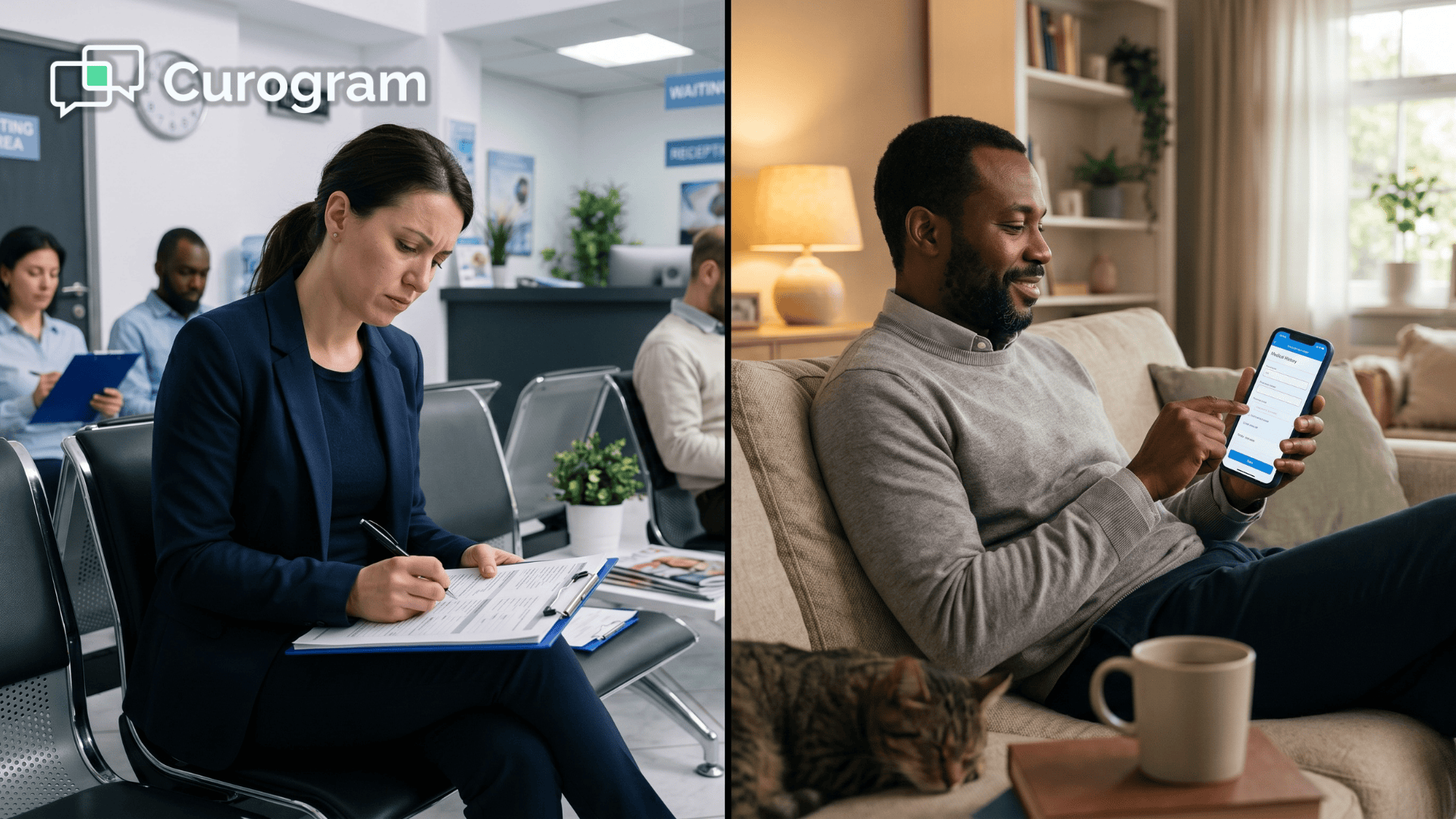
Curogram sends that same paperwork as a link that skips the login, so a first-time client can finish histories, screenings, and e-signatures at their kitchen table instead of a lobby chair. It removes what we call "The Waiting Room Disclosure": the moment a client writes their hardest history in public, on a deadline, for a practice they have known for eight minutes.
A new client shows up at 8:52 for a 9:00 session and gets handed a nine-page packet. Page four asks about substance use. Page six asks about trauma history.
They work through it in a chair three feet from a stranger's chair, on a clipboard, while the front desk answers a ringing phone.
Most practices read that scene as a paperwork problem and answer with a shorter form or a louder reminder. The room deserves more of the blame.
Where a client fills out intake changes what they are willing to write down. Moving that moment onto their own phone, at home, is the cheapest quality improvement a behavioral health practice can make this quarter.
Notenetic runs the documentation, scheduling, billing, and the Client Portal where clients review and sign what you send them. That portal works well for the client who sets the password. Everyone else defaults back to the clipboard.
A texted link changes the default. Clients complete therapy intake on a phone they already have open, in a room where nobody reads over their shoulder.
Your team has the packet days before anyone walks in, and the front desk stops running a paperwork rescue at 8:52.
We are writing this from the provider's side of the desk, for the clinician who would rather spend the first hour on the client than on the blanks in a screening tool.
The Villain: The Waiting Room Disclosure
Behavioral health carries the longest and most sensitive intake packet in outpatient care. It asks about use frequency, suicidal ideation, prior hospitalizations, and legal history. Practices ask all of that inside the first ten minutes of a relationship that has not earned any trust yet.
Where the Packet Actually Gets Filled Out
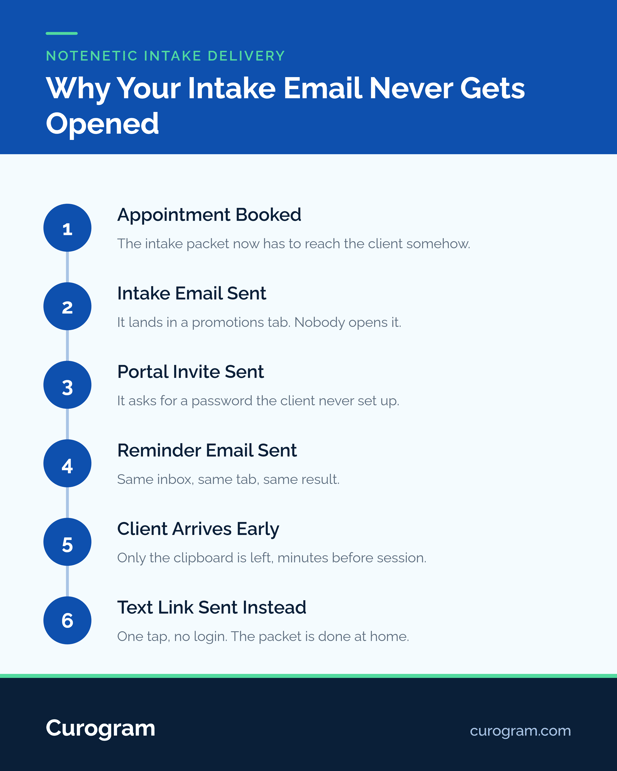
Trace the path a real client takes. Your intake email lands in a promotions tab and never gets opened. A portal invitation follows, asking for a password they never set, or set once and forgot. By the time they park, the only option left is a clipboard at the counter.
Practices already running texting alongside Notenetic know why that email failed. A message thread reaches people where they actually look.
That is why HIPAA-compliant texting for Notenetic practices is usually the first thing a behavioral health group adds on top of the EHR.
What Gets Skipped, and What That Costs
Blanks cluster in predictable places: substance use frequency, the two ideation items, and anything about a past inpatient stay. A client who would answer honestly at home leaves those lines empty in a lobby. Some cancel the morning of rather than sit with the packet at all.
Your clinician then opens session one half-blind and spends twenty minutes rebuilding what the form was supposed to capture, out loud, with someone they met at the door.
Billing chases the missing insurance field later that week. The client experience of digital intake in behavioral health starts here, and friction this early reads as indifference.

The Guide: One Text, One Tap, Done at Home
The private intake is a single message sent when the appointment gets booked, carrying the packet as a link. No login intake forms for mental health practices work because they remove the two steps that break everything: the password and the desktop.
How the Link Reaches the Client
Your form goes out in the same thread as the appointment reminder, so nobody hunts across three channels for it. One tap opens the packet sized for a phone, with plain-language sections instead of a shrunken PDF pinched at 40% zoom.
Private intake form completion happens on the couch at 10 p.m., after the kids are down, with no receptionist four feet away.
Phone-first is not a nice-to-have for this population. Pew Research Center found in its 2025 survey that 16% of US adults are smartphone-dependent, owning a phone but no home broadband. Send those clients to a desktop portal, and you have sent them nowhere.
Mobile Forms Built for a Phone Screen
Curogram Secure Online Forms handle the parts a phone makes awkward. Progress saves as the client goes, so a packet abandoned at question 12 reopens at question 12 three days later.
Conditional questions hide branches that do not apply, which cuts a 40-item history down to what that particular client needs to answer. Signing takes a fingertip.
Staff see completed packets in Curogram before day one and read them alongside the Notenetic record. Curogram complements Notenetic rather than replacing any part of it, and we do not claim a write-back into your chart.
The platform is HIPAA-compliant and SOC 2 Type II certified, and the text itself carries only a secure link, never clinical detail. Practices standardizing this across their whole front end usually start with secure online patient forms and expand from there.
The Success: The First Session That Starts on Time
What changes is small, mechanical, and visible on the first morning you run it.
What Leaves the Waiting Room
The clipboard goes. So does the eight-minute scramble, the pen that skips, and the awkward hand-back of a page with three items left blank. Your front desk gets those minutes back on every new client, which is the part staff notice first.
|
The 8:52 arrival |
Clipboard packet |
Texted link |
|---|---|---|
|
Where it gets filled out |
Lobby chair, minutes before session |
Home, days earlier |
|
Who can see the screen |
Whoever is sitting nearby |
The client alone |
|
What the front desk does |
Hands over forms, chases blanks |
Confirms and seats |
|
What the clinician has at 9:00 |
A partial history |
A full packet, already read |
Session One Opens on the Conversation
A clinician who read the packet the night before opens with a real question. No checklist. That hour becomes care rather than transcription, and the client walks in already known by the person sitting across from them.
One thread carries both the form link and the reminder, which is where our verified numbers sit. Atlas Medical Center cut no-shows from 14.20% to 4.91% within three months on automated reminders and confirmations, 3X better than the industry average.
Confirmation rates run above 75% across our client base, based on our internal data. Texting for behavioral health practices does double duty here: whoever confirms the appointment is usually whoever already finished the packet.
Conclusion: Make the First Step the Easiest One
Mobile intake forms for Notenetic mental health clients change one variable: the room a client is sitting in when they answer the hard questions.
That variable turns out to carry a lot. Notenetic is where the record lives, and Curogram is how that record gets filled in gently.
Fill out your own intake packet on your own phone before you decide anything. Book a demo and we will text you a sample form, delivered the same way your 9:00 tomorrow would receive it. Then compare it to the clipboard sitting at your front desk.
Frequently Asked Questions
The text contains a secure single-use link tied to that client's appointment. Tapping it opens the packet directly in the phone browser, so there is no account to create, no app to download, and no password reset call.
Privacy removes the audience. Nobody is waiting for the clipboard back and nobody is seated within reading distance, so clients answer substance use, ideation, and trauma items more fully than they do at a public counter.
The message carries only a link, never clinical content. Form data is encrypted in transit and at rest on a HIPAA-compliant, SOC 2 Type II certified platform, and completed packets are visible only to authorized staff accounts.
Forms are lightweight and save progress automatically, so a client can stop mid-packet on a weak signal and resume later without losing answers. Links expire, which matters on a phone shared with family.
Send the link to the authorized guardian's number, with consent documented in your record. Adolescent and dependent-adult care runs on this regularly, since the person filling out the packet is rarely the person in the chair.