

Curogram adds 48-hour, 24-hour, and 2-hour texts beside your Notenetic schedule, routing every reply into a shared inbox so a cancellation gets refilled instead of becoming an "empty hour." Atlas Medical Center cut no-shows from 14.20% to 4.91% in three months, based on our internal data, and clients confirm without a portal login.
Most behavioral health practices we talk with believe Notenetic has no reminder feature at all. It does. Open More > Settings > Appointment Reminders and you can switch on text reminders, pick a dedicated sending number, write your own template, and choose how many days ahead it goes.
The setting is real. What it allows is the gap.
One reminder per appointment, 1 to 7 days out. The send queue opens between 8 AM and 12 PM, so no same-day nudge exists. Clients get three usable replies: YES, NO, STOP.
Anything outside that list fires a staff alert with no thread behind it, and the default template signs off by asking clients to call the clinic if they need a different day. That last instruction is where sessions die.
A client who wants out of Tuesday at 2 is often the client least able to phone anyone about it. So she says nothing, and nobody finds out until 2:05. Your clinician sits with a free hour. Your waitlist never hears the slot opened.
Behavioral health no-show reduction rarely calls for a new EHR. It calls for more than one touch, and somewhere for the reply to go.
That holds whether you run solo therapy hours, a psychiatry panel, an IOP group, or substance use counseling on a Medicaid contract.
We walk through what the reminder tab does, where clients fall out of it, and what a layered two-way reminder and confirmation workflow changes about a Tuesday afternoon.
The Villain: The Empty Hour
An empty hour looks the same every time. A clinician free at 2, a slot nobody offered to the waitlist, and a claim that never gets filed.
One Reminder, Three Replies
Notenetic's Text tab holds a single send window. You pick a number between 1 and 7 days ahead, then choose whether the queue starts at 8, 9, 10, 11, or 12. Delivery drifts from there.
Supported responses are YES, NO, and STOP. Settings can alert staff when a client sends something else, which tells you a client spoke without giving you anywhere to answer.
The Reschedule Nobody Makes
Notenetic's default template closes with a line asking the client to call the clinic phone number if they need to reschedule. For someone managing panic symptoms, that is a wall. Calling means a hold queue, a live voice, and explaining why.
Plenty of clients skip it. Your schedule keeps the slot, waits, and learns the answer at 2:05. Automated SMS reminders from the Notenetic EHR reach the client fine. What never comes back is the reschedule request.
Front desk staff may feel this is a guessing game. Nobody knows which of tomorrow's 20 sessions are real, so the safe move is calling all 20, which is the manual work the reminder was meant to remove.
When a Miss Is Clinical, Not Just Financial
Behavioral health carries the highest miss rate in medicine. A VA pragmatic trial covering more than 38,000 appointments, published in the Journal of General Internal Medicine, found mental health clinics missing 18.0% to 21.9% of visits against 10.5% to 12.1% in primary care.
Weekly cadence is part of why. Miss one session and the next is 14 days out, so exposure work stalls, a medication check slides, and a client in early recovery goes a fortnight without contact.
What Silence Costs
Run those rates against a mid-sized therapy schedule and the figure stops being abstract.
|
Illustrative therapy schedule |
Figure |
|---|---|
|
Sessions booked per day |
20 |
|
Empty hours at a 20% no-show rate |
4 per day |
|
Average session value |
$120 |
|
Lost across 22 business days |
$10,560 |
Illustrative figures for modeling only, not client data.
No-show cost at a therapy practice compounds past the billing. Miss twice, and many clients stop coming altogether, so the treatment plan lapses alongside the revenue. Group programs take it harder still, since a half-empty IOP session changes the clinical work in the room.

The Guide: The Attendance Engine
Adding touches sounds like nagging your clients. Practices that do it report the reverse. Fewer people get caught out, and fewer get a phone call from the front desk.
Three Touches, Set to Your Cadence
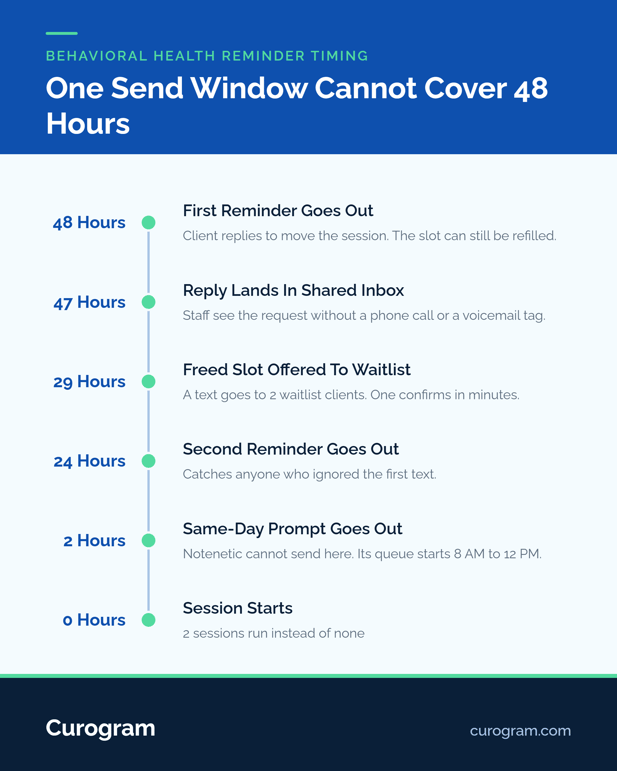
Curogram sends reminders at intervals you choose, commonly 48 hours, 24 hours, and 2 hours ahead. A 48-hour text gives clients room to move things around while the slot can still be refilled.
The 24-hour text catches whoever ignored the first one. That 2-hour prompt is the message a morning-only queue cannot send, and for a 6 PM group it decides whether six people show or three.
2-Way Confirmation and Where Replies Land
2-Way Confirmation turns a reminder into a conversation. Clients confirm, cancel, or ask for a different day in whatever words they use, and the message opens in a shared inbox beside the rest of that client's texts.
Any staff member on shift can pick it up, answer in the same thread, and move the appointment in Notenetic. Therapy appointment confirmation texts stop being a broadcast and become a queue somebody actually works.
Curogram is HIPAA-compliant and SOC 2 Type II audited, and a BAA comes with every plan. Clients reply from the phone they already carry, with no app and no login. For the same mechanic applied across a full session roster, see group therapy session confirmations.
Beside Notenetic, Not Over It
Curogram works with your Notenetic schedule as a parallel layer. Appointment data flows one way, out of Notenetic and into the reminder queue. Nothing clinical gets retyped, and nobody keeps a second client list.
Notenetic holds the note, the treatment plan, and the claim. Curogram handles the texting.
What Stays Out of the Message
For substance use treatment clients under 42 CFR Part 2, message content is a compliance question. Templates carry logistics only: date, time, provider initials if you want them, and confirm or reschedule options.
No diagnosis, no program name, no session content. Notenetic applies the same discipline natively, letting you show client initials, a client ID, or no client data at all.
The Success: The Full Schedule
Watch one session move through the layered version, minute by minute, and the mechanic stops being abstract.
One Tuesday, Walked Through
Sunday, 2 PM. The 48-hour text goes out for a Tuesday 2 PM session. Your client reads it while sorting out her week and replies, "Any chance we can do Thursday?"
Sunday, 2:06 PM. That reply opens in the shared inbox. A scheduler picks it up Monday, moves the session inside Notenetic, and answers in the same thread. No voicemail, no callback tag.
Monday, 9 AM. The freed Tuesday slot goes out by text to two waitlist clients. One confirms in four minutes, before anybody has dialed a number.
Tuesday, noon. Both clients get the 2-hour prompt. At 2 PM, two sessions happen where zero would have, and Thursday holds a third.
What Changes on the Schedule
|
Measure |
Before |
After |
|---|---|---|
|
No-show rate, Atlas Medical Center |
14.20% |
4.91% |
|
Appointment confirmation rate |
manual and uneven |
above 75% |
|
Revenue from recovered slots |
not tracked |
10% to 20% lift |
Based on our internal data (Curogram Case Studies).
Atlas is a medical clinic rather than a behavioral health practice, and we would rather say so than let the figure imply otherwise. Across our client base, no-show rates run 53% below the industry average.
Recovered slots are where collecting the balance by text starts to matter, since a filled hour only helps the practice once it collects.
Confirmation rate is the number to watch in month one. It moves before the no-show rate does, and it tells you whether clients are reading the messages or ignoring them.
Confirmed by Default
The daily shift is smaller than it sounds. Staff stop dialing to discover who is coming and start working a short list of exceptions: four clients who have not replied, two who asked to move, one slot to offer.
Reducing missed appointments at a mental health practice mostly looks like that swap, a phone shift traded for a queue.
The clinical gain follows the operational one. A client who reschedules on Sunday stays in treatment. A client who vanishes on Tuesday often does not come back, and re-engaging her costs far more than the hour she missed.
Conclusion: Stop Paying for Empty Hours
Notenetic holds the clinical record and holds it well. Its reminder tab does what it was built to do: one text, three replies, a phone number for anything harder. Therapy schedules ask for more, because the clients most likely to miss are the clients least likely to call.
Work out your own figure before changing anything. Take last month's no-shows, multiply by your average session rate, and look at the total written down. Most practice managers we show that math to have never seen it as a single number, and the number is usually larger than the fix.
Book a demo, and we will build your first reminder sequence with you. Your session types, your intervals, your template wording, running beside the Notenetic schedule you already keep.
Frequently Asked Questions
Templates carry logistics only: date, time, and confirm or reschedule options. No diagnosis, no program name. Curogram is HIPAA compliant and SOC 2 Type II audited and signs a BAA, keeping messages appropriate under 42 CFR Part 2.
A portal notice asks for a password before it asks for a decision. A text needs one thumb and four seconds. For clients managing anxiety or executive function strain, that gap decides whether you hear anything back.
The reply opens in your shared inbox within seconds, so staff spots the opening while time remains to offer it elsewhere. A cancellation 48 hours out gets refilled. A 2 PM no-show cannot.
Symptoms move day to day. Someone who felt steady on Sunday may not feel able to leave the house by Tuesday. A 2-hour text catches that shift while rescheduling is still possible.
Staff stop calling through tomorrow's schedule and start reading an exception list: unconfirmed clients, reschedule requests, waitlist offers to send. Most practices redirect that hour into intake and billing follow-up.