Mass Patient Texting for MD Systems: Stop Losing Slots
💡 Mass patient texting for MD Systems clinics lets you fill open slots in minutes — not hours — by texting your whole waitlist at once. Sync with...
9 min read
Aubreigh Lee Daculug
:
April 2, 2026
Somewhere inside your NextGen PM database, there are patients you haven't seen in over a year.
Not because they moved away. Not because they switched providers.
They're still in the system, still attributed to your practice, still carrying open care gaps. They just haven't heard from you — at least not in a way that actually worked.
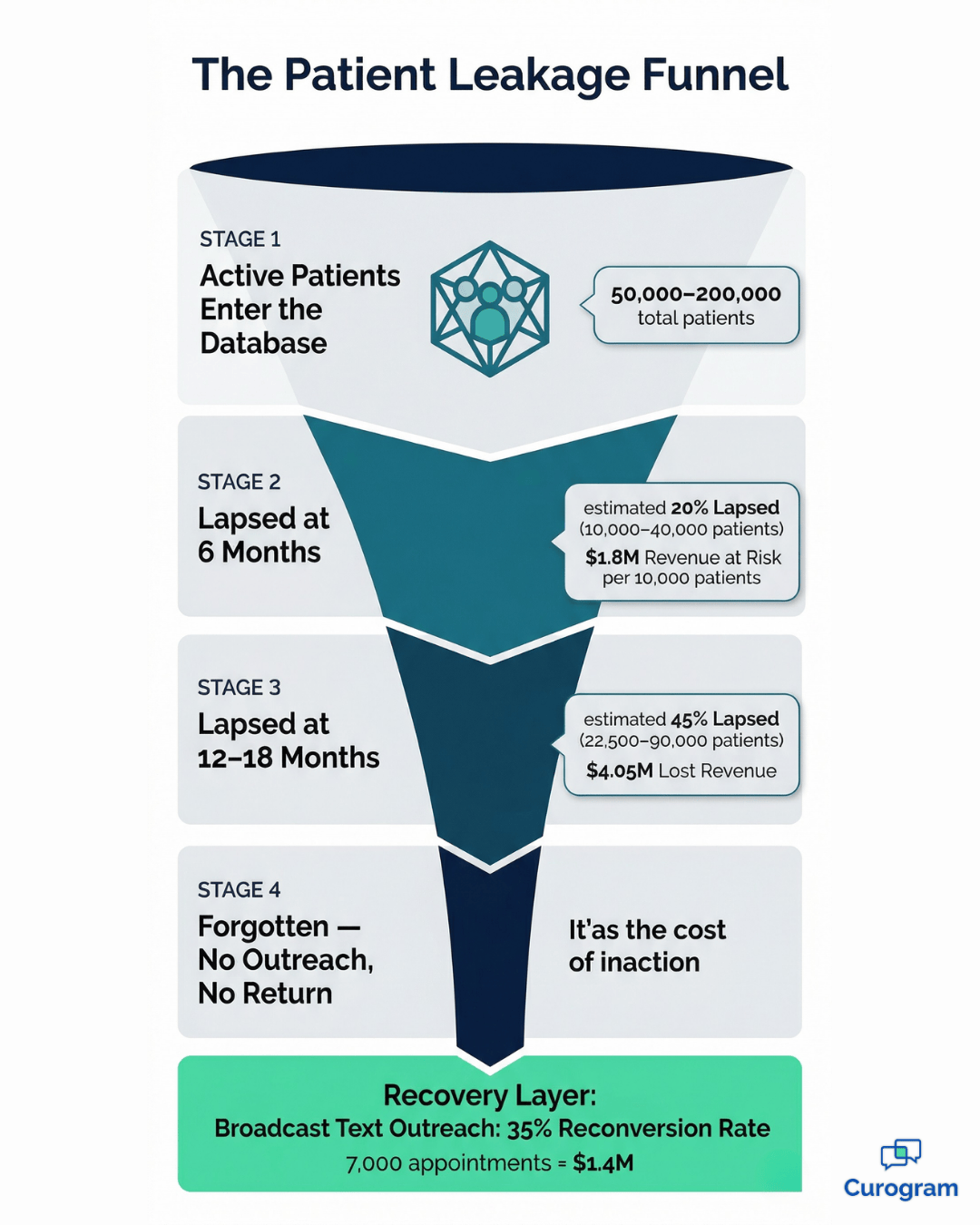
For a 50-provider network, that could mean 20,000 or more lapsed patients. Each one represents an annual wellness visit that never happened, a chronic care check-in that got skipped, a flu shot that went unscheduled.
Multiply that across your locations and the revenue sitting dormant inside your own database isn't a rounding error. It's a six- or seven-figure problem hiding in plain sight.
Here's the part that makes it genuinely frustrating: you already have everything you need. The records are there. The contact information is there. The appointment history is there.
What's missing isn't data — it's the ability to act on it at scale.
Think about the last time your team tried to run a recall campaign.
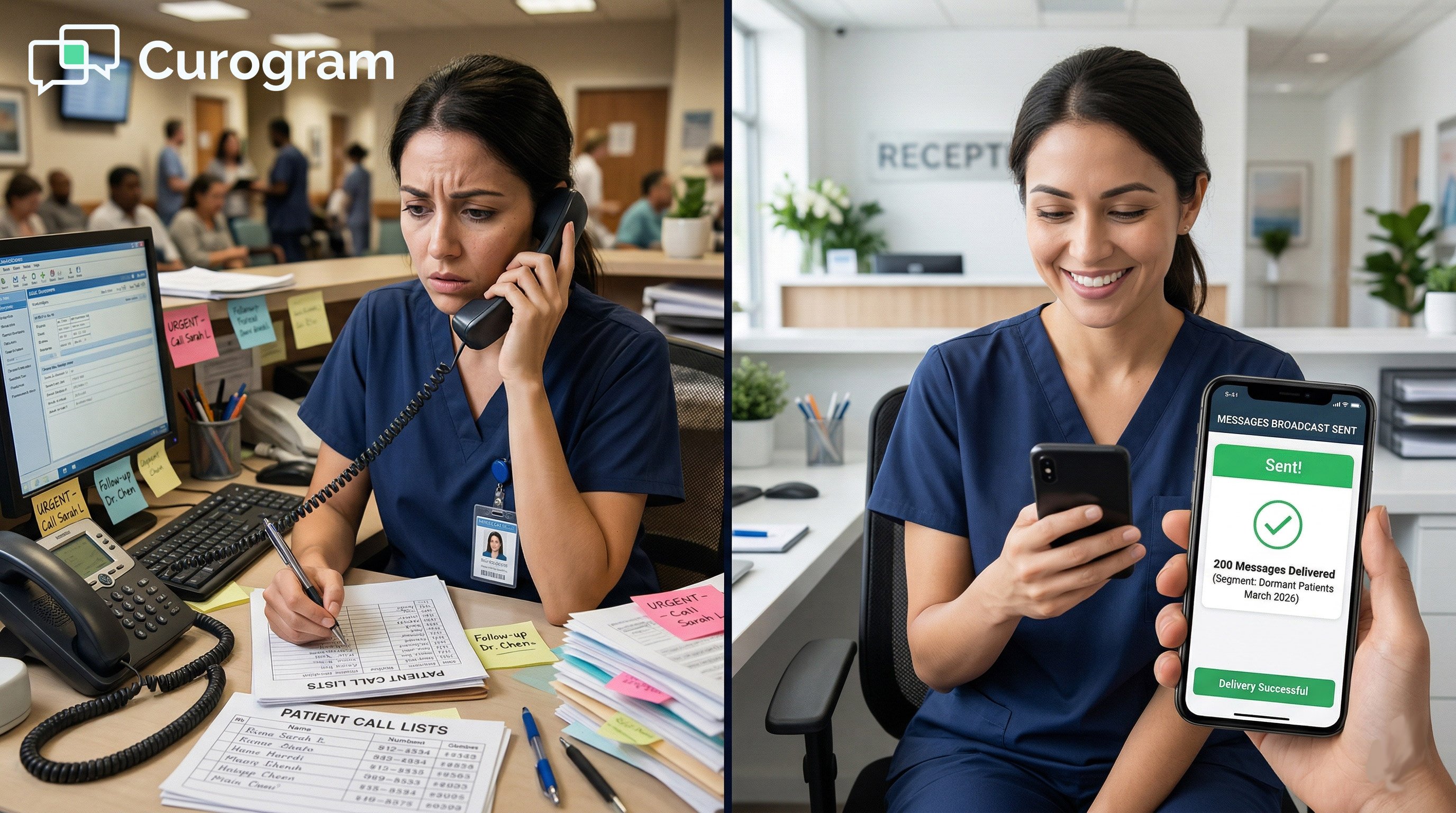
Someone pulled a report from NextGen, exported it to Excel, filtered it manually, and then what? Called patients one by one? Sent portal messages that no one opened? Mailed letters that went straight to recycling?
It feels like outreach. It isn't.
The channel patients actually respond to — text messaging — delivers a 98% open rate and gets read within minutes.
But sending a broadcast text to 5,000 patients across multiple locations isn't something NextGen does natively. You need a separately licensed module or a manual process that simply doesn't scale.
That gap is costing your organization real money, every single quarter.
This article explains how NextGen Enterprise mass patient messaging, powered by Curogram's Population Outreach Engine, closes that gap — and turns a dormant patient list into your highest-ROI growth asset.
Let's start with the math.
A 50-provider NextGen Enterprise network sees roughly 1,250 patients per day across all locations — about 300,000 encounters in a year.
But the total patient database is far larger: 50,000, 100,000, sometimes 200,000 patients who have been seen at least once.
At any given time, a significant chunk of those patients are lapsed. They haven't scheduled in 6+ months. They have open chronic care flags that no one has acted on. They're overdue for annual wellness visits no one has followed up on.
These patients aren't gone. They're forgotten.
They're still in your NextGen PM database, still attributed to your providers, still representing real revenue potential.
But without a broadcast outreach capability, they're invisible to your operations team — a quietly growing list of missed opportunities, compounding quarter after quarter.
NextGen's native platform handles scheduling, charting, and billing well. What it doesn't do is mass outreach.
If you want to run a NextGen mass text campaign for patient recall across your enterprise, you have two options:
Purchase Luma Health's broadcast messaging module — yet another line item on the Module Tax stack — or build the workflow manually.
Manual means quality coordinators pulling patient lists from NextGen reporting, exporting to CSV, filtering rows in Excel, and coordinating individual phone calls or portal messages.
Consider what that looks like at any real scale:
This isn't just inefficient — it's a structural ceiling on how much of your patient base you can realistically reactivate.
When organizations do attempt outreach, they often default to channels that patients ignore.
Mailed recall letters cost $0.80–$1.50 each and go directly to recycling for most households.
Patient portal messages require patients to log in — and portal adoption sits at just 15–25% for most NextGen organizations.
Phone calls eat staff time and go unanswered when an unknown number appears on the screen.
Text messaging, by contrast, carries a 98% open rate and gets read within 3 minutes on average.
That isn't a marginal improvement over a portal message. It's a completely different outcome. The channel mismatch means that even when organizations invest in recall campaigns, response rates are low enough to make the whole effort feel futile.
For operations leaders tracking panel performance, the forgotten patient list is the organization's largest untapped revenue source.
A lapsed patient who returns for an annual wellness visit generates an office visit charge plus potential follow-up referrals, lab orders, and care plan revenue downstream.
The table below shows what a conservative reconversion rate looks like at different scale points — using a $200 average per-visit value as a baseline:
| Lapsed Patients | Reconversion Rate | Recovered Appts | Est. Revenue (@ $200/visit) |
|---|---|---|---|
| 5,000 | 20% | 1,000 | $200,000 |
| 10,000 | 25% | 2,500 | $500,000 |
| 20,000 | 35% | 7,000 | $1,400,000 |
These aren't projections from a vendor pitch deck. They're what's possible when you stop treating your patient database as a historical record and start treating it as an active revenue asset.
Lab orders, referrals, and downstream care plan revenue are all additive — meaning the real per-patient value likely exceeds the visit fee alone.
Here's the shift that changes everything.
Your NextGen PM database already contains everything needed to run a sophisticated outreach campaign — patient demographics, appointment history, diagnosis codes, care gap flags.
The missing piece isn't data. It's the action layer that converts that data into scheduled appointments.
That's exactly what Curogram's Population Outreach Engine is built to do.

Curogram's Targeted Campaign Builder gives population health managers enterprise-level targeting precision without the enterprise complexity.
You define the criteria, and Curogram identifies the qualifying population from your NextGen PM database in real time — no CSV exports, no manual filtering, no third-party data prep.
The key targeting dimensions include:
Once targeting is set, you preview the full audience size before sending a single message. Adjust the filters, refine the list, customize the message text, and launch. The entire process takes minutes, not days.
This is where Curogram's integration approach matters most. Campaign targeting draws from the same NextGen PM data connection that powers daily texting, appointment reminders, and digital intake forms — so there's no separate system to learn, no parallel database to maintain.
Mass patient messaging in NextGen PM includes a schedule sync that feeds each targeted campaign directly into the enterprise broadcast pipeline.
When patients respond to a broadcast text, their replies land in the Curogram unified inbox — the same inbox your staff already works in every day.
Staff schedule the appointment from within the conversation thread in NextGen PM, and the patient enters the standard confirmation workflow automatically:
Reminders, intake forms, pre-visit communication.
No platform switching. No broken handoffs.
The mass messaging campaign feeds into the engagement pipeline your team already runs. It doesn't create a new one.
If you're already running NextGen and evaluating your total cost of ownership, Luma Health's broadcast module is probably already in the conversation.
NextGen Enterprise population health text outreach that's built to recall lapsed patients for revenue recovery is available through Luma — but it means another vendor relationship, another contract, and another implementation timeline added to an already complex stack.
Curogram collapses the gap between insight and action.
The same platform handling your daily patient communication also handles campaign-level broadcast.
No additional licensing. No separate system to manage.
For organizations already feeling the weight of the Module Tax across their NextGen ecosystem, that consolidation is worth a hard look — both operationally and financially.
Patients don't answer unknown numbers. They don't check the portal. They don't open recall letters.
But they do read texts — almost every time, within minutes. NextGen multi-location patient outreach via broadcast text covers everything from annual wellness recall to chronic care follow-up and seasonal flu shot campaigns, all through the one channel with the highest response rate in healthcare communication.
If your outreach program isn't built on text, it's not really a program. It's a workflow that produces inconsistent results and makes no measurable dent in your lapsed patient population.

Numbers matter. So let's talk about what actually happens when a large ambulatory organization runs a targeted recall campaign through Curogram.
One multi-location client recovered 1,240 patients from text-based recall campaigns with a 35% appointment reconversion rate. That means out of every 100 patients who received a text, 35 scheduled an appointment — not just clicked a link, not just replied with a question, but booked.
For a 50-provider NextGen network with 20,000 lapsed patients, a 35% reconversion rate translates to 7,000 recovered appointments.
At $200 per visit, that's $1.4 million in recovered revenue from a single campaign cycle.
That's not marketing spend. That's activating data you already own.
The real value isn't the one-time recovery number. It's what happens when population health outreach becomes systematic rather than ad hoc.
Population health managers can run targeted campaigns on a rolling cadence — flu shot drives in October, annual wellness pushes in January, chronic care recalls monthly.
Each cycle adds to a predictable patient reactivation pipeline that works alongside new patient acquisition, not instead of it.
The economics favor reactivation strongly: existing patients already have chart history, established provider relationships, and attribution to the network. Converting them back costs far less than acquiring someone new. They just needed a text.
There's a MIPS dimension here that operations and compliance leaders should factor in.
MIPS quality measures — preventive screenings, annual wellness visits, chronic disease management — depend directly on patient engagement.
When lapsed patients don't come in, those measures don't get met.
Systematic population health text outreach for recall and lapsed patient revenue recovery does two things at once: it brings patients back for the visits that generate revenue, and it drives care gap closure rates that move the needle on quality performance.
The financial narrative shifts as a result. Instead of investing exclusively in new patient acquisition, the organization builds a parallel strategy centered on reactivating the patients it already has — patients who are cheaper to convert, easier to engage, and already attributed to the network.
The patient database stops being a cost center for record storage and becomes a measurable driver of quarterly growth.
Stop looking for growth in places you haven't been yet.
The patients who will drive your next quarter's revenue are already in your NextGen PM database.
They have chart history. They have established provider relationships. They have contact information on file. What they don't have is a reason to come back — because no one has reached out in a way that actually works.
That changes when you add broadcast text outreach to your operational toolkit.
Curogram's Population Outreach Engine transforms your patient database from a static archive into an active engine for revenue recovery and care gap closure.
You define the criteria — lapsed patients, chronic care populations, wellness visit gaps — and Curogram reaches them at scale, through the one channel they reliably respond to.
One campaign. Thousands of patients. Measurable results your operations team can defend in any leadership review.
For large ambulatory organizations managing multiple locations across a NextGen Enterprise network, this isn't an incremental improvement. It's a structural shift in how you grow. You stop waiting for patients to find you, and you start proactively reaching the patients you already have.
The math is straightforward: if 35% of your lapsed patients respond to a targeted text and schedule, and you have 20,000 lapsed patients in your database, you're looking at 7,000 recovered appointments.
Run that quarterly, and patient reactivation becomes a real line item on your revenue forecast — not a hope.
Your most valuable growth asset isn't a new marketing campaign. It's the patient list you've been sitting on.
Ready to see what your patient reactivation potential actually looks like? Schedule a demo today and let Curogram model the revenue opportunity across your NextGen Enterprise locations — before your lapsed patients find another provider.
Yes. Curogram's mass messaging platform is fully HIPAA-compliant, SOC 2 Type II certified, and covered under a Business Associate Agreement. Broadcast messages are designed to avoid including protected health information in the initial text. Patients receive a general recall message — something like "You're due for your annual visit — tap here to schedule" — that prompts engagement without disclosing diagnosis or treatment details. When patients reply, the conversation continues through Curogram's encrypted platform with full audit logging.
Very granular. Curogram's Targeted Campaign Builder supports multiple filter dimensions drawn directly from your NextGen PM database: time since last appointment, age bracket, ICD-10 diagnosis code ranges, clinic location, provider attribution, and custom fields. You can target every patient over 65 who hasn't had an annual wellness visit in 12+ months at a specific location — or all patients with a diabetes diagnosis code who are overdue for HbA1c monitoring. Before you send anything, you can preview the full audience size and refine your targeting until it's exactly right.
All responses route to Curogram's unified inbox — the same inbox your staff already uses for daily patient texting. Each response is tagged with the campaign name so your team can track engagement at the campaign level. Staff can schedule appointments directly from the conversation thread in NextGen PM without switching platforms or interrupting their normal workflow. If you're concerned about inbox volume from a large send, Curogram supports staggered delivery — releasing messages in batches over hours or days — to keep response flow manageable and prevent staff overload.
Once Curogram is integrated with your NextGen PM environment, building and launching a targeted campaign typically takes under an hour. You define the audience criteria, preview the qualifying patient count, write or select the message template, and send. There's no custom development required, no separate database to configure, and no lengthy implementation timeline — the targeting draws directly from the patient data already living in NextGen PM. Most operations teams are running their first campaign within days of go-live.
Curogram's campaign dashboard tracks delivery rates, open rates, response rates, and scheduling conversions in real time. After a campaign closes, you can pull a report showing how many patients received the message, how many responded, and how many booked an appointment. From there, calculating ROI is straightforward: take the number of recovered appointments, multiply by your average per-visit revenue, and compare against the cost of the outreach. Most organizations find that a single mid-size campaign pays for itself many times over — especially when downstream lab orders, referrals, and follow-up visits are factored in.
💡 Mass patient texting for MD Systems clinics lets you fill open slots in minutes — not hours — by texting your whole waitlist at once. Sync with...
💡 When a rural clinic closes unexpectedly, rural patient text notification for clinic closure at Azalea Health practices makes sure no one drives...
💡 Curogram’s “Two-Minute Intake” texts patients a form before their visit. They complete it on their phone, and the data writes directly into...