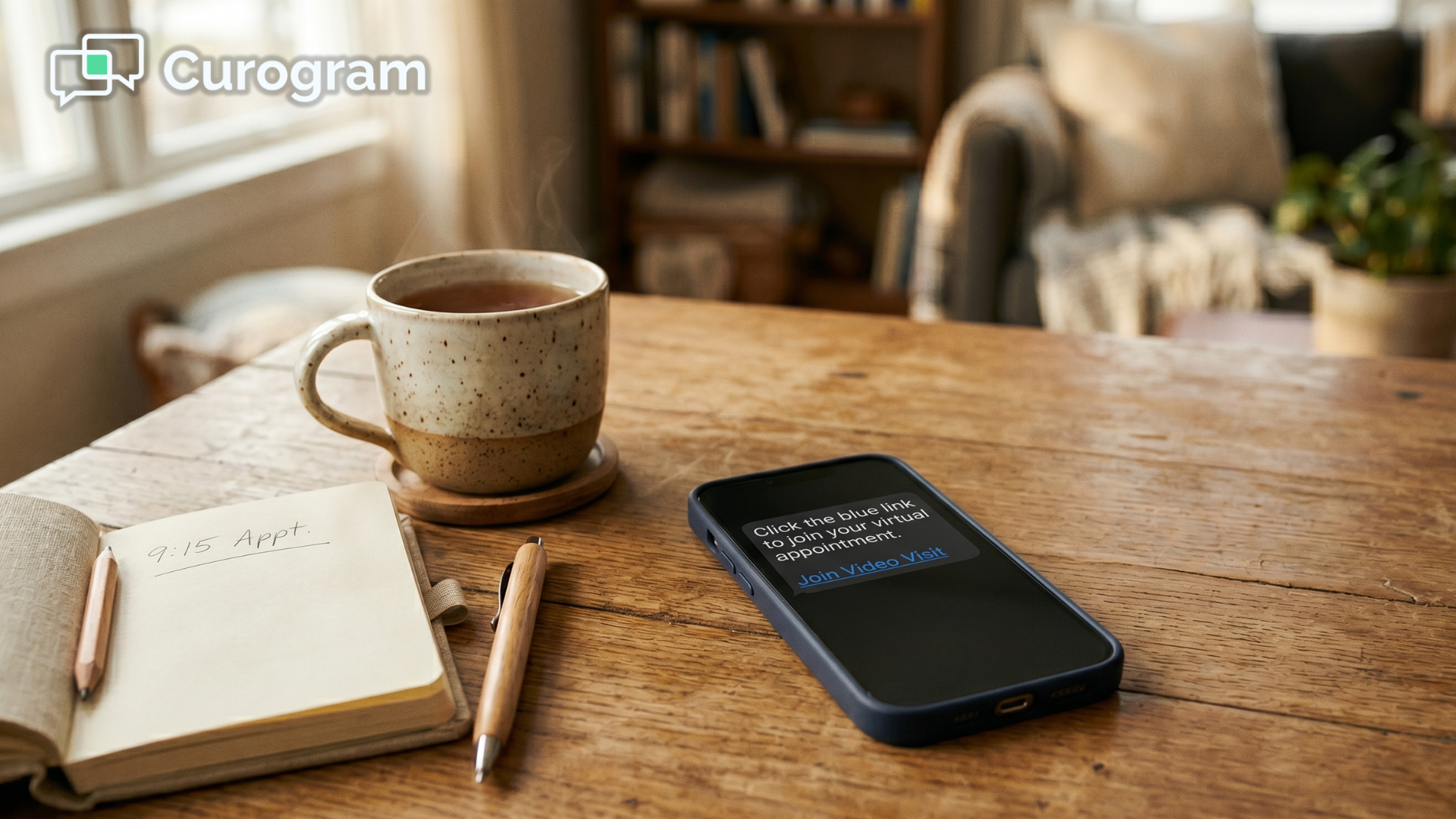
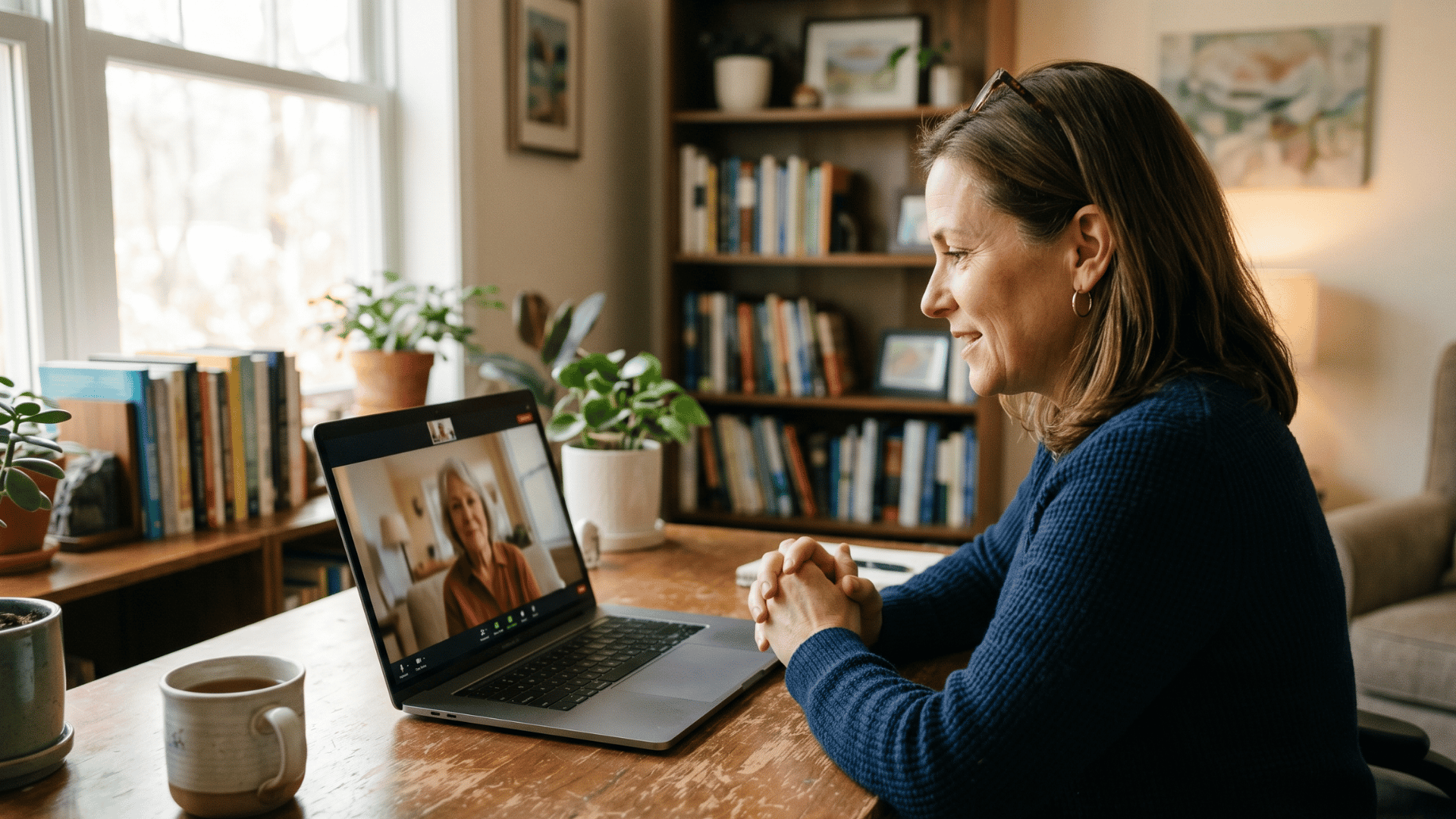
The patient gets a text, taps the secure link, and the session opens right in their phone's browser.
No app store. No account. No portal login. Total time from text to therapist is under 10 seconds — a real accommodation for patients managing ADHD, anxiety, depression, or psychosis.
Practices using this approach see no-show rates 53% lower than industry averages. No app icon ever appears on the device, protecting privacy for patients on shared phones or in monitored living situations.
A patient with depression finally agrees to a telehealth session. The reminder arrives. Then comes the wall.
Download the app. Create an account. Verify the email. Set a password. Forget the password. Reset it. Wait for the link. Log back in. For someone whose condition already drains motivation, that list is not a minor hurdle. It is a reason to quit.
This is the quiet problem behind so many missed behavioral health visits. The technology meant to remove barriers becomes the barrier itself. The people it shuts out are usually the ones who need care the most. Worse, it happens silently, with no warning for your front desk.
Behavioral health populations face challenges that general medical patients often do not. ADHD makes every extra step a chance to get distracted. Anxiety turns a login error into a panic trigger. Depression makes low-effort tasks feel impossible.
So the session gets pushed. "I'll reschedule" becomes "I'll call tomorrow," which becomes a person who slips out of treatment without anyone noticing. Care does not fail because the patient stopped caring. It fails because the front door was too hard to open.
There is a simpler way. Easy telehealth for behavioral health consumers, no app required, is not a wish — it is a workflow your practice can run today. Instead of forcing a download, you send a text. The patient taps the link, and the session opens in their phone's browser.
No app store. No account. No portal. Under 10 seconds from text to therapist.
This article walks through what that experience feels like for your patients, why it matters clinically, and how it changes attendance for the people hardest to reach.
Along the way, you will see the real numbers behind it and how it fits beside tools your team already uses.
Where Behavioral Health Telehealth Quietly Breaks Down
Most behavioral health telehealth still runs through a portal. And a portal asks the patient to clear the same gauntlet that makes portals fail in the first place.
Here is the full path a patient often walks before they ever see their provider:
- Download an app from the store
- Create an account and verify an email
- Set a password — then reset the one they forgot
- Wait for the reset link to land
- Log in and find the right screen
- Grant camera and microphone permissions
- Finally, join the visit
It reads like a checklist. To the right patient, it feels like a locked door.
For someone managing severe depression, each step demands motivation the illness has already taken.
For someone with ADHD, each step is a fresh chance to wander off.
The process was built to deliver care. Instead, it filters out the people least able to push through it.
Watch how a missed session actually happens. Tech anxiety creeps in, so the patient avoids the link. "I'll reschedule" turns into "I'll call tomorrow." Tomorrow never comes, and a person quietly drops out of treatment. No dramatic exit — just silence.
The cruel part is who gets left behind. Patients with shared devices, limited tech access, or conditions that impair executive function are exactly the ones the system shuts out.
That is the strongest argument for behavioral health telehealth with no portal at all — because for these populations, the portal is the problem.
.png?width=1080&height=1350&name=easy%20telehealth%20behavioral%20health%20consumer%20no%20app%20-%20mid%20(1).png)
Here is the encouraging part:
Almost none of this loss is permanent.
~106 visits |
| Recovered every month for a typical practice once the download wall comes down |
How a Text Replaces the Login Gauntlet
Now run that same moment with a different setup.
A text arrives from the practice's number. The patient taps the link. The browser asks once for camera and microphone access. Their therapist appears. That is the entire process — under 10 seconds, no download, no login, no troubleshooting.
This is the no-download telehealth behavioral health experience in practice.
The video runs inside the phone's standard web browser, so there is no app store visit, no account, and no software to update. The technology becomes invisible. The patient simply sees their therapist.
The two paths could not look more different:
- Getting started: a portal sends the patient to an app store to download software and build a brand-new account before anything else can happen. Text-launched care is a single tap on a link already sitting in their messages — no store, no signup, no waiting on an email.
- Logging in: portals run on usernames and passwords, which sets off the familiar loop of forgetting, resetting, and waiting for a link that may land in spam. Text-launched care has no login at all, so there is nothing to remember and nothing that can lock a patient out.
- Permissions: inside a portal, the camera and microphone settings are often buried in menus the patient must dig through. Text-launched care asks once, right in the browser, and a single tap of "allow" clears the way.
- Time to provider: a portal visit can burn several minutes fixing problems before the video even loads, assuming every step works the first time. Text-launched care puts the patient face to face with their provider in under 10 seconds.
- App on the device: a downloaded app leaves a permanent icon on the home screen, plainly visible to anyone who picks up the phone. Text-launched care runs in the browser and vanishes when the session ends, leaving nothing behind.

Stacked side by side, the contrast is hard to miss. One path asks the patient to earn their way to the visit, step by step, before they get any reward. The other simply opens the door and lets them in.
For a population already short on motivation and patience, that difference is not cosmetic — it often decides whether the session happens at all.
Why does shaving a few steps matter so much?
Because in behavioral health, friction is never neutral.
For an easy telepsych no app consumer, removing the login is not about convenience — it is a clinical accommodation. ADHD raises the odds of abandoning a multi-step process.
Anxiety turns troubleshooting into avoidance. Low motivation from depression makes a single extra tap feel like a wall.
There is a quieter benefit too.
Because the session runs in the browser, no app icon ever lands on the patient's phone.
For someone on a shared device, in recovery housing, or in a domestic violence shelter, that matters.
The text-launched therapy session consumer leaves no visible trace of having attended at all.
~$15,900 |
| In monthly revenue recovered when patients connect in one tap instead of fighting a login |
What Changes When the Technology Gets Out of the Way
The headline number is simple: practices that remove these barriers see no-show rates 53% lower than industry averages. But a percentage only matters when you tie it to real visits, real patients, and real dollars.
Say your practice books 1,000 behavioral health visits a month, and your no-show rate sits at 20% — about 200 missed visits. Cut that by 53% and you recover roughly 106 visits every month.
At an average session value of $150, that is about $15,900 back in monthly revenue. Hold that across a full year and it adds up to roughly 1,272 recovered visits and about $190,800 you were quietly losing to no-shows.
For your team, that is not just money. It is more than 100 patients a month who actually made it to their session instead of slipping away.
The deeper change happens in the patient's head.
The question shifts from "how do I work the app to see my therapist" to "I just tap a text."
When attendance becomes the path of least resistance, treatment continuity improves — and that consistency is what makes CBT, DBT, and medication management work.
The SMS video visit becomes a normal, almost forgettable part of the mental health consumer experience: they tap, they connect, they talk. Patients join from home, a parked car, a break room, or a shelter.
Care reaches people who were quietly being left out, and your practice finally delivers on what telehealth promised — fewer barriers, not new ones.
Care Should Be One Tap Away
Here is the whole idea in one line: a behavioral health patient should be able to see their therapist by tapping a text, with nothing standing between them and the session.
SMS-launched telehealth makes that real. No app to download. No portal to log into. No password to forget at the worst possible moment. Just a secure video link that opens in the browser and connects your patient to their provider in seconds.
The clinical case is as strong as the convenience case. The patients who struggle most with multi-step technology — those managing depression, anxiety, ADHD, or psychosis — are often the ones who benefit most from one-tap access. Removing friction is not a nice-to-have for these populations. It is part of meeting them where they are.
Think of it as a clean division of labor.
Netsmart stores the clinical record and documents the care your team delivers. Curogram makes sure your patient can actually show up for the visit that creates that record. One system captures the work; a single text makes the work possible.
Your patients already carry the only device they need. It is in their pocket right now. Seeing their therapist should feel as easy as opening a text message — because for most of them, that is the level of effort they can reliably manage.
When the technology disappears, what is left is the part that matters: the patient and the provider, in the same virtual room, on time. That is the point worth protecting.
Want to see it work alongside Netsmart? Schedule a Demo with Curogram and watch a text-launched video visit happen in real time. You will see exactly how your patients connect, and how much friction quietly disappears from your schedule.
Frequently Asked Questions
Yes. Curogram's video sessions use strong encryption whether they run in a browser or an app. Sessions are HIPAA-compliant and meet 42 CFR Part 2 requirements for substance use treatment. No session data is stored on the patient's device.
A smartphone with a camera, microphone, and web browser is best for video visits. For patients without one, sessions can fall back to an audio-only phone call. The key point is that no special app or portal account is ever required — any modern phone browser works.
Curogram's video adjusts quality based on the available connection. In low-bandwidth situations, it lowers the video resolution to keep the session stable. If the signal is too weak for video, the clinician can switch to a phone call while keeping the appointment on record.
Yes. Curogram works alongside Netsmart rather than replacing it. The session happens through the text link, while the clinical record, notes, and documentation live in Netsmart as they always have. Your team keeps one source of truth for the chart and adds a friction-free way for patients to show up.
No setup or test call is needed. The one-time browser prompt for camera and microphone access happens the moment the patient taps the link, so there is nothing to install or configure in advance. If a patient wants to check ahead of time, they can simply tap a test link and confirm their video works in a few seconds.