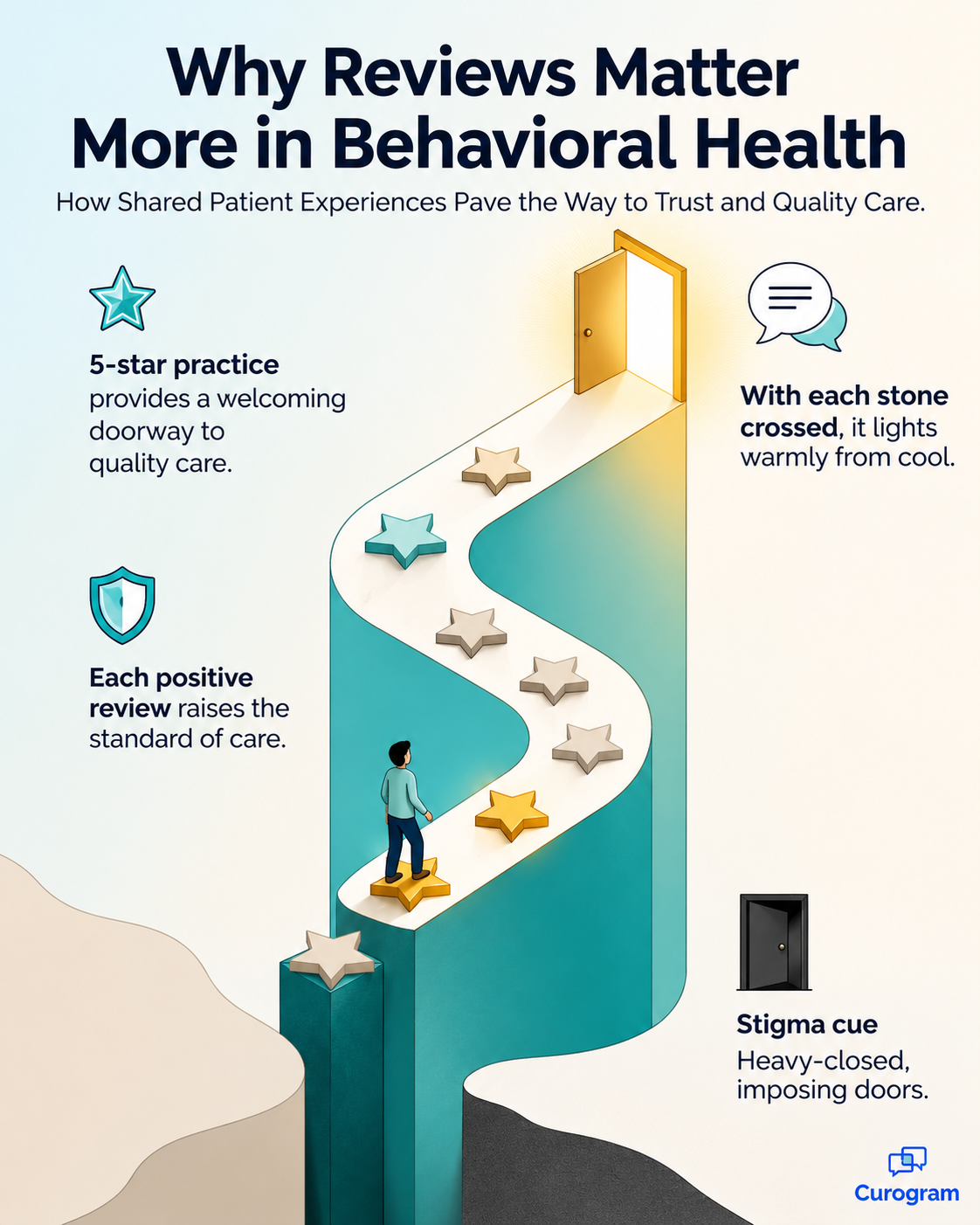
One multi-location practice earned 1,064 new 5-star reviews in three months. With 90% of prospective clients checking a Google profile before the website, reviews act as a clinical pipeline, not a vanity metric.
Netsmart and myHealthPointe include no reputation tools, so Curogram runs alongside them with no API access needed.
Your clinicians are excellent. Your outcomes speak for themselves. So why does your Google profile look like a ghost town?
Here is the uncomfortable truth.
The quality of care inside your practice has almost nothing to do with what a stranger sees when they search for help. They never walk through your door. They see a star rating, a few reviews, and a quiet decision forms. Once that tab closes, it rarely opens again.
For behavioral health practices, that decision carries extra weight. Someone searching for a therapist or psychiatrist is often nervous and reaching out for the first time. They are already fighting stigma.
A thin or low-rated profile gives them one more reason to leave.
Now look at the numbers. Most behavioral health organizations have fewer than 50 Google reviews.
Some sit at ratings of 1.8, 2.5, or 2.9 stars. Meanwhile, 90% of prospective clients view a Google Business Profile before they ever reach the website.
That is a painful gap. Real clinical excellence on one side. A weak online reputation on the other. The people who need you most never see the difference.
The usual fix is to ask. Hand out a card. Send an email. Hope someone follows through. It sounds simple. It isn't. Response rates stay in the single digits, and asking a client face-to-face feels awkward in a clinical relationship.
So the reviews never come. The profile stays thin. The next person searching scrolls right past you. Not because your care fell short, but because no one ever saw it.
This article shows a better way.
You will see how Netsmart behavioral health Google Reviews automation turns the care you already deliver into visible, Google-indexed proof, without adding a single task to your team's day.
When Great Care Stays Invisible Online
Here is a hard thing to sit with.
The quality of your clinical work and the strength of your online reputation are two completely different things.
One happens behind closed doors. The other is the only thing a stranger can see.
Most behavioral health organizations have fewer than 50 Google reviews. Some carry ratings as low as 1.8, 2.5, or 2.9 stars. That is not a sign of bad care. It is a sign of a system that was never built to collect reviews in the first place.
Netsmart and myHealthPointe handle your clinical operations well. But neither one includes any reputation tools. So the job of earning the Google reviews behavioral health practice owners actually need lands on no one in particular.
Why the Reviews Never Come
When reviews do get requested, it usually happens the hard way:
- A staff member asks in person, which feels awkward inside a clinical relationship.
- An email or paper card goes out and lands in single-digit response rates.
- No one owns the task, so it quietly slips off everyone's plate.
None of this is anyone's fault. It is simply what happens when reputation depends on memory and goodwill instead of a system.
The Quiet Cost of a Sparse Profile
The slow drip has a real cost. Without steady review volume, your spot in the Google Local Pack barely moves. A prospective client searches for a therapist, sees a sparse profile, and scrolls to the next name. You never know they were there.
In behavioral health, this hits even harder. Someone is already weighing stigma and fear before they reach out.
A weak behavioral health practice Google rating can be the small push that sends them elsewhere, or stops them from seeking care at all. Excellent work, invisible proof.

Turn Every Good Session Into Quiet Proof
What if collecting reviews didn't depend on anyone remembering to ask? That is the whole idea. Curogram works as a passive reputation engine that runs in the background after each visit.
It starts with one short text. After an appointment, Curogram sends a brief satisfaction survey through its Intelligent Review Routing. The message reads like a warm check-in, not a sales pitch.
Here is the simple version of how it works:
- A client reports a positive experience and gets a direct link to your Google Business Profile.
- A client reports a negative experience and triggers a private internal alert instead.
- Your team follows up before that frustration ever becomes a public review.
You decide when the survey goes out, too. Send it right after the visit, at the end of the day, or the next morning. Whatever fits your clients best.
This is the kind of automated online review requests Netsmart doesn't offer, running cleanly alongside your existing setup. No API access. No deep integration project. Curogram tracks review volume, average rating, and response trends on its own dashboard.
Think of it as the online reputation management Netsmart practices have been missing. Your EHR keeps doing its job. Curogram quietly builds your public reputation on top of it.
Built for Behavioral Health Sensitivity
The wording matters here. Survey language is built for behavioral health sensitivity, so it stays warm, brief, and never intrusive. And reviews do something special in this field.
Every positive one lowers the perceived stigma for the next person deciding whether to ask for help.
That is the quiet power behind Curogram reputation management Netsmart practices can add without changing how they work. A good review is more than social proof. It is a hand extended to a stranger.
What Happens When Reviews Run on Autopilot
The results are not theoretical. One multi-location practice generated 1,064 new 5-star reviews in just 3 months using automated surveys. That is the kind of momentum that moves rankings.
Steady review velocity tends to lift Local Pack ranking within weeks, not years. Practices that cross 100+ reviews with a 4.5+ star average start showing up where it counts. And every flagged complaint gets handled in private, before it ever goes public.
What the Numbers Look Like
Here is what that can look like in plain numbers. Say your survey reaches 400 clients a month, and 30% leave a review. That is about 120 new reviews monthly, or roughly 360 in a quarter.
Now translate a stronger profile into people and revenue. Say a better-rated page brings 50 extra profile visits a week, and 8% of those visitors book an appointment. That works out to about 4 new clients a week, or roughly 16 a month.
If your average client relationship is worth around $1,200, those 16 new clients add close to $19,200 in monthly value. That is what one short text, sent at the right moment, can quietly build.
This means your reputation stops being a hope and starts being a pipeline. For your team, it runs without adding work.
From Wishing to a Working System
The mindset changes completely. You move from hoping clients leave reviews to running a review pipeline that works on its own. Reputation becomes a system, not a wish.
And the payoff compounds. Prospective clients finally see a profile that matches the care you actually give. New client acquisition climbs. Your reputation becomes a 24/7 referral engine, building trust with strangers long before the first phone call.
Make Your Profile Match Your Practice
Your care already speaks for itself inside the room. The problem has never been the quality of your work. It has been the silence around it online.
Netsmart runs your clinical operations. It was built for charts, scheduling, and documentation, not for reputation. That gap is exactly where good practices lose prospective clients they never knew were looking.
Netsmart behavioral health Google Reviews automation closes that gap. It takes the care you already deliver and turns it into visible, Google-indexed proof, one short text at a time. No awkward asks. No extra task list for your team.
Remember what is at stake. 90% of prospective clients check your Google profile before they ever reach your website. For someone nervous about seeking help, that profile is the first handshake. A warm, well-rated page tells them they are in good hands.
A practice that starts from near-zero can build momentum fast, the way one organization earned 1,064 new 5-star reviews in three months. Satisfied clients get routed to Google. Unhappy ones get caught early and handled privately. The system simply runs.
Your behavioral health practice Google rating should reflect the people you have already helped. Not a sparse page. Not a number that undersells you.
So let your care speak where it matters most.
Schedule a Demo to see automated review collection in action, and find out exactly how many reviews you need to rank #1 in your area. In one short conversation, you will see how a quiet system turns your everyday excellent care into the reputation you have already earned.
Frequently Asked Questions
Yes, when it's done with care. The survey reads as a simple satisfaction check-in, not a review demand. Everything happens by text, so there is no in-person ask and no awkward moment. Clients who had a good experience are gently invited to share, with zero pressure.
No. The messages are generic check-ins with no clinical details, no appointment specifics, and no PHI. Review collection stays completely separate from clinical communication. HIPAA compliance holds the whole way through.
One multi-location practice earned 1,064 new 5-star reviews in 3 months. Most practices notice better ratings and faster review velocity within the first month. Google tends to favor businesses that earn frequent, recent reviews.
No. Curogram runs alongside Netsmart and myHealthPointe, not in place of them. There is no API access or deep integration project to manage. Your EHR keeps handling clinical work while Curogram quietly builds your reputation on top of it.
That can still happen, and it's healthy. A profile with only 5-star reviews looks staged, while a strong average rating with a few honest notes builds trust. The routing simply catches frustration early, so you can fix the issue in private before it ever shows up online. You respond to public reviews the same way you always would, with care and professionalism.