9 min read

SMS Appointment Reminders for Modmed Patients | 98% Open Rate

SMS Appointment Reminders for Modmed Patients | 98% Open Rate
💡 Modmed patients respond to SMS appointment reminders at a 98% open rate because text messages arrive in the same app patients already use every day — not in a portal inbox or buried email thread.   

For dermatology, ophthalmology, orthopedic, and other specialty practices, this is the difference between a confirmed procedure and an empty chair.   

Curogram's SMS reminders helped Atlas Medical Center drop no-shows from 14.20% to 4.91%. 

The "ignored reminder" is not a patient behavior problem. It is a delivery channel problem — and SMS solves it immediately.


Your reminder system is doing its job. The reminders are scheduled. The reminders are sent. The reports show 100% delivery.

So why are 1 in 4 patients still no-showing?

Here is the uncomfortable truth most Modmed practices have not faced yet. Sending a reminder and getting a reminder read are two very different things.

A portal notification that sits behind a forgotten password is not a reminder. An email that lands in the Gmail Promotions tab is not a reminder. A Klara message a patient never opened is not a reminder. It is a record of an attempt.

Meanwhile, your front desk team is dialing patient after patient the day before surgery, trying to confirm appointments that should have already been confirmed.

Your surgical coordinator is rebuilding tomorrow's schedule on the fly because three cataract patients never responded. Your dermatology providers are walking into rooms expecting a full day of procedures and finding 20% of their slots empty.

The frustrating part?

Those patients wanted to come. They had every intention of showing up. The reminder just never reached them in a way they would actually see.

This is the gap between "reminder sent" and "reminder received," and it costs specialty practices tens of thousands of dollars every month. Modmed patients respond to SMS appointment reminders at 98% open rates for one simple reason — text messages arrive where patients already live.

Their phone's native messaging app. The same screen they check 50+ times a day. No login. No app download. No password reset.

Just a message, read within minutes, replied to in seconds. Here is why the channel matters more than the message itself.

The Real Villain Isn't Your Patients — It's the Ignored Reminder

Most practice managers blame patients for no-shows. They are forgetful. They are unreliable. They do not respect the schedule. None of that is the real problem.

The real problem is a channel mismatch. You are sending reminders through systems your patients do not actively use, and then expecting the same response rate as if you had reached them directly.

Klara sends reminders.

Patient portals send reminders.

Email platforms send reminders.

The reminder leaves your system. It just never arrives in a place your patient is paying attention to.

Why Portal and Email Reminders Quietly Fail

Each non-SMS channel fails for a different, specific reason — and the failure is silent every time:

  • Patient portals: Patients forget passwords, hit the reset wall, and abandon the login before they ever see the reminder.
  • Email: Spam filters and crowded inboxes bury the message under newsletters and promotions.
  • Klara notifications: Patients did not choose to install the app and rarely prioritize the alerts it sends.

The result is what we call the ignored reminder. The system reports a successful send. The patient reports never seeing anything. Both are technically correct.

Three Patients Who Wanted to Show Up

Consider what actually happens in a Modmed practice running portal or email reminders.

A 68-year-old cataract patient gets an email about her pre-surgical consult. It lands in her Gmail Promotions tab. She never sees it.

A 45-year-old orthopedic patient gets a Klara notification on his phone. He vaguely remembers downloading something for his doctor but cannot find the app. He plans to call to confirm. He forgets.

A 55-year-old dermatology patient receives a portal reminder. She tries to log in, cannot remember her password, attempts a reset twice, and gives up.

All three wanted to attend. One forgot the time. One showed up 45 minutes late. One missed entirely. The practice lost roughly $1,200 in procedure revenue — not because patients did not care, but because the reminder never reached them.

Specialty Demographics Make the Channel Even More Critical

Modmed serves specialties with very specific patient profiles, and those profiles matter for how reminders should be delivered.

Ophthalmology patients skew older. Many cataract patients are 65+. They are far less likely to check email daily or navigate a portal login. Orthopedic patients vary in age, but post-surgical and joint replacement patients almost always have their phone within arm's reach.

Dermatology patients are often tech-savvy but overwhelmed by digital noise. SMS cuts through the clutter. Pain management patients may experience cognitive fog from chronic conditions or medication, which makes portal navigation harder than it should be.

The pattern is consistent. Across every Modmed specialty, SMS is the channel with the lowest friction and the highest engagement.

The Math Behind Ignored Reminders

Let's put numbers to it. Imagine a dermatology practice that books 40 appointments a day and sends reminders through a portal or email system with a typical 25% non-engagement rate.

That means 10 patients a day never actually see their reminder. Over a 20-day work month, that's 200 unseen reminders quietly piling up behind the scenes.

5 no-shows per day

The estimated fallout from 10 unseen reminders daily Roughly half of patients who miss a reminder end up missing the appointment.

At $200–$500 per procedure slot, those 5 daily no-shows translate into $1,000 to $2,500 in lost revenue every single day.

$20,000–$50,000 / month

Avoidable revenue loss from reminders patients never read That is the cost of a delivery channel mismatch — not a patient problem.

This means a single practice can quietly lose $20,000 to $50,000 a month — not from bad patients, but from reminders that were never actually read.

For your team, this is the cost of using a delivery channel that does not match patient behavior. SMS reminders with a 98% open rate shrink that unread population to almost nothing, cutting off the no-show pipeline before it ever starts.

The Message That Gets Read: Why SMS Closes the Gap

There is a simple way to think about appointment reminders. The best reminder is not the most beautifully designed one. It is the one that gets opened.

That is the entire idea behind SMS appointment reminders, and it is why Modmed patients respond SMS appointment reminders 98% open rate is more than a marketing line — it is a description of how text-based communication actually works.

How an SMS Reminder Lands Differently

A Curogram SMS reminder arrives in the patient's native messaging app. The same place where they get texts from their daughter, their partner, their best friend.

There is no app to install. No portal to log into. No password to recover. The reminder appears alongside the messages they already check every few minutes.

That is not a small distinction. It is the entire reason text message appointment reminders dermatology ophthalmology practices use see such different engagement than portal-based systems.

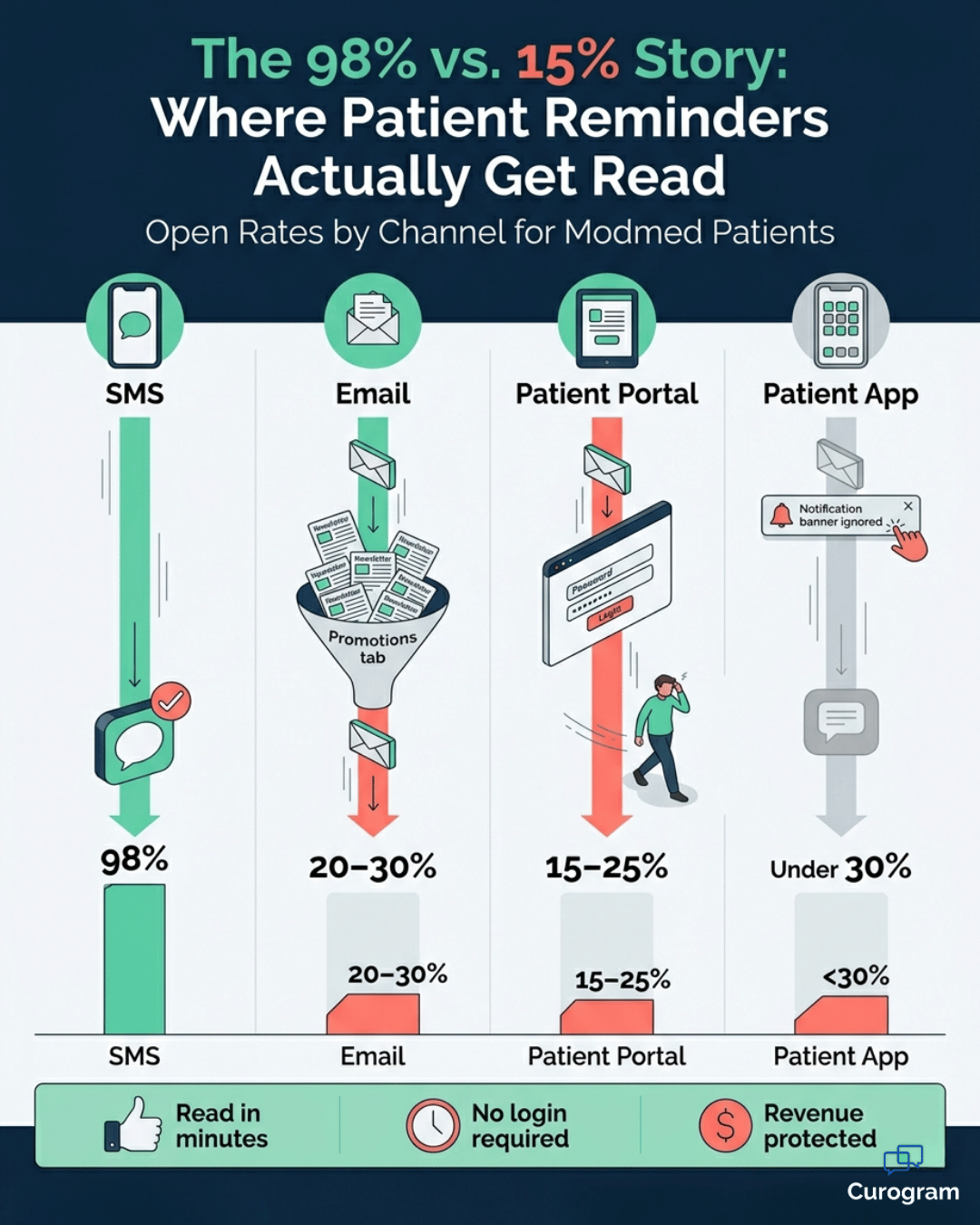
Infographic comparing SMS appointment reminders 98% open rate against email, portal, and Klara

Conversational Confirmation in 5 Seconds

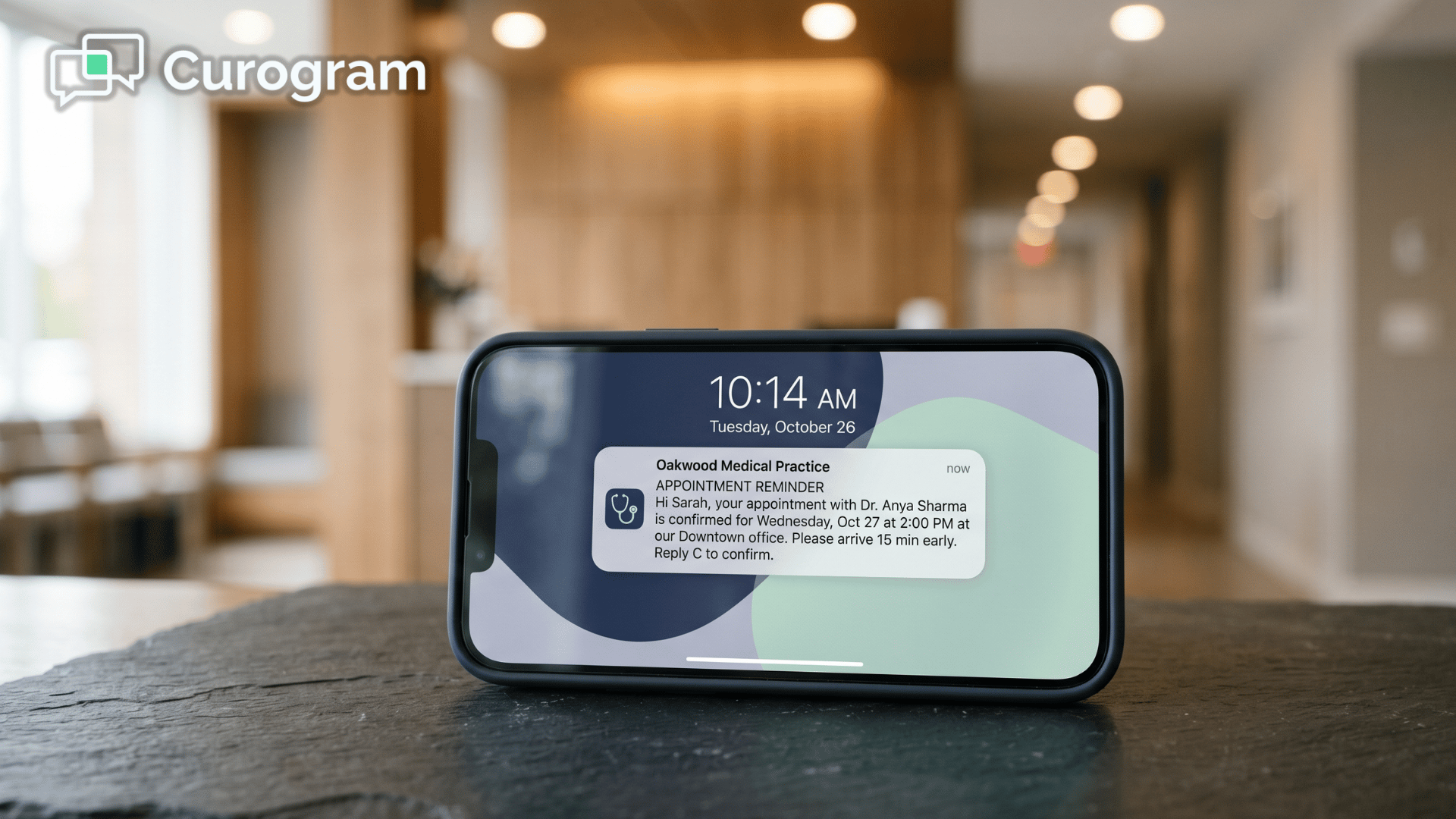
The reminder itself is simple and specific. It includes the appointment date, time, provider name, and location. The patient confirms with a single word — "Yes" or "Confirm." If they need to reschedule, they reply "Reschedule" and the request lands instantly in your practice dashboard.

The whole interaction takes about 5 seconds. No login. No password. No app. No portal. Just a text message and a reply.

This is also why Curogram SMS reminders patient experience Modmed practices report differs so sharply from older systems. The conversational simplicity is the feature. It is why more than 75% of patients across current Curogram clients actually confirm their appointments, while portal-based confirmation systems often struggle to break 30%.

From the Patient's Perspective, It's Just Their Doctor

Here is a detail that matters more than it sounds. From the patient's side, the message looks like it came from their doctor's office. The number, the tone, the format — all of it feels native to their relationship with your practice.

They do not know Curogram is the platform syncing with Modmed in the background. They do not need to. The technology is intentionally invisible to the patient, which is exactly why it works.

Why SMS Matches How Specialty Patients Actually Live

The reason patient response rate SMS vs portal reminders Modmed practices see such a wide gap comes down to how each specialty's patient base communicates day to day:

  • Ophthalmology: Elderly cataract patients often rely on adult children to help manage care. A text reminder can be forwarded to a family member — a portal login cannot.
  • Dermatology: Patients prefer discreet, professional text reminders over portal notifications. This is one of the clearer cases of why patients prefer SMS over Klara reminders, which patients have described as cryptic and unclear.
  • Orthopedics: Post-surgical patients with mobility limitations can confirm from the couch with a one-word reply. A portal login on a laptop is the opposite of convenient mid-recovery.
  • Pain management: Patients managing chronic pain need reminders that are reliable, simple, and don't get lost in email. SMS gives them exactly that.

The thread connecting all four is the same. SMS removes friction at the moment a patient is most likely to drop off.

Modmed patients respond SMS appointment reminders 98% open rate - inline

When Every Reminder Gets Read, Every Chair Gets Filled

Once you fix the channel, the downstream metrics shift in ways that are almost immediate.

The Numbers Tell a Clean Story

The Modmed patient engagement open rate comparison is not subtle.

A 98% open rate on SMS reminders versus single-digit engagement on portal notifications is not a small bump — it is a category difference.

The gap in open rates leads directly to a gap in response rates. When patients can see the reminder, they actually act on it.

75%+

Average appointment confirmation response rate across Curogram clients Portal-based confirmation systems often struggle to break 30%.

These two numbers explain everything that follows. When reminders are read and replied to, the entire downstream operation changes.

From Hoping They Remember to Knowing They're Coming

The real shift is not even in the data. It is in how the schedule feels.

Before SMS, your team is sending reminders into a void and hoping patients show up. The schedule is a wish list. The day-before scramble is just part of the job.

No-shows cost you money! Reduce missed appointments by up to 75% with Curogram's automated, customizable smart reminders.  

After SMS, three operational shifts happen almost immediately:

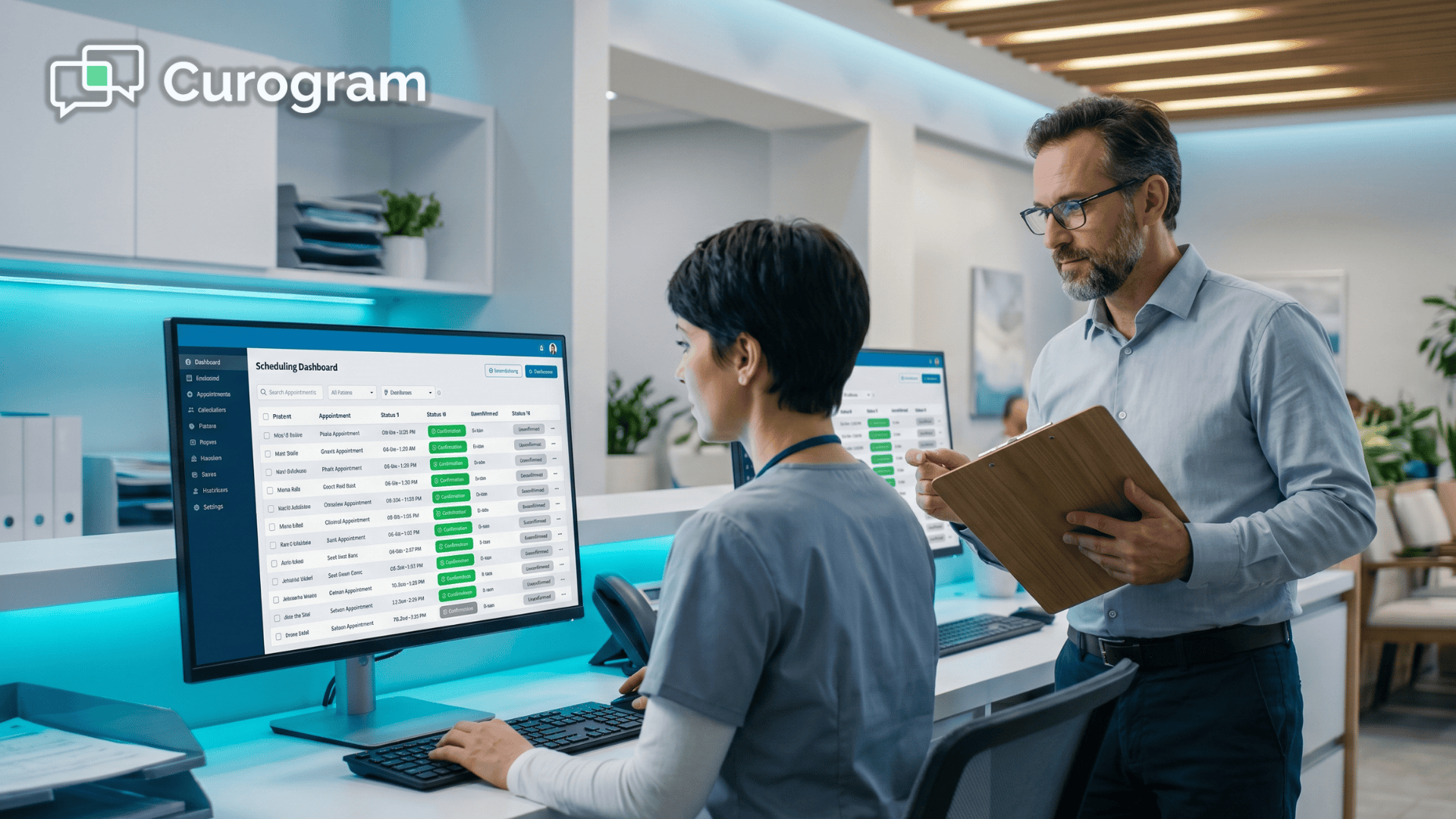
  • The schedule becomes a confirmed list, not a guess. Patients respond before the appointment day, so your team knows exactly who is coming.
  • The day-before call marathon disappears. Surgical coordinators stop dialing 30+ patients the night before; most are already confirmed by text.
  • Front desk capacity opens up. Staff hours once spent chasing confirmations shift to higher-value work like intake and follow-up.

14.20% → 4.91%

Atlas Medical Center no-show rate, before and after Curogram A 3x improvement over the industry average — in just three months.

That kind of drop is not a marginal gain. It is the difference between a schedule that drains revenue and a schedule that protects it.

A Real-World Outcome for a Specialty Practice

Picture a multi-provider ophthalmology group switching from email and portal reminders to Curogram's SMS reminders. Open rates jump from 15% to 98%. Confirmation rates climb from 20% to over 75%. No-shows drop from 18% to 7%.

The surgical coordinator no longer spends hours on confirmation calls because 90% of patients have already confirmed by text. Patients report feeling more connected to the practice — the communication feels personal, not bureaucratic.

And because SMS is a two-way channel, the same system used to confirm appointments can also send post-visit review requests. One multi-location practice generated 1,064 new 5-star reviews in just three months using Curogram's automated post-appointment surveys.

The appointment reminder response rate specialty practice teams care about is just the starting point. Once reminders are getting through, every other patient-facing workflow improves too.

Curogram clients consistently see dermatology no-show rates around 9% compared to a 25% industry average, and specialty clinic no-show rates around 10% versus 23% industry-wide — a 53% lower no-show rate overall, which translates into a 10–20% revenue increase tied to recovered appointments.

Make the Switch That Patients Actually Notice

Here is the simple version of everything above. Portal and email reminders are not failing because patients do not care. They are failing because patients do not check those channels.

SMS solves the delivery problem, not by working harder, but by working in the place patients already are.

Modmed's EMA is built around how your providers work. Curogram is built around how your patients communicate. And patients communicate by textnot by portal login, not by email check, not by app notification.

When every reminder gets read, your schedule stops being a guessing game.

Your front desk stops chasing confirmations. Your providers stop walking into empty exam rooms. Your revenue per scheduled day climbs because the slots you booked are the slots that get filled.

The change is operational, but the impact is financial. A 9% dermatology no-show rate versus a 25% industry average is not just a better number — it is roughly 16 additional patients seen per 100 booked. Multiply that across a year of procedures, and the math gets hard to ignore.

Your patients want to confirm their appointments. They want to show up. They want the reminder to arrive somewhere they will see it. SMS gives them that, and gives your team a confirmation dashboard that turns no-shows into the exception rather than the expectation.

If you are running Modmed and still relying on portal or email reminders to fight no-shows, you are working against the channel — not with it.

There is a faster, simpler, and measurably more effective way to reach your patients.

Schedule a Demo with Curogram and see the patient-side SMS reminder workflow in action. In 15 minutes, you will see exactly how Modmed patients respond to SMS appointment reminders at a 98% open rate, how confirmation responses flow back into your dashboard, and how the no-show numbers shift once reminders finally land where patients actually read them.


Frequently Asked Questions

Do patients need to download an app or create an account to receive Curogram's SMS reminders?

No. Curogram's reminders arrive as standard text messages in the patient's native messaging app. There is no app to download, no account to create, and no password to remember. Patients read and reply to reminders exactly like any other text message on their phone.

What if a patient does not have a cell phone or prefers not to receive texts?

Curogram works alongside your existing communication channels, not as a replacement. Patients who prefer phone calls or portal messages can continue using those methods. SMS reminders are an additional channel that captures the majority of patients who respond better to text. Your team can mark individual patients as phone-only in their outreach preferences.

Are SMS reminders more expensive than portal-based reminders for a Modmed practice?

Curogram's SMS reminders are included in the platform — there is no per-message fee. When you compare the cost of Curogram to the revenue lost from no-shows that portal reminders fail to prevent, the ROI is immediate. Atlas Medical Center's no-show reduction from 14.20% to 4.91% represents tens of thousands of dollars in recovered monthly revenue, which far exceeds the cost of any patient engagement platform.

How does Curogram sync with Modmed to send SMS reminders without disrupting our workflow?

Curogram integrates directly with Modmed, pulling appointment data in real time so reminders are always accurate and up to date. When a patient is scheduled, rescheduled, or canceled in Modmed, Curogram automatically reflects that change. Your front desk staff continues using Modmed exactly as they do today — no duplicate data entry, no parallel systems to manage. The SMS workflow runs in the background, and confirmations flow back into a simple dashboard your team can monitor at a glance.

Are Curogram's SMS appointment reminders HIPAA compliant?

Yes. Curogram is fully HIPAA compliant, and all SMS communication is built to meet healthcare privacy standards. Reminder messages are designed to share only the necessary appointment details — date, time, provider, and location — without exposing protected health information unnecessarily. The platform also supports patient consent management, so your practice maintains a clear record of which patients have agreed to receive text communication.