The ROI of Online Patient Forms for Medstreaming Imaging Centers
💡 Online patient forms are transforming how Medstreaming imaging centers operate by reducing manual work and improving data accuracy before...
10 min read
Aubreigh Lee Daculug
:
January 22, 2026
Table of Contents
No imaging center sets out to create long check-in lines. It just happens—slowly, quietly, one paper form at a time.
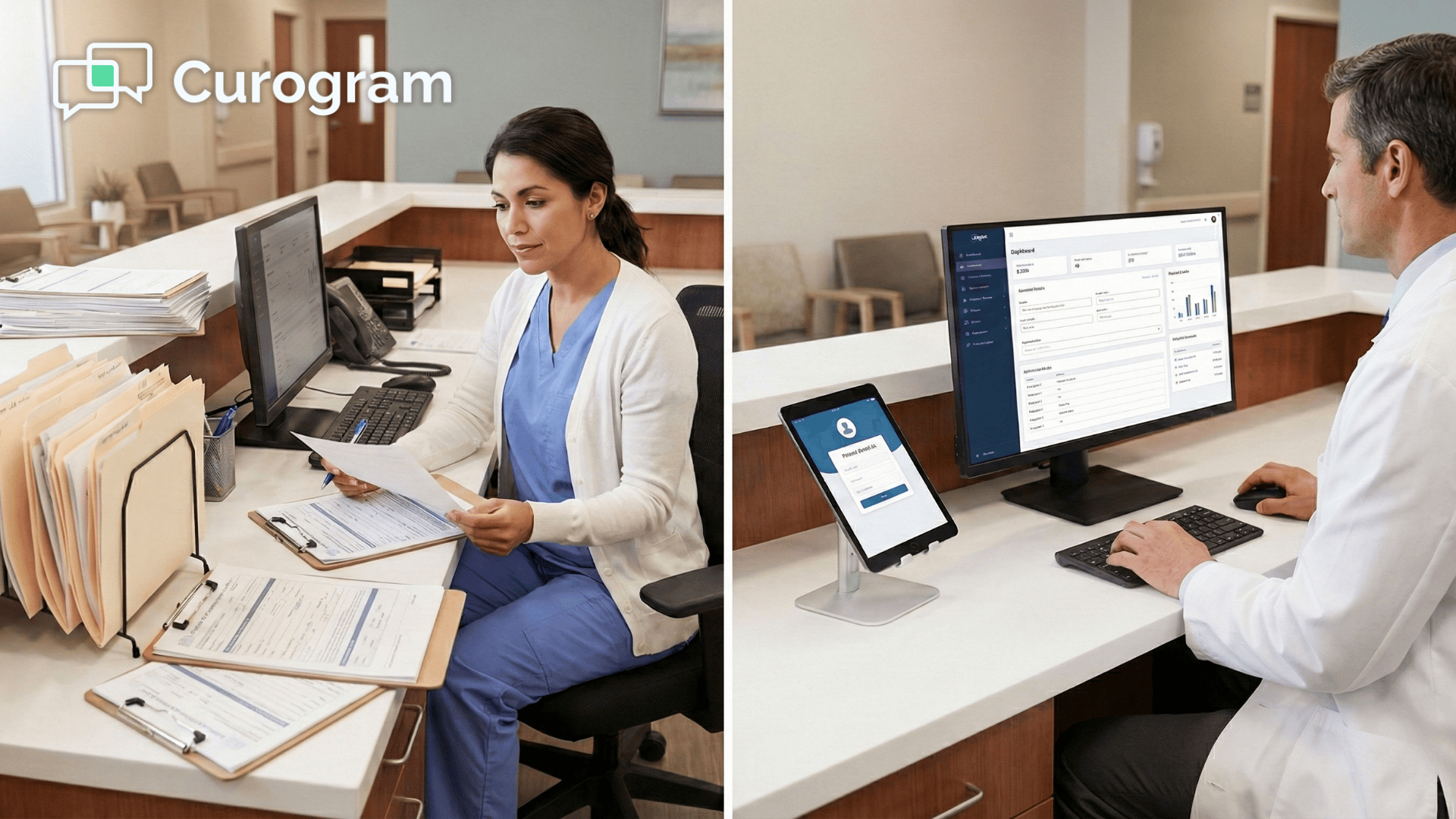
A patient arrives ten minutes early and still ends up late to their scan. The front desk is juggling phones, walk-ins, and paperwork. Someone realizes a screening question was skipped. Another patient needs clarification on prep instructions. By mid-morning, the schedule is already behind.
This is the hidden cost of manual intake.
Paper-based workflows force critical questions into the most chaotic part of the visit: arrival. Patients are rushed. Staff are interrupted. Information gets missed, rewritten, or entered twice. In high-volume environments, those small inefficiencies compound into real operational drag.
Digital intake changes where—and when—that work happens.
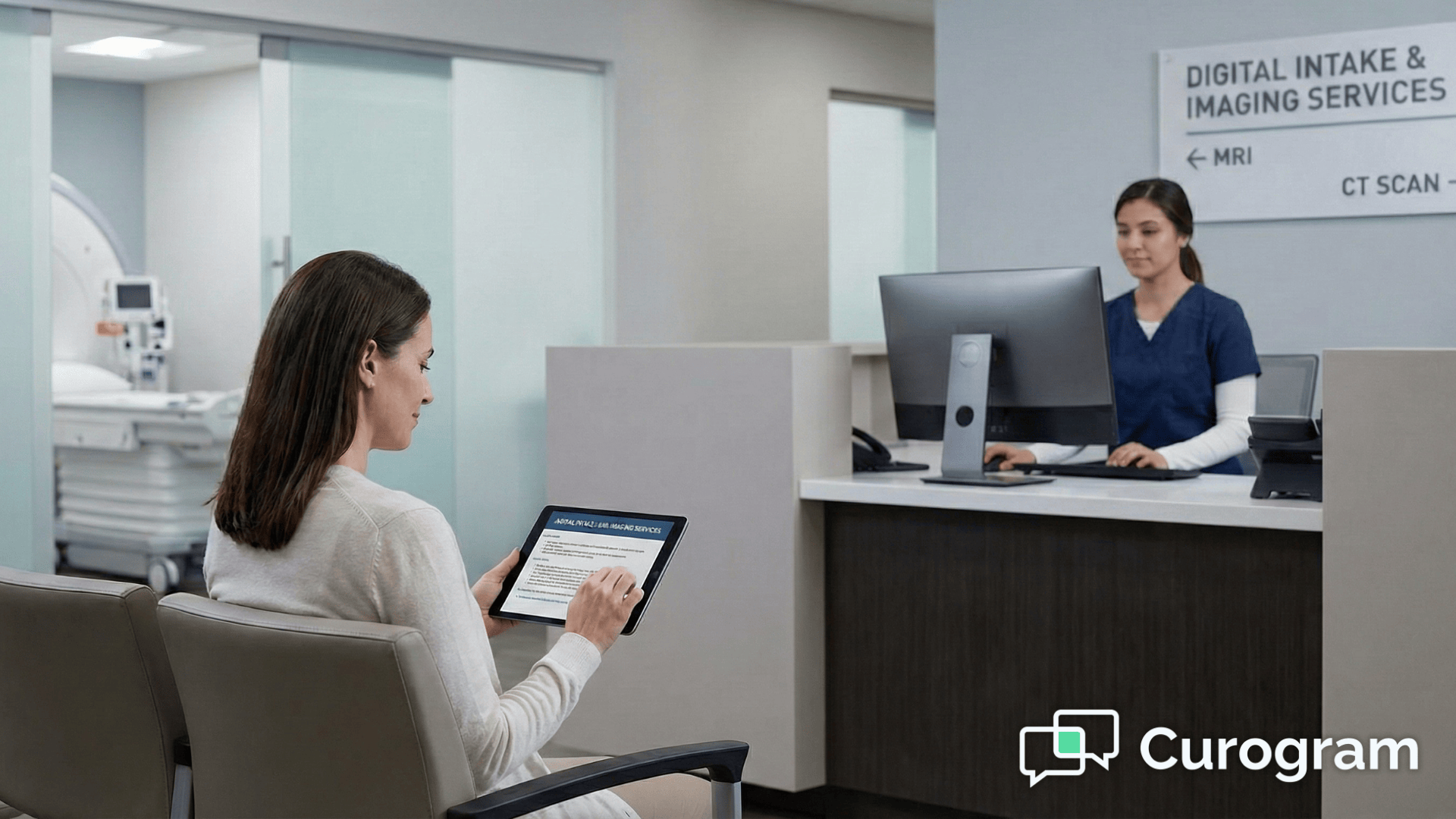
Instead of asking patients to complete forms under pressure, intake begins before the visit. Forms are sent automatically based on the scheduled exam. Patients complete them at home, on their phone or laptop, when they have time to read carefully and respond accurately.
The experience adapts to the procedure. MRI safety questions appear only when needed. CT exams trigger contrast and allergy screening. Ultrasound patients receive prep questions specific to their scan. Nothing extra. Nothing missing.
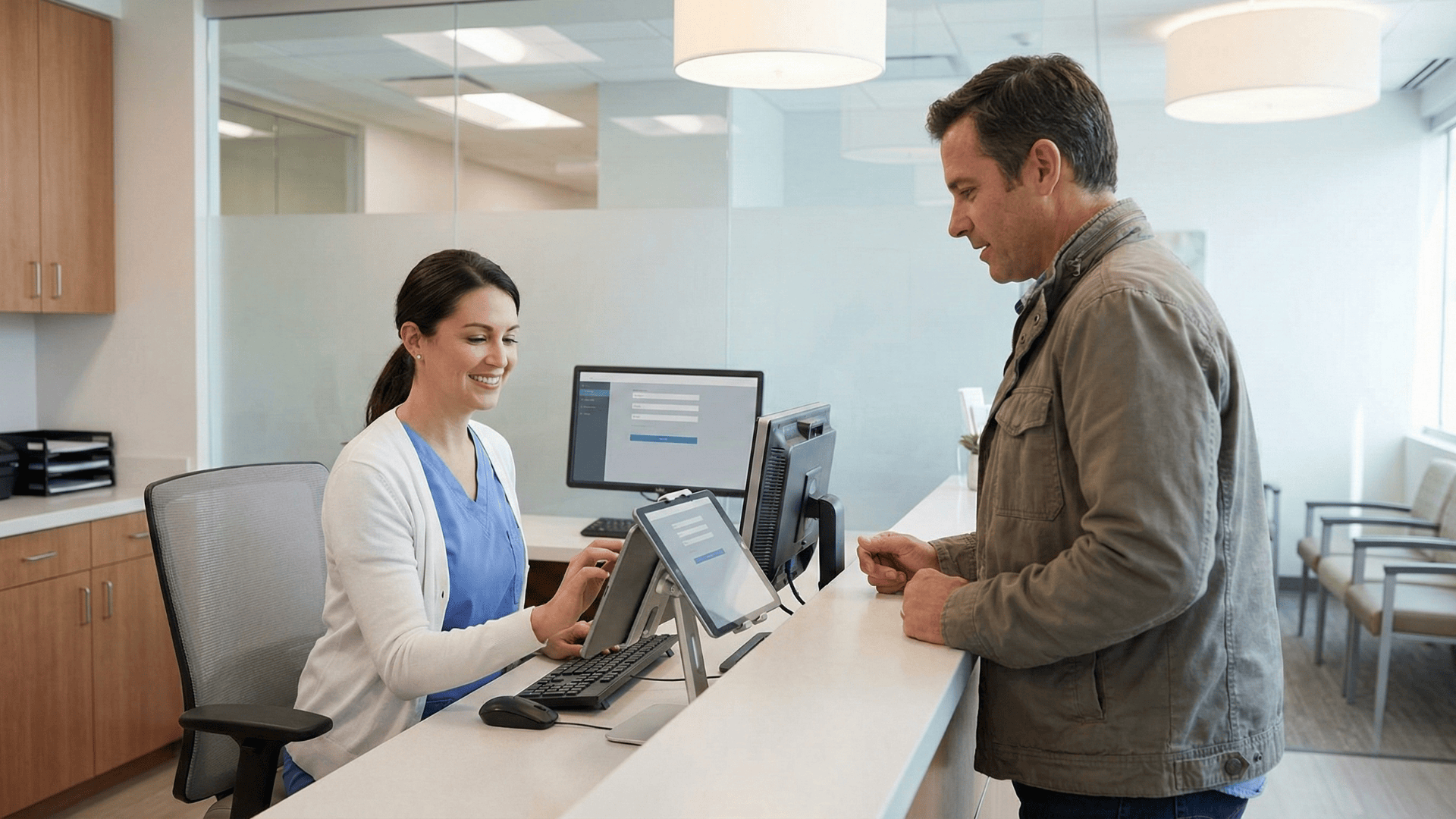
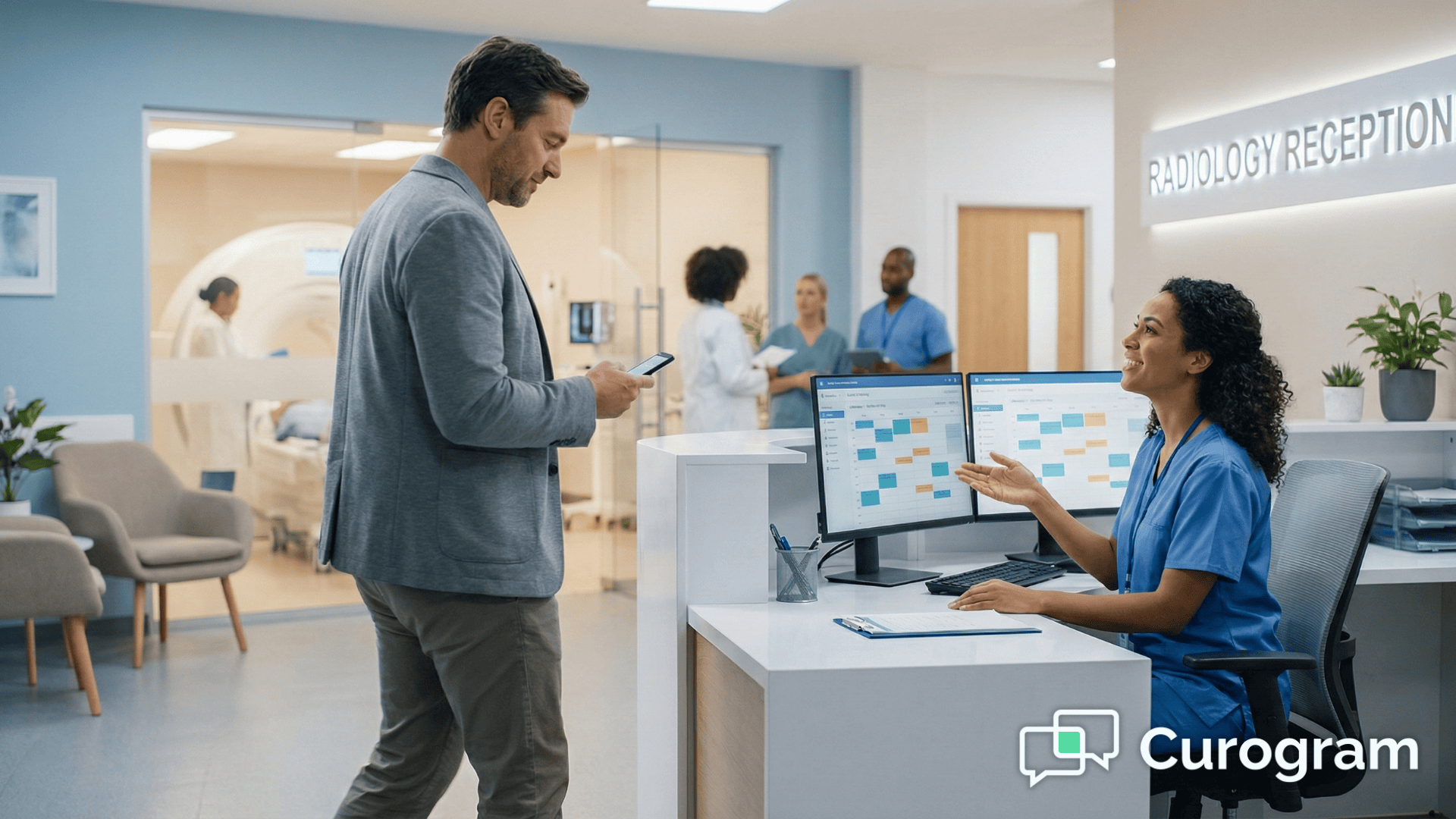
By the time the patient arrives, staff already have the information they need. Intake data is available in Medstreaming. Potential issues surface early, not at the front desk. Check-in becomes a confirmation step, not a paperwork scramble.
The impact shows up quickly. Wait times shrink. Peak-hour congestion eases. Schedules stay intact because fewer exams are delayed or rescheduled due to incomplete screening. Staff spend more time moving patients through the day and less time chasing forms.
For multi-location networks, consistency becomes a quiet advantage. Every patient, at every site, completes the same structured intake process. Data arrives clean, complete, and standardized. No more location-by-location variations. No more deciphering handwriting or tracking down missing pages.
Digital intake doesn’t try to impress patients. It simply removes friction. And when friction disappears at the front door, the entire operation runs smoother—from the waiting room to the last scan of the day.
The difference between a smooth imaging visit and a delayed one often comes down to what’s known before the patient arrives. When intake happens at check-in, critical questions compete with paperwork, waiting rooms, and time pressure. Digital intake changes that dynamic by shifting preparation upstream—where it actually works.
Different scans require different screening, and the system is built to recognize that automatically. MRI safety questions aren’t treated the same as CT contrast checklists or ultrasound prep requirements. Each appointment triggers the right forms based on procedure type, so patients only see what applies to their visit.
Paper intake forces these questions into the busiest moment of the day. Patients rush through forms. Staff review answers on the fly. Missing or unclear information surfaces too late, especially for prep-sensitive exams where metal implants, kidney function, or contrast eligibility matter.
Patients spend 10–15 minutes completing paperwork after arrival
Multi-location facilities juggle different form versions and processes
Staff re-enter handwritten responses into Medstreaming
Transcription errors increase safety and operational risk
Digital forms replace this entire workflow with a single, automated experience. Patients receive intake forms by text or email ahead of their appointment and complete them on their own time, using any device.
Built-in validation prevents incomplete submissions. Required fields ensure critical questions are answered before the form can be sent, eliminating last-minute surprises at the front desk.
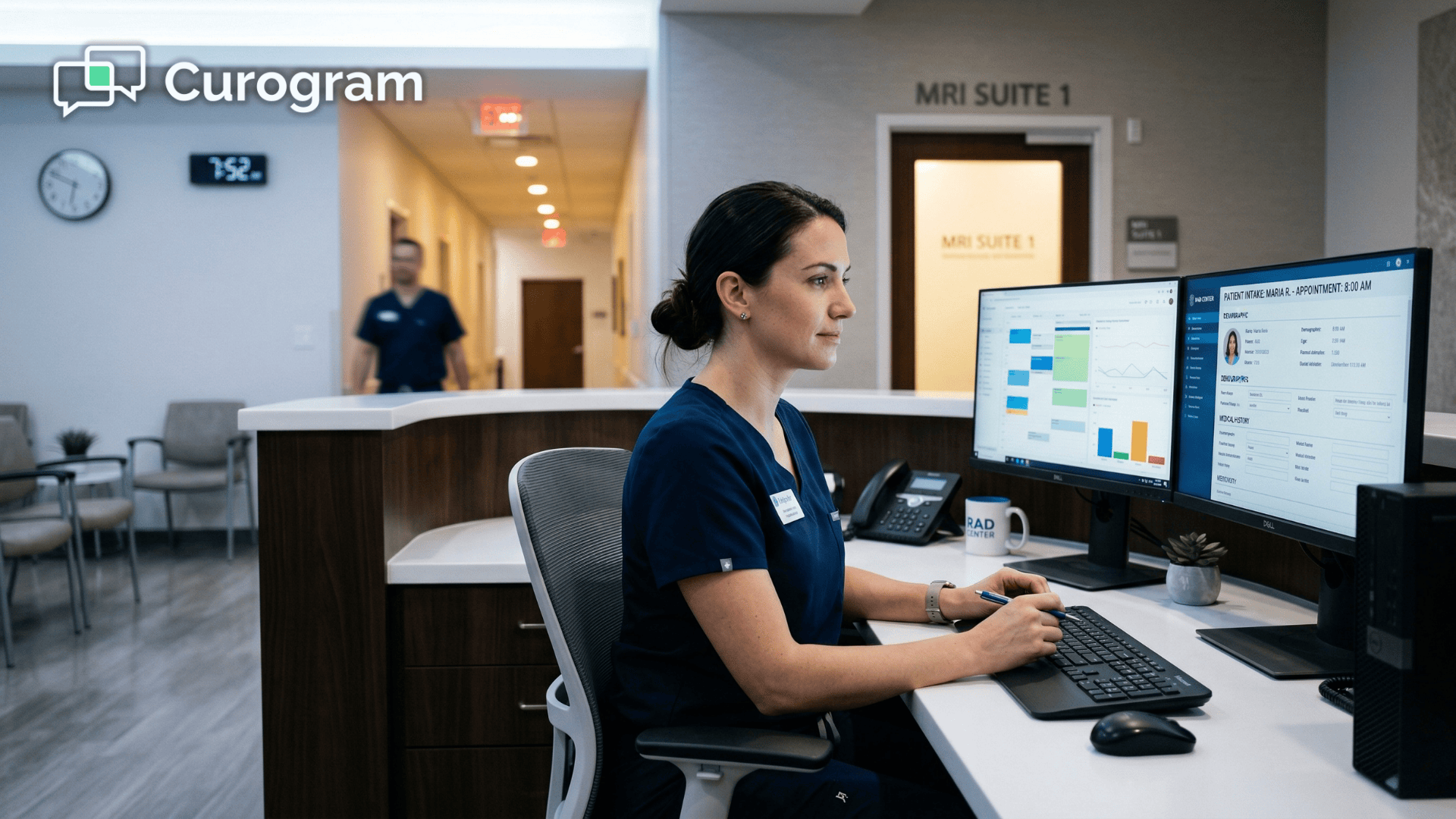
For staff, everything changes. Completed forms are available in advance, giving teams time to review responses, flag concerns, and prepare for special accommodations. Check-in becomes faster, calmer, and more predictable.
Standardization happens automatically across all locations. Every facility uses the same templates, logic, and screening rules, creating consistent data quality and a more reliable patient experience. The result is safer exams, shorter wait times, and workflows that finally match the pace of modern imaging operations.
Paper intake doesn’t fail all at once—it fails in small, costly ways that add up over time. Critical details get missed, rushed, or misunderstood when forms are completed at the front desk under pressure.
Safety risks emerge first. A patient skips an allergy question on a CT contrast form. Another rushes past surgical history or medication details. Checked boxes don’t always reflect reality, and blank fields often go unnoticed until it’s too late to fix them.
Once those gaps enter the workflow, downstream problems follow quickly.
Front desk notes that never reach the technologist or procedure room
Patients arriving unprepared because instructions weren’t understood or remembered
Repeat scans caused by missed prep steps or incomplete screening
Long wait times during peak hours that create delays throughout the schedule
Last-minute cancellations that can cost $500 or more per procedure
These issues don’t just affect patients—they take a toll on staff. Front desk teams spend their day collecting paperwork, clarifying handwritten responses, answering follow-up calls, and relaying information manually. Over time, that constant friction contributes to burnout and frustration.
Quality control is another blind spot. Paper forms offer no visibility into completion rates, error trends, or recurring problem areas. Leaders can’t measure what’s working and what’s breaking down. In multi-location networks, the challenge multiplies as each facility develops its own intake habits and workarounds.
Digital intake replaces this uncertainty with structure. Required fields prevent missing information. Validation rules reduce errors. Completed forms route automatically to the right teams, at the right time, before the patient ever walks through the door. The result is safer exams, smoother schedules, and a calmer front desk experience across every location.
A modern digital intake platform integrates directly with Medstreaming to streamline patient intake and reduce administrative burden. As soon as an appointment is scheduled, the system automatically triggers delivery of the correct intake and safety screening forms.
Forms are sent securely via text message and email, improving visibility and completion rates without requiring staff outreach. This automation reduces call volume and front-desk congestion while improving the patient experience.
Form delivery timing is fully configurable. Imaging centers can send forms 48 hours, one week, or at a custom interval before the appointment. Automated reminders follow up with patients who have not completed their forms, helping ensure readiness before arrival.
Modality-specific form mapping automatically assigns the correct forms based on exam type, ensuring each patient receives relevant safety and prep questions
Accurate patient matching uses name, date of birth, and phone number to tie form responses to the correct appointment and record
Device-agnostic mobile access allows patients to complete forms on any device without app downloads
Smart form validation enforces required fields and structured inputs to reduce incomplete or unusable submissions
Dynamic conditional logic displays only relevant follow-up questions based on patient responses
Real-time staff alerts notify teams when forms are completed, incomplete, or contain flagged responses
A centralized dashboard provides real-time visibility into form completion status across all upcoming appointments. Staff can quickly identify which patients still need follow-up and prioritize outreach efficiently.
Form templates are fully customizable to support facility-specific workflows, policies, and clinical requirements. Pre-built templates are available for common imaging procedures, accelerating setup and standardization.
Multi-location support enables health systems and imaging groups to manage all locations from a single platform while maintaining consistent forms, workflows, and branding across sites.
A centralized dashboard provides real-time visibility into form completion status across all upcoming appointments. Staff can quickly identify which patients still need follow-up and prioritize outreach efficiently.

Digital intake creates measurable operational improvements. System features affect facility efficiency, staff workload, and patient processing times.
Check-in time reduction represents the most immediate operational change. Pre-completed forms require 5 minutes or less at front desk. Staff verification includes identity confirmation and brief question review. Processing efficiency prevents bottlenecks during peak periods.
Imaging readiness increases through advance information access. Staff review contraindications, special requirements, and prep compliance before patient arrival. Equipment and supply preparation occurs based on patient data. This advance knowledge reduces delayed or canceled procedure probability.
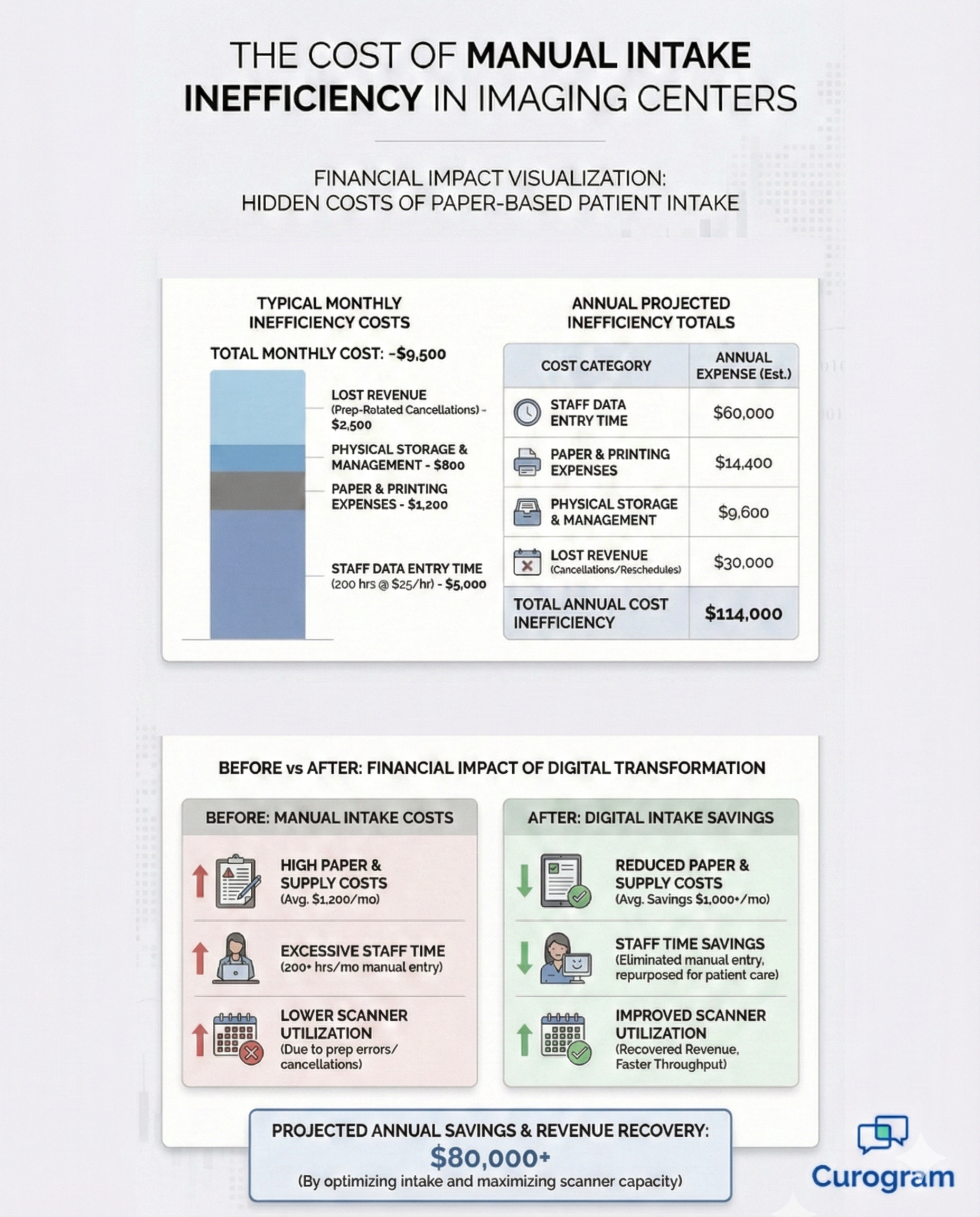
Paperwork reduction affects supply costs and storage requirements. Facilities eliminate printed form orders and paper record filing systems. Environmental impact improves with 90% or more paper usage reduction in some facilities.
Multi-location cost reduction multiplies across facility networks. Paper inventory management across sites becomes unnecessary. Form version consistency no longer requires physical distribution. Storage space requirements decrease at all locations.
Patient experience metrics show improvement in satisfaction scores and retention rates. Remote form completion provides scheduling flexibility. Patient control over the intake process increases. Facility recommendation rates improve with convenience features.
Staff productivity increases through data entry elimination. Front desk focus shifts to patient interaction and scheduling support. Administrative task reduction improves job satisfaction metrics. Turnover rates decrease with improved work conditions.
Imaging team efficiency improves with complete advance information. Radiologists access patient history before image interpretation. Techs identify special accommodations before procedure room preparation. This information availability supports improved care delivery and procedure efficiency.
Different imaging modalities require different clinical, safety, and preparation information. A comprehensive digital intake platform supports modality-specific workflows, ensuring patients receive only the questions relevant to their exam while imaging teams collect complete, accurate data ahead of time.
By tailoring forms to each modality, imaging centers improve safety compliance, reduce same-day delays, and support more efficient clinical workflows.
MRI safety screening is essential due to the risks posed by strong magnetic fields. Digital MRI forms collect detailed information about implants, surgical history, metal fragments, and exposure to metallic materials.
Patients are prompted to disclose pacemakers, defibrillators, insulin pumps, cochlear implants, aneurysm clips, and other metal-containing devices. Additional questions assess prior MRI experience, claustrophobia, and pregnancy status when applicable. Required fields and validation help prevent incomplete screenings and exam delays.
CT contrast forms focus on identifying allergy risks and assessing renal function prior to contrast administration. Forms collect a history of previous contrast reactions, known allergies including shellfish, and medications that may impact contrast safety.
Kidney disease screening helps identify patients at higher risk for contrast-related complications. Preparation sections document fasting requirements, hydration guidance, and diabetes medication adjustment needs. Patient confirmation ensures prep instructions are understood before the day of the exam.
Ultrasound forms deliver exam-specific preparation instructions based on the scheduled procedure. Abdominal ultrasound forms prompt patients to confirm fasting windows, while pelvic ultrasound forms specify full bladder requirements.
Instructions are written in clear, patient-friendly language and include confirmation prompts to verify understanding. This reduces arrivals without proper preparation and helps avoid rescheduling or repeat exams.
Echo and vascular imaging forms collect targeted clinical history to support accurate exam performance and interpretation. Patients document symptoms such as chest pain, shortness of breath, leg pain, swelling, or dizziness.
Forms also capture cardiovascular risk factors, previous cardiac or vascular procedures, and current medications. This information is available to imaging teams and interpreting physicians before the exam, improving clinical context and workflow efficiency.
Multi-modality imaging centers benefit from a structured digital pre-registration workflow. Initial forms collect demographic details, insurance information, medical history, and general health screening data.
Once the exam is scheduled, modality-specific forms are automatically triggered to capture procedure-specific information without duplicating data. This two-stage approach improves efficiency while maintaining thorough, consistent data collection across all imaging services.

Digital intake implementation affects daily operations across imaging facility departments. System features create lasting efficiency and accuracy improvements.
Manual transcription elimination removes data entry requirements. Staff no longer type patient responses from paper documents. This eliminates hours of daily data entry work. Front desk personnel can process additional patients or complete other operational tasks.
Missing field reduction occurs through required question validation. The system prevents form submission with incomplete critical information. Patients attempting to skip allergy history or medication fields receive completion prompts. This ensures comprehensive data collection before submission.
Front desk workflow streamlining shifts staff focus to patient care. Staff greeting, identity verification, and information confirmation become primary activities. Administrative work reduction allows increased patient interaction time. This shift improves operational experience across all stakeholders.
Pre-arrival information clarity supports appointment preparation. Imaging techs review forms during operational gaps to identify special considerations. Supply gathering, equipment adjustment, and radiologist consultation occur before patient arrival. This advance preparation supports complex case management.
Platform selection affects long-term facility operations. Solution features should align with Medstreaming imaging center requirements.
Radiology-specific templates eliminate the need for custom development. Pre-configured forms support MRI, CT, ultrasound, X-ray, and other common procedures, while still allowing customization. This ensures exact requirement matching without starting from generic forms.
Multi-location standardization occurs automatically across facility networks. Single form creation deploys across entire networks. Updates and improvements distribute to all locations simultaneously. Consistency and quality maintenance becomes centralized rather than site-specific.
Cross-device patient accessibility affects completion rates. Platform functionality across iPhone, Android, tablets, and computers without application requirements increases usage. Setup complexity elimination through link-based access improves adoption. Information entry begins immediately upon link selection.
Workflow alignment features adapt to existing processes. Systems should conform to facility operations rather than requiring operational changes. Learning curves remain minimal for staff members. Job difficulty reduction becomes apparent in daily operations.
Results documentation from other facilities demonstrates practical success. Imaging centers using quality platforms report measurable improvements in check-in duration, completion rates, and staff satisfaction metrics. Healthcare-specific platform design produces different outcomes than generic form software.
Support responsiveness determines implementation success. Platform teams should understand imaging workflow requirements and provide situation-specific guidance. Setup assistance, training support, optimization help, and ongoing question response support long-term needs.
Patient information protection requires strict security standards in digital intake systems. Platform features must balance security requirements with operational usability.
HIPAA-compliant form submission includes end-to-end encryption. Data transmission from patient devices to facility systems uses banking-standard encryption protocols. Unauthorized access prevention occurs throughout the transmission process. Information interception becomes technically unfeasible during transit.
Paper elimination removes common security vulnerabilities. Physical forms cannot be misplaced, left unsecured, or accidentally discarded. Digital submissions route directly to secure storage with automatic backup systems. Physical security risks no longer exist in the intake process.
Access control features limit form viewing to authorized personnel. Permission systems operate on role and location criteria. Front desk staff access differs from billing staff or radiologist access levels. Granular control prevents unauthorized viewing while enabling necessary information access.
Audit trail functionality tracks all form-related actions. System logs document viewing activity, access timestamps, and modification records. This documentation supports compliance audit requirements. Accountability exists across the organization for all data interactions.
Security update systems maintain current threat protection. Continuous monitoring identifies suspicious activity patterns. Administrator alerts trigger for potential security issues. Protection operates continuously without requiring staff intervention.
Digital patient intake implementation produces immediate operational effects. System features address patient convenience, staff workload, and facility efficiency simultaneously.
Operational improvements span all imaging practice aspects. Check-in duration drops from 20 minutes to single-digit timeframes. Prep error frequency decreases significantly. Staff productivity metrics increase. Patient satisfaction scores improve. These changes accumulate into comprehensive experience improvements.
For Medstreaming-powered imaging centers, appropriate digital intake solutions provide seamless platform integration. Form design should address imaging procedure requirements specifically. Implementation processes should follow straightforward protocols with reliable support structures.
Implementation timelines typically span several weeks for most facilities. Staff training, patient instruction materials, and automated technical processes all contribute to system activation. Platform automation handles technical complexity independently.
Investment return occurs through efficiency gains and cost reductions. Paper supply expenses decrease. Data entry time requirements drop. Scanner utilization improves through prep-related cancellation prevention. Monthly savings accumulate over operational periods.
Your next step is simple. Book your demo to see how digital intake works with Medstreaming.
The system sends forms automatically via text message and email upon appointment scheduling in Medstreaming. Patients receive secure links accessible on any device. Reminder systems activate when forms remain incomplete within specified timeframes. Delivery timing and frequency remain under facility control.
Digital forms include mandatory field completion requirements before submission. Required fields prevent information gaps. Validation systems catch formatting errors in contact numbers, dates, and other data fields. Handwriting interpretation becomes unnecessary. Manual transcription error elimination occurs automatically. Duplicate submission prevention and accurate patient matching are built-in features.
Form mapping to procedure types occurs automatically. MRI scheduling triggers MRI-specific safety screening delivery. CT appointments activate contrast allergy form transmission. Ultrasound bookings send prep instruction documents. Mapping configuration occurs once using Medstreaming procedure codes. Automated delivery handles all subsequent appointments without manual intervention.
Digital intake standardizes processes across all network facilities. Every location uses identical forms, follows uniform procedures, and maintains consistent quality standards. Patient experience remains consistent regardless of facility selection. Management teams access performance metrics across the network for improvement identification. Updates and changes distribute to all locations simultaneously through centralized deployment.
Platforms provide multiple contingency options. On-site tablet completion remains available upon patient arrival. Front desk staff can assist patients requiring support or complete forms collaboratively during check-in. Completion status tracking identifies patients needing assistance. Most facilities report 80% advance completion rates once patients become familiar with the system.
💡 Online patient forms are transforming how Medstreaming imaging centers operate by reducing manual work and improving data accuracy before...
💡 Medstreaming imaging centers manage high volumes of MRI, CT, ultrasound, and cardiovascular scans, each requiring specific prep and safety...
💡 Online patient forms in Veradigm enable imaging centers to transition away from paper-based intake that causes delays and errors. Patients...