
12 min read

ROI of Automated Reputation Management for Medstreaming Centers

ROI of Automated Reputation Management for Medstreaming Centers
💡 Your imaging center's online reputation directly affects revenue. When patients search for MRI or CT services, they choose providers based on Google reviews and star ratings.
  • Automated systems help you boost Google reviews Medstreaming locations display without staff involvement
  • Better ratings drive more patient visits and higher revenue across all your centers
  • HIPAA-compliant tools make review collection completely hands-free and systematic
This approach improves search rankings and builds trust with potential patients, delivering measurable financial returns through increased appointments and better equipment utilization.

Here's something most imaging center administrators don't realize until it's too late: every day without a strong online presence is a day you're hemorrhaging revenue to competitors who figured this out first.

Picture this. A patient needs an MRI and receives three referrals. At home, they search each imaging center online. One has 200 reviews with a 4.8 rating. Another has 30 reviews at 4.2 stars. The third has 15 outdated reviews and a 4.0 rating. The choice is obvious before a phone call is ever made.

Most imaging centers struggle here not because they don’t care, but because they’re busy. Front desk teams manage check-ins, phones, scheduling, insurance, and constant interruptions. Asking every patient for a review falls to the bottom of the list. When it happens, it’s inconsistent and easy to forget.

Across multi-location networks, this creates uneven visibility. Some locations build strong online reputations while others collect almost no reviews. To patients searching online, your network looks fragmented, as if each location is a separate business with varying quality.

The financial impact adds up quickly. An idle MRI or CT scanner costs money every hour it sits unused. Strong online visibility helps fill open slots. More reviews improve search rankings, rankings drive appointments, and appointments keep equipment producing revenue. The connection is simple and measurable.

Why Online Reputation Directly Impacts Imaging Center Revenue

Let's talk about how patients actually find imaging centers in 2025. The days of choosing based solely on physician referrals are fading. Sure, doctors still refer patients, but those patients immediately verify the recommendation online before booking. If your online presence doesn't match your clinical quality, you lose them.

Google’s algorithm treats review volume and recency as major ranking factors. A center with 300 reviews will almost always outrank one with 50, even when star ratings are similar. Consistent review activity signals that you’re actively serving patients and maintaining quality.

Stagnant reviews from years ago send the opposite message. They suggest lower relevance and less ongoing engagement. This directly impacts visibility in local search results.

The Google Maps “map pack” captures about 70% of local search clicks, but only three centers appear. Ranking fourth means far less visibility, often translating to hundreds of missed appointments each month.

Reviews also shape patient decisions beyond rankings. Around 84% of people trust online reviews as much as personal recommendations. Positive feedback about staff, check-in, and comfort sets expectations before patients arrive, creating a strong trust advantage.

The revenue impact shows up across multiple channels:

  • Search visibility drives direct appointment requests from patients actively looking for imaging services
  • Strong ratings increase conversion rates when potential patients call your center
  • Physician confidence grows when they see documented quality through reviews, leading to more referrals
  • Patient loyalty builds when online reputation matches actual experience, creating repeat business

For multi-location networks, balanced visibility is essential. A strong brand can’t exist when one location looks great online and another raises doubts. Consistent reviews across all sites build patient confidence and help your marketing efforts deliver better results.

The Financial Risk of Poor or Uneven Online Reputation

Let’s look at the numbers. Filling just 50 additional MRI slots per month—without adding staff or equipment—can generate real revenue. At $400 per scan, that’s $20,000 per month or $240,000 per year. Many imaging centers miss this opportunity simply because patients can’t find them online.

Low review volume creates a self-reinforcing cycle. Fewer reviews lead to lower search visibility. Lower visibility means fewer patients discover your center. Fewer patients result in even fewer reviews. Without a deliberate strategy, this cycle continues while competitors build an advantage that becomes harder to overcome over time.

Negative reviews are also far more damaging when volume is low. With hundreds of positive reviews, a few negatives have little effect. With only a handful of total reviews, even two or three poor ones can significantly drag down your rating and deter new patients—even when the complaint isn’t fully within your control.

The compounding risks include:

  • Marketing waste: Advertising drives traffic to locations with weak reviews that can't convert visitors into appointments
  • Competitive erosion: Rivals improving their reputation monthly while you stay stagnant creates widening gaps
  • Equipment underutilization: Expensive MRI and CT machines sitting idle during gaps that better visibility would fill
  • Staff instability: Low patient volume creates uncertainty that leads to turnover and replacement costs

For multi-location networks, uneven reputation creates real challenges. One location may have 150 reviews while another has only 12, causing patients in different areas to see very different versions of your brand.

You may invest equally in marketing each location, but only the ones with strong reviews convert consistently. The risk goes beyond short-term revenue loss and limits growth opportunities over time.

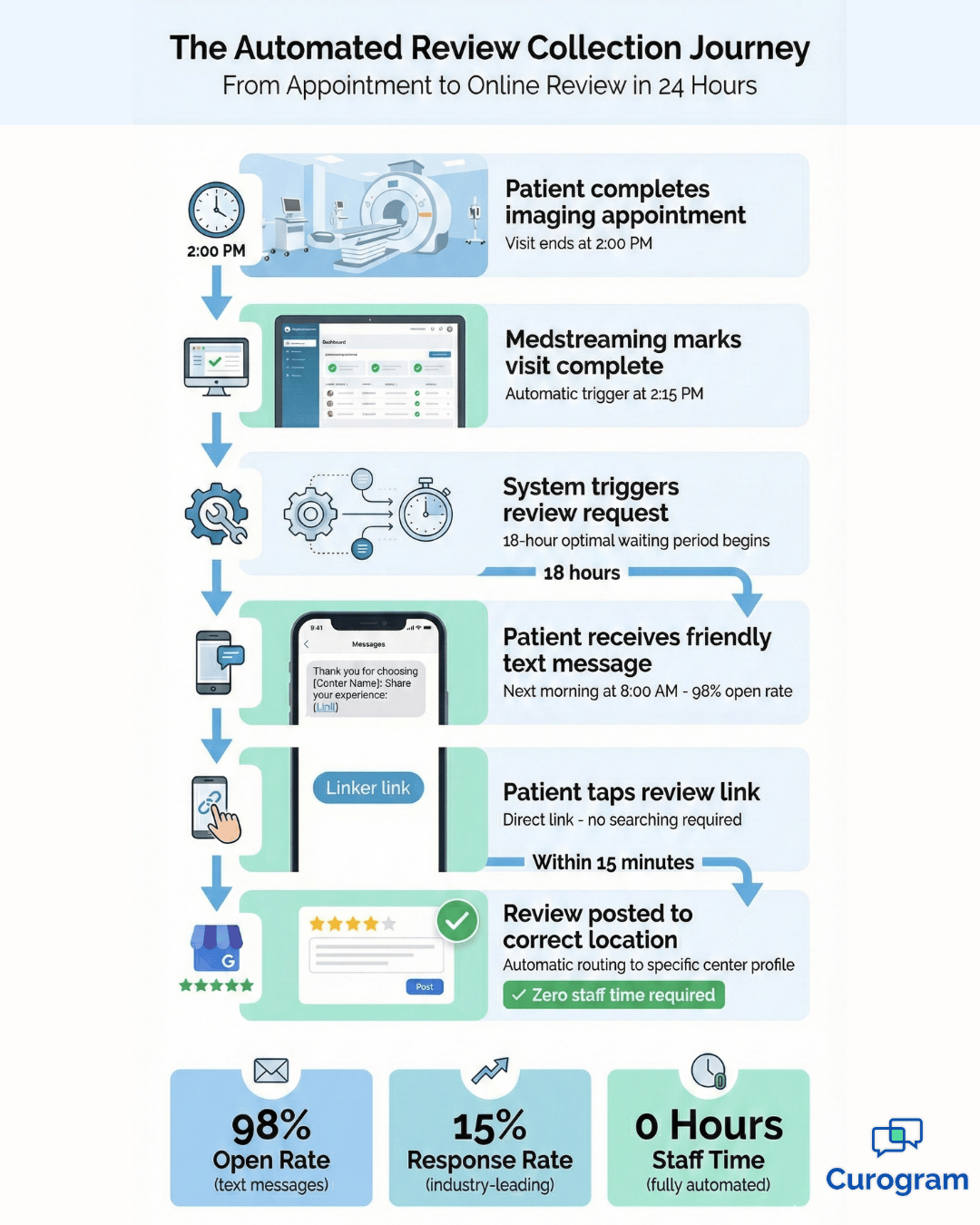
Automated review collection workflow from imaging appointment to Google review posting

How Automated Review Requests Increase 5-Star Ratings

Manual review collection fails because people are inconsistent. Even with good intentions, busy staff juggling phones, check-ins, and scheduling often forget to ask for reviews. Manual processes depend on perfect execution every time, which rarely happens in a fast-paced imaging center.

Automation solves the consistency problem completely. Every patient who completes a visit triggers the review request automatically. No human needs to remember anything. The system never gets tired, never gets busy, never takes a day off. This consistency is what drives predictable results that you can actually measure and improve.

Timing matters more than most people think. The ideal window for review requests is 12–24 hours after the visit, while the experience is still fresh. Patients remember the friendly technologist, the smooth check-in, and how quickly everything moved. After a week, those details fade. After a month, the visit is barely memorable.

Automated systems get this timing right every time. When an appointment is marked complete in Medstreaming, the process starts automatically. Later that day or the next morning, the patient receives a warm, personalized text thanking them and inviting them to leave feedback through a simple link.

The key advantages that drive higher response rates include:

  • Zero friction: Patients tap one link and land directly on your Google review page—no searching required
  • Smart routing: Unhappy patients get directed to your team for private follow-up before posting publicly
  • High visibility: Text messages have 98% open rates compared to 20% for emails
  • Perfect timing: Requests arrive when the experience is fresh, maximizing authentic positive feedback

Smart systems protect your online reputation while still capturing valuable feedback. Patients complete a brief survey first. Happy patients are guided to public reviews, while unhappy ones are routed to your team for private follow-up. This allows you to address issues early and keep your public reviews positive.

The volume math works in your favor. If you see 500 patients per month and 15% leave reviews, that’s about 75 new reviews monthly. In six months, you add roughly 450 reviews—enough to improve search rankings and drive more appointment bookings.

Automation also ensures geographic balance across all locations. Every center receives the same consistent outreach, including smaller or lower-visibility sites. Over time, each location builds its own strong review presence instead of relying on one flagship center.

Medstreaming Integration Benefits That Improve ROI

Generic reputation management tools aren’t built for imaging center workflows. They’re designed for simple businesses like restaurants or retail. Imaging centers, with multiple modalities and complex scheduling, need solutions built specifically for healthcare operations.

Direct integration with Medstreaming changes everything. The system already knows when patients check in, what procedure they're having, when they check out, and which location served them. This data becomes the foundation for intelligent automation that doesn't require any staff involvement whatsoever.

Post-visit triggers tied to imaging workflow

The Medstreaming integration enables precise timing for review requests. The system knows exactly when each visit is completed, so messages go out at the right moment. A quick X-ray patient may receive a request the same day, while someone who had a longer cardiac MRI gets it the next morning after they’ve had time to recover.

Different modalities can trigger different messaging too. The system can recognize that breast imaging patients might appreciate different language than sports medicine patients getting shoulder MRIs. This level of customization creates better patient experiences and higher response rates.

Zero staff involvement in review collection

Staff time adds up quickly. If one employee spends just 30 minutes a day managing review requests, that’s about 10 hours a month. At $25 per hour, you’re spending roughly $3,000 per year per location on manual review collection. For a five-location network, that’s $15,000 in labor costs that automation removes entirely.

Hands-free automation also eliminates risk from staff turnover. When experienced employees leave, manual processes often fall apart with them. Automated review collection runs consistently in the background, regardless of who’s on shift, with no training or reminders required.

Multi-location routing for even reputation growth

Each location in your network has its own Google Business Profile, and the integrated system routes reviews automatically. It knows which location served the patient and sends them to the correct profile—North Side patients review North Side, West End patients review West End. No manual sorting or tracking is required.

Without proper routing, reviews get diluted. Patients may leave feedback on the wrong profile, creating uneven visibility across locations. Smart routing prevents this by matching every review request to the correct site automatically.

The result is balanced growth across your network. Each center builds steady review volume and strong ratings. Marketing performs better, brand presence stays consistent, and every location converts interest into appointments more effectively.

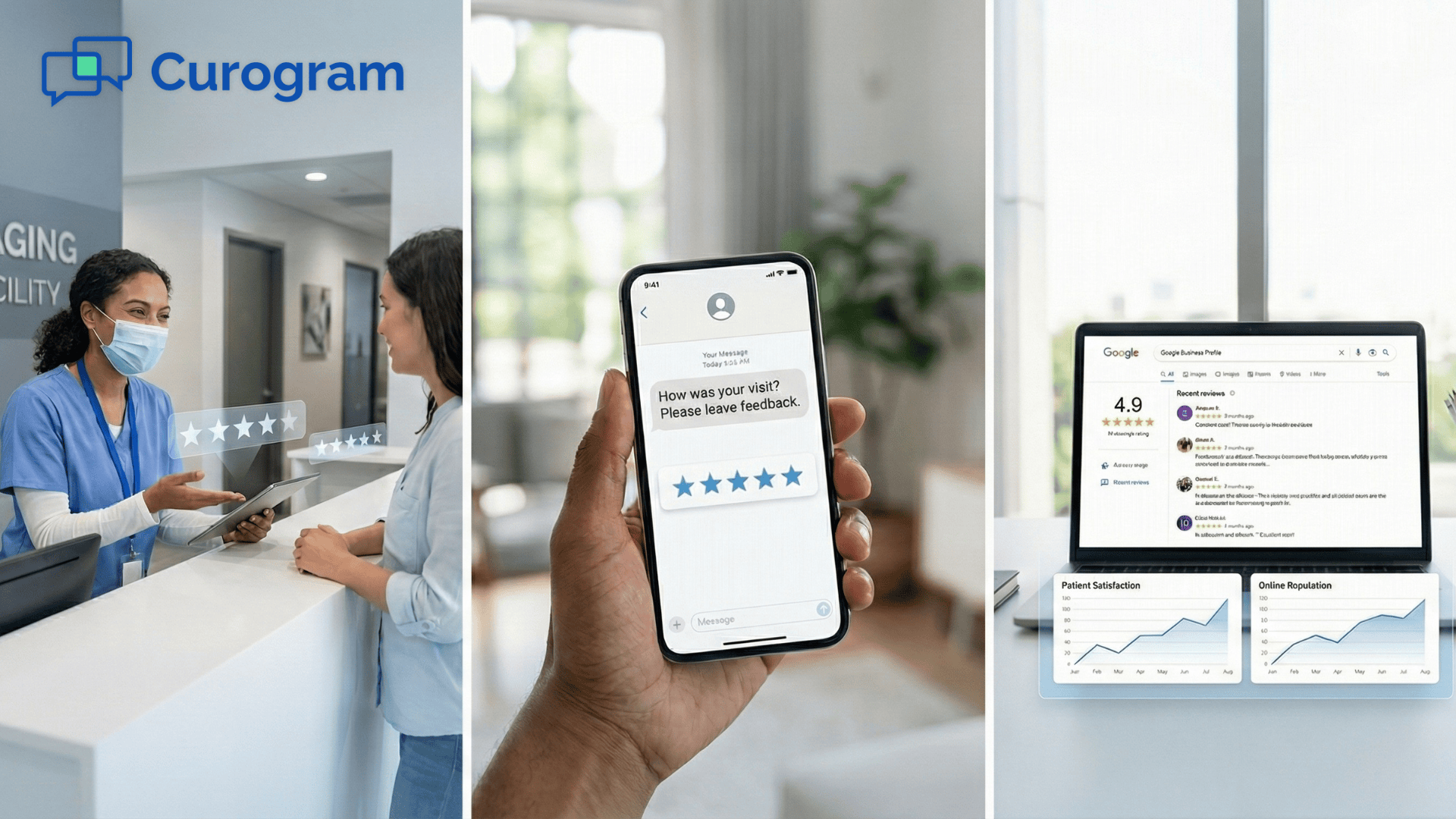
Front desk staff greeting patient at modern imaging center reception with friendly service

Revenue Impact for Radiology and Cardiovascular Imaging Centers

Better online visibility leads directly to more scheduled appointments—and more revenue. When you increase Google reviews through Medstreaming, your search rankings improve. Higher rankings mean more people find your center, and more visibility results in more booked procedures.

“Near me” searches are valuable because these patients are ready to book. Google’s map pack shows only three centers, capturing most clicks—about 33% for position one, 20% for position two, and 14% for position three. Centers outside the map pack get far less visibility, so ranking in the top results can drive a major increase in patient volume.

Online reputation also influences physician referrals. Doctors often check reviews before referring patients. Strong ratings and recent feedback build trust, while weak or outdated reviews can shift referrals to competitors. Even a few additional referrals per physician each month can add up to hundreds of high-quality appointments each year.

The equipment utilization impact creates compounding financial benefits:

  • MRI machines running $1-3 million and CT scanners costing $500,000-$2 million must stay busy to justify investment
  • Better online visibility fills more time slots, spreading fixed equipment costs across more procedures
  • A 20% patient volume increase dramatically improves per-procedure profitability without additional capital costs
  • Year one might bring 15% growth, enabling investment in extended hours that supports year two's additional 12% growth

The impact compounds over time. By year three, many centers reach capacity and begin considering expansion—driven largely by steady gains in online reputation. Every empty time slot represents lost revenue that can’t be recovered, making consistent patient acquisition through strong online visibility essential to long-term financial performance.

Cost Savings from Automated Reputation Workflows

Automation doesn't just drive revenue growth. It also cuts costs in ways that might not be immediately obvious but add up significantly over time.

Manual reputation management steadily drains staff time. Identifying patients, sending messages, and tracking responses can easily take 30 minutes a day—about 10 hours a month. Across a five-location network, that’s 50 hours monthly, adding up to roughly $15,000 per year in admin labor just to collect reviews.

Automation eliminates this entire cost category. The system handles everything automatically without requiring any staff time. Those hours get redirected to patient care, appointment scheduling, or other productive activities. The time savings alone often covers the cost of the automation platform, making the improved review volume essentially free.

Complaint management overhead drops as issues are addressed before they become public. Instead of spending time responding to negative Google reviews, teams resolve concerns privately and directly with patients. This approach is faster, more personal, and leads to better outcomes.

Early feedback also reveals patterns sooner. Repeated comments about parking, check-in delays, or paperwork surface quickly when every patient is surveyed. Catching these issues early allows fast fixes before small frustrations affect many patients.

Service recovery becomes more efficient as well. Feedback routes instantly to the right team member, eliminating delays or lost messages. Patient relations staff can follow up within hours, often turning negative experiences into positive ones through timely, empathetic outreach.

Enterprise-Level Benefits for Multi-Location Imaging Networks

Large imaging networks face unique challenges that single-location centers don't encounter. Maintaining brand consistency across multiple locations while allowing for local market differences requires sophisticated systems and careful management.

Reputation management automation creates consistency without feeling rigid. Every location follows the same review workflow, uses standardized (but locally customizable) templates, and benefits from the same timing and follow-up. Patients experience the same level of professionalism across your entire network.

A balanced review presence strengthens your brand. When all locations show strong ratings and recent feedback, your organization looks reliable and well managed. Patients see one cohesive brand instead of disconnected centers with uneven reputations, which builds trust in your name overall.

Market positioning improves across all service areas. Rather than excelling in only a few markets, your network gains strong online visibility everywhere. This makes marketing campaigns more effective because every location can convert the traffic it receives.

Patient loyalty increases with consistent experiences. A positive visit at one location builds confidence in your other centers. Patients are more likely to return to your network as their imaging needs change, without worrying about quality differences.

Retention improves through repeat and recurring visits. Imaging services are often ongoing, from annual screenings to follow-up studies. When patients trust your brand and have good experiences, they return—delivering higher lifetime value without repeated acquisition costs.

Enterprise-level reporting adds even more value. Systematic feedback across locations reveals patterns in communication, wait times, and service quality. These insights help replicate best practices and drive continuous improvement across the entire organization.


Why Curogram Delivers the Highest ROI for Medstreaming Imaging Centers

Most reputation management platforms are built for general businesses. They're designed for restaurants, retailers, and service providers where the customer journey is straightforward and compliance requirements are minimal. Healthcare is different, and imaging centers have unique needs that generic tools can't address properly.

Curogram is built for medical practices, including imaging centers. Its healthcare-first automation recognizes procedure types and adjusts timing—treating quick X-rays differently from longer MRIs to improve patient experience and response rates.

HIPAA compliance is built into the platform, not added later. Patient data stays protected throughout the entire review workflow using secure, healthcare-grade messaging. You never risk privacy violations or costly compliance issues.

The platform scales easily as your network grows. Whether you manage a few locations or dozens, Curogram handles multi-location routing, local messaging, and network-wide reporting without added complexity. You get high-level visibility while still being able to drill down into individual location performance.

Curogram’s impact on review volume sets it apart. Most centers see a 3–5x increase in monthly reviews within the first quarter. As positive feedback grows, star ratings improve and local search visibility rises, helping centers rank higher and attract more patients.

The ROI is driven by both higher revenue and lower costs. Automation removes manual labor, improves equipment utilization by filling schedules, and allows staff to focus on patient care. Many centers see returns exceeding 400% in the first year.

Its Medstreaming integration is deep and reliable. The system knows when visits truly end, which location served the patient, and what procedure was performed. This precision enables automation that works consistently without monitoring or manual intervention.

Conclusion

Your imaging center’s online reputation impacts revenue every day. When patients choose competitors with stronger reviews, real revenue is lost. Locations with weak online visibility consistently underperform, and the longer this goes unaddressed, the larger the gap grows between you and better-positioned competitors.

Automated reputation management is more than collecting reviews. It creates a sustainable system that improves online presence without adding work for busy staff. The right solution integrates with Medstreaming, protects patient data, and delivers measurable results across all locations.

The return comes quickly. Stronger SEO rankings drive more appointment requests. Improved visibility builds physician trust and referrals. Better schedule fill rates increase equipment utilization, while automation reduces staff time spent on manual tasks. These gains compound as your online presence grows.

Getting started is simple. A live demo shows how automated reputation management works with Medstreaming imaging centers. You can see the platform in action, understand the integration, ask questions specific to your network, and estimate ROI based on your patient volume and current visibility.

The demo includes real examples of imaging centers increasing Google reviews, improving patient satisfaction, and boosting revenue. You’ll see how routing works, review implementation timelines, and walk through real workflow scenarios to clearly understand the potential impact.

Ready to see how it works? Book a demo with Curogram today and discover how automated reputation management can transform your imaging center's online visibility and revenue growth.


Frequently Asked Questions

How does automated review collection improve patient satisfaction scores?

Automated systems collect feedback when experiences are fresh in patients' minds, capturing positive moments before they're forgotten. The smart routing identifies unhappy patients early, directing them to your team for private follow-up instead of public reviews. Your staff can address concerns within hours, often resolving issues before they escalate. Many patients appreciate this proactive follow-up, which shows your center genuinely cares about their experience. This approach consistently leads to higher satisfaction scores because problems get resolved quickly rather than lingering as complaints.

Why is review volume more important than just star rating?

Google's algorithm weighs both rating and volume heavily. A 5.0 rating with only 10 reviews ranks lower than a 4.8 rating with 200 reviews because volume signals credibility and ongoing activity. High volume tells both Google and potential patients that many people trust your center. Recent reviews show you're actively serving patients and maintaining quality. Volume also provides statistical confidence—150 positive reviews create trust that 8 reviews simply can't match, regardless of the star rating.

How quickly can imaging centers see ROI from reputation management?

Most centers see measurable improvements within 60-90 days. Review volume increases immediately after implementation. Google recognizes this activity and adjusts rankings within weeks. Patient acquisition through online searches typically increases by 10-15% in the first quarter. The full ROI becomes clear by month six as better rankings, more reviews, and increased patient volume compound together. The exact timeline varies based on starting position and market competition, but the directional pattern holds consistently.

How does multi-location review routing prevent reviews from getting diluted?

Smart routing tracks which specific location served each patient and directs review requests to that exact Google Business Profile. This ensures each center builds its own presence rather than having reviews concentrate randomly. Without proper routing, patients might search your brand name and leave reviews on any location profile they find first, creating uneven distribution. Automated routing eliminates this confusion by matching every review to the correct location automatically, resulting in balanced visibility across your entire network.

Why does integration with imaging software matter for reputation management?

Direct integration eliminates manual work and ensures no patient is missed. The system automatically knows when visits are complete and triggers review requests at optimal times based on actual procedure data. It understands different procedure types and adjusts messaging accordingly. Integration means zero staff involvement, which saves time and prevents the program from breaking down during staff changes or busy periods. The automation only works reliably when it's truly integrated into your existing workflows rather than requiring manual data exports and uploads.


ROI of Reputation Management for GE Centricity Clinics

ROI of Reputation Management for GE Centricity Clinics

💡 Automated reputation management drives revenue growth for GE Centricity clinics through increased review volume and better online visibility.

Read More
Medstreaming Reputation Management: More 5-Star Reviews

Medstreaming Reputation Management: More 5-Star Reviews

💡 Multi-location imaging centers struggle with uneven online reputations. One site has hundreds of reviews while another has barely a dozen, even...

Read More
Reputation Management in Veradigm with Curogram

Reputation Management in Veradigm with Curogram

💡 Imaging centers face unique trust issues. A single bad review can damage referral flow and hurt revenue across multi-site networks.Reputation...

Read More