
1 min read
Reputation Management in Veradigm with Curogram
 Jo Galvez : Jan 5, 2026, 8:00:00 AM
💡 Imaging centers face unique trust issues. A single bad review can damage referral flow and hurt revenue across multi-site networks.Reputation...

Your specialty clinic loses new patients every day. Not because of poor care or outdated equipment. You lose them because potential patients can't find enough reviews about your practice online.
When someone searches for radiology services or specialty care in your area, they look at two things: how many Google reviews you have and what those ratings say. If your practice has 15 reviews while competitors have 150, you become invisible. Even if your clinical outcomes are superior.
This creates a real problem for GE Centricity clinics. Your staff already handles complex scheduling, insurance verification, and patient coordination across multiple locations. Adding manual review requests to their workload simply doesn't happen consistently. A few patients might leave reviews on their own, but not enough to compete.
The solution isn't working harder. It's working smarter with automation that connects directly to your existing EMR system. When you boost Google reviews GE Centricity through automated requests, you build the online visibility that drives new patient bookings.
This guide shows the measurable return on investment from automated reputation management. You'll see how review volume directly impacts revenue, why timing matters for patient feedback, and what enterprise-level clinics gain from standardized review generation across all locations.
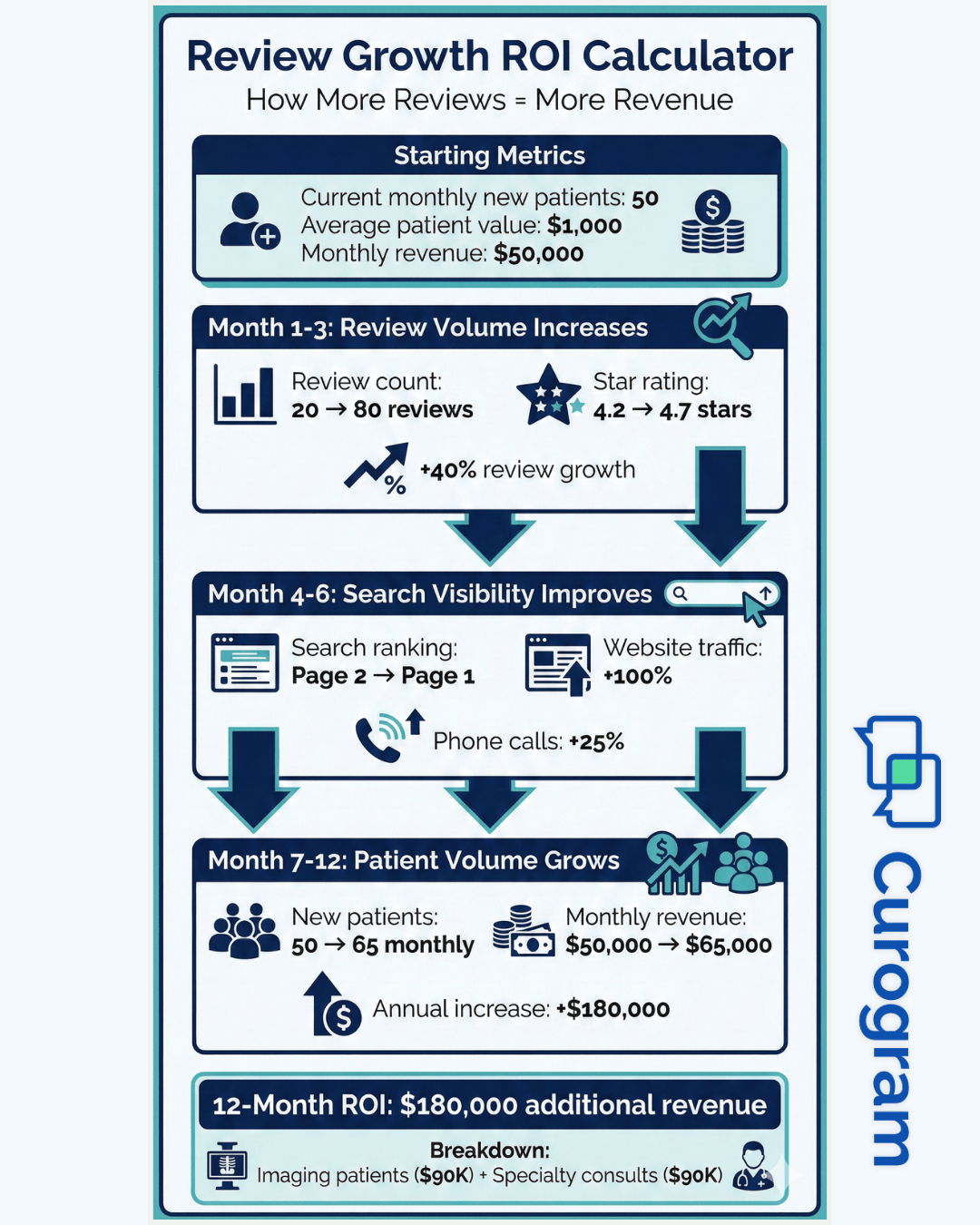
The numbers tell a clear story. Clinics that implement automated reputation management see 40-60% increases in review volume within three months. That growth translates to better search rankings, more website visits, and ultimately more booked appointments. Let's look at exactly how this works.
Patients make healthcare decisions the same way they choose restaurants or hotels. They start with online searches and base their choices on review counts and star ratings. This behavior creates a direct line between your online reputation and your bottom line.
Consider what happens when someone needs imaging services. They type their location plus the service into Google. The results show multiple practices, all offering similar equipment and credentials. What separates one practice from another? The number of reviews and the average rating.
Research shows 84% of patients trust online reviews as much as personal recommendations from friends. They won't call your office if they see only a handful of older reviews. They move to the next option that demonstrates recent, consistent patient satisfaction through dozens or hundreds of current reviews.
Specialty and radiology markets face intense competition. In most metro areas, patients have five to ten choices for advanced imaging or specialty care within a reasonable drive. The deciding factor becomes trust, and online reviews build that trust faster than any other marketing method.
Search visibility determines patient acquisition in modern healthcare. Here's how it works:
The revenue impact goes beyond new patient acquisition. Current patients who see strong online reviews feel validated in their choice of provider. They're more likely to return for follow-up care, refer family members, and try additional services your practice offers. This creates a compound effect where initial reputation growth leads to sustained patient volume increases.
Multi-location clinics face an additional challenge. Each location needs its own strong review presence. A downtown office with great reviews doesn't help your suburban location that potential patients actually want to visit. Building reputation across all sites requires consistent effort that manual processes simply can't maintain.
The cost of poor online visibility adds up quickly. Every potential patient who chooses a competitor represents lost revenue not just from that visit but from all future care they might need. A single MRI patient could become a regular patient requiring multiple imaging services over years. Losing that patient because of weak online presence means losing thousands in lifetime value.
GE Centricity clinics invest heavily in clinical quality, advanced equipment, and skilled staff. That investment only pays off when patients know about it. Online reviews serve as the bridge between your clinical excellence and the patients who need your services. Without that bridge, potential patients simply can't find you in the crowded digital marketplace.
Low review volume creates an invisible barrier between your practice and new patients. You might think a 4.8-star average with 15 reviews looks good. But potential patients comparing you to a competitor with 150 reviews at 4.7 stars will choose the competitor every time.
The math reveals the real impact. Assume your practice needs 50 new patients monthly to maintain growth targets. With weak online presence, your website receives fewer visitors from search results. Of those visitors, fewer convert to calls because the limited reviews don't build enough trust. You might capture only 30 new patients instead of 50.
That 20-patient gap represents significant lost revenue:
If you operate five locations and each one suffers from poor online visibility, you're losing 100 potential patients monthly across your enterprise. Scale that to annual figures and the impact becomes severe: 1,200 lost patient opportunities representing $600,000 to $2.4 million in revenue.
Poor ratings create an even worse problem than low volume. A practice averaging 3.5 stars essentially becomes invisible to most patients. They assume something is wrong with your care quality, even if those ratings came from rare negative experiences that don't represent typical outcomes. Recovering from poor ratings takes months of sustained positive review generation.
The competitive disadvantage extends to referral relationships. Other physicians check online reviews before sending patients to specialists or imaging centers. They want to protect their own reputations by recommending highly-rated providers. Weak online presence means fewer physician referrals, cutting off a major source of new patients.
Marketing spend becomes less effective when online reputation lags behind. You might invest in digital advertising to drive traffic to your website. But those advertising dollars get wasted when visitors see limited reviews and leave without calling. Strong online reviews act as a multiplier for all other marketing efforts.
Staff morale suffers when online reputation doesn't reflect the quality care they provide daily. Team members see competitors with stronger online presence and wonder why their own practice isn't getting recognition. This can lead to questions about leadership and reduced engagement from otherwise excellent clinical and administrative staff.
The opportunity cost extends beyond direct patient revenue. Practices with strong online reputations have easier times recruiting top talent, negotiating better rates with payers, and expanding to new locations. Poor online presence limits growth options even when clinical operations and financial fundamentals are strong.
Picture your front desk at 4:45 PM on a Friday. Three patients wait to check out. Two phone lines are ringing. Someone needs to reschedule next week's appointments. In this chaos, who remembers to ask Mrs. Johnson for a Google review?
Nobody does. That's why manual review requests fail.
Automated systems solve this by connecting directly to your GE Centricity EMR. When a visit completes and gets marked in the system, an automated trigger sends a review request via text message or email. This happens within hours of the appointment, capturing patient sentiment while the positive experience remains fresh.
The timing advantage proves critical. Patients who receive requests the same day respond at rates 3-4 times higher than those who get requests a week later. Think about your own behavior - how often do you remember to leave a review for something that happened last Tuesday?
Manual processes might reach 10-20% of eligible patients on a good week. Your staff has great intentions, but competing priorities always win. Automated systems reach 95% or more, simply because technology doesn't forget or get distracted.
Here's what that looks like in real numbers. A practice seeing 500 patients monthly with manual requests might generate 10-15 reviews. The same practice with automation generates 50-75 reviews. That's the difference between page three and page one in Google search results.
Response rates vary by patient age, but automation helps capture reviews from everyone. Younger patients respond quickly via text. Older patients prefer email links. The system adapts to communication preferences recorded in your EMR, meeting each patient where they're most comfortable.
This matters more than you might think. Manual processes tend to get reviews only from the extremes - your biggest fans and your unhappiest patients. Automated outreach brings in the quiet majority who had good experiences but wouldn't think to leave reviews unprompted.
Month one: you generate 30 new reviews. Month two brings 40 more as the system reaches steady state. By month three, you've added 120 reviews.
Meanwhile, competitors using manual processes added perhaps 10 reviews total. This acceleration creates separation in search rankings that becomes nearly impossible for them to close. You're not just ahead - you're pulling further ahead every month.
Negative review management improves through early detection. When a patient leaves a low rating, your team sees it immediately and can reach out to address concerns before the situation escalates.
Here's what often happens: you call the patient, discover they were frustrated by a simple miscommunication, resolve it in five minutes, and they update their review to five stars. These quick wins protect your overall rating while building stronger patient relationships.
The system scales effortlessly as your practice grows. Opening a new location? It automatically starts generating reviews from day one. Adding providers? They're included immediately. Launching new services? Same seamless integration.
Staff adoption happens instantly because the system requires zero behavior changes. Team members continue their normal checkout processes. The technology handles review generation invisibly in the background, removing any burden from already busy administrative staff.
Integration with your existing EMR system makes automated reputation management feel invisible to your team while delivering maximum results. The connection between GE Centricity and review automation happens behind the scenes, requiring zero manual data entry or workflow disruptions.
Your EMR already tracks every patient visit from check-in through checkout. When a visit status changes to completed in GE Centricity, the reputation management system receives that trigger and sends review requests automatically. This perfect timing captures patient feedback when satisfaction is highest.
The system knows which patients to contact based on visit type and outcome data from your EMR. Patients who completed routine wellness visits receive requests immediately. Those with complex procedures might receive requests after appropriate recovery time. This intelligence ensures requests arrive when patients are most likely to respond positively.
No Manual Staff Effort Required
Your front desk team already handles dozens of tasks during patient checkout. Adding one more responsibility rarely succeeds long-term, even with good intentions. EMR integration removes this burden entirely by automating the entire process from visit completion to review request delivery.
Staff members never need to remember to ask, log into separate systems, or track which patients received requests. The technology handles everything invisibly. This zero-effort approach delivers consistent results month after month without requiring sustained team engagement or periodic retraining.
Scalable Across All Locations and Departments
Multi-location practices face the challenge of maintaining consistent processes across different sites with different staff. EMR integration solves this by creating a single source of truth. When any location completes a visit in GE Centricity, the review system responds identically regardless of geography or staff.
This scalability extends to new departments and service lines. Opening an imaging center at a new location requires no new reputation management setup. The system automatically begins generating reviews for that location as soon as visits start flowing through your EMR. Growth becomes frictionless.
Advanced imaging and specialty procedures generate higher revenue per patient than routine care. These high-value services also face more competition, making online visibility critical. Patients research thoroughly before choosing where to get an MRI or specialty consultation.
Strong review presence positions your radiology department as the obvious choice. When potential patients see 200 positive reviews about your imaging services, they don't comparison shop further. They book with confidence, reducing your cost per acquisition while increasing conversion rates from search traffic.
Search rankings directly impact appointment volume. Moving from page two to page one of Google results can double your website traffic. Moving from position five to position one can triple it. These ranking improvements come primarily from review count and recency.
The revenue impact scales with service complexity. Each new imaging patient might generate $1,500 in immediate revenue. Specialty consultations can lead to ongoing treatment plans worth $10,000 or more. Even small improvements in online visibility produce significant financial returns when dealing with high-value services.
Patients feel anxious about advanced imaging and specialty procedures. Reading reviews from other patients who had positive experiences reduces that anxiety. Detailed reviews about specific procedures help potential patients understand what to expect, making them more likely to move forward with recommended care.
This trust factor particularly benefits procedures that patients might otherwise delay or avoid. When reviews emphasize comfortable experiences, professional staff, and clear communication, patients feel more confident scheduling procedures they've been putting off. This increases both initial booking rates and show rates for scheduled appointments.
The return on reputation management investment appears across multiple metrics that directly connect to revenue growth. Understanding these measures helps set realistic expectations and track progress toward enterprise goals.
Here's what clinics typically see within the first 90 days:
New patient conversions increase as review volume grows. These aren't leads that might convert someday but actual appointments scheduled by patients ready to receive care. The traffic comes from patients actively seeking your services, making them much more likely to convert than general website visitors.
Patient loyalty strengthens when current patients see their positive experiences reflected in strong online reviews. They feel part of a community that values and receives quality care. This emotional connection drives retention rates up and reduces the constant churn that plagues practices with weak online presence.
Long-term growth trajectory improves because reputation compounds over time. Each new review makes the next review more likely to drive conversions. As your star count rises and review recency stays current, the gap between you and competitors widens. Eventually you reach market-dominant status where patients default to choosing your practice.
Curogram delivers the specialized integration that GE Centricity practices need for effective reputation management. The platform was built specifically for healthcare communication, not adapted from generic business tools. This healthcare focus ensures HIPAA compliance and EMR compatibility from the ground up.
EMR-aligned automation means Curogram works with your existing workflows rather than requiring new processes. The platform pulls patient data, visit information, and contact preferences directly from GE Centricity. This native integration eliminates manual data entry and reduces implementation complexity.
Enterprise scalability allows multi-location organizations to implement once and benefit everywhere. Curogram handles thousands of daily review requests across dozens of locations without performance degradation. Central dashboards give administrators complete visibility while individual sites maintain local control where appropriate.
HIPAA-compliant workflows protect patient privacy throughout the review process. All communications use secure channels that meet healthcare regulatory requirements. Curogram never asks patients to share protected health information in public reviews, maintaining compliance while generating valuable feedback.
Proven success in multi-location specialty settings provides confidence that the platform handles complex healthcare environments. Curogram works with radiology groups, specialty clinics, and integrated delivery networks that face the same challenges you do. This track record means fewer implementation surprises and faster time to results.
Your GE Centricity clinic needs more reviews to compete effectively. Every day without automated reputation management means lost patients who choose competitors with stronger online presence.
The ROI from review automation appears quickly. Most practices see measurable increases in new patient volume within 60-90 days. The investment required is minimal compared to traditional marketing, and the results compound over time as your review base grows.
Book a demo to see exactly how Curogram integrates with GE Centricity to boost Google reviews GE Centricity practices need for growth. You'll see the platform in action, understand implementation timelines, and get specific projections for your patient volume and location count.
The best time to start building your online reputation was a year ago. The second best time is today. Book your demo and start capturing the reviews that will drive your next year of patient growth.
1 min read
Jo Galvez : Jan 5, 2026, 8:00:00 AM
💡 Imaging centers face unique trust issues. A single bad review can damage referral flow and hurt revenue across multi-site networks.Reputation...

1 min read
 Aubreigh Lee Daculug : Jan 8, 2026, 10:00:00 AM
💡 Clinics using GE Centricity face a tough challenge with reputation management in GE Centricity. Getting patients to leave reviews takes time and...
1 min read
Aubreigh Lee Daculug : Jan 5, 2026, 6:00:00 PM
💡 Specialty clinics using GE Centricity face unique challenges in building their online reputation. Getting patient reviews takes time and staff...