8 min read
Why Patients Prefer Text-Link Telehealth | Meditab IMS Practices
Aubreigh Lee Daculug
:
May 21, 2026
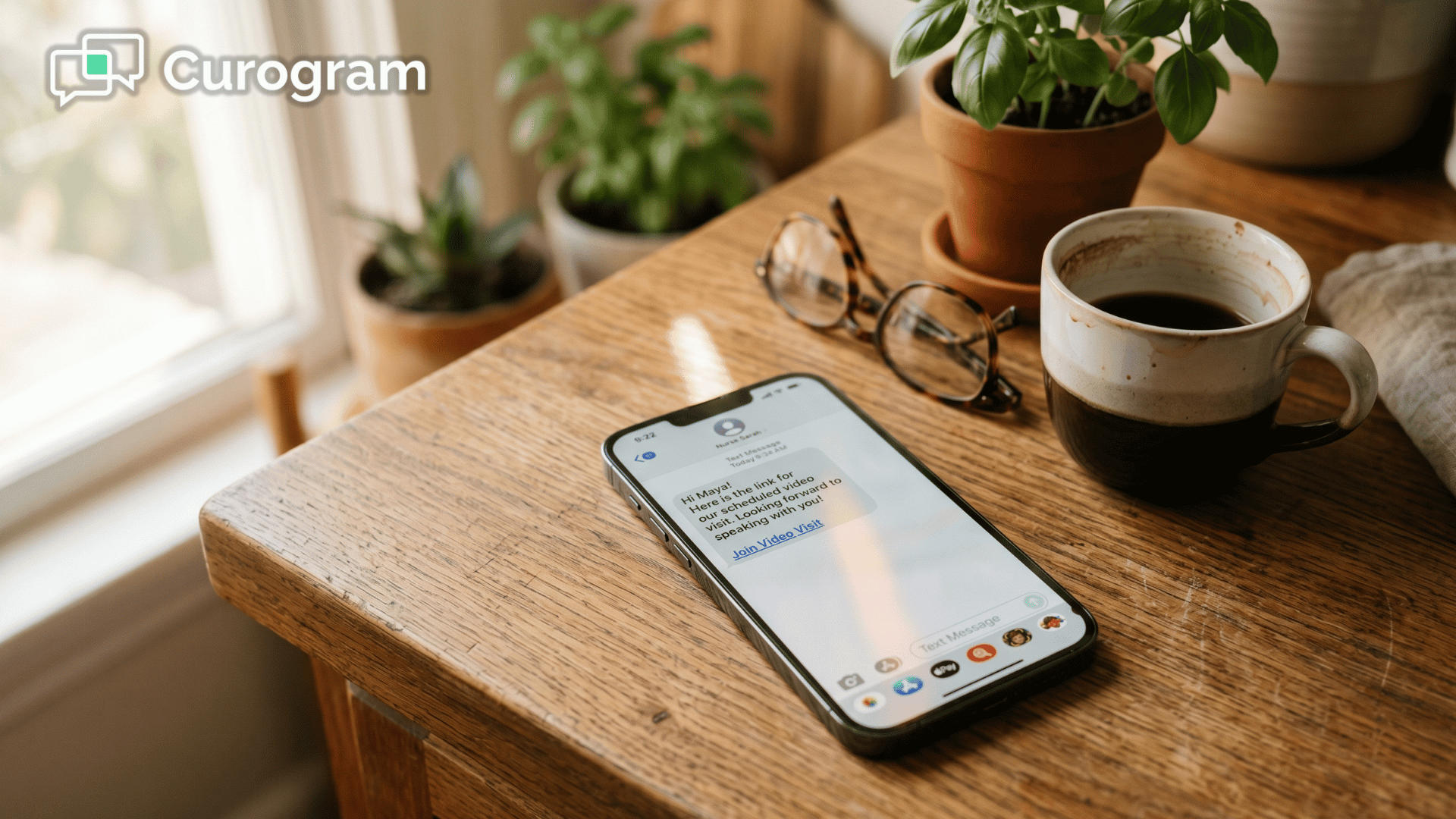
No download. No password reset. No permissions screen. Just a text, a tap, and a doctor on screen in about 10 seconds.
App-based telemedicine through IMS Care asks patients to remember a tool they use once every few months. Most won't. They'll cancel, no-show, or call the front desk in a panic.
Curogram replaces that overhead with the simplest interface patients already use every day — their text messages.
A patient books a video visit. She's ready. She wants the convenience. She's done everything you asked her to do.
Then her appointment time arrives and the wheels fall off.
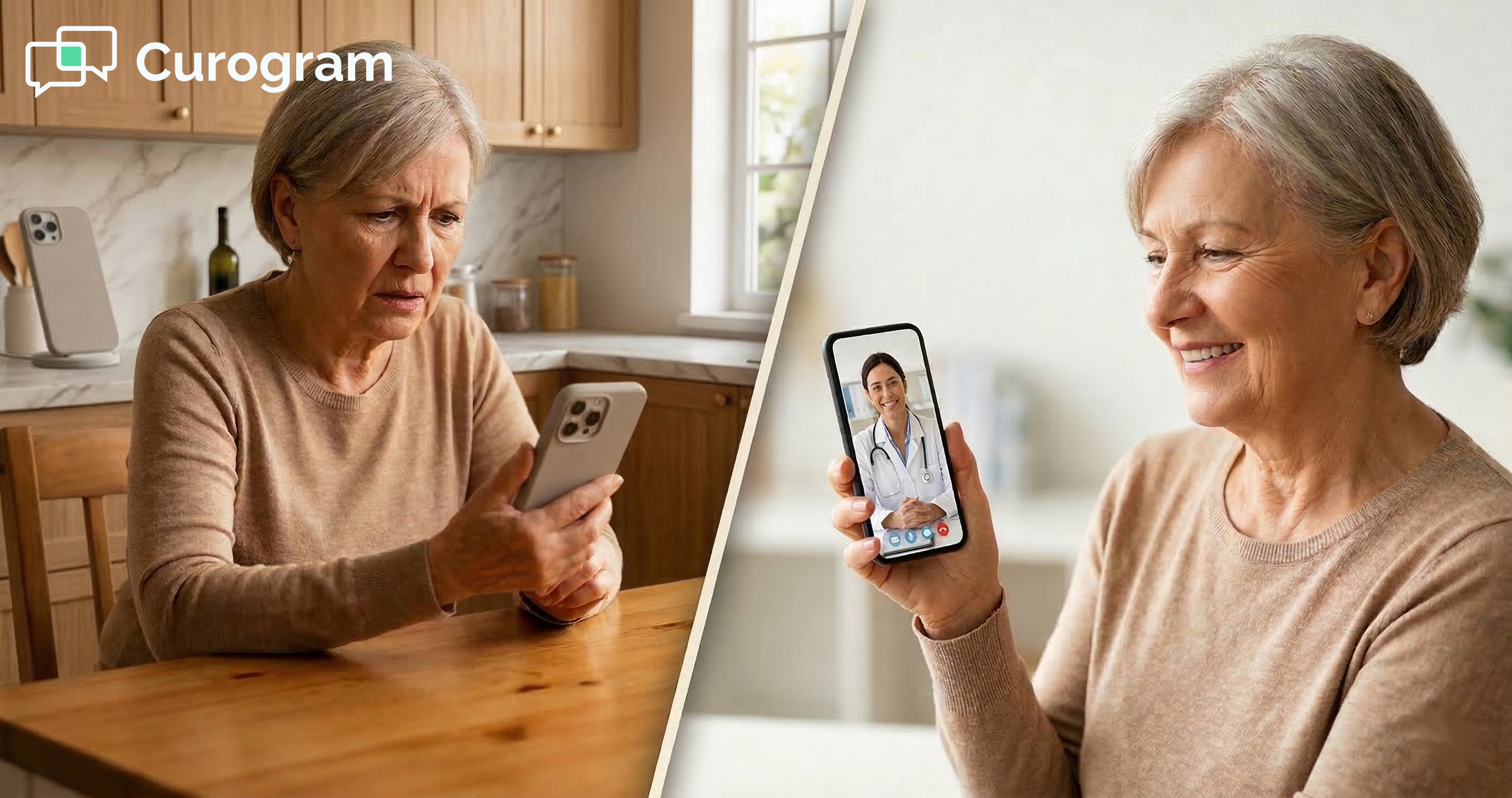
She can't find the telehealth app she downloaded last spring. She deletes apps she doesn't recognize. The reset email lands four minutes later. By the time she clicks "Allow camera," she's already six minutes late and apologizing to your provider.
This is the part of telehealth nobody promised when "virtual care" became a selling point. The visit itself is rarely the problem. The runway leading up to it is.
For practices on Meditab IMS, the pattern repeats every day across primary care, dermatology, gastroenterology, pain management, and multi-specialty clinics. Patients want the appointment.
They just can't get through the front door without help.
And every minute they spend troubleshooting is a minute your staff spends on the phone instead of caring for the next patient. That's the real cost of app-based telehealth — not the technology itself, but the human friction wrapped around it. The cancellation that wasn't really a cancellation.
The 78-year-old who quietly stops booking video visits altogether. The dermatology slot that goes empty because the patient gave up at 2:08 PM.
You don't have a telehealth adoption problem. You have a download problem.
And there's a much simpler way for your patients to join a visit — one that requires nothing they don't already have. It starts with the text message they already know how to open.
Why "The App Nobody Asked For" Quietly Wrecks Your Telehealth Numbers
App fatigue is a real number, and it's working against you
The average smartphone user has roughly 40 apps installed but actively uses only 9 or 10. Every other app sits in a folder, forgotten, taking up storage and mental space.
Now ask where a telehealth app fits on that list. A patient uses it once every three to six months — sometimes once a year. That kind of usage doesn't earn a permanent spot on the home screen.
It gets deleted within weeks of the visit and re-downloaded the next time. Each re-download means a new login, a new permission prompt, a new chance to give up.
This is at the heart of patient telehealth preferences text vs app medical practice teams keep running into. Patients aren't refusing virtual care. They're refusing the tax they have to pay to access it.
The 18-minute pre-visit spiral
Run the math on what really happens before an app-based visit. The patient spends 1 to 2 minutes hunting for an app she deleted three months ago.
Another 2 to 3 minutes re-downloading it while her Wi-Fi crawls and her storage warns her she's almost full. About a minute trying her old password before giving up. Then 4 to 5 minutes waiting for the password reset email to land.
Now she's finally inside. She spends another minute granting camera and microphone permissions. Then 2 to 3 minutes trying to find the actual visit room inside an interface she's never used before.
Eleven to fifteen minutes of setup. For a visit scheduled to last ten.
For your team, this means roughly 6 to 8 minutes of help-desk calls per video visit. Multiply that across 30 telehealth visits a week. That's three to four hours of front-desk time spent on tech support instead of patient care.
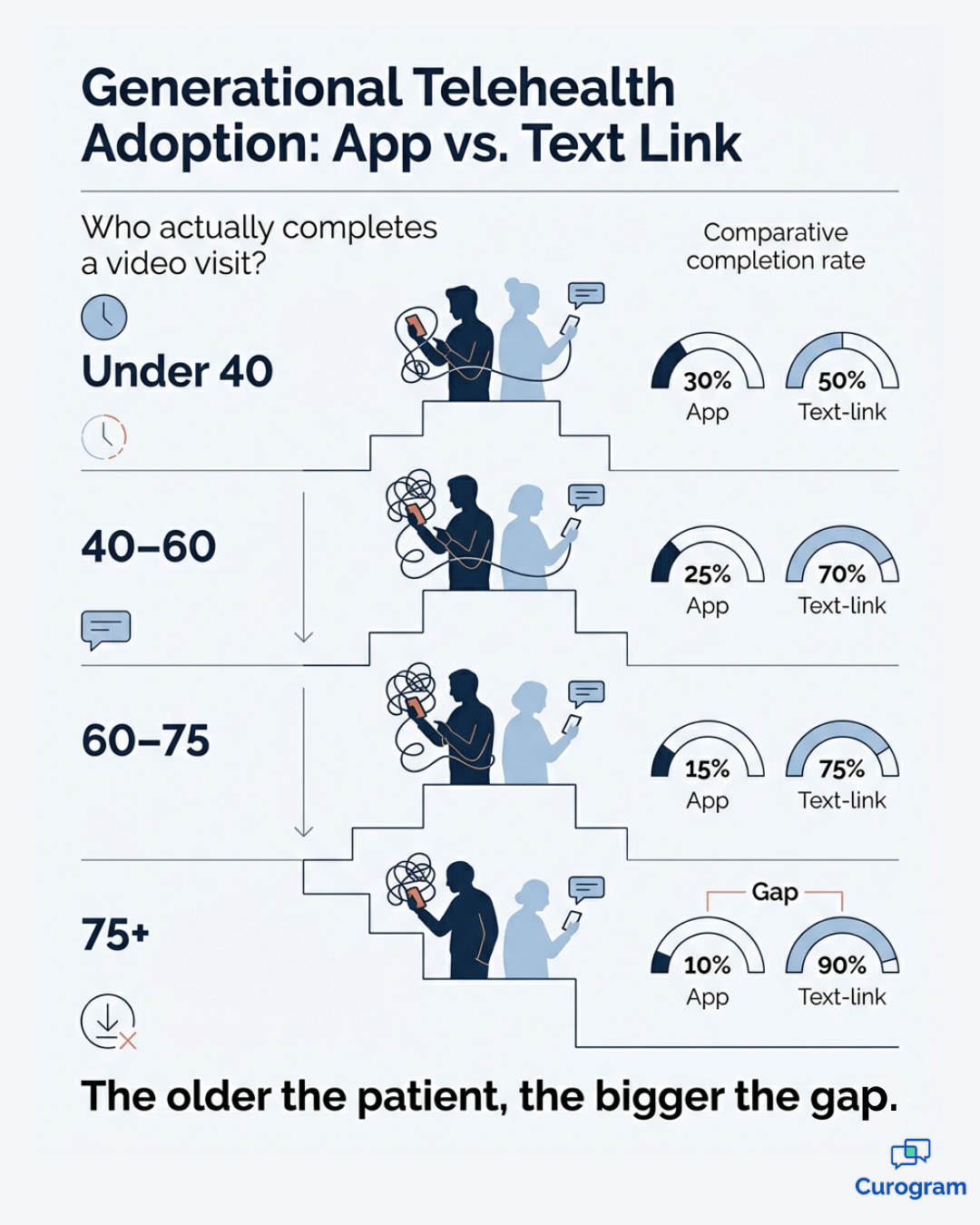
Why older patients give up first
Older patients carry the heaviest load here. They're a significant slice of the population your practice serves — especially in pain management, chronic care, and primary care.
Many of them video chat with their grandkids weekly through FaceTime or WhatsApp. They are absolutely capable of a video visit.
What stops them is the app store.
When older patients hesitate before installing a new app, it's almost always one of a few specific worries:
- "Is this going to give my phone a virus?"
- "Will it charge me something?"
- "Did I just give the wrong app permission to my camera?"
These aren't irrational concerns. They're the result of years of being told to be careful online — and a telehealth visit is not a strong enough reason to override that caution. An easy video visit elderly patients Meditab IMS practices need looks nothing like a standalone app.
It looks like a text from their doctor's office. And that's a distinction that changes everything.
14% → 31%Share of telehealth visits completed by elderly patients |
| When practices switch from app-based to text-link visits, elderly patient participation more than doubles — from 14% of total telehealth volume to 31%. The patients who needed virtual care the most finally have a path to use it. |
The accessibility paradox
Telehealth was supposed to expand access. That was the whole point. Reach patients who can't drive. Reach patients who can't take time off work. Reach patients in rural counties without nearby specialists.
App-dependent telemedicine quietly undermines that promise. The patients who most need virtual care — elderly, disabled, lower-tech-literacy, rural — reflect the broader challenge of virtual care accessibility.
The technology meant to remove barriers ends up rebuilding them in a different shape.
This is why telehealth adoption barriers patients Meditab clinics report tend to cluster around the same population: not the unwilling, but the unable to navigate the setup.

The Telehealth Experience Patients Actually Expect in 2026
Receive a message. Tap a link. Done.
Here's the entire workflow your patient experiences with Curogram.
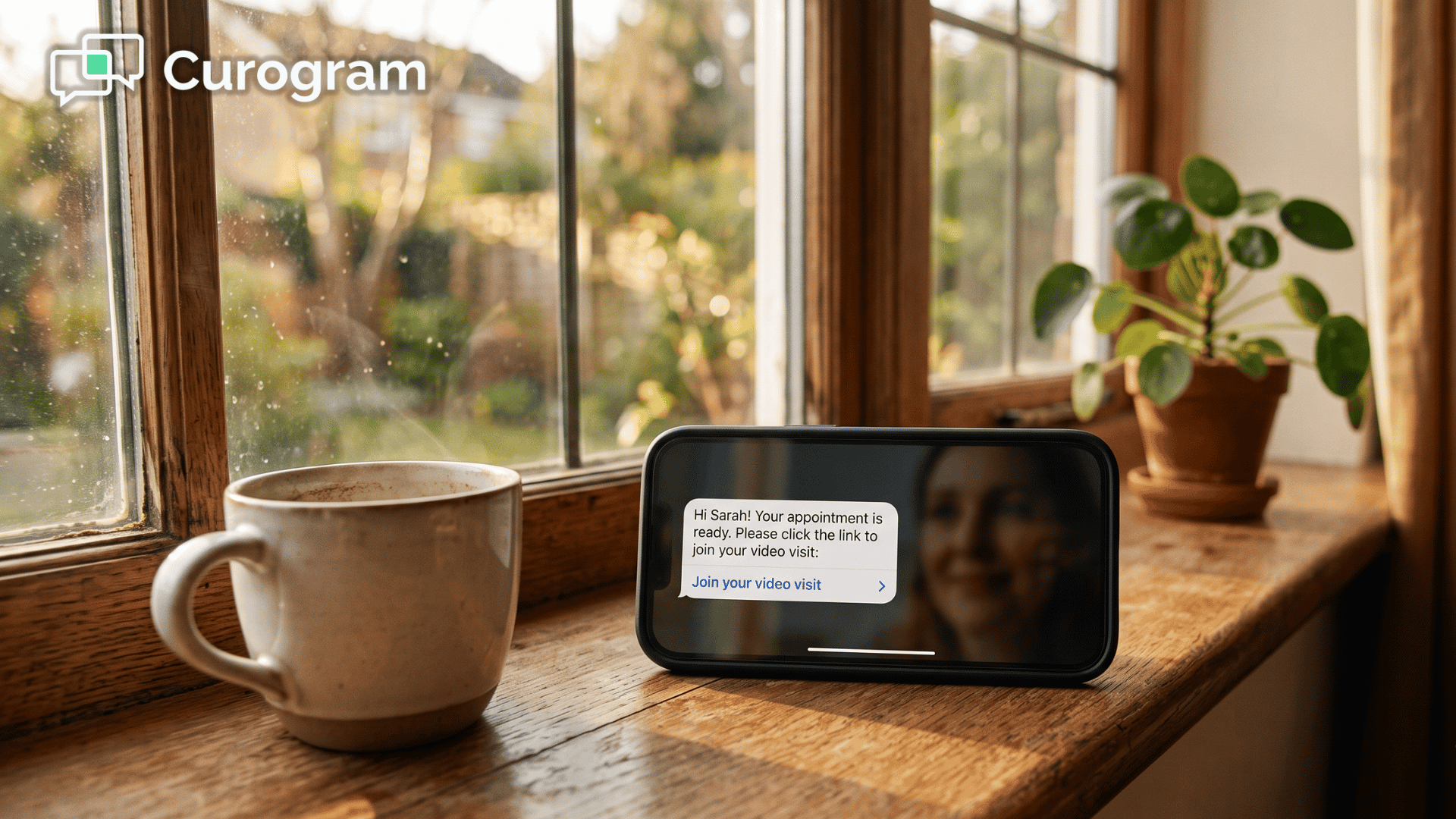
A text arrives. It contains a link. They tap it. Their browser opens, the camera turns on, and they see their provider's face.
Total time: about 10 seconds.
There is no app to find. No password to remember. No "allow notifications" prompt halfway through. The visit opens inside the same browser they use daily, aligning with familiar mobile technology habits. It's the most familiar surface on their phone.
That's the foundation of every text message video visit patient experience Meditab IMS practices want to deliver — predictable, fast, and built on tools the patient already trusts.
Universal browser compatibility means no device left behind
Curogram's video visits run in every major mobile browser without any app store dependency:
- Safari on iOS
- Chrome on Android
- Firefox, Edge, and other modern mobile browsers
There's no operating system requirement and no minimum device specification beyond a working camera and a stable connection. That three-year-old iPhone in the patient's purse works. The tablet the patient inherited from her daughter works.
Even the cheap backup Android the caregiver uses works. The download wall doesn't exist because there's nothing to download.
One thread, one workflow, zero context switching
The visit link arrives in the same text conversation where your patient received their appointment reminder, completed their intake forms, and got their pre-visit instructions.
They don't switch apps. They don't open a portal. The visit happens inside the messaging interface they use more than any other tool on their phone.
This continuity matters. Every time you ask a patient to leave one app and open another, you introduce a moment where they can lose the thread, get distracted, or give up.

What this looks like in real patient lives
A 72-year-old pain management patient who hasn't driven in two years. Her son shows her the link once. She taps it. She sees her doctor. She's done in 12 minutes flat.
A working parent with a 15-minute lunch break and a dermatology follow-up. She taps the link from her car. She's back at her desk before the next meeting.
A post-surgical patient five days out from a procedure. He props his phone on the couch, taps the link, and shows his provider the incision site without leaving the house.
This is patient-friendly telemedicine Meditab IMS text link delivery makes possible. Same clinical visit. Radically simpler experience.
The Patients Didn't Change. The Technology Did.
What practices see when they switch
Practices that move from app-based to text-link telemedicine report telehealth adoption rates jumping 40–60% within the first 90 days.
That's not because the patient base suddenly got more tech-savvy. It's because the barrier dropped to roughly zero.
A few things shift quickly once the download wall comes down:
- Tech support calls related to video visits fall to near zero.
- Front-desk staff stop walking patients through password resets.
- Providers stop sitting in empty visit rooms waiting on someone stuck in the app store.
The schedule looks the same on paper. The day feels completely different.
58% → 91%Telehealth visit completion rate |
| The same patient base. The same providers. The same schedule. Switching the join experience alone moves completion rates from 58% to 91% in the first 90 days — a 33-point jump that comes entirely from removing friction. |
For your team, that's a meaningful jump in telehealth revenue from the same calendar slots you're already offering.
The Point is that Patients Shouldn't Notice the Technology
The best video visit is one where the patient doesn't remember the technology at all. They remember the conversation with their doctor. They remember the answer to their question. They don't remember which app they used or where they tapped.
When telehealth runs on a text link, the technology becomes invisible. The visit is the experience, not the 15 minutes of setup before it.
One clinic, 90 days, one number
A pain management clinic with patients aged 45 to 80 swapped IMS Care telemedicine for Curogram text-link visits. In three months, completed telehealth visits rose 55%. Front-desk tech support calls fell to zero.
A 78-year-old patient who had refused three previous telehealth offers finished her first video visit in under a minute from the moment the text arrived.
What she told the front desk afterward was the part worth quoting: "That was easier than calling."
That's the bar. And it's a bar app-based telemedicine almost never clears.
Stop Asking Patients to Download One More Thing
App-based telemedicine isn't a technology problem. It's a friction problem.
Every barrier you put between a patient and their provider — every download, every password, every permission prompt — is a chance for them to walk away. And the patients most likely to walk away are the ones who need virtual care the most.
This is why patients skip app-based telehealth Meditab practices keep building around. The clinical work is fine. The platform underneath it is the bottleneck.
Text-link video visits flip the equation. They take the most familiar tool on a patient's phone — text messaging — and let the visit live inside it. Nothing to install.
Nothing to remember. Nothing new to learn. The clinical interaction stays exactly the same. The patient experience changes completely.
For Meditab IMS practices, that shift is the difference between a telehealth program patients use once and forget, and a telehealth program patients actually come back to.
The difference between a 58% completion rate and a 91% one. The difference between an empty visit room and a patient who joined in 10 seconds and is already telling her family how easy it was.
Your patients aren't avoiding telehealth. They're avoiding the setup.
Schedule a Demo with Curogram and experience the text-link video visit the way your patients will — a single message, a single tap, a doctor on screen.
Frequently Asked Questions
They tap the same text link again and rejoin instantly. Because the visit lives in the browser, there's no app to relaunch or session to restore. Reconnection takes about 5 seconds. In an app-based platform, the patient often has to log back in and navigate to the visit room again — which is exactly when they give up.
Yes. Modern mobile browsers support high-quality video and audio through WebRTC, the same standard used by Google Meet and most other browser-based video tools. Curogram's video adjusts to each patient's available bandwidth and maintains the best possible quality for their connection. In practice, most patients can't tell the difference between a browser-based visit and an app-based one.
Yes. Patients can share photos, documents, and images directly through the Curogram text thread before or during the visit. For dermatology patients sending skin photos or post-surgical patients showing wound healing, the two-way texting channel works as a visual companion to the video. It's often easier than fighting with an app's upload interface.
No. The whole point of a text-link visit is that nothing is required beyond the link itself. The patient doesn't need a portal account, an app login, or stored credentials. If they can receive a text and tap, they can join.
Yes. The visit runs over end-to-end encrypted connections and is HIPAA-compliant. Each visit link is unique and time-limited, so it can't be reused or forwarded after the appointment. Security doesn't require a complicated interface — it requires the right architecture underneath, which Curogram has built in by default.