
Office Closures & Prime Clinical | Notify Patients Instantly
 Jo Galvez : Feb 13, 2026, 8:00:00 AM
Stop the phone tree panic. Learn how to use Curogram to broadcast office closure alerts to Prime Clinical patients in under 2 minutes.
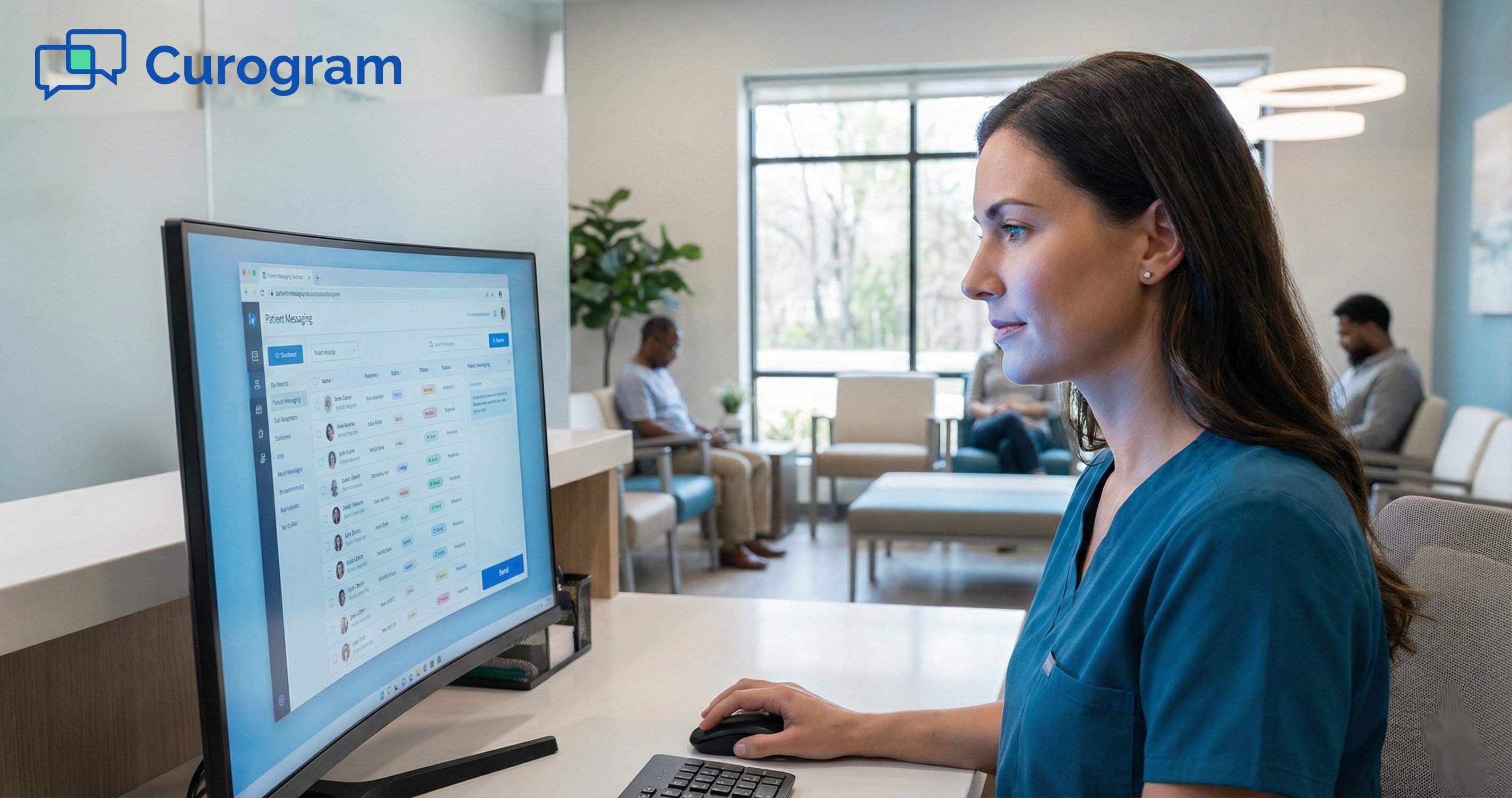
It’s 6 AM on a Monday. The day has barely started, but there’s already a crisis. A pipe bursts in your office ceiling. Water pools on the floor, and you have 47 patients on the books today.
Someone has to call each one. Your front desk staff scrambles to pull up lists, dial numbers, and leave voicemails that may never get heard.
By the time you reach patient number 20, three hours have passed. And half your team hasn’t even clocked in yet.
Now imagine a different scene. You open your laptop, filter today’s schedule in Lytec, type a quick message, and hit send. Every patient gets a text within five minutes. Crisis handled before breakfast.
That’s the power of mass patient messaging for Lytec practice workflows. It turns your biggest headaches into simple, fast tasks. Whether you need to cancel a full day due to a crisis or fill empty slots next week, bulk texting puts you in control.
But there’s a bigger story here. Most Lytec practices sit on a goldmine they never touch. Thousands of patients who haven’t walked through the door in over a year still live in that database. They’re not gone. They just haven’t been asked to come back.
Reactivating dormant patients through a simple text campaign has shown real results. One practice brought in over $20,000 in booked visits from a single recall blast. That’s revenue hiding in plain sight inside your own system.
This article walks you through how to use Curogram’s SMS broadcast for medical office needs with Lytec. You’ll learn how to filter your data, draft the right message, and turn a static patient list into a tool for growth.
No more phone trees. No more guesswork. Just fast, focused outreach that fills your schedule and keeps patients in the loop.
Every practice has faced these two problems at some point. The first is a crisis that demands fast action. The second is a slow leak of lost revenue that no one has time to fix.
Both share the same root cause: relying on one-by-one phone calls in a world that moves much faster.
When a storm rolls in or the power goes out, the clock starts ticking. Your team has to reach every patient on the day’s schedule before they show up to locked doors. The pressure is instant, and the stakes are high.
Most offices handle this the old way. Someone prints the day’s list, grabs a phone, and starts dialing. Voicemails pile up fast. Some patients don’t pick up at all.
Others show up anyway because they never got the word. The whole process eats up three to four hours on a good day. Meanwhile, your staff is stressed and stretched thin.
Patients arriving just to see a dark building feel confused and let down. Your reviews take a hit. Your team’s morale dips. The whole thing could have been avoided with one group text sent in minutes.
Every missed call is a missed chance to save that patient’s trust.
When someone drives across town to find a closed office, the damage goes beyond one bad day. Some patients will look for a new provider right then and there.
An emergency office closure text could have solved this in under five minutes. Instead, the damage adds up—lost time, lost patients, and lost goodwill that takes months to rebuild. Speed isn’t a luxury in these moments. It’s a must.
While crises are loud and sudden, the bigger problem is silent. It grows slowly inside your Lytec database, month after month, with no alarms and no alerts. And it costs you far more in the long run.
Most practices have thousands of patients who haven’t been seen in 12 months or more. These aren’t strangers. They came in, got care, and simply drifted away over time.
Maybe they forgot to book a follow-up. Maybe life got busy. Maybe they moved and came back, but never called. Whatever the reason, they still need care and your practice still needs their visits on the books.
This dormant database is the silent revenue leak that most practice managers overlook. It’s not a problem that screams for help. It just quietly shrinks your growth, week after week.
The math tells the whole story. If your staff can make 10 calls per hour and you have 1,200 overdue patients, that’s 120 hours of phone work. No front desk team has time for that kind of project.
So those patients sit untouched. A Lytec patient recall system powered by bulk texting changes that math for good. It reaches all 1,200 patients in a single action—no extra hires, no overtime, no burnout.
The phone tree and the dormant database are two sides of the same coin. One creates stress in the short term. The other drains revenue in the long term.
Both exist because manual outreach doesn’t scale. You can’t grow a modern practice on one phone call at a time.
Curogram bridges the gap between your Lytec data and your patients’ phones. It reads the fields already stored in your system and turns them into smart filters for outreach.
The result is a simple three-step process that any team member can run: filter, draft, send.
Curogram connects to Lytec and pulls key data fields in real time. This means you don’t have to export files or build lists by hand. Your patient data is ready to use the moment you need it, with no extra steps.
You can sort patients by last visit date, procedure code, provider name, or insurance type. Need to reach everyone who’s overdue for a cleaning? Filter by “Last Visit > 12 Months” and your list builds itself in seconds.
Want to alert only Dr. Smith’s patients that she’s out sick today? Filter by provider and today’s date.
Using bulk SMS for Lytec is as easy as sorting a column in a spreadsheet, except the next step is a text, not a stack of phone calls.
You can also filter by procedure code for specific recall types. If it’s flu season, pull everyone due for a shot.
If you offer dental cleanings every six months, target that group alone. The filters match whatever your practice needs at that moment.
Some tools force you to export a file, upload it, match columns, and hope nothing breaks along the way. Curogram skips all of that. The data syncs straight from Lytec, so your lists are always current and clean.
This matters most when you’re in a rush. Sending an emergency office closure text at 6 AM leaves no time to wrangle a spreadsheet. With live syncing, your data is ready the second you open the dashboard. No delay, no room for error.
Once your list is filtered, sending the message takes almost no effort. There are no complex steps, no drawn-out approval chains, and no IT tickets. You type, you review, you send.
Even though you’re sending one message to hundreds of people, each patient sees their own name. Curogram uses dynamic tags like [First Name] to make every text feel like it was written just for them.
Instead of a bland group blast, the patient gets something like: “Hi Sarah, it’s been a while since your last visit. We’d love to see you. Call us or reply to this text to book an appointment.”
That doesn’t feel like marketing. It feels like someone at your office reached out because they care.
You can also tailor the message by campaign type. A recall text sounds different from a snow day alert. Curogram lets you write what fits the moment, not a one-size-fits-all template.
After you send, replies come back as private one-on-one chats inside the Curogram dashboard. There is no group chat risk and no chance of a reply going to the wrong person. Your staff handles each patient on their own, just like a normal text thread.
This is what makes an SMS broadcast for medical office use different from consumer tools. It’s built for how clinics actually work—private, fast, and HIPAA-safe. Every reply stays between your team and that patient.
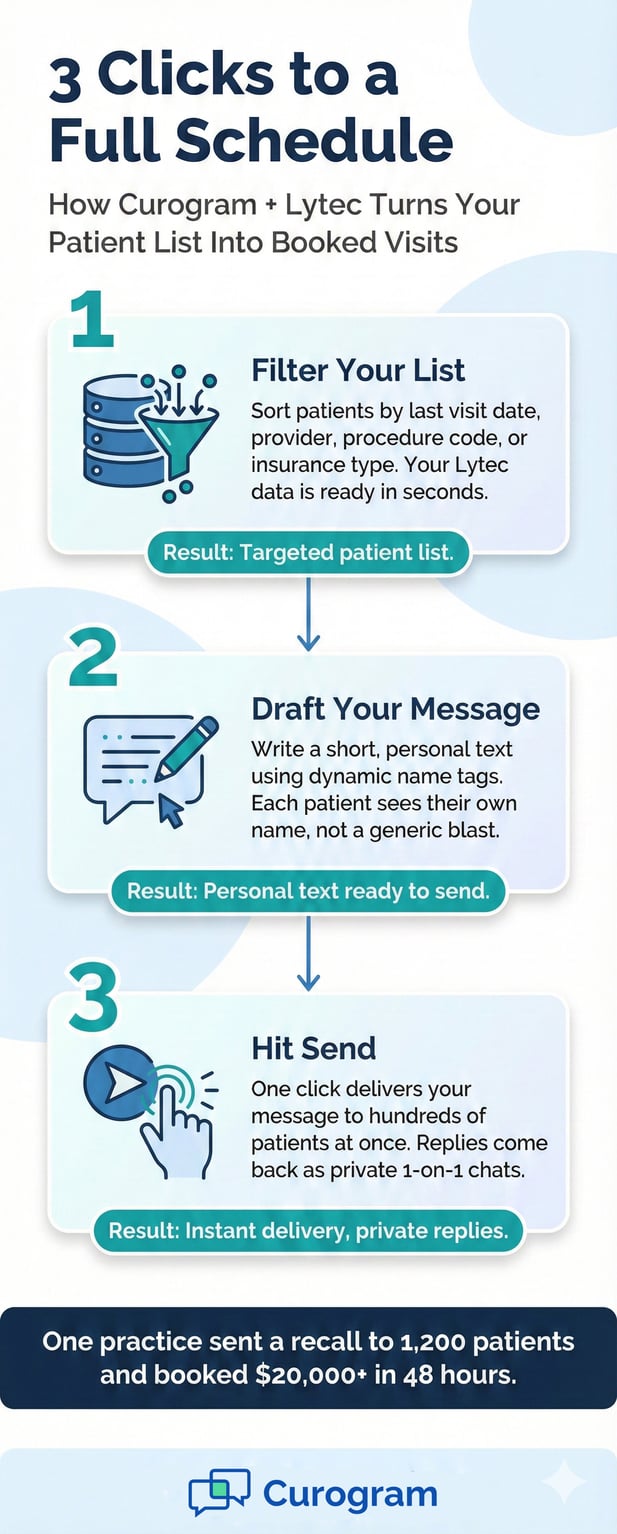
Numbers don’t lie. When practices switch from phone-based outreach to text-based campaigns, the results show up fast.
Speed goes up. Revenue goes up. The effort to make it all happen goes way down. Here’s what that looks like in the real world.
One Lytec practice decided to test mass patient messaging for Lytec practice workflows with a clear goal: bring back patients who hadn’t been seen in over a year. They wanted to see if a single campaign could move the needle on revenue.
The office filtered its Lytec database for every patient whose last visit was older than 12 months. That list came to 1,200 names—real people who had simply fallen off the radar.
The team drafted a short, friendly text: “Hi [First Name], it’s been a while. We have openings this week and would love to see you. Reply to book an appointment or call us at [number].”
They reviewed it once, then hit send. The whole setup took under 10 minutes from start to finish.
No printing. No dialing. No voicemails. Just one message to 1,200 patients in a single click. That’s the kind of reach that used to take weeks of staff time.
Within 48 hours, the practice booked over $20,000 in new visits. Patients who hadn’t been in for a year or more were suddenly back on the schedule. Many replied within minutes of getting the text.
That’s not a theory or a best-case guess. It’s what happens when you stop waiting for patients to come back on their own.
Reactivating dormant patients at this scale is only doable with a tool that plugs into your data and moves as fast as your front desk needs it to.
The return on this one campaign dwarfs the cost of the tool itself. For most practices, a single recall blast more than pays for the year.
Time is the one thing your staff never has enough of. Whether it’s a busy Monday or a crisis, texting fixes the speed gap in ways that phone calls simply can’t match.
When you send a bulk text through Curogram, every patient on the list gets a message within minutes.
Compare that to manual calling, which takes roughly four hours to reach just 50 patients. The gap is massive.
In a crisis, like a weather event or a doctor calling in sick, those four hours could mean dozens of confused patients showing up at your door.
With a Lytec patient recall system built on texting, your team fixes the problem before most patients have even left their homes.
That speed doesn’t just save time. It saves trust. Patients who get a clear, fast update feel taken care of, even when things go wrong.
SMS recall campaigns see a booking rate of around 35%. That’s well above what email or postcards tend to produce. Texts get opened within minutes, and most people respond the same day.
For a practice trying to fill gaps in the schedule or bring back overdue patients, that kind of rate can turn a quiet week into a packed one. It’s the difference between hoping patients call and knowing they will.

Lytec users often have a few questions before getting started with mass texting. Here are the most common ones, along with clear answers.
No. These are your existing patients who have already received care at your practice. Under HIPAA and TCPA rules, you can contact patients about care-related topics without needing special marketing opt-ins.
Recalls, follow-ups, overdue visit notices, and office updates all count as care-related. If the message ties back to the patient’s health or your practice logistics, it falls under allowed use. This includes things like an emergency office closure text or a notice about a missed annual checkup.
If you want to promote a new cosmetic service or a cash-pay special, that may need a separate opt-in from the patient.
Curogram helps you manage consent tracking so your practice stays on the right side of the rules. You always know which patients have opted in and which haven’t.
This is where Curogram stands apart from other tools. Replies do not go to the whole group.
There is no group chat risk at all. Each reply comes back as a private one-on-one thread inside the Curogram dashboard for your team to handle.
When a patient replies, your team handles it just like they would a normal text. They see the patient’s name, visit history, and message all in one clean view. It’s fast, simple, and easy to manage even during a busy day.
Unlike basic group texts or consumer apps, Curogram treats every reply as its own private thread.
Your patients never see each other’s messages or personal details. That protects their privacy and keeps the whole exchange professional.
Yes. If you drop a specific insurance carrier, you can message only those affected patients to let them know.
This saves your staff from having to explain the same change over the phone, one patient at a time.
Say your practice drops a plan mid-year. Instead of waiting for patients to find out at the front desk during their next visit, you send a targeted text ahead of time. They know what changed before they arrive. That’s better for them and far easier on your team.
Beyond insurance type, you can filter by provider, last visit date, procedure code, and more by using online intake forms. The Lytec patient recall system through Curogram gives you full control over exactly who gets each message. You pick the audience. You write the note. The tool handles the rest.

Your patient list is not just a record. It’s the most valuable asset your practice owns. But it only works if you use it. Letting names sit idle in Lytec is like leaving money in a drawer nobody opens.
Every name in your system once walked through your door. They chose your practice. They trusted your team with their care. The fact that they haven’t come back doesn’t mean they don’t need you.
When patient records sit untouched for months or years, your practice loses revenue in silence. No alerts fire. No reminders go out. The patient drifts away, not because they wanted to leave, but because no one reached out.
Mass patient messaging for Lytec practice workflows flips that script. It takes the data you already have and puts it to work—on your schedule, at your pace, with no extra effort from your staff.
Think of it this way: every name in that database is a patient who already said yes to your practice once. Getting them to say yes again is far easier than finding a brand-new patient. The data is there. You just need the right tool to act on it.
A single message can remind a patient that your practice exists and that you care about their health. It doesn’t need to be long or complex. A short note with their name, an open invite, and a way to reply is more than enough.
That’s what Curogram delivers through bulk SMS for Lytec—simple, personal outreach that reopens the door. One text can bring someone back after a year of silence. That’s the kind of return you can’t get from a postcard or an email blast.
Most practices spend their days putting out fires. A no-show? Call the waitlist. A last-minute cancel? Scramble to fill the slot. An office closure? Panic and start dialing. That cycle doesn’t scale, and it wears your team out over time.
With an SMS broadcast for medical office workflows, you set the terms. You decide when to reach out, who to contact, and what to say. There’s no scrambling and no guesswork.
Fill next week’s gaps before they happen. Send a recall to overdue patients on a slow Tuesday. Alert everyone about flu shots at the start of the season. Notify patients about a change in office hours before they show up at the wrong time.
The tool is there and ready to go. Your team just needs to pick the audience, write the message, and click send. That’s the shift from reactive to proactive. It changes everything about how your practice runs day to day.
Stop letting your database collect dust. The patients are there. The tool is there. The only thing missing is that first text.
Schedule a Demo to see how we can filter your Lytec data to find your lost revenue. Your patient list is ready. Your growth engine is waiting. All it needs is the first message.
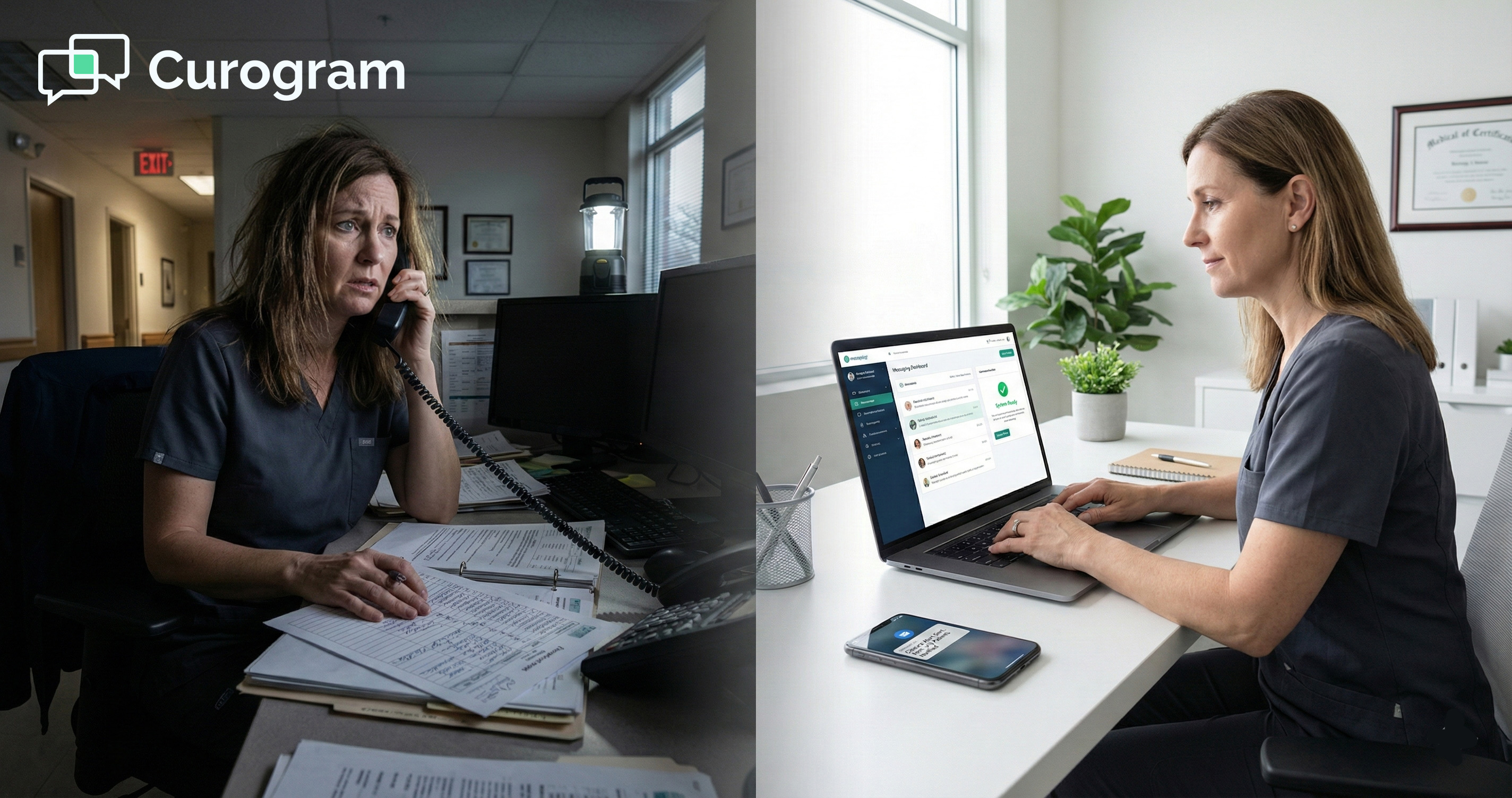 Jo Galvez : Feb 13, 2026, 8:00:00 AM
Stop the phone tree panic. Learn how to use Curogram to broadcast office closure alerts to Prime Clinical patients in under 2 minutes.
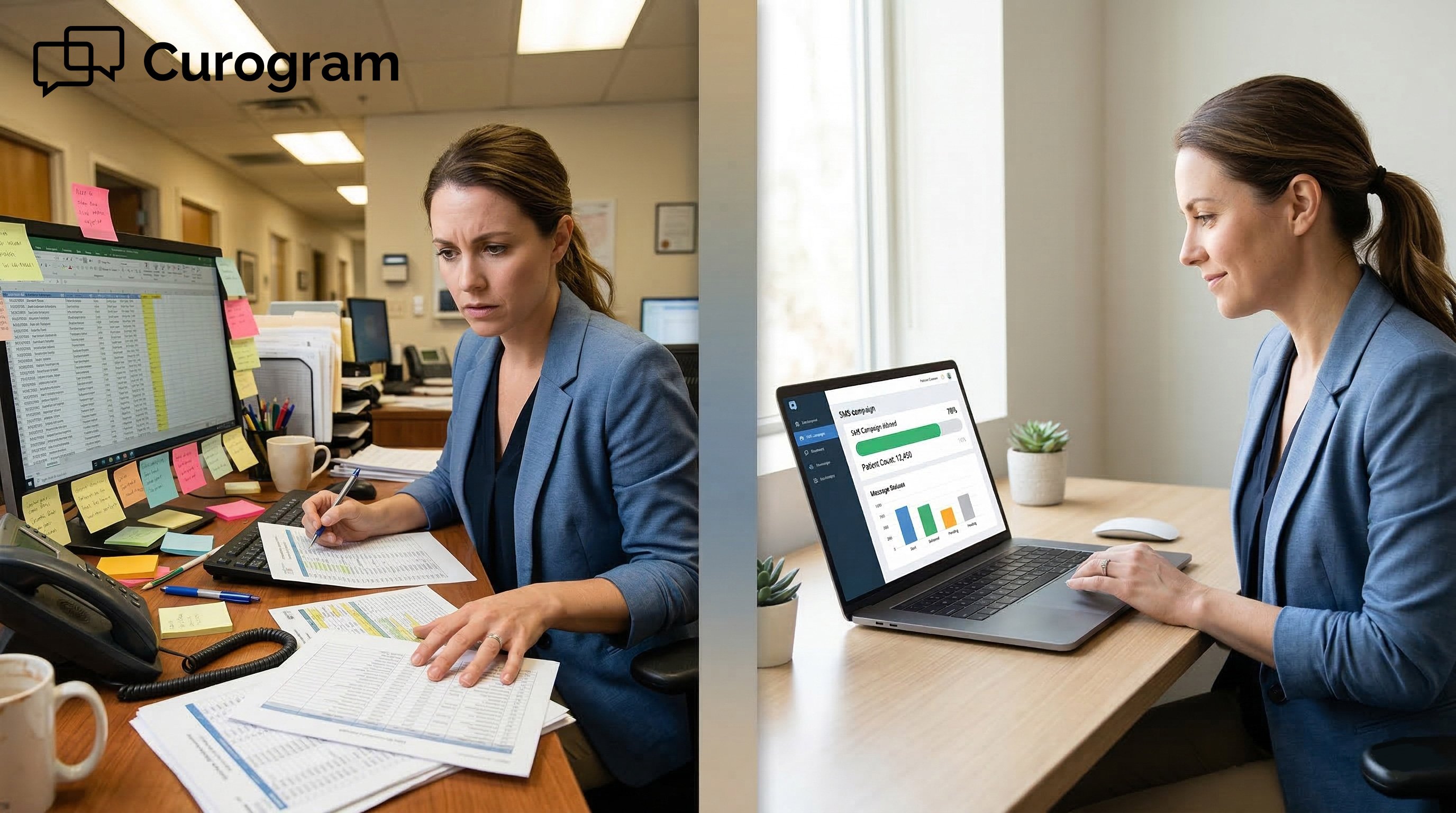 Jo Galvez : Mar 12, 2026, 3:00:00 PM
eCW operations teams automate patient recall with Curogram’s filtered SMS campaigns. Replace spreadsheet exports and phone marathons.
 Jo Galvez : Mar 4, 2026, 11:00:01 AM
Learn how Curogram's urgent mass texting for WebPT clinics notifies patients of closures or cancellations in minutes with a 98% open rate.