
1 min read
Reduce No-Shows & Boost Revenue with Allscripts PM Reminders
💡 Missed appointments are one of the most common revenue leaks in healthcare. Practices using Allscripts PM can reduce no-shows with structured...

Fewer missed exams, protecting daily revenue.
Higher attendance and improved provider utilization.
Patients feeling supported and informed.
Staff spending less time on rescheduling.
Smart reminders improve ROI by streamlining your communications process. Integrating with a HIPAA-compliant platform like Curogram is a simple way to start.
No-shows are one of the most common challenges in radiology. A patient misses an exam. A scanner sits idle. Staff scramble to adjust the schedule. These gaps affect revenue even though the equipment and staff are already in place.
Many patients do not miss appointments on purpose. They forget. They misunderstand the date or time. Some feel unsure about preparation steps. Without reminders, small lapses turn into missed visits.
For imaging centers using Exa, attendance directly affects provider utilization and revenue. When you reduce no-shows Exa radiology teams manage, more procedures are completed each day. This helps protect revenue without adding machines or staff.
Appointment reminders are a simple but powerful tool. Timely messages remind patients of upcoming exams. Clear instructions help them arrive prepared. This reduces last-minute cancellations.
This blog explains the business risks tied to missed appointments. You will learn how Curogram improves ROI using smart reminders that integrate with Exa. The article also covers benefits for executives and operations leaders who manage utilization and performance.
You will then review a real ROI example where reduced no-shows led to measurable revenue gains. Finally, you will see clear next steps for improving attendance and protecting revenue with appointment reminders.
If utilization, efficiency, and patient satisfaction matter to your organization, appointment reminders are no longer optional. They are a practical way to protect revenue and keep operations running smoothly.
Missed appointments create immediate revenue loss. Imaging equipment remains unused during scheduled time slots. These gaps cannot be recovered later.
Idle scanners reduce daily throughput. Even a few missed exams each day add up over time. This limits revenue potential.
No-shows also disrupt scheduling. Staff must fill gaps or move patients. This creates stress and inefficiency.
Patient satisfaction can decline. Long waits caused by rescheduling frustrate patients. Confusion affects trust.
Referring providers may notice access issues. When schedules feel unreliable, referrals may shift elsewhere.
Operational costs rise without reminders. Staff spend time calling patients and rescheduling. This adds labor cost.
For Exa revenue boost goals, no-shows quietly limit growth. Without reminders, utilization remains below potential.
Curogram uses automated reminders to improve attendance. Patients receive timely messages before exams. This reduces forgetfulness.
Clear reminders improve preparation. Patients arrive ready. Last-minute cancellations drop.
When you reduce no-shows Exa radiology teams face, more procedures are completed. This directly increases revenue.
Scheduling efficiency improves. Fewer gaps mean smoother daily operations. Staff time is used more effectively.
Costs tied to rescheduling decrease. Fewer calls are needed. Administrative burden drops.
Smart reminders turn attendance into a measurable ROI driver. They protect revenue without new equipment.
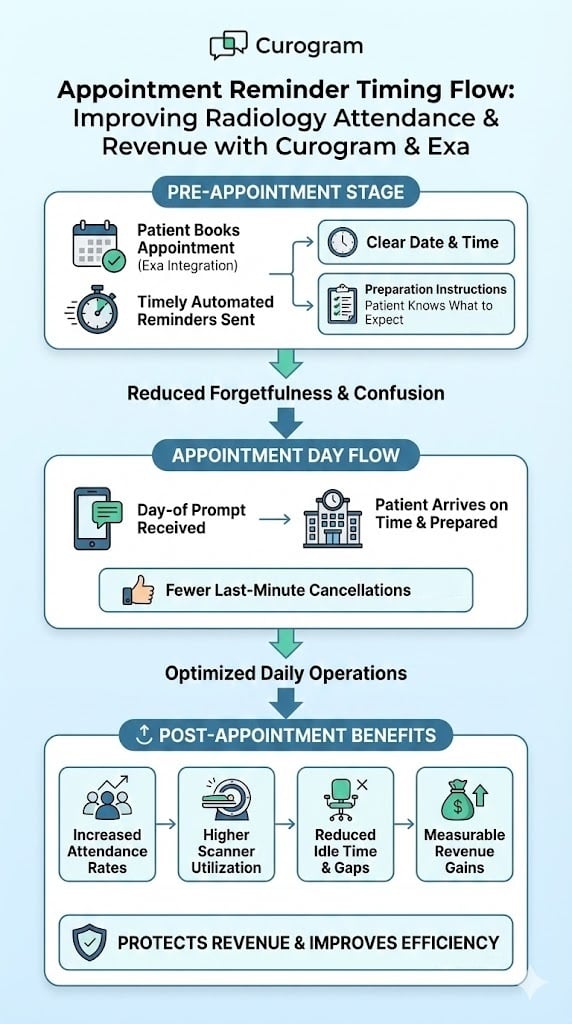
Appointment reminders help keep scanners in use throughout the day. Fewer missed exams mean less idle time. This allows imaging centers to get more value from existing equipment.
When no-shows decrease, more patients complete their scheduled exams. This raises daily exam volume. Higher volume supports stronger financial performance.
Each scanner generates revenue only when it is used. Filling schedules more consistently increases revenue per machine. This improves return on existing assets.
Reminders lower last-minute cancellations. Schedules remain full and predictable. This reduces the need for constant adjustments.
Front desk and clinical staff spend less time rescheduling. Their time shifts to patient support and coordination. This improves overall efficiency.
Automated reminders reduce outbound calls. Staff no longer need to chase confirmations. This lowers workload and interruptions.
Stable attendance creates smoother daily workflows. Teams know what to expect each day. This reduces stress and last-minute changes.
Radiologists spend more time reading studies when schedules stay full. Downtime decreases. Productivity becomes more consistent.
Fewer gaps between exams reduce waiting periods. Providers remain engaged throughout shifts. This supports better use of expertise.
Consistent attendance improves revenue predictability. Leadership can forecast more accurately. Planning becomes more reliable.
Fixed costs are spread across more completed exams. This lowers the cost per procedure. Margins improve as efficiency rises.
Reliable schedules build trust with referring physicians. They feel confident their patients will be seen on time. This supports referral growth.
Clear reminders help patients remember appointments. Attendance rates improve across locations. This strengthens operational performance.
Reminders confirm dates, times, and preparation steps. Patients know what to expect. Confusion is reduced.
Patients are less likely to cancel when reminded early. This protects the schedule. Gaps decrease.
Patients appreciate timely communication. They feel supported and informed. Satisfaction scores improve.
Fewer missed appointments reduce pressure. Staff work in a calmer environment. Morale improves.
Predictable attendance helps leaders schedule staff accurately. Overstaffing and understaffing are reduced. Resources are used wisely.
Attendance data becomes easier to measure. Leaders can track improvement over time. Decisions are data-driven.
When disruptions occur, reminders help stabilize schedules quickly. Recovery is smoother. Operations return to normal faster.
Clear utilization metrics support executive reporting. Leadership gains visibility into performance. This supports strategic planning.
No new equipment is needed to see gains. Existing infrastructure performs better. ROI improves.
Standardized reminders create consistency across sites. Multi-location operations run more smoothly. Oversight improves.
Each attended appointment protects revenue. Missed opportunities decline. Financial leakage is reduced.
Reliable attendance supports long-term planning. Operations become less reactive. Stability improves over time.
An imaging network struggled with missed appointments. Scanner utilization was inconsistent.
After implementing reminders, attendance improved. No-shows dropped by 25%.
The network achieved stronger provider utilization. Schedules stabilized.
Curogram delivers automated appointment reminders designed for radiology workflows. Messages are timely and clear.
Integration with Exa keeps schedules accurate. Staff effort is reduced.
Attendance improves while patient communication remains simple and reliable.
No-shows create revenue gaps that are entirely preventable. Every missed appointment represents lost potential for your imaging center—idle equipment, underutilized staff, and revenue that cannot be recovered. For radiology teams using Exa, the impact compounds quickly across daily schedules and multiple locations.
Appointment reminders powered by Curogram offer a straightforward solution to this challenge. Automated messages keep patients informed and prepared, which directly translates to higher attendance rates and fuller schedules. The ROI is measurable: more completed exams, improved provider utilization, reduced administrative burden, and protected revenue from existing infrastructure.
The benefits extend beyond financial metrics. Your staff experience less stress from last-minute rescheduling. Your patients feel supported with clear communication. Your referring providers gain confidence in your reliable scheduling. These improvements strengthen your operation from every angle.
The question is not whether appointment reminders improve performance—the data is clear. The question is how quickly your organization can capture these gains and turn attendance into a competitive advantage.
Ready to reduce no-shows and boost scanner utilization? Book a demo with Curogram today to see how seamless integration with Exa can transform your radiology operations and protect your revenue.

1 min read
💡 Missed appointments are one of the most common revenue leaks in healthcare. Practices using Allscripts PM can reduce no-shows with structured...

1 min read
 Sharee Narciso : Dec 9, 2025, 2:30:00 PM
💡 Using reminders can reduce no-shows DrChrono clinics face every week. Patients receive helpful prompts that keep visits top-of-mind. Reduce...

1 min read
💡 Missed appointments create serious problems for behavioral health practices. When patients do not show up, provider time is wasted and revenue...