
9 min read

Exa Connect Imaging Recalls | Automated Follow-Up Texts

Exa Connect Imaging Recalls | Automated Follow-Up Texts
💡 Exa Connect finds follow-up imaging recommendations inside radiology reports and creates pending orders in Exa RIS. But finding the recommendation is only half the job. The other half is making sure the patient actually schedules the study.

Curogram's automated messaging platform connects to Exa Connect through Exa's API. When a follow-up order is created, Curogram texts the patient directly. The message explains the recommendation and gives the patient a clear path to schedule.

Based on our internal data, this approach drives a 35% appointment reconversion rate. For a busy imaging center, that translates to $56,000 or more in recovered revenue each quarter, from studies that were already recommended and would otherwise have been lost.

A radiologist finishes reading a chest CT. The report says: "6-month follow-up CT recommended to monitor pulmonary nodule."

Exa Connect picks up the recommendation. A pending order lands in Exa RIS. The system works exactly as designed.

Then nothing happens.

No one calls the patient. The referring physician's office is busy. The patient assumes no news is good news. Six months pass. The follow-up never happens. The nodule grows. The imaging center loses an $800+ study. And the patient loses time they can't get back.

This is not a rare edge case. Follow-up imaging compliance rates range from 30% to 50% for many recommendation types. That means for every 100 follow-up studies a radiologist recommends, 50 to 70 may never get scheduled. For imaging centers running 50 to 80 studies per day, the financial and clinical costs are enormous.

Exa Connect follow-up imaging recall automated text patient scheduling changes this picture. When Curogram connects to Exa Connect through Exa's API, the full workflow becomes automated.

The recommendation is identified, the patient is texted, and the study gets scheduled. No manual calls. No chasing referrals.

Based on our internal research, a multi-location healthcare client achieved a 35% appointment reconversion rate using Curogram recall campaigns. That brought back 1,240 patients who had fallen out of the follow-up loop.

Applied to radiology, an imaging center with 200 open follow-up recommendations per quarter could expect to recover 70 or more studies, equal to $56,000+ in quarterly revenue.

This article breaks down why the follow-up gap exists, how the Curogram and Exa Connect integration closes it, and what imaging centers can expect when the full circuit runs automatically. 

The Villain: The Follow-Up That Never Happened

Most imaging centers know the follow-up gap exists. What they underestimate is how much it costs, both in revenue and in patient outcomes.

The gap is not caused by one failure. It is caused by several small ones that stack up.

The Recommendation That Vanished

Exa Connect does its job well. It reads radiology reports, finds follow-up recommendations, and creates pending orders in Exa RIS. The clinical intent is captured. The data exists. But the data sitting in a system does not contact the patient.

The referring physician's office is managing its own patient load. A follow-up imaging recommendation might be communicated at discharge or buried in a long visit summary.

The patient, who was told their doctor would discuss the results, hears nothing and assumes everything is fine.

Why Patients Do Not Follow Up On Their Own

Most patients do not understand how urgent a follow-up imaging recommendation is. They did not read the radiology report. They may not have been clearly told what the recommendation means or how soon they need to act. Without a direct, clear message telling them to schedule, a large share will simply not follow up.

This is not a patient failure. It is a communication gap. The information exists in Exa RIS. The patient just never received it.

The Referring Physician Disconnect

When a radiologist recommends follow-up imaging, and it does not happen, the referring physician's care plan breaks down. The oncologist waiting for surveillance imaging cannot adjust treatment. The hospitalist who ordered the initial CT does not get the follow-up data they expected.

Over time, referring physicians notice which imaging centers execute on follow-up recommendations and which ones do not. Referrals tend to move toward centers that close the loop.

A disconnected radiology follow-up workflow is not just a revenue problem. It is a referral relationship problem.

The Compliance Crisis in Radiology

Industry research shows follow-up imaging compliance rates range from 30% to 50% for many recommendation types. For lung nodule surveillance, breast imaging callbacks, and post-surgical assessments, the stakes of non-compliance are especially high. These are not optional studies.

Without automated outreach, compliance depends on manual phone calls. Overworked staff cannot consistently make those calls. Voicemails go unreturned. Letters get ignored. The imaging center follow-up scheduling gap grows wider with every unreached patient.

The Revenue Picture

The math is not complicated. Here is what the follow-up gap costs at different compliance rates for a center generating 60 follow-up recommendations per week:

Compliance Rate

Studies Scheduled (per week)

Studies Lost (per week)

Revenue Lost (est. $600 avg)

50%

30

30

$18,000

40%

24

36

$21,600

30%

18

42

$25,200


At a 40% compliance rate, a single imaging center can lose more than $1 million per year in studies that were already recommended by a radiologist and ready to be scheduled.

Why Manual Outreach Fails At Scale

Phone calls take time. On average, it takes three to five attempts to reach a patient by phone. Staff at imaging centers are already stretched across scheduling, intake, and billing.

Consistent follow-up calling at the volume radiology generates is not realistic without dedicated resources that most centers do not have.

This is where radiology follow-up imaging compliance automation becomes essential. The volume is too high for manual work. The stakes are too high for silence.


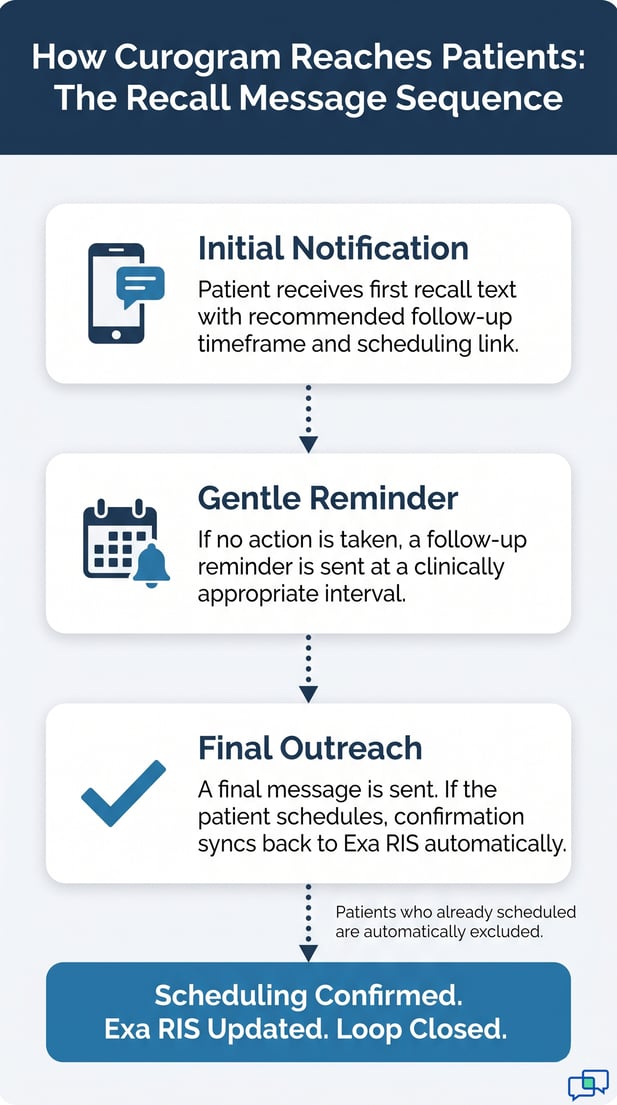
Curogram patient recall sequence: automated text message workflow

The Guide: How Curogram Closes the Exa Connect Follow-Up Loop

Curogram works as the automated recall engine that picks up where Exa Connect leaves off. When Exa Connect flags a follow-up recommendation and creates an order in Exa RIS, Curogram takes over patient communication automatically. No manual steps. No reliance on referring physician follow-through.

The Recommendation-to-Text Recall Pipeline

The Curogram and Exa RIS patient recall text notification pipeline works like this: Exa Connect identifies the follow-up recommendation. An order is created in Exa RIS. Curogram accesses that recommendation data through Exa's API. A patient-specific text message goes out.

Each message references the recommended timeframe in plain, clear language. It provides a direct path to schedule and includes the imaging center's contact information. The tone is professional and clinically appropriate, not alarming.

A Staged Outreach Sequence

Curogram does not send a single message and stops. The recall pipeline sends messages at clinically appropriate intervals. An initial notification goes out first. If the patient does not schedule, a gentle reminder follows. A final outreach message closes the sequence.

This staged approach maximizes scheduling without overwhelming the patient. It mirrors what a well-run front desk team would do if they had unlimited time, which they do not.

Bidirectional Sync With Exa Ris

When a patient schedules, the confirmation syncs back to Exa RIS. This closes the loop for clinical documentation and revenue cycle tracking. The integration is bidirectional: recommendation data flows in, scheduling confirmation flows out.

Patients who have already been scheduled through their referring physician are automatically excluded from recall outreach. The system checks the scheduling status before any message is sent. No duplicate communication. No patient confusion.

The Clinical Case for Automated Messaging

Follow-up imaging recalls are not marketing messages. They are clinically motivated communications. A patient with a pulmonary nodule needs surveillance imaging.

A breast imaging callback needs timely follow-up. Post-surgical assessment requires a scheduled study. These are medical needs, not promotional targets.

Curogram treats these messages with the right clinical gravity. Language is clear and professional. Messages convey the importance of the follow-up without causing unnecessary alarm. This is a radiology report recommendation outreach done with care.

HIPAA Compliance And Patient Safety

All Curogram recall messages are crafted to convey the need to schedule without disclosing specific diagnostic findings. A message references "a recommended follow-up imaging study," not a diagnosis or condition. All communication is encrypted, HIPAA compliant, and SOC 2 Type II certified.

Curogram executes a Business Associate Agreement with every imaging center. The Curogram Exa Connect integration recall workflow is built for the compliance requirements of healthcare communication, not just general SMS.

The Referring Physician Relationship

When follow-up imaging is executed reliably, referring physicians notice. The oncologist gets the surveillance results they needed. The hospitalist's care plan stays on track.

The imaging center becomes the partner that makes clinical recommendations real, not the one that lets them disappear.

Automated follow-up outreach is one of the most direct ways an imaging center can strengthen its referral relationships. It shows that radiology recommendations matter beyond the report.


The Success: The Complete Follow-Up Circuit in Action

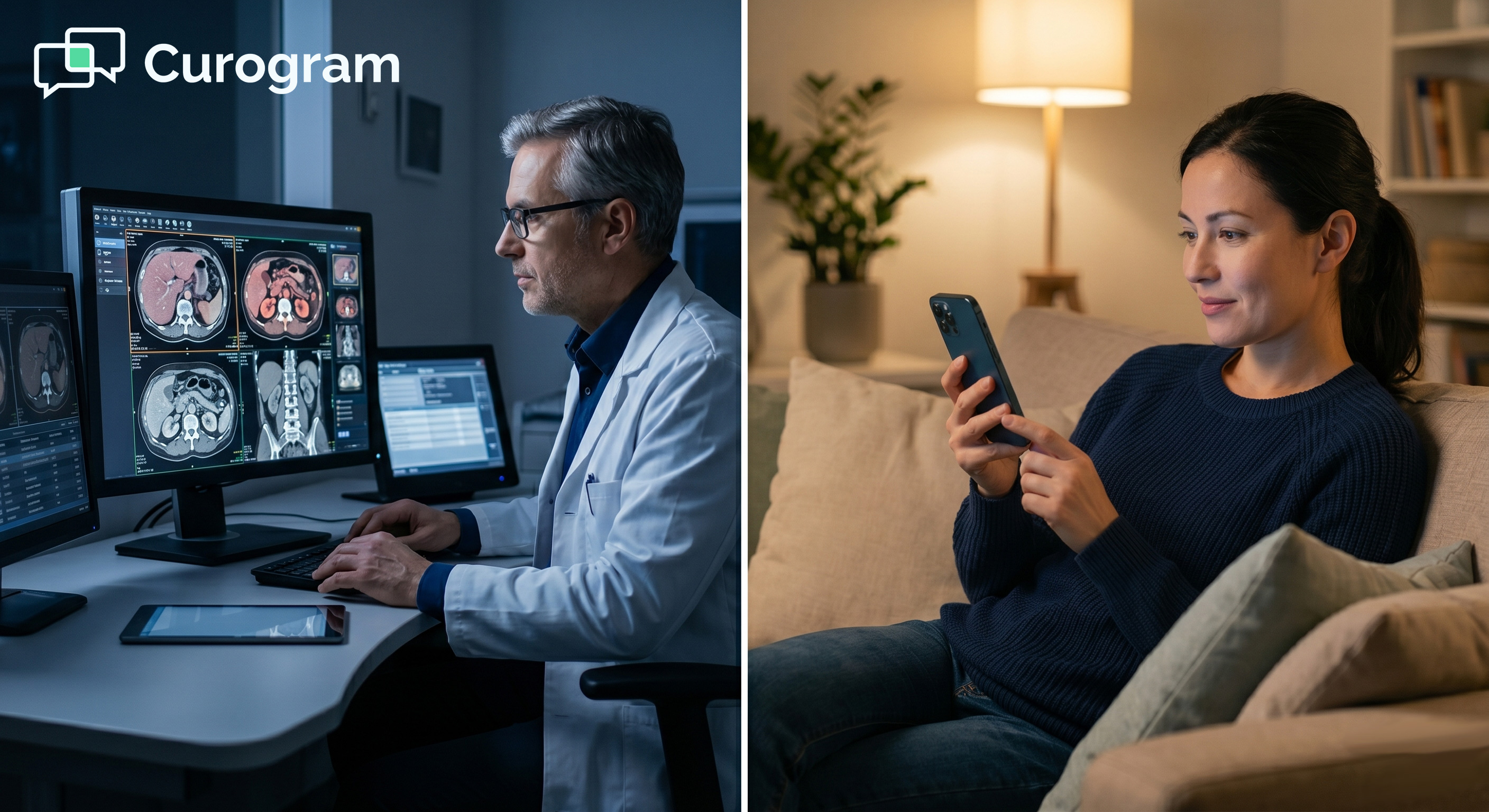
What does it look like when the full pipeline runs? Exa Connect identifies the follow-up. Curogram contacts the patient.

The patient schedules. The study happens. The radiologist reads the follow-up. The referring physician gets the results. Every step connects.

Real Results from Recall Campaigns

Based on our internal data, a multi-location healthcare client achieved a 35% appointment reconversion rate from Curogram recall messages. 1,240 patients who had fallen out of the care loop were brought back within a month.

Applied to radiology follow-up revenue recovery, the numbers scale quickly. An imaging center with 200 open follow-up recommendations per quarter can expect to recover 70 or more studies at that reconversion rate.

At an average of $800 per MRI or CT study, that is $56,000 or more in recovered revenue from a single quarter of recall campaigns.

Open Follow-Up Recs (per quarter)

Est. Recovered Studies (35%)

Avg Study Value

Quarterly Revenue Recovered

100

35

$600

$21,000

200

70

$800

$56,000

300

105

$800

$84,000

400

140

$1,000

$140,000


Over a full year, that is $200,000 or more in follow-up imaging revenue recovery for a single busy imaging center. These are studies that a radiologist already recommended. They just needed a patient communication system to execute.

Compliance Rates That Shift The Clinical Picture

With automated text outreach through the Curogram and Exa Connect integration, follow-up compliance rises from the industry norm of 30% to 40%, up to 65% or higher.

This is not just a revenue story. Higher compliance means more pulmonary nodules caught in time. More breast callbacks completed. More post-surgical assessments on schedule.

The follow-up imaging revenue recovery is real and measurable. But so is the clinical value of patients who return for care they genuinely need.

What The Shift Looks Like For Staff

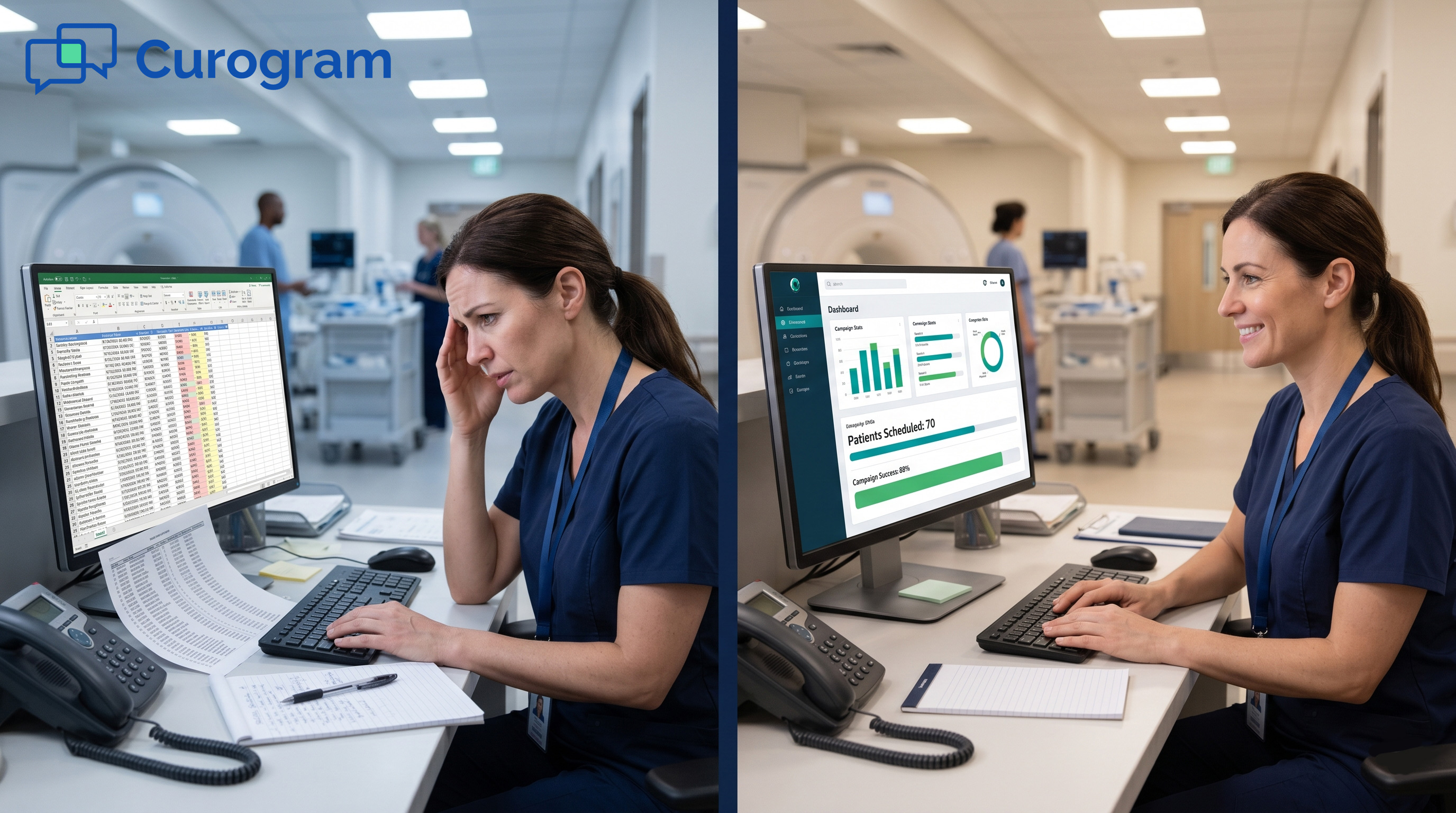
For imaging center staff, the change is immediate. Follow-up calls that once took hours of manual outreach now happen automatically.

The schedule fills with studies that used to disappear. Revenue cycle managers see previously invisible revenue show up on the schedule.

Staff time shifts from chasing patients by phone to handling the patients who actually book. The work gets easier. The outcomes get better.

From Recommendation to Reality

Before Curogram, the radiology follow-up workflow had a hard stop. Exa Connect did its job, but the patient communication never happened. The recommendation existed as a data point in Exa RIS, not as a scheduled study on the calendar.

With Curogram closing the loop, imaging recommendations stop being documentation artifacts. They become scheduled studies. The radiologist's intent is fulfilled. The patient receives care. The center recovers revenue that was already earned in clinical terms but never realized on the schedule.

The Value Of A Fully Automated Circuit

The recommendation engine and the communication engine are two halves of the same clinical workflow. Exa Connect handles what needs to happen next. Curogram handles making sure it actually happens. Both sides need to be automated for the circuit to be complete.

An imaging center that automates only the recommendation side still has a 30% to 40% compliance rate. An imaging center that automates both sides can realistically reach 65% and above.

That difference, compounded over a year, is the difference between a hidden revenue gap and a closed one.

Measuring Progress From The First Campaign

Most imaging centers see their first recovered studies within the first recall campaign cycle. Scheduling improvement can be measured directly against the pre-campaign compliance baseline.

The data is clear: how many patients were contacted, how many were scheduled, and how many studies were completed.

This makes it easy to see the return on the Curogram Exa Connect integration in plain terms. Not as a feature list. As a number on the schedule.

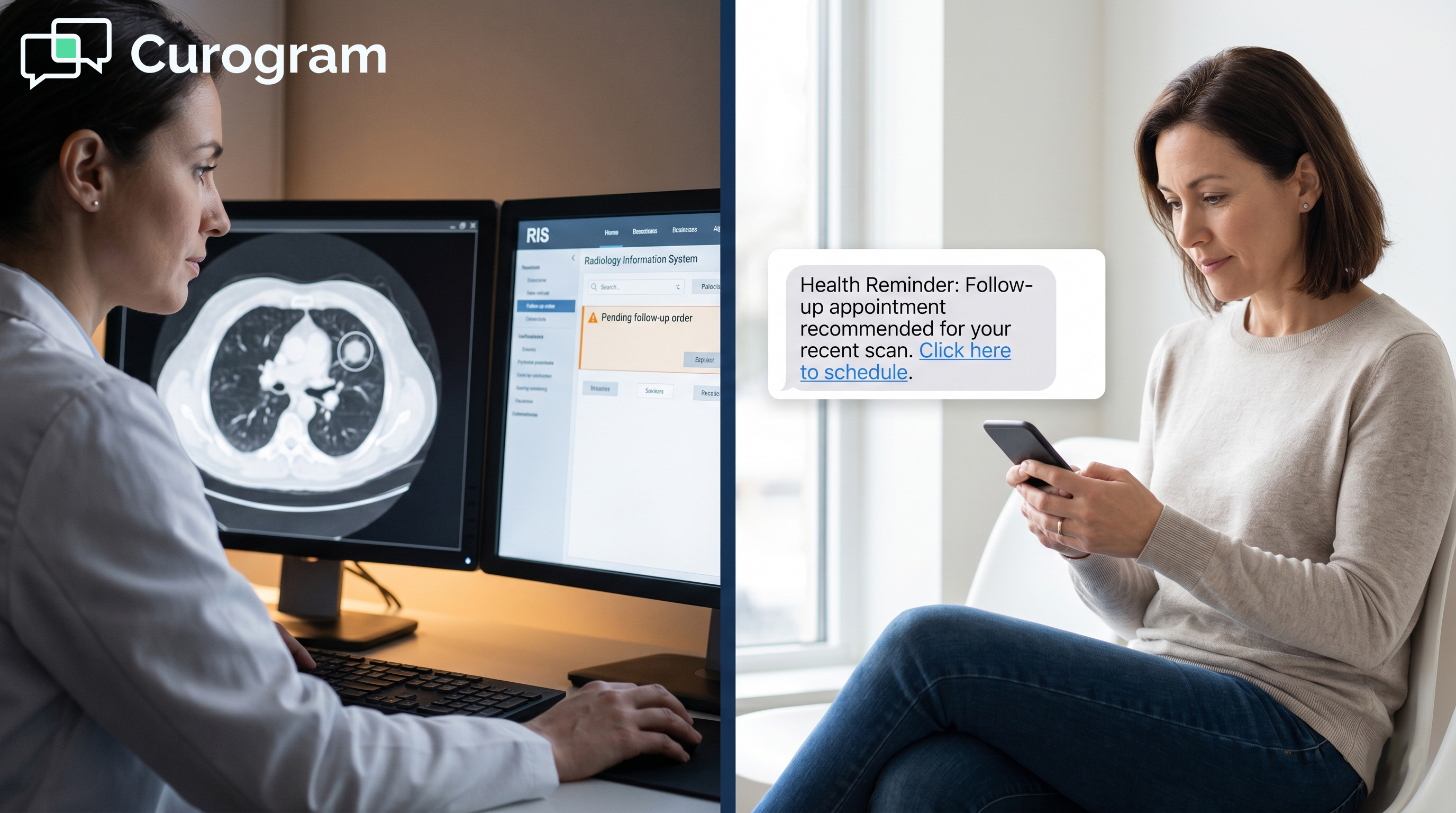
Split-screen: radiologist reading a CT scan and patient receiving a health reminder text message

Conclusion: Complete the Circuit Exa Connect Started

Exa Connect identifies follow-up imaging recommendations with precision. That is the first half of the job. The second half is making sure the patient knows and actually books the study.

Curogram connects to Exa Connect through Exa's API to complete that second half automatically. When a recommendation is flagged, and an order is created in Exa RIS, Curogram texts the patient, walks them to scheduling, and syncs the confirmation back. The loop closes.

For imaging centers, this means follow-up compliance rates that climb from 30% to 65% and higher. It means revenue recovered from studies that were already recommended.

It means clinical outcomes that improve because patients actually return for the care they need.

Ready to see how it works? Schedule a demo to connect Curogram to your Exa Connect workflow and measure follow-up scheduling improvement against your current baseline. 


Frequently Asked Questions

How does the Curogram and Exa Connect integration actually work?

Curogram connects to Exa RIS through Exa's API platform. When Exa Connect flags a follow-up imaging recommendation and creates a pending order, Curogram accesses that data and automatically sends the patient a text message.

The message includes the recommended timeframe and a direct path to schedule. When the patient books, the confirmation syncs back to Exa RIS, closing the loop on both the clinical and scheduling sides.

Why do so many follow-up imaging recommendations go unscheduled?

The recommendation gets documented in the radiology report and flagged in Exa RIS, but someone still has to contact the patient. In most imaging centers, that contact depends on manual phone calls from staff who are already stretched thin.

Patients who do not hear from anyone often assume everything is fine and do not follow up on their own. The gap is not caused by a lack of clinical intent. It is caused by a communication breakdown between the recommendation and the patient.

How does automated recall messaging protect patient privacy?

Curogram recall messages are carefully written to convey the need to schedule without disclosing any specific diagnostic information. A message will reference "a recommended follow-up imaging study" without naming conditions or findings.

All communication is encrypted, HIPAA compliant, and SOC 2 Type II certified. Curogram also executes a Business Associate Agreement with every imaging center before the integration goes live.

How does Curogram avoid contacting patients who are already scheduled?

Before any recall message is sent, Curogram checks the scheduling status in Exa RIS. If the patient already has a follow-up appointment on the calendar, they are automatically excluded from the recall campaign.

This prevents duplicate outreach and ensures patients only receive a message when a genuine scheduling gap exists. The system handles this check automatically, without any manual review required from staff.

How quickly can imaging centers expect to see results from a recall campaign?

Based on our internal data, a multi-location healthcare client achieved a 35% appointment reconversion rate with 1,240 patients scheduling within one month of receiving a recall message.

Most imaging centers see their first recovered studies within the first campaign cycle. The results are measurable and trackable directly against the pre-campaign compliance baseline, so it is easy to see the return in concrete terms.