
1 min read
Exa Connect Imaging Recalls | Automated Follow-Up Texts
 Jo Galvez : Apr 24, 2026, 12:00:01 PM
💡 Exa Connect finds follow-up imaging recommendations inside radiology reports and creates pending orders in Exa RIS. But finding the...
You finished your scan. You waited for results. Then you got a notification that said results available and moved on with your life.
What you may not know is that your radiologist could have noted something in that report worth watching closely. A recommendation for a follow-up scan may have been written, filed, and forgotten by everyone except the radiologist who wrote it.
That gap between what was recommended and what you were told is more common than you think. Radiology works on a referral model. Once your scan is done and the report is sent to your doctor, the imaging center's job is technically finished. But your care is not.
This is where a follow-up imaging text message comes in. When Curogram is connected to your imaging center's system through Exa, it identifies patients who have a recommended follow-up study and sends them a clear, simple text.
No jargon. No portal login. Just a message that says: we have a follow-up study recommended for you. Here is how to schedule it.
That one text is often the only thing standing between a clinical recommendation and actual care. Patients who receive it book an appointment. Patients who do not receive it often never do. It is not a failure of patients. It is a failure of communication.
This article explains why imaging centers send follow-up texts, what those texts mean for you, and how this kind of radiology patient recall notification keeps patients safe.
Whether you just got a text about a follow-up MRI or CT scan, or you want to understand how this process works, this is for you.
There is a gap in how radiology care works. Most patients do not see it until something slips through. This section explains how a clinical recommendation can go unheard, and why that happens more often than it should.
You go in for a chest CT. The radiologist reads the images and writes a report. In that report, they might note a finding and add a note like: recommend a 6-month follow-up CT to monitor this area. That report goes to your referring doctor. It does not go directly to you in plain language.
Your patient portal might show a notification that says your results are ready. But if you open it and see a wall of medical terms, you may not catch the line buried near the end about scheduling a follow-up scan.
Most patients do not. And if no one calls to explain it, the recommendation disappears into the background.
Many patients assume that no news is good news. If something was really wrong, surely someone would have called. But in the referral-based world of radiology, that is not always how it works.
The imaging center sees you for the scan. Your referring doctor gets the results. The follow-up is often listed as a task for that doctor's office to handle.
Sometimes it gets communicated clearly. Sometimes it does not. Your doctor may not have a scheduled visit with you for weeks. By the time anyone circles back, the recommended time window for the follow-up study may have already passed.
Radiology follow-up recommendations are not suggestions. They are clinical decisions made by a doctor who reviewed your scan. A pulmonary nodule needs a 6-month CT to see if it changed. A breast imaging finding may need a short-interval follow-up. A post-surgical check may be the only way to catch a problem before it becomes serious.
When patients do not hear about these recommendations, those studies do not get done. The original scan was completed, but the clinical purpose behind it is lost. The radiologist did their job. The system failed the patient.
From where you sit, the scan was one episode of care. You went. You had it done. You got your results. You assumed that if more action was needed, someone would make sure you knew. That is a fair assumption. And it is one the healthcare system does not always meet.
Studies on missed follow-up imaging show that the failure is almost never due to patient refusal. It is patient non-notification. Patients who are told about a recommended imaging study and given a simple way to schedule it will, in most cases, schedule it. The barrier is not willingness. It is awareness.
Table: Where the Recommendation Gets Lost
|
Step |
Who Is Involved |
What Can Go Wrong |
|
Radiologist writes report |
Radiologist |
Follow-up note buried in clinical language |
|
Report sent to referring doctor |
Referring doctor's office |
Task added to list, not always followed up on |
|
Patient notified via portal |
Patient |
Patient sees 'results ready,' misses follow-up note |
|
Follow-up window passes |
Patient |
No call, no text — patient assumes everything is fine |
|
Recommended study never scheduled |
Everyone |
Clinical gap remains open |
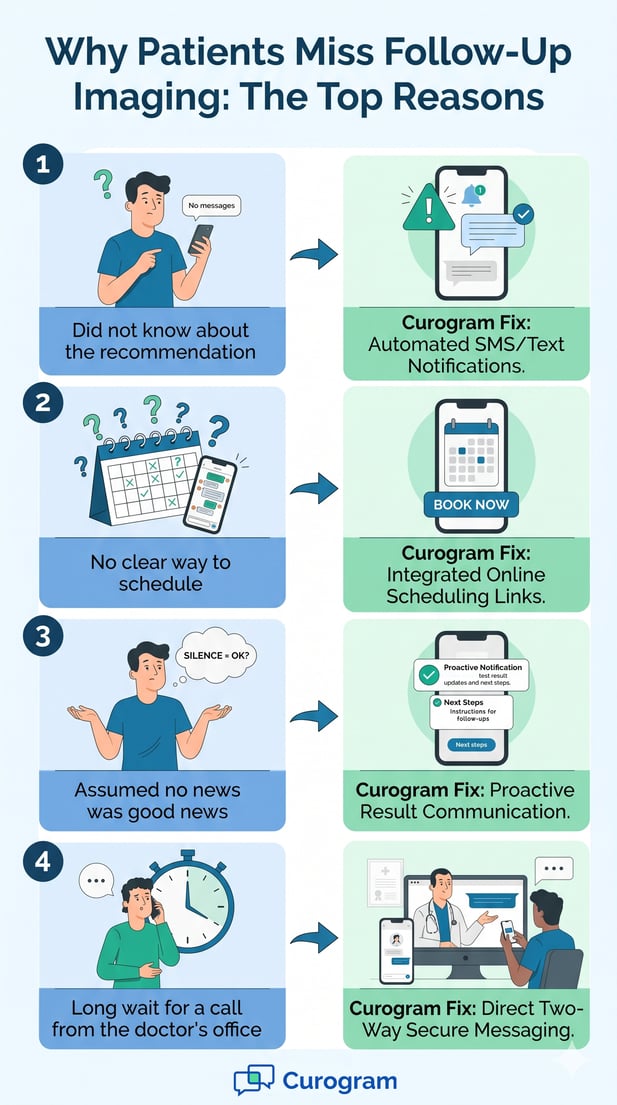
Understanding the problem is one thing. Knowing how it gets solved is another. This section covers how Curogram's follow-up text system works and why patients find it easy to use.
Curogram sends a follow-up imaging text message in plain, easy-to-read language. It references your imaging center by name. It tells you that a follow-up study has been recommended. It gives you a number to text or call to schedule. That is it.
No diagnosis. No clinical details. No confusing terms. The text does not tell you what the radiologist found. It tells you that someone reviewed your scan and believes a follow-up study is in your best interest. The message is professional and calm. It is not meant to alarm you.
A common question patients have is whether a follow-up text is safe. Curogram's system is fully HIPAA compliant. All messages are encrypted.
Your medical information is not shared via text. The text simply alerts you that a recommended imaging study exists and gives you a way to act on it.
This is the balance the system strikes: inform without disclosing. You get enough information to know you need to schedule something. The specific clinical details stay in your medical record, where they belong.
Curogram receives data from Exa Connect through the Exa API platform. When a follow-up imaging recommendation is identified, Curogram determines whether the patient has already been scheduled. If they have, no text is sent. If they have not, Curogram sends the text at the right time.
The timing matters. The text is not sent immediately after your scan. It is sent after a window that allows your referring doctor to contact you first.
If your doctor reaches out and you schedule through them, the system detects that and stops. The goal is to close the gap, not to flood you with messages.
Patients prefer texting for healthcare communication. A phone call can be missed, forgotten, or anxiety-inducing when it comes from an unknown number.
take
You can read it when you are ready. You can tap the number and schedule at your convenience.
For an imaging center follow-up scheduling text, this format removes nearly every barrier. You do not need to remember the imaging center's number.
You do not need to explain what scan you had or what study was recommended. The text has it all. You tap, you schedule, you go.

This section looks at what happens when patients do receive a follow-up text and what that means for their care. The data and outcomes tell a clear story.
Based on our internal data, one multi-location imaging practice used Curogram's recall system and recovered 1,240 patients who had fallen out of care.
Of those patients who received a radiology patient recall notification, 35% scheduled their recommended study within a month. That means more than one in three people who got a text acted on it.
That is not a marketing number. That is a clinical outcome. Every patient who scheduled had a follow-up MRI, CT scan, or other imaging study that their radiologist had recommended. Without the text, most of them would not have known.
Table: Recall Campaign Results (Based on Our Internal Research)
|
Metric |
Result |
|
Patients reached via recall text |
Multi-location practice pool |
|
Patients recovered (scheduled) |
1,240 patients |
|
Scheduling rate from recall text |
35% |
|
Time to schedule after receiving text |
Within one month |
Before Curogram's recall text, these patients were not refusing care. They were unaware that care was recommended. The clinical gap between a radiologist's note and a patient's next appointment can stretch from weeks to months, or never close at all.
With a follow-up imaging text message, that gap narrows to days. Patients transition from unknowing non-compliance to informed action.
That shift does not happen because patients suddenly become more responsible. It happens because the system finally told them what they needed to know.
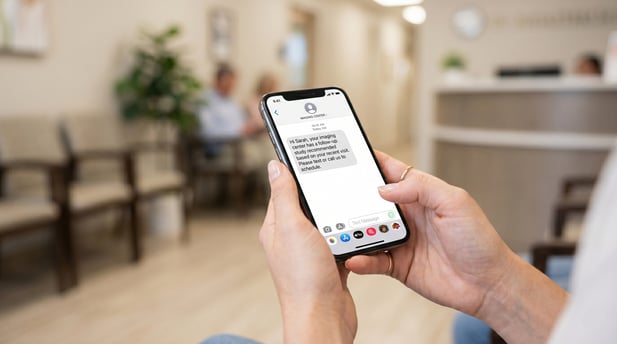
The patient receives a text: "Hi [Name], your imaging center has a follow-up study recommended based on your recent visit. Please text or call us to schedule at your convenience."
The patient taps the number. Staff responds. The appointment is booked.
From there, Curogram's system can also send reminders and prep instructions for the recommended study. So when the patient arrives, they are ready.
The follow-up scan is completed. The radiologist reads it. The referring doctor gets the results. What started as a silent note in a report becomes a completed episode of clinical care.
When a radiology follow-up recommendation never becomes a scheduled study, two things happen. First, the patient's health is not actively monitored. Second, the clinical value of the original scan is reduced.
The first scan pointed to something worth watching. If nothing is done, the scan was, in a sense, incomplete.
Curogram closes that loop. Not just for one patient, but for every patient in a practice who has an unscheduled follow-up. The imaging center does not have to build a manual outreach process. The system identifies the gap and sends the text automatically.
Follow-up imaging exists because your radiologist saw something worth watching. That recommendation should reach you clearly and simply, not sit in a report you never read.
If you received an imaging center text message after your scan, take it seriously. You do not need to panic. The text does not mean something is wrong.
It means your imaging center is doing its job, making sure you know a follow-up study was recommended and giving you a clear path to schedule.
You can reply to the text, call the number, or tap a link to schedule. One action is all it takes. The recommended study could be a short scan scheduled within weeks.
It could be a 6-month follow-up CT. Whatever it is, your radiologist thought it was worth doing. That is reason enough to follow through.
Imaging centers that use Curogram alongside Exa PACS and RIS are using those systems the way they were meant to work together. Exa manages the clinical workflow: storing images, tracking reports, and identifying follow-up recommendations. Curogram handles the patient communication side, making sure the person who needs to act on that recommendation actually hears about it.
The result is a more complete care cycle. Clinical recommendations reach patients. Patients schedule. Studies get completed. Radiologists can do their work knowing it will lead to real action.
If you are a patient who received a follow-up text, schedule your study. If you run an imaging center and want your patients to receive these texts, Curogram can help.
See How Curogram Fills the Exa Engagement Gap. Schedule a demo to find out how the system works.
1 min read
Jo Galvez : Apr 24, 2026, 12:00:01 PM
💡 Exa Connect finds follow-up imaging recommendations inside radiology reports and creates pending orders in Exa RIS. But finding the...
1 min read
Jo Galvez : Apr 24, 2026, 10:00:01 AM
💡 Radiology follow-up recall operations are a core part of how imaging centers recover lost revenue. When patients skip their recommended follow-up...
1 min read
Jo Galvez : Mar 23, 2026, 2:00:00 PM
💡 Practice Fusion mass messaging for patient recall lets small clinics send bulk SMS to hundreds of overdue patients at once. Practice Fusion has...