
1 min read
Boosting Patient Engagement and Revenue: Mass Texting in Allscripts PM
💡 Boosting engagement with Allscripts mass texting is what health organizations need. You can help your organization reach more patients in ways...
8 min read
Send fast messages that patients actually read.
Support Exa patient campaigns with clear written outreach.
Reduce missed appointments caused by confusion.
Lower staff workload tied to repeated phone calls.
Strengthen radiology outreach with consistent communication.
Curogram's HIPAA-compliant, structured texting can help improve patient communication across your imaging network.
In radiology, clear communication keeps patients moving from scheduling to exam completion. When messages are unclear or easy to miss, that bridge weakens. Patients forget prep instructions, misunderstand arrival times, or miss important reminders. Staff try to compensate with phone calls, but many people do not answer unknown numbers.
Over time, this creates a pattern of avoidable delays that affect your reputation. If you want to boost engagement, mass texting provides a better path. People read texts faster than email and respond more often than voicemail.
When instructions arrive in writing, patients can return to them later. This lowers stress for your team because fewer patients call back confused. You also create more stable communication with steady contact and reliable follow through.
In this blog, we will:
Explore the business risks of low engagement in radiology.
See how structured texting supports radiology outreach and exam readiness.
Review benefits that affect imaging center capacity and revenue.
Study a sample ROI scenario based on better communication.
Get practical next steps to introduce mass texting in a manageable way.
By the end, you will see how simple, clear messages can create meaningful improvements.
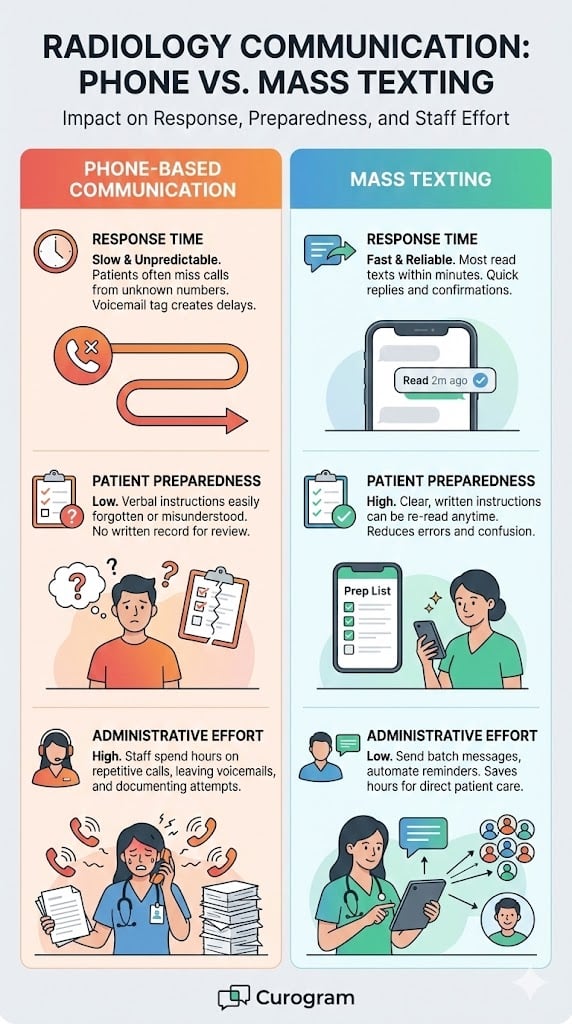
As we emphasized in our previous article, when you rely only on phone calls or scattered emails, radiology communication becomes unpredictable. Many patients do not answer calls from unknown numbers. Others forget details from verbal conversations. Even when staff leave voicemails, they cannot be sure the message was heard. As a result, patients may show up late, skip instructions, or arrive unprepared.
These small breakdowns create real business risks. A single missed fast for MRI or CT can cause a same day cancellation. A patient who misunderstands scheduling times may arrive an hour early or an hour late, which disrupts your entire workflow. Staff try to fix these issues on the spot, but they often must reshuffle schedules or delay the next patient. Each interruption affects the day’s pacing and may reduce the number of exams you complete.
Your organization also loses efficiency when communication lacks structure. Staff spend time repeating the same information over multiple calls. They leave messages, wait for responses, and try again. These repeated steps take energy and time that could be used for more meaningful patient support. When your team feels stretched, burnout increases and morale drops. Over time, this affects not only productivity but also staff retention.
There is also a documentation risk. Without written messages, it becomes difficult to prove what was communicated. If a patient claims they never received prep instructions or appointment reminders, you may not have a record to support your staff. Leaders must rely on memory and handwritten notes. This creates gaps during audits, complaints, or internal reviews. A lack of documentation often leads to more time spent investigating issues that could have been avoided with structured communication.
These risks add up across the year. You may not notice them day by day, but every missed instruction, preventable cancellation, and repeated phone call affects your bottom line. Without clear pathways for communication, your Exa patient campaigns also lose their strength. They depend on reliable outreach to move patients through the care journey. If messages are inconsistent, the entire campaign may feel weaker and less effective.
Mass texting gives you a reliable way to boost engagement Exa mass texting workflows because it matches how people actually communicate today. Most patients read texts within minutes. They also check their phones frequently throughout the day. When you use structured texting, your messages fit naturally into this pattern. Patients do not have to search through email folders or listen to long voicemails.
Written messages create clarity. Patients receive prep instructions they can reread the night before their exam. They can check arrival times without calling back. They can forward details to caretakers or family members when needed. This helps them feel more prepared and reduces avoidable errors. It also lowers the emotional stress that comes with last minute confusion.
Structured texting also supports consistency. When your staff use templates aligned with Exa patient campaigns, every patient receives the same core information. This consistency ensures fair communication and reduces misunderstandings. It also protects your organization by showing that staff followed a uniform process. Clear wording, approved by leadership, lowers the chance of errors or mixed messages.
Your staff benefit from fewer repetitive tasks. Instead of calling dozens of patients each day, they can send a batch message for reminders, instruction updates, or schedule changes. This saves hours of work during peak seasons. Staff can then focus on patients who need more guidance. The workflow becomes calmer and easier to manage.
Radiology outreach also becomes more effective. You can notify referring providers about operational changes, new exam offerings, or status updates for shared patients. These messages reinforce trust and collaboration. When your outreach feels timely and clear, referring providers see your imaging center as organized and dependable. That stability supports both your daily work and your long term relationships.
Executives look beyond daily tasks. You focus on how processes scale, how risks accumulate, and how communication affects long term performance. Mass texting supports these goals by creating structure in a part of your workflow that often feels scattered. Integration with Curogram can give you clearer visibility into patterns that were previously hidden. This helps you make decisions grounded in real data instead of assumptions or anecdotal reports.
Unprepared patients cause preventable gaps. If someone forgets to fast or misses contrast instructions, they cannot complete the exam. This leads to empty slots that cost you money. With structured messaging, fewer patients arrive unprepared. Written instructions reduce misunderstanding. The result is higher completion rates and better use of your fixed resources. Even a small increase per day can have a meaningful impact on annual revenue.
Your campaigns depend on consistent outreach. If people miss messages, a pathway designed to support follow up care falls apart. Mass texting ensures that messages reach patients quickly, improving the success of campaigns tied to imaging reminders, follow up scans, and communication between providers. When these campaigns run smoothly, you support clinical outcomes and patient loyalty at the same time.
Phone based communication requires more labor. Staff dial numbers, wait, leave messages, and repeat the process for hours. Mass texting reduces this cycle. When you send one message to many patients, staff recover valuable time. They can shift their energy toward problem solving and patient support. This improves morale and reduces turnover risks. It also gives leaders a more efficient staffing structure.
Executives benefit from knowing what to expect. When communication is unpredictable, it is hard to understand where problems start. Structured texting creates patterns you can monitor. You can track open rates, response times, and common questions. These patterns help you pinpoint areas that need improvement. They also help you measure the impact of changes over time.
If you operate multiple sites, you know how difficult it can be to keep messaging consistent. Each location may interpret prep instructions differently or use slightly different wording. This inconsistency creates confusion for patients who move between sites. Mass texting centralizes your templates. Each location sends the same core information, which supports clinical consistency and simplifies oversight.
When messages lack documentation, you face risk during audits. If a patient challenges whether instructions were shared, you need written proof. Mass texting stores this information. This protects your organization from misunderstandings and provides a clear record for reviews. It also creates peace of mind for compliance officers who want to know that messaging practices are controlled.
For executives, the true value of structured texting lies in stability. You lower risk, improve throughput, and gain clearer visibility into daily operations. These benefits create a stronger imaging network that can serve more patients with fewer disruptions. When your communication system supports your strategy, everything around it becomes steadier.
A radiology group with several outpatient locations struggled with frequent cancellations. Many appointments were lost due to unclear prep instructions. Patients often said they did not hear the voicemail or could not remember what was said. Staff spent hours each day calling patients again. Leaders knew this pattern was hurting both revenue and morale.
The group began using structured mass texting. They created templates for MRI, CT, ultrasound, and X ray prep instructions. These messages reached patients quickly, and the written format made it easier for them to follow directions. Staff also asked patients to confirm appointments by replying to texts. This helped the team identify issues earlier and make schedule adjustments before the day began.
Within three months, preventable cancellations decreased enough to recover thousands of dollars in revenue each month. Scanner utilization improved, which increased daily exam counts without adding new equipment. Staff reported less stress and more time to focus on patients who needed extra help. Leadership calculated that the organization recovered significant annual revenue and reduced administrative costs tied to repeated calls. The improvement came not from expensive changes, but from clearer and more consistent communication.
Start by reviewing your current messaging gaps. Look for patterns like repeated phone calls, common prep misunderstandings, or high cancellation rates. Here’s a rundown of what you should do:
When the pilot feels steady, introduce mass texting to more sites. Continue gathering feedback. Adjust templates when needed. Share your results with leadership to show how messaging supports larger goals. At this point, you can begin planning how structured communication will integrate into your broader radiology outreach strategy.
Radiology centers choose Curogram because it helps them manage communication that shapes the entire patient experience. When patients receive clear messages at the right time, they arrive prepared and less anxious. Staff feel more in control because they do not have to juggle repeated calls or rushed explanations. Leaders gain reliable data that shows where communication succeeds and where it needs improvement.
Curogram also supports radiology outreach by giving you a structured messaging system that can reach patients and referring providers quickly. Written instructions reduce misunderstandings, while message templates bring consistency across locations. This helps imaging networks maintain a unified communication style even when staff and schedules change.
With audit ready messaging, Curogram also supports compliance efforts. You can review message history, see response patterns, and understand how instructions affect exam readiness. When you bring these strengths into Exa patient campaigns, your outreach becomes not only faster but also clearer and more dependable. Over time, these improvements help your imaging center feel more organized, more patient centered, and more resilient.
Mass texting gives you a simple way to boost engagement and reduce disruptions. Written messages help patients prepare for exams with more confidence. Staff spend less time repeating information and more time supporting care. Leaders gain a clearer view of communication patterns as they build stronger campaigns.
When communication becomes predictable, everything else becomes steadier. Exams stay on schedule. Patients feel more comfortable. Staff find their workday less stressful. Over time, these improvements contribute to a more reliable imaging environment. Mass texting is not just a tool. It is a foundation for smoother radiology outreach and better patient experiences.
Drive patient engagement and ROI with mass texting for Exa. Book your free demo today.

1 min read
💡 Boosting engagement with Allscripts mass texting is what health organizations need. You can help your organization reach more patients in ways...

1 min read
💡 Many behavioral health organizations use InSync for documentation and scheduling. Mass texting in InSync helps clinics reach people quickly and...

1 min read
💡 Mass texting in Konica Minolta Exa is a gamechanger for radiology centers. With secure bulk SMS, they can reach thousands of patients all at...