
InSync Copay Collection Workflow | No Paper Statements
 Aubreigh Lee Daculug : Sep 21, 2026, 10:00:00 AM
InSync EHR copay workflow texts payment links instead of mailing statements, helping practices collect 2–3X more, the same day.

A $30 copay is not a hard sell. Your patient wants to pay it. They just never open the envelope.
That gap explains most of the aging report in behavioral health and therapy practices. The balance is small. The willingness is there. The delivery channel is broken.
Think about a client on a sliding scale who sees you twice a week.
Each visit adds another $25 to $40 in patient responsibility. By month's end, that is eight to twelve small charges sitting in InSync, waiting on a paper statement that may never get opened.
Your billing team knows the routine by heart. Print the statement, mail it, then wait 30 days for silence. Then print another one.
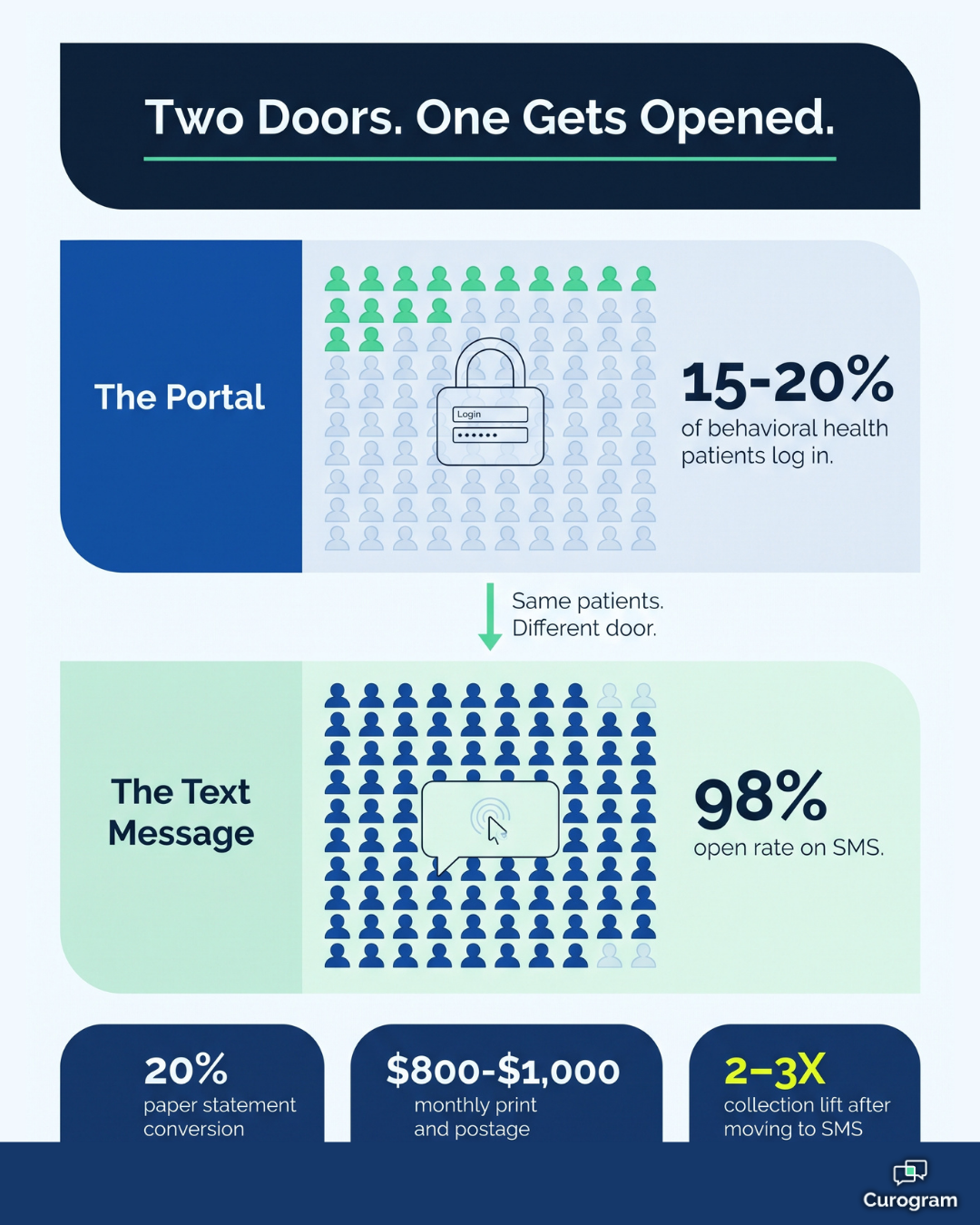
Meanwhile the practice spends $800 to $1,000 a month per location to keep that cycle running. Paper statements collect roughly 20% of what they ask for. You are effectively paying four figures a year to finance the losing side of your own collection process.
The InSync patient portal does process payments, and it works beautifully for the patients who actually use it. The problem is how few of them do. Portal engagement in behavioral health hovers somewhere around 15% to 20%, and the clients least likely to create a login are frequently the same ones carrying self-pay and sliding-scale balances.
It looks like a payment problem. It isn't. It's a delivery problem.
Nobody is refusing to pay a $35 copay. They are refusing to hunt down an envelope, remember a password, or call back during business hours. Eliminate those three steps and most of the balance clears itself.
This guide walks through where small balances get stuck, why statements and portals keep missing the people who owe them, and how practices are closing that gap with a secure payment link sent by text.
Give InSync its due. Qualifacts built a system that behavioral health and therapy teams shape to fit their own notes, and 96% of reviewers praise that flexibility.
Billing and claims management live in the same place, and secure patient messaging for behavioral health in InSync EMR already has a proven home there. The portal even takes payments.
Here is the catch.
That payment page sits behind a browser login. And the clients least likely to set up an account — someone managing serious mental illness, active substance use, high anxiety, or unstable housing — are often the same ones carrying self-pay and sliding-scale balances.
So the balance takes the slow road instead.
| Stage | What happens | Time elapsed | What it costs you |
|---|---|---|---|
| Visit | Balance posts in InSync | Day 0 | Staff time |
| First statement | Printed and mailed | Days 1–5 | $0.80–$1.00 per piece |
| The mail pile | Envelope goes unopened | Days 5–30 | Nothing yet |
| Second statement | Printed and mailed again | Day 30 | Another $0.80–$1.00 |
| Phone outreach | Billing calls, reaches voicemail | Days 45–60 | 5–10 minutes per call |
| Aging | Balance joins the write-off talk | Day 90 | The full balance |
Read that table as a spend, not a schedule.
Most single locations land between $800 and $1,000 a month on print and postage. The second statement doubles the cost of chasing the same dollar. The calls add staff hours that mostly reach voicemail.
Now multiply it by visit volume. A PT patient at two to three visits a week racks up eight to twelve small copays a month, so one plan of care can leave $200 to $400 on the table.
Across a behavioral health caseload, hundreds of $20 to $50 Medicaid copays and sliding-scale payments do the same thing.
Small balances. High volume. 20% conversion. The math writes itself off.
Patient responsibility collection behavioral health practices manage every month has a punishing shape: the work grows with every new balance, but the recovery doesn't.
Benchmarking groups like MGMA track this as days in accounts receivable, and patient responsibility is where the number quietly swells. Ask your billing manager how the last week of the month goes.
It is usually the aging report — balances too small to chase one at a time, and too big to ignore all together.
Your patients pay for parking by text. They split dinner by text. They confirm their next appointment by text. The one bill they cannot settle that way is yours.
Curogram closes that gap. It is a HIPAA-compliant patient communication platform that runs the patient-facing side of your practice — texting, reminders, forms, reviews, mass messages, telemedicine, and payments. One login, one invoice, one vendor.
Text-to-pay sends a secure payment link straight to the patient's phone. They tap, pay in under a minute, and get an instant digital receipt. The message itself carries a link and an amount — never a diagnosis or a treatment detail.
That last part matters more than it sounds. SMS payment links for behavioral health practices have to be discreet by design, because an envelope landing in a shared mailbox can reveal far more than a balance.
A client on a sliding scale settles their session fee from a thread nobody else sees. The same no-login flow carries payment consent and card-on-file authorization forms when you need them.
Therapy clinics get a different win from the same flow. You can collect therapy copays by text before the next visit is even confirmed, which means a patient clears two weeks of visits from the parking lot instead of six weeks later by mail.
Our walkthrough of the InSync copay workflow that retires the statement run shows how front-desk teams sequence it.
We should be honest about the pathway. InSync exposes a documented FHIR R4 API built on Smile CDR, with OAuth 2.0, SMART App Launch 2.0.0, and US Core v6.1.0 support. That is stronger than most behavioral health systems offer, and Qualifacts documents the specification publicly.
But a deep InSync EHR text-to-pay integration is not a checkbox. It involves BAAs with both Qualifacts and your practice, sandbox registration, and sign-off from an API coordinator.
So Curogram starts working on day one through workflow instead of wiring. InSync stays the system of record for charges, claims, and posting. Curogram runs the collection conversation with the patient, which is the model our InSync integration page walks through in detail.
No rip-and-replace, and no plug-and-play promise anyone has to walk back later.
Qualifacts has built real tools around InSync. Qualifacts iQ speeds up clinical notes and scheduling. OnCall Virtual Care covers telehealth.
Neither one texts a payment link. That is the piece Qualifacts InSync patient payment collection still leaves open, and it is exactly where Curogram fits.
Because Curogram works with any EHR, it also travels with you. If the practice ever moves from InSync to Credible or CareLogic, the payment workflow goes along for the ride.
Practices that move patient balances to SMS see 2 to 3 times the collection of the paper baseline. That is not clever design. It is the 98% SMS open rate doing the work — the balance finally gets seen.
Here is what that shift can look like on paper. The figures below are illustrative, built from sample inputs rather than reported client results.
| Line item | Statement-first | Text-first |
|---|---|---|
| Monthly patient balances billed | $20,000 | $20,000 |
| Collection rate | 20% | 50% |
| Collected per month | $4,000 | $10,000 |
| Print and postage | $900 | $150 |
| Net per month | $3,100 | $9,850 |
| Net per year | $37,200 | $118,200 |
Read the bottom row first. In this example, the practice doesn't just collect more. It stops spending $9,000 a year to collect less.
That is what text-to-pay ROI for small practices usually comes down to: fewer mailed pieces, more dollars landing inside 30 days, and a postage line that shrinks toward zero.
Adoption compounds, too. Covina Arthritic Clinic grew from 369 text confirmations a month to 1,300+ in five months once texting the practice became normal for patients. Payment behavior follows the same curve — the second text is easier than the first.
The automated SMS reminder that fills the chair is what earns the trust the payment text later spends.
For your team, the day-to-day change shows up in three places:
If you want to see it from the patient's perspective first, one tap to paid walks through the full experience screen by screen.
That last one deserves weight. One InSync practice documented 663 ungenerated claims, worth more than $1M in exposure. Payer-side risk like that needs your billing team's full attention, and patient responsibility shouldn't be the thing competing for it.
The loudest objection to text-to-pay rarely comes from patients. It comes from the billing team, and it is a fair one. They have a reconciliation routine that works, and nobody wants a second place to hunt for money.
Good implementations are built around that concern.
Most practices go live in deliberate phases instead of flipping a switch across the entire caseload.
Somewhere around week six, the pattern usually settles into place. Statement volume drops, the 30-day bucket thins, and the billing manager stops defending the old workflow because the aging report is making the argument for them.
That is the moment to retire the statement run for copays and turn the team's attention to the balances that genuinely need a human conversation.
Your systems are not the problem. InSync runs your charges, your claims, and your clinical record, and it handles that responsibility well. What it cannot do is convince a patient to log in.
Curogram takes over at that line. It delivers the balance as a secure payment link through the one channel with a 98% open rate, and the patient settles it in roughly 40 seconds.
Think of the split this way.
The InSync portal exists for your records and the minority of patients who log in. Text-to-pay exists for their thumbs.
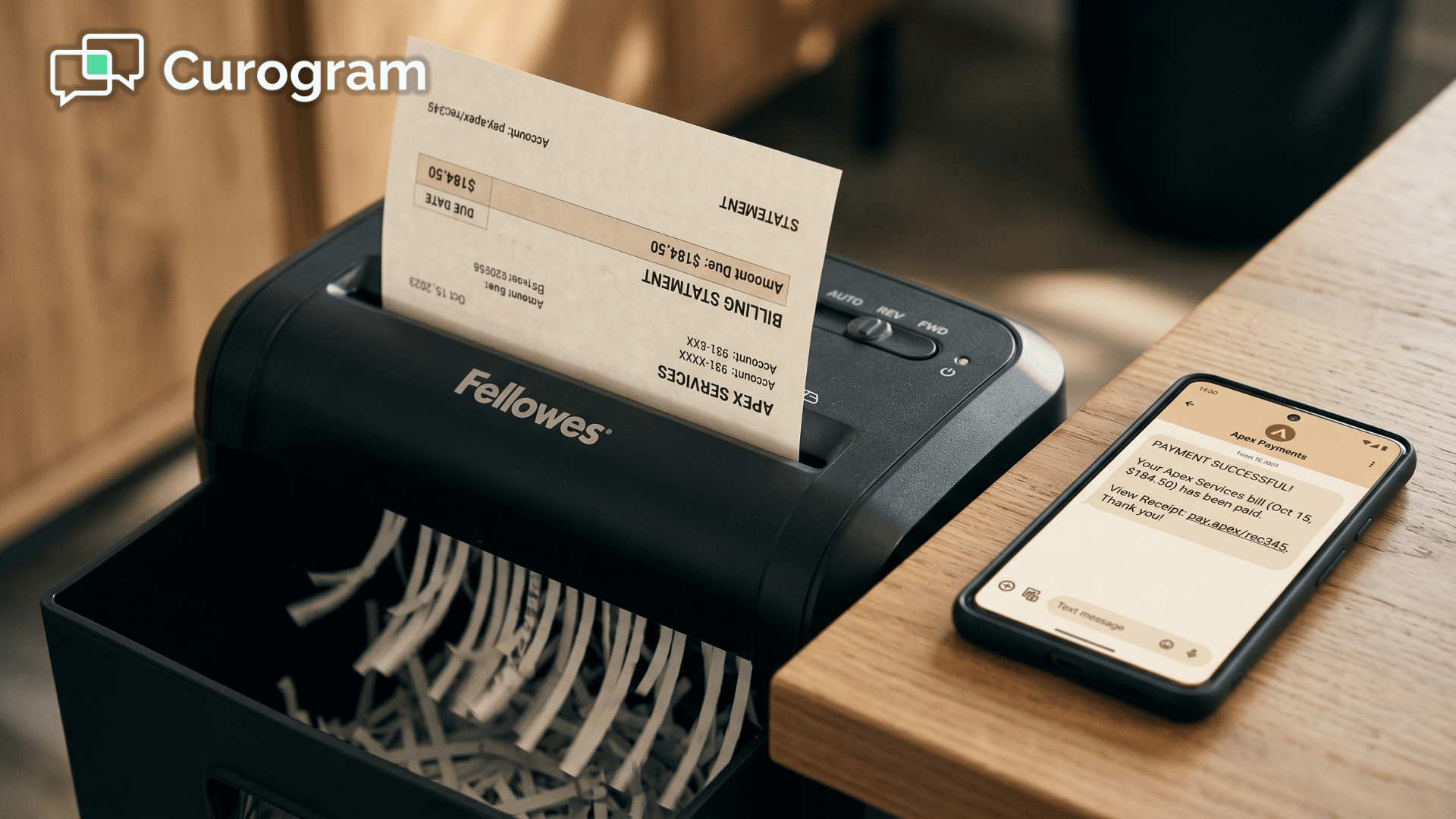
That 40-second tap replaces the third statement, the voicemail nobody returns, and the collections call your billing manager dreads. It also replaces the $1,000 a month you currently spend mailing envelopes that go unopened.
The math deserves a moment. At a 20% paper conversion rate, four of every five dollars you bill depend on somebody opening an envelope. That is not a collection strategy.
Moving to text does not change how you bill, post, or reconcile. Charges still originate in InSync, and your team works its familiar reconciliation routine with a clean digital record behind every payment.
What changes is where the request arrives. Not in a mailbox. On a lock screen, directly beneath the appointment reminder they already read.
Start with your own figures. Pull last month's statement count, print-and-postage total, and every balance past 60 days. Multiply that statement count by $0.90, then ask what tripling your patient collection rate would do to the aging report.
Schedule a Demo and bring those numbers. We will walk the one-tap payment flow from your patient's side of the screen and map what the first 90 days look like for your billing team.
 Aubreigh Lee Daculug : Sep 21, 2026, 10:00:00 AM
InSync EHR copay workflow texts payment links instead of mailing statements, helping practices collect 2–3X more, the same day.
 Aubreigh Lee Daculug : May 21, 2026, 11:00:00 AM
Paper statements cost $1,000/month and convert at 20%. Curogram text-to-pay collects Meditab IMS balances in seconds. Demo.
 Aubreigh Lee Daculug : Jun 9, 2026, 10:00:00 AM
Osmind billing teams lose hours to paper and calls with 20% conversion. Text-to-pay lifts same-week collections to 60–80%.