
 Aubreigh Lee Daculug

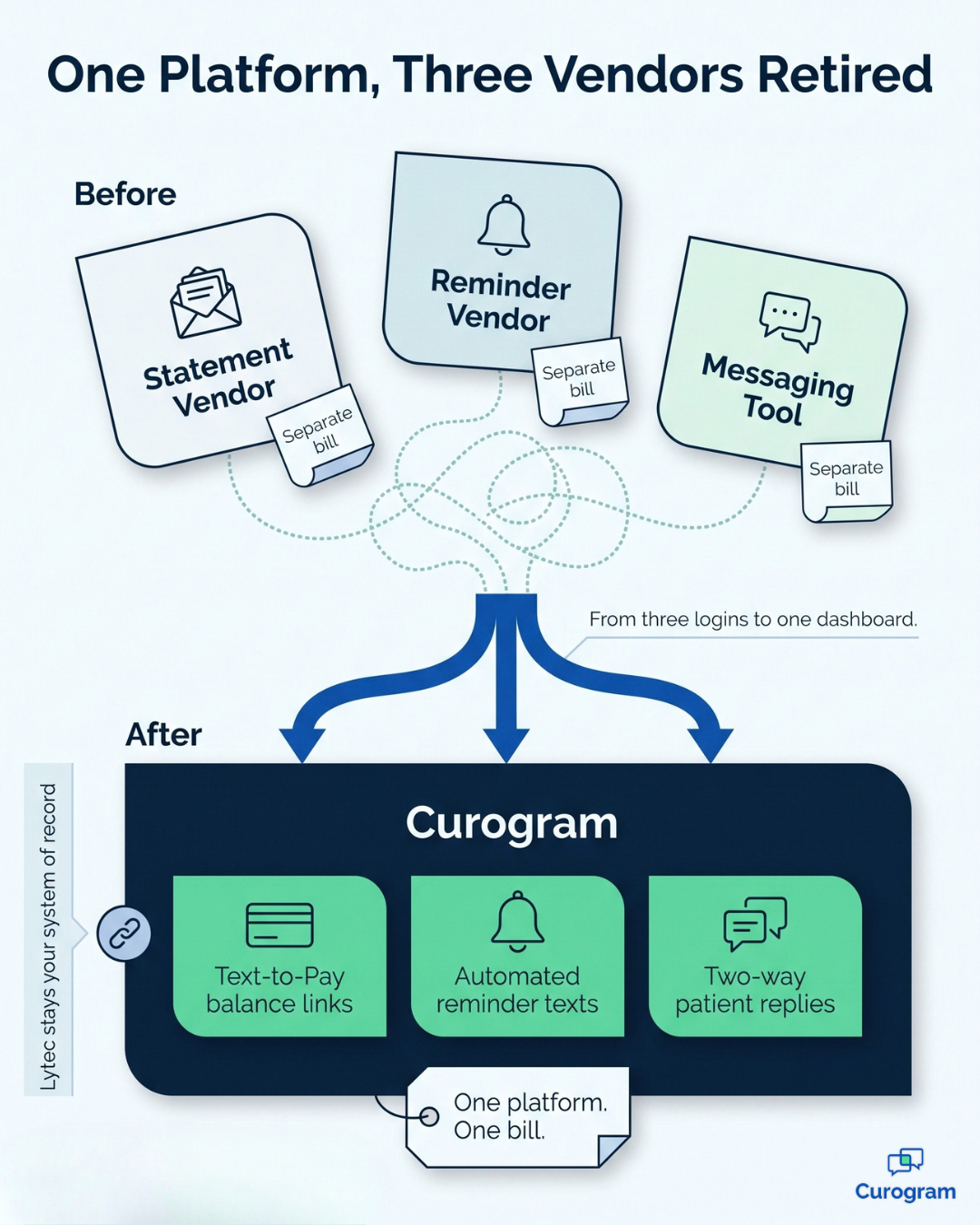
Lytec stays your system of record for patient accounts and eMEDIX claims. Curogram handles the patient-facing step, automated reminders, and one shared dashboard for your billing team.
The financial payoff arrives quickly. Practices spending $800–$1,000 a month on printing and postage can retire that cost entirely. And texts reach patients with a 98% open rate, while paper statements collect roughly 20% of what's billed.
Somewhere in your office, a stack of window envelopes is waiting for the next statement run, and most will accomplish very little.
Patients open them late, set them aside, and forget them. Roughly one in five becomes a payment. The remaining balances eventually become a collection call list.
That's "The 20% Envelope," and it quietly controls your entire billing month. Your team generates statements, waits 30 days for responses, and then repeats the process.
Then someone spends an afternoon leaving voicemails about $46 balances while insurance denials continue to accumulate.
Here's the frustrating part: Lytec does its job well.
Charges post accurately, claims move through eMEDIX, and patient accounts stay current. The weak link is the final step, when responsibility shifts to the patient and the only collection tool is paper.
It sounds like a minor gap. It isn't.
Printing and postage alone can cost a small practice $800 to $1,000 every month. Add a separate statement vendor like BillFlash, plus administrative hours lost to collection calls, and the real expense climbs quickly.
For a team of one to three people already managing 80 or more calls a day, that time has to come from somewhere.
A Lytec patient balance collection workflow without paper statements solves this with one practical change. Instead of mailing an envelope, you text each balance with a secure payment link. The patient taps, pays, and receives a receipt, while your team monitors everything from a single dashboard.
No envelope stuffing, no 30-day wait, and no second vendor to call when statements misfire.
This guide walks through the complete staff workflow, from the day a balance posts to the day it clears.
You'll see where the traditional cycle breaks down, how the new process operates, and why the switch can pay for itself in month one.
Why the Statement Cycle Keeps Your Billing Team Stuck
Lytec has earned its place in your office. Many practices have relied on it for 15 years or more because the billing foundation is dependable. Charges, patient accounts, and insurance claims all behave the way your team expects them to.
The gap appears after the claim adjudicates. Once the insurance company pays its portion, the remaining balance becomes the patient's responsibility.
At that point, the primary method for collecting it is still a paper statement delivered by mail.
Here's how a typical billing month unfolds in most Lytec offices:
- Balances post to patient accounts after claims are processed.
- Someone generates statements, then prints, folds, stuffs, and mails them, or uploads the file to an outside statement vendor.
- Everyone waits two to four weeks for patients to respond.
- Approximately 20% of patients send payment.
- Second statements go out to everyone who didn't respond.
- The collection call list gets printed, and your billing manager starts dialing.
Step six is where the month slips away.
Your billing manager is leaving voicemails about relatively small balances while also working denials and posting insurance payments. Most of those calls go unanswered, which simply means more calls the following week.
Now consider what this repetitive loop actually costs. Printing and postage run $800 to $1,000 a month, and that spending produces a collection rate of about one in five.
On top of that sits the BillFlash invoice, one more layer of "The Add-On Maze," followed by all the staff hours spent on the phone.
For a small front office, those lost hours hurt the most. A team of one to three people fielding 80 or more calls a day can't realistically absorb another afternoon of voicemails.
That's exactly why more offices want to cut paper statement costs small practice budgets were never designed to carry.
Talk with any experienced billing manager, and you'll hear a familiar story.
They can review a batch of statements and predict which balances will age past 90 days before the envelopes even leave the building. They know the current system isn't working, but they never signed up to operate a print shop.
One Shared Dashboard for Every Patient Balance
If you've been searching for a CGM Lytec statement alternative, the answer isn't another statement tool.
It's an entirely different collection path. Curogram's Text-to-Pay turns the balance itself into a text message that goes out on the same day it's ready.
Text-to-Pay Becomes the Workflow, Not One More Tool
Once a balance posts, your team sends it as a text message containing a secure payment link. The patient opens it, reviews the amount, and completes payment in two taps on a secure page.
There's no portal password to remember and no checkbook to locate.
Every payment appears in one shared dashboard. Your entire billing team can see which balances were sent, opened, and paid without switching over to a separate statement vendor's portal.
Self-pay balance collection by SMS works because people read their texts. Curogram messages get a 98% open rate. In practice, that means your balance request gets noticed within minutes instead of whenever someone finally sorts through the mail.
Friendly Reminders That Replace the Second Statement
This is where the real time savings happen. The patient balance follow-up texts Lytec practices send through Curogram go out automatically, based on a schedule your team controls.
They're short, polite, and easy to act on, and they replace the second statement along with most of the collection call list.
Because every conversation happens in a two-way thread, patients can reply directly.
A question like "Is this after my insurance?" gets answered within the same conversation.
It never becomes another inbound phone call that your front desk has to handle.
Lytec Stays Your System of Record
Nothing about your core setup changes. Lytec remains the home for patient accounts, and your insurance claims continue flowing through eMEDIX exactly as they do today.
Curogram manages the technical side of connecting with Lytec, including CGM's FHIR connector requirement and developer approval. Your office manager never has to navigate that process alone.
During setup, the Curogram team also maps how text payments reconcile with your Lytec patient accounts, so posting procedures are defined before the first link goes out.
One Platform in Place of Three Vendors
Over the years, many Lytec offices have pieced together a statement vendor, a reminder vendor, and a separate messaging tool. Curogram rolls all three into one platform and one bill.
Your reseller relationship stays exactly where it is. Resellers like SMG Systems already offer Curogram as the communication add-on for Lytec practices.
What Your Billing Week Looks Like After the Switch
So how do you reduce statement mailing costs?
Medical practice teams that move to text usually start with the easiest number to measure:
The monthly statement invoice. Curogram can pay for itself within the first month simply by replacing that $800 to $1,000 expense.
And that's before you count any of the other benefits. Balances get collected at text-message speed instead of a 20% mail-back rate. Practices using Curogram also target up to 50% fewer phone calls and see front desk productivity improve by 30% or more.
Here's how the two workflows compare for a typical small practice.
The dollar and hour figures below are an illustrative example, based on a $900 monthly statement bill and 20 hours of collection calls each month.
| Paper statement cycle | Text-to-Pay workflow | |
|---|---|---|
| Balance to first request | 5–10 days to print and mail | Same day |
| Follow-up method | Second statement plus call list | Automated reminder texts |
| Monthly printing and postage | About $900 | $0 |
| Yearly printing and postage | About $10,800 | $0 |
| Staff time on collection calls | About 20 hours a month | About 10 hours or less |
| Where payment status lives | Vendor portal plus Lytec | One shared dashboard |
In this example, the practice keeps roughly $10,800 a year that previously went to paper and postage.
For your team, it also means at least 10 fewer hours of voicemails every month, which adds up to more than a full workday returned to your staff.
Call it the move "From Statement Run to Send Button." The monthly routine of printing, stuffing, mailing, and waiting becomes a same-day text workflow that everyone can monitor.
This is the new Lytec billing staff collections workflow: post the balance, send the text, and watch it clear.
Consider what Monday morning looks like after the switch. Your billing manager opens a dashboard full of cleared balances instead of a printed call list. Statement-week overtime disappears, and collections stop being the assignment everyone quietly dreads.
Your First 30 Days Without Paper Statements
Changing how you collect money can feel risky when your cash flow depends on it. Fortunately, you don't have to convert everything overnight.
Most practices phase in text payments gradually, which gives the billing team time to build confidence before the envelopes disappear.
Here's what a sample 30-day rollout might look like:
- Week 1, setup and mapping: The Curogram team completes the Lytec connection and works with your billing staff to define how text payments reconcile with patient accounts.
- Week 2, first batch: Your team sends balance texts for newly posted balances, while older accounts stay on their current statement schedule.
- Week 3, reminders turned on: Automated follow-up texts replace the second statement for the new batch, and patient replies start arriving in the shared thread.
- Week 4, compare results: Your billing manager reviews the dashboard alongside last month's statement numbers and decides how quickly to move the remaining accounts.
This gradual approach protects your revenue during the transition. You're never without a collection method, and you can see real results from your own patients before committing completely.
It also gives your employees flexibility to adjust. Instead of learning a new process during a hectic statement week, they add one simple step to a routine they already know.
By the end of the month, sending a balance by text feels as ordinary as posting a charge.
One final tip:
Notify patients about the upcoming change. A short note on the last paper statement, or a quick mention at checkout, helps them recognize your practice's text when it arrives.
Familiar messages get opened, and opened messages get paid.
Keep Lytec, Retire the Envelope
The fastest improvement available to a Lytec billing office isn't a new system. It's moving patient balances out of the mailbox and into the text thread.
Same Lytec. Same reseller. No envelope.
Consider everything that single shift actually covers. Lytec continues doing exactly what it does best, which is managing your charges, your claims, and your patient accounts.
Curogram handles the one step paper has never handled well: securing the patient's payment. It transforms a month-long loop into a two-tap payment and returns the staff hours the statement cycle keeps consuming.
That's the heart of it: you're not replacing anything important, just exchanging a slow, expensive step for a faster, more visible one.
Here's a practical exercise for this week.
Pull your most recent statement invoice and record the total amount. Then count how many collection calls your team completed last month, including the voicemails nobody ever returned.
Now ask yourself what your month would look like with both numbers at zero.
That's exactly the month a text-first workflow makes possible: fewer envelopes, fewer calls, and balances that clear while the appointment is still fresh in the patient's memory.
For a small team juggling denials, payment posting, and a constantly ringing telephone, that recovered time genuinely matters.
You also don't need a lengthy rollout to determine whether it fits.
Curogram's team manages the Lytec connection, maps how payments post to your patient accounts, and gets your employees comfortable immediately. Your billing manager won't have to become an IT project coordinator to make the switch successfully.
Ready to see the workflow in action for yourself? Schedule a Demo and bring your statement costs with you. In 15 minutes, we'll show you exactly how the workflow operates with your Lytec system, from the moment a balance posts to the moment it clears.
Frequently Asked Questions