7 min read

InSync Copay Collection Workflow | No Paper Statements

InSync Copay Collection Workflow | No Paper Statements
💡An InSync EHR copay collection workflow without paper statements swaps the monthly mailing for a text. The day a balance posts, the patient gets a secure payment link on their phone.

Paper statements convert at roughly 20% and cost many locations $800 to $1,000 a month. Text payment links collect 2 to 3 times more, and the money often lands the same day.

InSync stays your system of record. Curogram handles the last mile. Staff send links one at a time or in batches, set the exact amount for each patient, and post payments through the same reconciliation routine they use now.

Your billing team did everything right this month.

Charges posted clean and claims went out on time. Statements printed, stuffed, stamped, and mailed on schedule. Then everyone waited.

About 20% of those envelopes came back with a payment. The rest vanished into a junk drawer, a recycling bin, or an address the patient left last spring. So you printed a second round, and someone spent an afternoon calling people who never answer unknown numbers.

The problem is not effort; it is the channel you are using to ask.

Small behavioral health and therapy practices running on InSync know this cycle by heart. The system itself is not the villain, because charges, claims, and posting work as designed. But none of that infrastructure decides how a patient actually hands you the $30 they owe.

The portal was supposed to solve that. In practice, only 15% to 20% of clients ever create a login, so collection falls back to paper that costs $800 to $1,000 a month per location while converting at one in five.

Meanwhile the balances pile up.

A behavioral health clinic can carry hundreds of $20 to $50 copays in a single month, and a therapy patient coming three times a week builds 8 to 12 copays before your first statement even reaches the mailbox.

Small amounts, enormous volume. Too tiny to chase one by one, too many to write off without flinching.

None of that is a staffing failure; it is a delivery failure, and delivery is the one piece you can change without touching your EHR.

This article walks the staff side of the alternative: what changes at check-out, what changes at month-end, and what the math looks like when payment requests go out by text instead of mail.

Let's start with what that routine costs you.

The Write-Off Column Is Not a Discipline Problem

Give InSync its due. Qualifacts InSync billing manager tools hand a small office real infrastructure, including integrated charges, automated claims management, and configurable billing rules that reviewers genuinely like.

None of it touches the last mile.

Your claims are managed. Your charges are clean. But the second a balance becomes the patient's responsibility, the whole operation drops back to envelopes and a portal login most clients never created.

The month you can recite from memory

A behavioral health billing office payment workflow tends to run like this. Post charges. Generate statements. Stuff, stamp, mail, and wait.

Post the 20% who respond. Print a second round. Start calling.

Those calls hit voicemail. Behavioral health clients screen unknown numbers as a habit, not an accident. Therapy patients are at work while your office is open. So you pull the aging report and have the write-off conversation with the owner.

While that happens, the front desk is fielding "how much do I owe?" calls. That is the exact question the statement was mailed to answer.

Where the money actually leaks

Practice type Monthly balance load Yearly statement cost The leak
Behavioral health Hundreds of $20–$50 copays and sliding-scale balances $9,600–$12,000 per location A Medicaid copay collection workflow built on mail converts near 20%, leaving a five-figure annual gap
Therapy (PT, OT, SLP) 8–12 copays per patient per month at 2–3 visits weekly Same postage line, faster growth Balances compound quicker than a 30-day statement cycle can catch

Read that last column twice. You are paying roughly $10,000 a year for the privilege of collecting one dollar in five.

If you want to reduce patient statement costs, your medical practice has to change the channel. Rewriting the letter will not do it.

And there is a human cost under the numbers. Your billing manager can recite the aging report from memory. That person ends every month apologizing for figures they did everything right to collect.

Practices already know what claims-side surprises feel like. One InSync user reported 663 claims that were never generated, worth more than $1M in exposure. The patient-responsibility side should not carry that kind of fog too.

One Text Where Three Envelopes Used to Go

Curogram's Text-to-Pay makes the billing office a simple promise. A balance posts, a payment link texts out, and the money lands. No print run, no wait, no second mailing.

It sits inside the same Curogram platform your practice already uses for reminders and intake. One login, one invoice, one vendor.

What staff actually do

Send links one at a time or in batches. Set the exact amount on every link, which makes sliding scale fee collection by text simple. No paper fee schedule changes hands.

Turn on automatic nudges for unpaid links. Watch payment status update in real time instead of waiting on the mail carrier.

Two scenarios show the range.

A substance use program can collect self-pay session fees discreetly, with no envelope going to a shared or unstable address.

And front desk payment collection in a therapy practice gets much easier when staff text this week's copay link the moment the visit checks out, long before the balance becomes a statement.

The message itself carries only an amount and a link.

No diagnosis, no program name, no card number ever travels through the text thread.

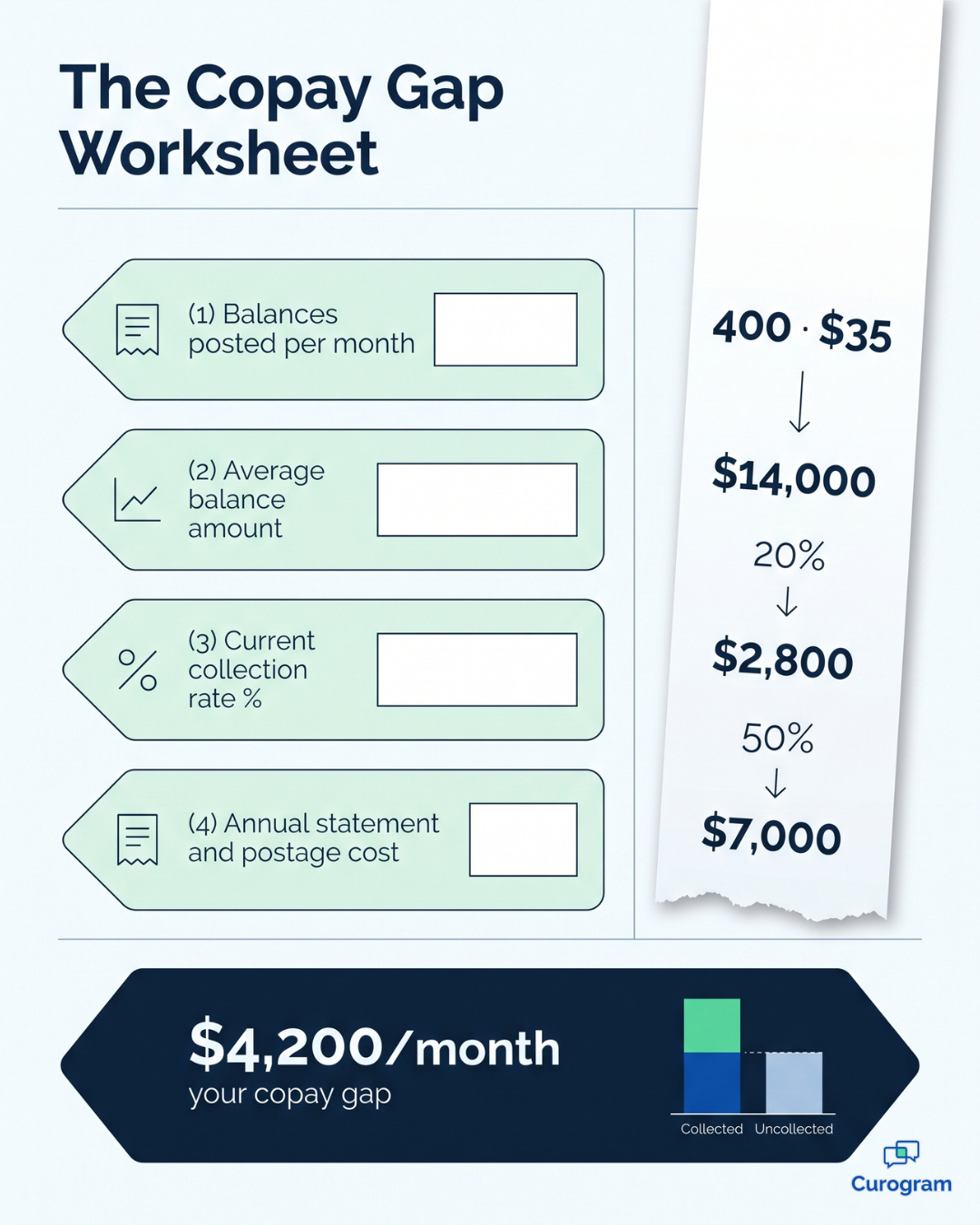
Copay gap worksheet showing paper vs text payment collection math for InSync practices

How it sits with InSync

InSync stays your system of record. Charges, claims, and posting do not move.

Staff post text payments through the reconciliation routine they already run, and every transaction carries a timestamped digital record. Most billing teams find that cleaner than matching mailed checks to statement numbers.

InSync does publish a FHIR R4 API through Smile CDR with OAuth 2.0, which is a real pathway to deeper connectivity. But Qualifacts BAAs, sandbox registration, and coordinator approval all sit in that path.

So Curogram starts you on the workflow that collects money now, and treats the API as a roadmap rather than a promise.

When the billing office is one person

Most practices with 1 to 20 providers have no RCM department. Often there is one billing person doing all of it.

Automation here feels more personal, not less. The follow-up nudge arrives politely and on time, every single time. That is the one thing a one-person billing office can never do by phone.

Month-End Without the Mail Run

Here is what changes when the text becomes the default.

Collection stops being a batch process that happens at month-end. It becomes an event that happens at check-out.

  • Conversion moves to 2–3X the 20% paper baseline
  • The $800–$1,000 monthly print-and-postage line drops toward zero
  • Payments arrive the day the balance posts, not 30 to 90 days later

Run it with real numbers. Say your practice posts 400 patient balances a month, averaging $35 each. That is $14,000 of patient responsibility.

At 20% paper conversion, you collect $2,800. At 50%, you collect $7,000. The difference is $4,200 a month, or roughly $50,000 a year, on top of the $10,000 in postage you stop spending.

Those figures are illustrative, so plug in your own.

Patient response also compounds once texting becomes normal. Covina Arthritic Clinic saw monthly appointment confirmations climb from 369 to more than 1,100 after automating the same channel. Payment behavior follows the same curve, because you are meeting people where they already read.

The after picture is the real payoff. Your billing manager spends the last week of the month on denials and payer follow-up instead of envelope triage. The front desk stops answering balance questions.

And the write-off column finally holds genuine hardship cases, not payments that simply never found their patient.

Stop Paying to Collect Less

The fastest collection improvement available to an InSync billing office is not a new module or a bigger team. It is replacing a letter the patient never opens with a text the patient reads in 40 seconds.

That is the whole idea, and it is why the change is so much smaller than most billing offices expect.

InSync handles your side of the transaction: charges, claims, posting, and the audit trail. Curogram handles their side: a link, a tap, and a receipt. One system runs your revenue cycle, the other closes it.

The math is not subtle: paper converts at 20% and costs you $10,000 a year to send. Text converts 2 to 3 times better and costs you nothing to mail. Every month you keep the statement run, you are funding the losing side of your own collections.

Try this before you change anything. Pull last month's statement invoice and your current aging report. Add the print-and-postage line to the patient-responsibility balances sitting past 60 days.

That number is your payment collection gap. Most practices are surprised by it, and almost nobody has ever added it up before.

Then decide whether that gap is worth another round of envelopes.

You do not need a rip-and-replace project to close it. You need a different last mile for money that is already yours, and a workflow your staff can run on day one without waiting on an integration queue.

Schedule a Demo and bring two things with you: your monthly statement count and your payer mix. We will map the text-to-pay workflow against your actual month-end, show you where the timeline compresses, and give you a straight answer about what your first 90 days look like.


Frequently Asked Questions

Is collecting payments by text compliant for a behavioral health billing office?

Yes. Curogram is HIPAA-compliant and SOC 2 Type II certified, and it is built to support 42 CFR Part 2 requirements for substance use populations. Payment links route to secure, PCI-compliant processing, so no card numbers ever travel through the message thread. The text itself carries an amount and a link, never a diagnosis or a program name, which protects client discretion.

How does this fit our existing InSync billing and reconciliation routine?

InSync stays your system of record. You post text payments through the same reconciliation process you run today, and each transaction carries a timestamped digital record. Most billing teams find that easier than matching mailed checks back to statement numbers. InSync's FHIR R4 API offers a documented path to deeper integration, but the Qualifacts BAA and approval process means we treat it as a pathway rather than a same-day switch. Your day-one workflow does not wait on it.

What about sliding-scale clients and patients on payment plans?

Staff set the exact amount on every link. A sliding-scale client gets billed their rate without a paper fee schedule changing hands. For payment plans, several smaller texted requests can replace one statement a client cannot clear at once. Patients who prefer the portal or paper keep those options. Text simply becomes the default for everyone else.

Do patients really pay by text, or does this just move the problem?

They pay, and the reason is friction. A statement asks someone to find a checkbook, an envelope, and a stamp, or to remember a portal password they never set. A text asks for one tap on a device already in their hand. That gap is why texted requests typically convert 2 to 3 times better than mailed ones.

How long does it take to switch our billing office over?

Faster than most teams expect, because nothing about InSync changes. Staff learn to send a link, set an amount, and read a status column. Many practices run text requests alongside their statement cycle for one month, compare the two, and then quietly stop the print run once the numbers make the case.