
1 min read
InSync Virtual Visit Workflow for Front Office Staff
 Jo Galvez : Sep 2, 2026, 4:00:00 PM
💡A virtual visit workflow for InSync EHR front office staff works when the reminder, the confirmation, and the join link all travel in one...

Your virtual block is probably the leakiest part of your schedule. The video software is fine. What fails sits in the ten minutes before the session, on the patient's side of the screen, where nobody at the practice can see it.
We call that stretch the Pre-Visit Maze. A session gets scheduled, and the alert lands in a portal the patient never activated.
Day-of, an email link asks for a password. That reset loops back to an old inbox. Somewhere in there, a prompt suggests an app download.
Five minutes pass, then ten. The patient gives up or calls the front desk.
A failed virtual join costs more than a missed in-person visit. The clinician is already in the room, on the clock, watching an empty waiting-room screen. Nothing gets rebooked into that slot on ten minutes' notice.
Our claim for this piece: InSync practices do not need another telehealth platform. They need patients to arrive in the one they already own, and arrival is a text-message problem rather than a video problem.
That reframe matters most for the patients virtual care was built for. Someone in early recovery, someone managing severe anxiety, someone 68 and three weeks post-knee-replacement.
Each fails the maze at a different step. All three can open a text, which is why SMS reaches about 98% of people who receive one.
Ahead: what the maze costs a behavioral health or therapy practice each month. Then where a text-launched visit sits next to InSync and OnCall, and what a full virtual block looks like once arrival stops being optional.
Give InSync its due. Behavioral health notes are configurable down to the assessment, and telehealth ships inside the platform. Qualifacts also sells OnCall Virtual Care for practices that want a fuller video product. Video is a solved problem in this stack.
Access is not. Every virtual session assumes the patient can find the right link, recall credentials, and work a browser flow. There is no native Android or iOS app to fall back on. The patients who need virtual care most tend to be the least equipped for that.
Count what stands between a booked session and a joined one. Step one, an alert arrives in an unactivated portal. Step two, the day-of email demands a login.
Third comes a password reset routed to an inbox on an old phone. Then an app download prompt. By the fifth step the session clock has run past five minutes, and the sixth is a call to your desk, or silence.
Each step filters people out. None of them are visible on your schedule, which shows only that the slot went unattended.
Psychiatry no-shows run around 23% across the field, and SUD programs see 30–50%. At $150–$250 a session across 10–15 providers, that is $15,000–$25,000+ in lost monthly revenue.
Virtual misses hurt worse than in-person ones. A clinic no-show at least frees a room. A patient who cannot join leaves a clinician alone in a video room, with no walk-in traffic to absorb the hour.
Therapy practices feel the same math at $150 a visit, where 5–8 daily misses drain $15,000–$24,000 a month and stretch 6–12 week plans toward dropout.
A counselor watches a blank waiting-room panel during a post-discharge follow-up, knowing this was the week that mattered. A PT lead turns a 10-minute home exercise review into 25 minutes of tech support.
An executive director asks why virtual no-shows beat in-person ones when telehealth was supposed to lower barriers.
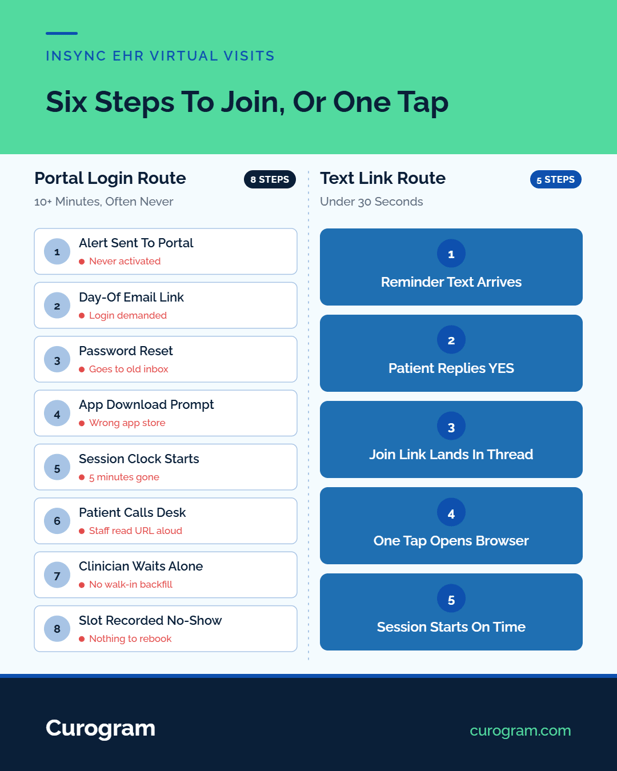
Curogram owns the last mile between your schedule and the patient's thumb. InSync stays the clinical system of record. OnCall keeps running the encounter if that is what your practice uses.
|
Part of a virtual visit |
InSync / OnCall |
Curogram |
|---|---|---|
|
Scheduling the session |
Yes |
Reads the schedule |
|
Reminder and confirmation |
Portal alert |
Automated SMS, reply YES |
|
Getting the patient in |
Login required |
One tap, browser-based |
|
The video encounter |
Yes |
— |
|
Documentation and billing |
Yes |
— |
Text-Launched Telemedicine opens a HIPAA-compliant video visit from an SMS link, in whatever browser the phone already has. No app store. Nothing to create in a portal. No separate telehealth password, and no reliance on a native InSync mobile app, which does not exist.
The reminder, the reply-YES confirmation, and the join link all sit in one thread the patient already reads. Curogram is SOC 2 Type II certified, signs a Business Associate Agreement, and offers 42 CFR Part 2-ready messaging. Telehealth without app download for SUD programs stays inside a consented, protected channel.
InSync exposes a documented FHIR R4 API on Smile CDR, with OAuth 2.0, SMART App Launch 2.0.0, and US Core v6.1.0. That is a stronger pathway than most behavioral health EHRs offer.
Connecting anything third-party still means BAAs with Qualifacts and your practice, sandbox registration, and API-coordinator sign-off. Users report friction with third-party onboarding generally.
Our practical answer: Curogram coordinates with the InSync schedule at the workflow level. Setup runs in days, with no IT department and no change to clinical or documentation workflows.
Behavioral health and SUD teams use it for post-discharge follow-ups, medication management checks, and continuity visits where digital literacy varies enormously. Browser-based telehealth for behavioral health practices removes the one step those clients reliably fail.
Rehab therapy uses it for telerehab check-ins, home exercise reviews, and discharge follow-ups. Text link video visits for therapy patients are what make a 15-minute virtual touchpoint cheaper than the drive it replaced. The patient's experience is a text from their own clinic, so the automation reads as personal.

Covina Arthritic Clinic confirms more than 1,100 appointments a month with no manual follow-up. Atlas Medical Center cut no-shows from 14.20% to 4.91% in three months, 3X better than the average it was measured against.
Across Curogram clients, confirmation rates average above 75%. All of these come from our internal client data.
Virtual schedules need that confirmation discipline more than in-person ones do, because a virtual slot has no walk-in traffic to backfill it.
The join link rides the same thread as the reminder. So the patient who confirmed is the patient who appears.
Qualifacts InSync virtual visit attendance stops depending on whoever answers the desk phone at 9:58.
A psychiatrist's 15-minute med checks start on time, back to back. The SUD program's week-one post-discharge follow-up actually happens.
A PT clinic's Friday telehealth block runs like a clinic day. Nobody at the front desk has walked a patient through a password reset in a month.
You already own the video capability. What you are missing is arrival, and arrival is a one-tap event once the link travels by text.
Split it by purpose. InSync and OnCall handle the clinical encounter: the schedule, the documentation, the session itself. Curogram handles the front door, which is the text that turns a booked session into an attended one.
Stop letting the Pre-Visit Maze make your virtual schedule your highest no-show block.
Book a Demo. See one-tap telemedicine from a patient's side, with your own virtual visit volume in the math.
1 min read
Jo Galvez : Sep 2, 2026, 4:00:00 PM
💡A virtual visit workflow for InSync EHR front office staff works when the reminder, the confirmation, and the join link all travel in one...

1 min read
Jo Galvez : Sep 3, 2026, 8:00:00 AM
💡One tap telehealth visits for InSync EHR patients, no app download required is the patient experience Curogram adds beside InSync's built-in...

1 min read
Jo Galvez : Jun 1, 2026, 4:00:00 PM
💡 HFor behavioral health teams using Opus EHR, virtual follow-ups stall when staff juggle Zoom, portals, and phone troubleshooting. An Opus EHR...