

6 min read
InSync EHR Review Request Workflow for Mental Health Practices
Jo Galvez
:
September 1, 2026
A completed appointment triggers a survey text. Satisfied patients reach Google in one tap; concerns route privately to your team.
Manual alternatives fail twice: a portal-posted request reaches only the 15–20% of clients who log in, and a face-to-face ask puts your front desk in the position of requesting a public review of a counseling or SUD program.
Every message is HIPAA-safe, with no PHI and no mention of treatment type. The workflow produced 1,064 new 5-star reviews in three months at one multi-location practice.
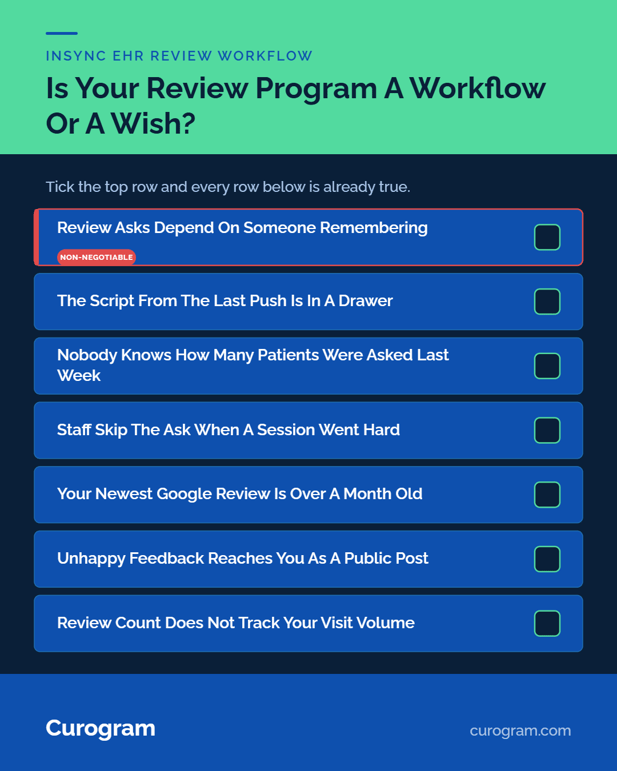
Most manual review programs have a shelf life of about three days. Monday's staff meeting produces the initiative. Tuesday produces two or three awkward asks. By Thursday the printed script lives under somebody's keyboard, and the practice adds one review that month.
We have watched this cycle enough times to stop blaming execution. The task is undoable at a front desk fielding 80+ calls a day. In behavioral health, it is worse than undoable. Asking a client leaving an SUD group to post publicly is a conversation nobody should open across a check-out counter.
Staff who stop asking are making the right call. The correct decision at the desk still produces a frozen Google profile. And 90% of new patient leads judge the practice by that profile before they reach the website.
Our position: a review program that depends on human memory is not a workflow. Automation is the sensitive option here as well as the reliable one. The request arrives privately, and nobody has to guess which client is safe to approach.
This playbook covers the automated review requests for counseling practices and therapy clinics we see working.
What triggers a request, what the wording can and cannot contain, where unhappy responses go, and which controls an office manager sets once. Curogram runs the pipeline. InSync stays the untouched system of record.
Why Review Pushes Die by Thursday
What Happens After a Visit Closes in InSync
InSync keeps the clinical and scheduling side organized, and 96% of reviewers praise its configurability. That is not the gap.
The gap opens the moment an appointment completes. Nothing sends. No request follows, and there is no follow-up step to schedule in the first place.
Reputation becomes a task belonging to everyone, which is the reliable way to make it belong to nobody.
The Script's Three-Day Life
Watch the workaround die in real time. The owner announces a review push on Monday and prints a script for the desk. Tuesday brings three asks, one of them to a client leaving group who visibly stiffens.
That reaction ends the program. Staff stops asking, correctly, and by Thursday the script is filed under a keyboard. Two reviews arrive that month, one of them from a staff member's cousin. The therapy clinic four blocks away adds fifteen in the same period.
The Part-Time Job Nobody Was Hired For
Price the manual version honestly. A consistent program needs 10–15 asks a day. Each one has to be timed, tracked, and worded compliantly, on top of the 80+ calls the desk already handles.
That is a part-time role. No practice has budgeted for it, and none of the people currently absorbing it were hired to do marketing.
What a Quota Does to the Ask
That single review from a staff member's relative deserves naming, because it shows what a target does to behavior.
Set a number as the goal and people optimize for the shortest path to it. The easiest reviews to collect are always the ones closest to the practice, and those reviewers were never patients. A prospective client reading them learns nothing about the care, which is the only thing they came to find out.
Automation removes the temptation by removing the quota. Every patient is asked as a matter of course, so the sample is patients and nobody is hunting for a shortcut.
Why Staff Are Right Not to Ask
In behavioral health, the risk is not just awkwardness. A poorly worded ask can feel like a privacy breach to a stigma-conscious client. Staff have no way to know in the moment which clients those are.
So the safest available choice is silence, and silence holds the profile at 3.6 stars. Your team is protecting patients and losing the practice's reputation with the same decision.

The Engine That Asks So Your Staff Never Has To
One Trigger, Two Destinations
This replaces the workflow rather than adding to it. An appointment completes, a survey text goes out automatically, and the response decides the path.
Satisfied patients get a one-tap Google link. Patients reporting a poor experience get a private route back to your team. Zero staff steps, every patient asked, every time.
Curogram Highlight: Automated Post-Appointment Surveys
Automated Post-Appointment Surveys carry the request over SMS, which opens at about 98%, so nothing depends on a portal login. Wording is neutral and HIPAA-safe, with no PHI and no reference to the program or diagnosis.
Curogram is HIPAA-compliant, SOC 2 Type II certified, and operates under a Business Associate Agreement, with 42 CFR Part 2-ready messaging discipline. Survey responses land in the same Curogram inbox your team uses for texting and reminders. No second dashboard to check.
The Controls an Office Manager Actually Sets
|
Control |
What it does |
Why it matters |
|---|---|---|
|
Timing rules |
Fires after evaluation, milestone, or discharge |
Keeps requests away from a hard session |
|
Frequency caps |
Limits asks per patient per episode |
A 3-visit-a-week PT patient is not over-asked |
|
Neutral wording |
Omits program, specialty, diagnosis |
Nothing in the text identifies the care |
|
Opt-out handling |
Processes STOP automatically |
No staff member tracks preferences |
|
Shared inbox |
Routes responses to your existing queue |
Nowhere new to look |
Each of these is configured once at setup. After that, the workflow runs without a standing meeting behind it.
The Four Decisions Setup Asks For
Week one is shorter than most teams expect, and four decisions carry it.
Which appointment types trigger a request, and which programs are excluded outright. Who owns the private queue, named rather than assumed. What the message says to the patient.
Everything else ships as a default you can leave alone. Budget an hour, bring somebody who knows the clinical programs, and treat the remainder as configuration rather than a project.
How It Connects to InSync
InSync's FHIR R4 API on Smile CDR, with OAuth 2.0 and SMART on FHIR, is well documented. Formal integration still carries real overhead: BAAs with Qualifacts and your practice, sandbox registration, API-coordinator sign-off.
Review automation keys off appointment completion, so most practices launch in days. Qualifacts iQ automates documentation, and OnCall handles telehealth, and neither one asks a patient for a review.
Because Curogram works with any EHR, the workflow survives a later move to Credible or CareLogic.
The Front Desk That Never Asks and Always Gets
A Month on the Engine
Week one, setup. Your office manager sets timing rules, frequency caps, and wording with our team, then approves the message text. Nobody prints anything.
Week two, first requests. Surveys fire after completed appointments across both verticals. Responses start appearing in the shared inbox the same afternoon.
Week three, the first concern. A patient reports a poor experience on Tuesday. It arrives as a private survey response. The program director calls that afternoon, rather than reading about it publicly a month later.
Week four, Friday review. The office manager spends a few minutes scanning responses instead of nagging staff at Monday's meeting. Nobody at the desk asked a single patient for anything.
When Feedback Comes Back Unhappy
Handle this deliberately, because it is the part that earns staff trust. A poor survey response is a private message to your practice, not a suppressed review.
The patient can still post publicly whenever they want, and the platform never blocks it. What the private channel buys you is the chance to resolve the problem while the patient still wants it resolved. Practices that route these to a named owner, with a same-week response commitment, get the most out of it.
Where the Volume Comes From
Ask a satisfied patient, and roughly nine in ten give five stars. That is what the 90% figure in our client data measures.
Across three months at one multi-location practice, it produced 1,064 new five-star reviews with no staff hours spent asking.
Therapy volume compounds fastest. A patient at 2–3 visits a week for 6–12 weeks passes evaluation, mid-plan, and discharge milestones. The engine asks at each one rather than after every session.
What Still Needs a Person
Three things stay human. Responding to public reviews is one, and it takes discipline, since staff must never confirm that a reviewer is a patient. Resolving a private concern is another; automation surfaces it but cannot fix it.
The third is judgment about timing rules for specific programs. An outpatient program and a PT clinic should not share a schedule. Somebody who knows both has to say so once, at setup.
Retire the Script, Keep the Reviews
The most reliable review request workflow for an InSync practice is the one nobody has to remember. Automated surveys ask every patient, protect every identity, and route every concern privately.
Split it by purpose. InSync documents the outcome. Curogram handles its public visibility, and gives your staff back the awkward conversations they were never equipped to have.
Count the patients your team saw last month, then count your new Google reviews. The gap between those two numbers is the Unasked Question, and it costs you the patients researching you tonight.
Schedule a Consultation. Bring your monthly visit volume and we will map your review potential live.
Frequently Asked Questions
Automated requests carry no PHI and never reference treatment type, program, or diagnosis, under a Business Associate Agreement. Staff should also never confirm publicly that a reviewer is a patient, which the private survey channel makes easier.
Effectively none after setup. Timing, caps, wording, and opt-outs are configured once. Most teams spend a few minutes weekly scanning responses in the Curogram inbox they already use.
Frequency caps, set per episode of care. A patient attending three sessions a week is asked at evaluation, progress, and discharge, and declining triggers no follow-up.
Anchor it to a completion milestone rather than a session count, and keep it away from clinically hard sessions. Somebody who knows the program sets that rule once at setup.
The request arrives privately on the client's own phone, worded so it reveals nothing about their care. No staff member has to decide which client is safe to approach, and nobody is asked within earshot of a waiting room.